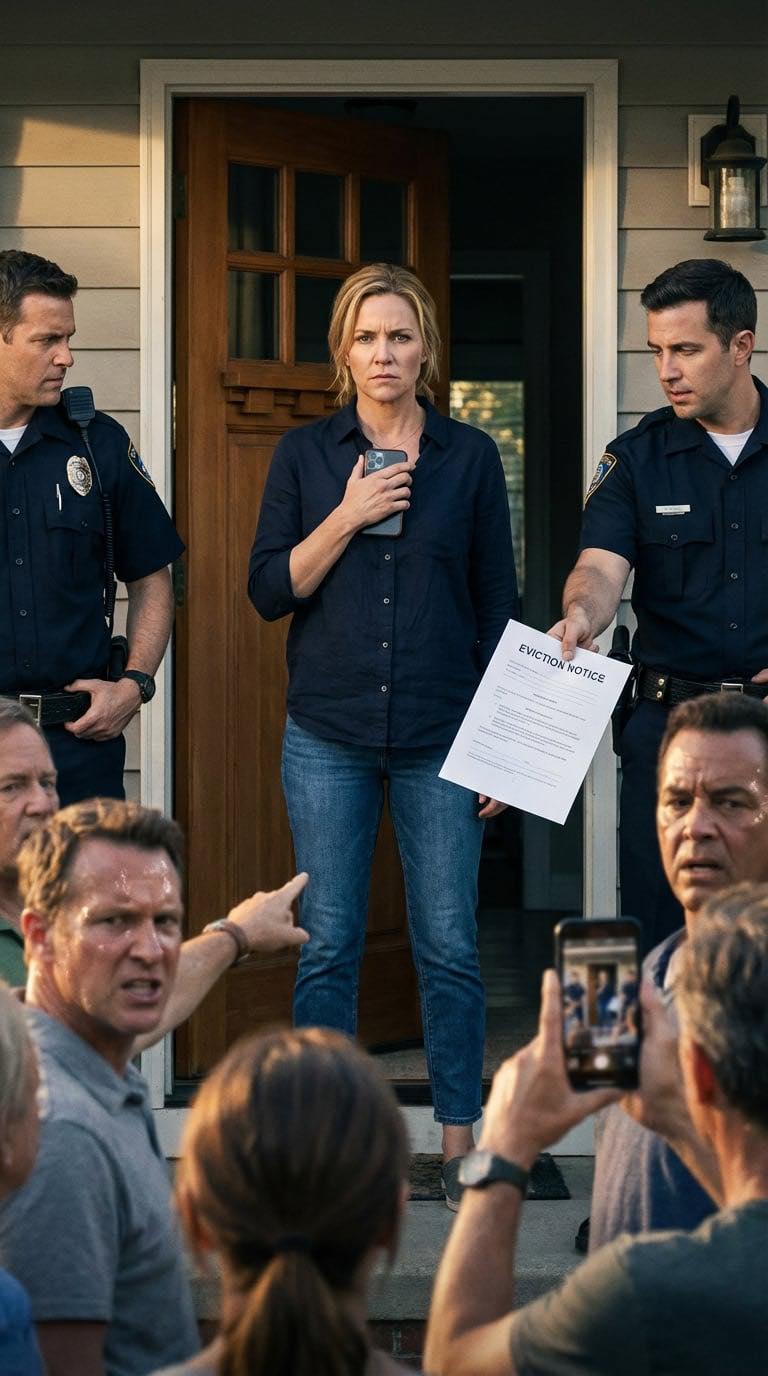
The knock was not neighborly. It wasn’t the rhythmic patter of a delivery person or the tentative rap of a friend. It was the kind of percussive, authoritative thud that forces your body to decide, long before your brain catches up, that you are no longer the one in control of your morning.
I stood in my entryway, draped in a pair of faded sweatpants and a T-shirt that had seen too many laundry cycles, my hair gathered into a messy, defiant knot. The cold morning air of our Oak Creek neighborhood rushed in as I opened the door, and my stomach plummeted with the sickening speed of a snapped elevator cable.
Two police officers stood on my porch. One, Officer Ramirez, was tall and carried a notepad like a shield. The other, Officer Hensley, lingered half a pace behind, his eyes scanning my hands as if he’d spent a career watching people do impulsive, regrettable things before their first cup of coffee.
“Ma’am,” Ramirez began, his voice firm but tempered with a professional kindness, “are you Olivia Wilson?”
“I am,” I managed, my voice sounding thin and unfamiliar.
“Did you receive a communication last night, approximately 1:00 a.m., demanding a wire transfer of twenty thousand dollars?”
My mouth went instantly dry, the moisture evaporating as if I were standing in a desert. Not a tragedy. Not an accident report. A demand.
The memory of the night before didn’t just return; it detonated. At exactly 1:01 a.m., my phone had vibrated against the nightstand, a rhythmic buzzing that felt like a warning. My husband, Matt, didn’t even stir. He is the kind of man who can slumber through a gale-force wind or the local fireworks display, but I am different. I am hyper-tuned to the frequency of my family’s chaos.
Mom had flashed on the screen.
I had answered on pure, Pavlovian instinct. “Mom? Is everything okay?”
The voice that came back was a fractured version of my mother’s, high-pitched and vibrating with a panic that felt like a physical weight. “Olivia—oh my God, honey—everything is falling apart.”
“What’s wrong?” I had sat bolt upright, the sheets tangling around my legs like a trap. “Are you hurt?”
“Twenty thousand,” she gasped, her voice breaking on the number as if it were a physical injury. “We need it now. We need it tonight.”
“For what? Mom, talk to me.”
“Mark,” she sobbed. My brother. The forty-two-year-old “boy with potential” who had spent his entire adult life as a professional disaster. “He’s in the emergency room at County General. It’s bad, Olivia. They won’t start the procedure… he’s in so much pain.”
There was a pause. It was a microscopic glitch in the rhythm of the conversation—a single sour note in a symphony I had heard my entire life. My body recognized the lie before my mind could process it.
Then my father’s voice had replaced hers, clipped and surgical. “Stop the interrogation, Olivia. Just do it. If you don’t, your brother suffers because of your hesitation.”
He spoke as if I were the one holding the scalpel, as if my refusal were the primary cause of Mark’s agony.
Mark… always Mark. The brother who crashed cars, maxed out my parents’ credit cards, and quit jobs with grand, Shakespearean speeches about “toxic environments,” only to land back on the family sofa like a law of gravity.
And then there was Emily, my younger sister, the “baby” of the family at thirty-two. Emily, who received the grace I was denied. Emily, who got second chances accompanied by gift cards and soft reassurances.
“Dad,” I had said, my voice leveling out into a cold, hard clarity, “tell me the name of the attending physician.”
Mom had jumped back on the line, her voice an octave higher. “Why are you doing this? He’s your brother! Don’t you love us?”
That line used to be the hook. It used to yank me out of my life and into “Fix-It Mode.” But that night, as I sat in the silent darkness of my bedroom, a window seemed to wipe clean. I saw the ledger of my life: the late-night wires, the “loans” that were actually gifts, the emotional extortion masquerading as family loyalty.
I said the words that had been gestating in my marrow for a decade.
“Call your favorite daughter.”
The silence that followed wasn’t a technical error. It was the heavy, pregnant silence of a predator that had just realized the prey had developed teeth.
“Don’t you start with that,” my father hissed.
“Goodnight,” I said, and I hung up.
I had set the phone face down and, miraculously, I had gone back to sleep. I thought I had simply closed a chapter. I didn’t realize that the officers on my porch were about to open a whole new book.
“Ma’am?” Ramirez prompted, pulling me back to the present. “Did you wire the funds?”
“No,” I said, my pulse thrumming in my ears.
Ramirez exchanged a glance with Hensley. “We’re here because that emergency call was flagged by our cyber-crime unit as a sophisticated fraud attempt. But the source of the data is… concerning.”
My skin prickled with a cold, electric dread. “If it wasn’t my parents,” I whispered, “who was on the phone?”
Ramirez stepped closer, his shadow falling across the entryway. “That’s what we need to determine. But first, we need you to look at a text message sent to your phone at 1:07 a.m.”
I looked down at my phone, and for the first time, I saw the text message that would shatter the last of my illusions.
The County Police Station smelled of ozone, industrial cleaner, and the heavy, lingering scent of bureaucracy. I sat in a small, windowless interview room that felt like a confession booth. Officer Ramirez had brought me a cup of water in a thin, crinkling plastic cup that felt like it would collapse if I gripped it with the intensity I felt inside.
“I want you to understand something, Olivia,” Ramirez said, leaning against the metal table. “You did the right thing. Most people, when they hear a parent’s voice in the middle of the night, their logic centers simply shut down. They pay. They pay because fear is a much more efficient motivator than truth.”
“It didn’t feel like the ‘right thing’ when I was staring at my father’s name on my screen,” I admitted, my voice trembling.
A woman in a sharp navy blazer entered the room. Her hair was pulled back into a severe bun, and her eyes had the weary, focused look of someone who had spent too much time peering into the dark corners of the human psyche.
“I’m Detective Green,” she said, pulling out a chair. “I’ve been tracking a series of ‘spoofed’ identity scams in this region. The caller uses software to mimic the phone number of a loved one. They often use AI to synthesize the voice based on social media clips or previous voicemails. It’s digital kidnapping, in a way.”
She slid my phone across the table. “But your case has a snag. Usually, these scammers are based overseas. They work in volume. They use generic scripts. But your caller used specific names. They knew about Mark. They knew about your brother’s ‘troubles.’”
“They mentioned County General,” I added.
Green nodded. “We called County General. Mark Wilson was never there. But more importantly, we traced the account provided in the text message you received after you hung up.”
She opened a folder and slid a printed screenshot toward me. “The name on the receiving account isn’t a shell company in Eastern Europe. It’s an active personal account at First National.”
I stared at the paper. The name on the account was Emily Wilson.
The room tilted. The air became thick, like I was trying to breathe underwater. Emily. My sister. The one who had always been shielded from the consequences of her own life.
“That… that has to be a mistake,” I stammered. “Someone must have stolen her identity too.”
Detective Green didn’t answer immediately. She watched me with a gaze that was far too patient. “We considered that. But we also found a series of outgoing calls from that account’s IP address. They were made using a spoofing service purchased with a credit card registered to your parents’ home address.”
I felt a hot, prickling sensation behind my eyes. It wasn’t just a scam. It was an ecosystem.
“We need to conduct a welfare check,” Green said. “And we need to ask some very difficult questions. We’d like you to come with us, Olivia. Not to talk, but to observe. Sometimes, the sight of the ‘victim’ is the only thing that breaks the script.”
The drive to my parents’ house was a twelve-minute journey through the familiar streets of my childhood. Everything looked the same—the perfectly manicured hedges, the flag on the porch, the wreath on the front door. It was a museum of the ordinary.
Two cruisers pulled up behind us. Matt had met me at the station and sat beside me in the back of Detective Green’s car, his hand crushing mine.
“You don’t have to go in,” he whispered.
“Yes, I do,” I said. “I need to see the moment the lie stops working.”
We walked up the path. Officer Ramirez knocked. The door opened, and there was my mother, her face already crumpling into a practiced, tragic mask.
“Olivia!” she cried, ignoring the officers and reaching for me. “Oh, thank God. Mark… he’s still so bad…”
“Stop it, Mom,” I said. My voice was a blade.
Mark walked into the hallway behind her. He was holding a mug of coffee, wearing a clean T-shirt, looking remarkably healthy for someone who was supposedly in a trauma ward six hours ago. He saw the uniforms and his eyes darted toward the stairs.
And then Emily appeared at the top of the landing. She looked down at us, her face pale, her hands shaking so violently she had to grip the banister.
“Olivia,” Emily whispered, her voice cracking. “I… I can explain.”
I looked at my sister, and I realized that the $20,000 wasn’t for a hospital bill. It was for a ledger of secrets I was only beginning to uncover.
The living room of my childhood home was a testament to my mother’s obsession with appearances. Every throw pillow was fluffed to perfection; every framed photograph of “The Happy Wilson Family” was positioned with mathematical precision. But with Detective Green and Officer Ramirez standing in the center of the rug, the room felt like a stage set after the lights had gone out.
“Mark,” Detective Green began, her voice echoing in the stifling quiet, “you look quite well for a man who was reportedly in a life-threatening condition at County General last night.”
Mark snorted, setting his mug down on a coaster with a defiant click. “It was a misunderstanding. I had a… a scare. A panic attack. Mom overreacted.”
“And the twenty thousand dollars?” Ramirez asked, his hand resting near his belt. “Was that for a panic attack?”
My father emerged from the kitchen, his face a mask of weary authority. “Frank Wilson,” he introduced himself, though the officers already knew his name. “Officers, this is a family matter. My daughters had a… a disagreement. It’s unfortunate that it’s wasted your time.”
“A ‘disagreement’ that involved the illegal use of spoofing software and an attempted fraudulent wire transfer of twenty thousand dollars,” Green corrected. “Emily, why don’t you come down here and tell us about the account at First National?”
Emily descended the stairs as if she were walking to the gallows. She sat on the edge of the velvet armchair, her shoulders hunched.
“Mark needed money,” she whispered, her eyes fixed on her own knees. “He… he got into trouble with some people. Real trouble. People who don’t care about ‘potential.’ They wanted their money back by this morning, or they were going to hurt him. Really hurt him.”
I felt a surge of incandescent rage. “So you decided to terrorize me? You used Mom’s voice? You used the image of our brother dying to bait me into giving you my savings?”
My mother rushed forward, her hands fluttering like trapped birds. “We didn’t know how else to get you to listen! You’ve become so… so cold, Olivia. So obsessed with your ‘boundaries.’ We knew if we just asked, you’d say no.”
“Because the answer is no!” I shouted. “I am not a bank! I am not a safety net for Mark’s gambling or whatever disaster he’s cultivated this month!”
“It wasn’t gambling,” Emily said, her voice rising into a jagged edge of hysteria. “He was trying to start a business. He just… he used the wrong investors.”
“Investors? You mean loan sharks, Emily,” I countered.
Detective Green stepped in, her tone as sharp as a scalpel. “Emily, did you use a spoofing app to impersonate your mother?”
Emily’s silence was the loudest thing in the room. Finally, she gave a microscopic nod. “I thought… if it was Mom, Olivia wouldn’t ask questions. She always fixes things for Mom.”
My father cleared his throat, looking at the ceiling. “We knew about the plan, Olivia. We didn’t like it, but we were desperate. We thought we’d pay you back as soon as Mark’s… ‘dividends’ came in.”
“Dividends from what?” I asked, looking at the grey, broken man who was my father. “There are no dividends. There is only more debt.”
Detective Green pulled out a set of handcuffs. The metallic clink was like a period at the end of a long, miserable sentence.
“Emily Wilson, you are under arrest for attempted grand larceny and telecommunications fraud. Mark Wilson, we have some questions about these ‘investors’ and a series of suspicious transfers into your secondary accounts.”
My mother let out a broken, animal wail. “You can’t do this! She’s just a girl! She was trying to save her brother!”
“She was trying to steal from her sister,” Green said, turning Emily toward the door.
As they led my sister out of the house she had never left, I looked at my parents and realized that the family I thought I was protecting had never really existed at all.
The weeks following the arrests were a masterclass in emotional warfare. My parents transformed our shared history into a weapon, using every guilt-trip and memory in their arsenal.
“How could you let them take her?” my mother would sob over the phone. “She’s in a holding cell, Olivia. Your sister. Because of you.”
“She’s there because she committed a felony, Mom,” I’d reply, my voice feeling more solid with every repetition. “I didn’t call the police. The bank’s fraud department did. I just didn’t lie to cover for her.”
I had started seeing a therapist, Dr. Lane, a woman who specialized in “parentified” children. She helped me realize that my family didn’t love me for who I was; they loved me for what I provided. I was the spare tire they only acknowledged when they were stranded on the side of the road.
“You are grieving a fantasy, Olivia,” Dr. Lane told me during a particularly heavy session. “You’re mourning the mother and father you deserved, while finally seeing the ones you actually have.”
Emily was eventually offered a diversion program—a first-time offender deal. No jail time, but a formal record, massive restitution fees, and mandatory counseling. Mark, however, was a different story. The “investors” he’d been involved with were part of a larger racketeering ring, and his “business” was nothing more than a front for money laundering. He was facing real time.
The final explosion happened a month later. I had agreed to meet my parents at The Silver Spoon, a neutral, public café, to discuss the “restitution.”
My father sat across from me, looking older and smaller than he ever had. My mother refused to look at me at all, her eyes fixed on her herbal tea.
“We need you to sign a character affidavit for Mark,” my father said, pushing a legal document across the table. “And we need you to take out a second mortgage on your house. To cover his legal fees. He’s your blood, Olivia.”
I looked at the paper, then back at the man who had taught me how to ride a bike and then told me I was “selfish” for not funding his son’s crimes.
“No,” I said.
“Olivia, please—” my mother began.
“The answer is no. I’m not signing anything. I’m not mortgaging my future for a man who would happily see me destitute if it meant he didn’t have to face a consequence.” I stood up, feeling a strange, buoyant lightness in my chest. “I’m done. I am blocking your numbers. I am changing my emergency contacts. If you want to be my parents, you can start by apologizing to the daughter you tried to rob. Until then, consider me an orphan.”
I walked out of the café. My mother’s cries followed me to the door, but for the first time in thirty years, they didn’t pull at my heart. They sounded like what they were: a siren song designed to lure me back onto the rocks.
I drove home, and as I deleted ‘Mom’ and ‘Dad’ from my contacts, I realized that some emergencies can’t be fixed with money. They can only be fixed with an exit.
A year has passed since the 1:00 a.m. call.
The silence in my life is no longer a void; it’s a sanctuary. I’ve spent the last twelve months reclaiming the pieces of myself that I’d traded for family approval. Matt and I are planning a trip to Italy—a trip paid for with the money I didn’t wire to a fake emergency.
Mark is serving three years. Emily is working a retail job, slowly paying off the fines the court imposed on her. My parents still send the occasional letter, filled with “updates” on the family’s suffering and subtle jabs at my “coldness,” but I’ve learned to read them like a foreign language I no longer speak.
Last night, my phone buzzed at 12:58 a.m.
For a heartbeat, the old panic flared—the Pavlovian response to the midnight vibration. My heart hammered against my ribs, and my breath hitched. I reached for the phone, my hand trembling.
Unknown Number.
I stared at the screen. I thought about the voice on the other end. Would it be Mom? Would it be a new disaster? Would it be another “emergency” designed to test my resolve?
I didn’t answer. I didn’t even decline the call. I simply watched the screen glow in the dark room until it timed out and went black.
Then, a text message arrived.
It’s your father. Your mother is in the hospital. This isn’t a game, Olivia. Use the code word ‘Tulip’ if you don’t believe me.
My throat tightened. “Tulip.” A code word we had agreed upon during a brief, attempted mediation session six months ago.
I sat up, the sheets tangling around my legs. I felt the familiar pull of the Fix-It Mode. I felt the guilt rising like a tide. I opened my contacts, my thumb hovering over my father’s real number.
But then, I remembered Detective Green’s voice. Verify before you trust.
I called the hospital directly. I didn’t use the number in the text. I searched for the main line of the local medical center.
“I’m trying to locate a patient,” I said to the night receptionist. “Margaret Wilson.”
“One moment… I’m sorry, ma’am. We have no one by that name currently admitted.”
I set the phone down. A cold, surgical calm settled over me. They had used the code word. They had learned how to make the lie even more convincing. They were still trying to bypass my boundaries with a new, improved script.
I blocked the unknown number. I laid back down and pulled the duvet up to my chin.
The quiet of my house wasn’t an emptiness anymore. It was a fortress.
I realized then that the most important lesson wasn’t about fraud or technology. It was about the architecture of an emergency. Real emergencies are built on truth. Fake ones are built on the hope that you’ll be too afraid to check.
I am Olivia Wilson. I am not a bank, I am not a spare tire, and I am no longer a victim of my own empathy.
As I fell back into a deep, dreamless sleep, I realized that the best answer to a midnight scream isn’t a wire transfer.
It’s the silence of a woman who finally knows her own worth.
Two weeks later, Aunt Dana called me during a Tuesday lunch break.
“They’re telling everyone you’ve gone full ‘no contact,’” she said, her voice sounding tired. “Your father told the neighbors you’ve joined a cult that forbids talking to family.”
I laughed, a genuine, hearty sound that startled a bird outside my window. “A cult of one, Dana. It’s called ‘Sovereignty.’”
“How do you do it?” she asked. “I’m still sending your brother money for commissary.”
“I decided that I’m not responsible for the storms they create,” I said. “And I’m not a lighthouse anymore. I’m just… a person. Living a life that doesn’t belong to them.”
I hung up and looked at my reflection in the office window. I didn’t look like a “disappointing daughter.” I looked like a woman who had finally stopped paying for a story she never agreed to be in.
The ledger was finally balanced. And for the first time in my life, I was in the black.