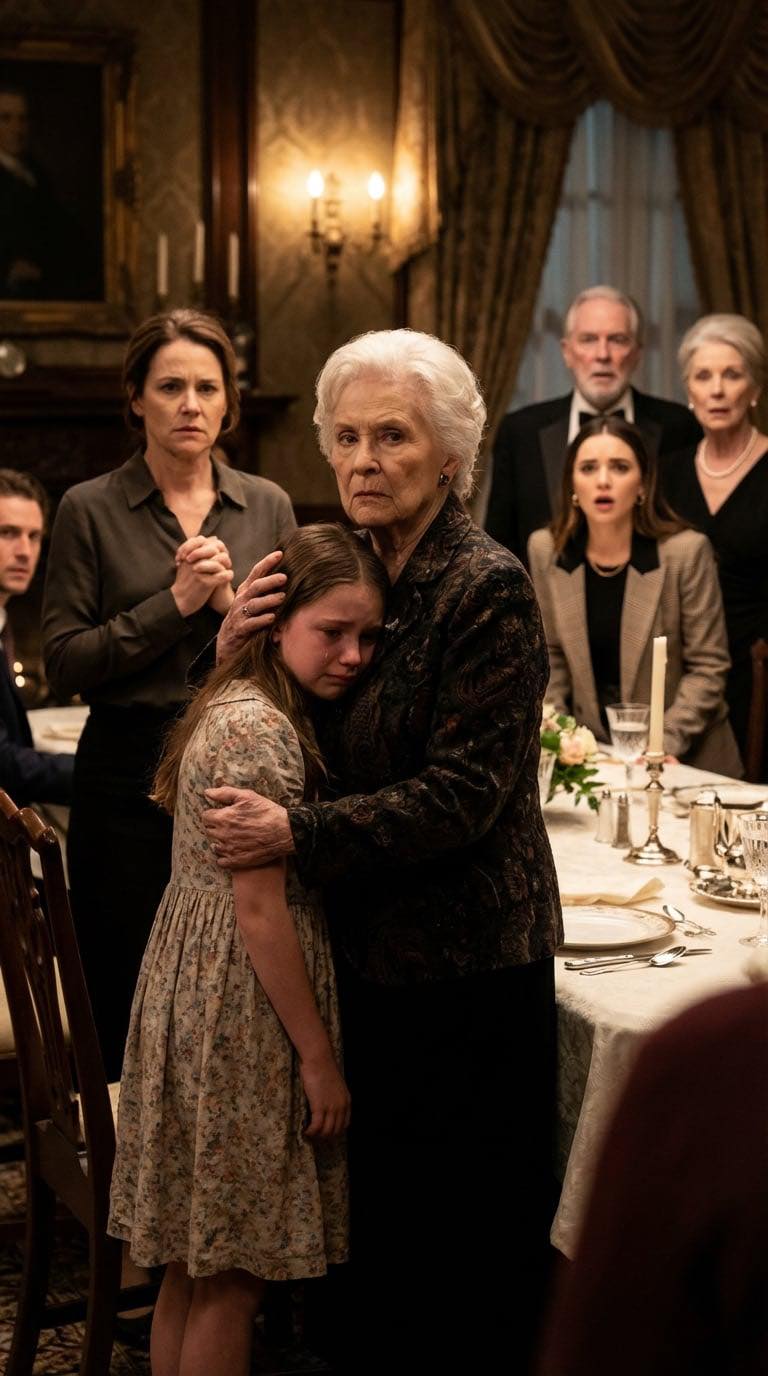
If you have never stood in a room where the air is so thick with unspoken judgment that it coats your tongue like wax, count yourself lucky.
The venue was one of those rented event halls that smell faintly of industrial floor polish and desperate ambition. It was a cavernous space draped in white linen, illuminated by too many candles, and populated by people who smiled with their teeth but never their eyes. My family has a special kind of noise for these gatherings. It isn’t the warm, chaotic hum of connection. It’s a frequency of competitive pleasantries, a sound where you can hear a compliment being sharpened into a shiv three minutes before it slides between your ribs.
I stood near the periphery, holding a glass of sparkling water I had no intention of drinking, doing the only job that mattered to me: orbiting my daughter, Emma.
Emma was twelve. She was all elbows and knees and intense, quiet focus. In a room full of peacocks preening for attention, she was a falcon—still, observant, and entirely uninterested in the performance. She wore a dress she had made herself. It was navy blue cotton, simple and structured, with tiny, hand-stitched detailing at the collar that she had agonized over for three nights. She had sat at her sewing table, muttering, “It’s not sitting right,” until her fingers were sore, ripping seams and restitching until the line was true.
To me, she looked like a miracle of competence. To my family, she was an aberration.
My sister, Nicole, arrived twenty minutes late, ensuring every head turned. Nicole looked like a department store mannequin that had been granted sentience and told to weaponize it. Her hair was a geometric marvel of blonde highlights; her dress likely cost more than my car. Trailing behind her was Grant, her husband, a man who perpetually looked like he was trying to remember where he’d parked his empathy, and their three children—Tyler, Avery, and Ila. They were dressed like miniature adults, branded from head to toe, looking bored and expensive.
The dynamic in our family was ancient and immutable. Nicole was the sun; my parents were the planets orbiting her, basking in her reflected glow. I was the dark matter—necessary for the universe to exist, perhaps, but largely invisible and expected to absorb the impact of any debris.
Nicole’s eyes scanned the room like a predator seeking the weakest member of the herd. She spotted a woman near the buffet—a potential business contact, someone sleek and important. I saw the gears turn in Nicole’s head. She needed a prop.
She beelined for us.
“Come here,” Nicole chirped, her voice bright and brittle as spun sugar. She didn’t ask; she reached out and hooked her manicured fingers around Emma’s shoulder.
Emma stiffened. I took a step forward, placing myself subtly between them, a barrier of maternal instinct. “Nicole,” I said, a warning in my tone.
“Oh, relax, Lauren,” she laughed, dragging Emma toward the woman in the blazer. “You have to meet my niece,” she announced to the stranger.
The woman smiled that polite, trapped smile of someone realizing they have been conscripted into a family drama they did not audition for.
“This,” Nicole announced, squeezing Emma’s shoulder just hard enough to make my daughter flinch, “is my stinky niece.”
She paused, waiting for the laugh. It was a punchline she felt she had purchased the rights to.
“She insists on wearing these cheap little outfits she makes herself,” Nicole continued, her voice dripping with playful disgust, the kind that allows bullies to claim they were just joking. “She thinks she’s creative. But honestly? With clothes like that and an attitude like hers… no future.”
The words hung in the air, sharp enough to draw blood.
Nicole laughed. My mother, standing nearby with a glass of Chardonnay, laughed that airy, complicit titter that signaled, We are all in on the joke. My father chuckled, a low rumble of enabling that had been the soundtrack of my childhood.
Emma went still. Not the stillness of a statue, but the stillness of a small animal hoping the predator loses interest. She didn’t speak. She didn’t pull away. She just stared at her shoes, her fingers tightly gripping the sleeve of the dress she had stitched with so much pride.
My blood ran cold, then hot. There is a specific kind of rage that ignites in a mother’s chest when her child is humiliated. I wanted to scream. I wanted to flip the table. I wanted to tear down the facade of this perfect family.
But before I could exhale the fire building in my lungs, the room shifted.
My grandmother stood up.
She was seated at the head table, a small, elegant general in a silk suit. She didn’t stand shakily. She rose with the fluid, terrifying grace of a queen who has decided the court is dismissed.
The chatter in the room died. The clinking of silverware ceased. My grandmother didn’t look at my parents. She didn’t look at the guests. Her gaze was a laser, fixed solely on my sister.
“Nicole,” she said. Her voice wasn’t loud, but it carried to the back corners of the hall. “You really called her stinky. In front of strangers.”
Nicole’s smile faltered, the edges trembling. “It’s just a joke, Grandma. God, everyone is so sensitive.”
My grandmother tilted her head. “If it is a joke, explain to me what is funny.”
“Oh, come on,” Nicole started, rolling her eyes, a reflex from her teenage years that she had never outgrown.
“Don’t ‘Oh, come on’ me,” my grandmother snapped. The authority in her voice cracked the air like a whip. “You are a grown woman bullying a twelve-year-old child.”
She stepped away from the head table and walked toward us. She didn’t stop at me. She went straight to Emma. She took Emma’s hand, her aged, paper-thin skin contrasting with Emma’s youthful grip.
“Come here, sweetheart,” she whispered.
Then, she turned to face the room. She looked at my parents, who were now pale, their laughter dead in their throats. She looked at Nicole, who was flushing a blotchy, ugly red.
“You all treat this girl like she is nothing,” Grandma said. “I have watched it for years. The snide comments. The exclusion. The way you look at her like she is a stain on your perfect picture.”
“Mom, please,” my mother hissed, looking around at the guests. “Not here.”
“Yes. Here,” Grandma said. “Because you chose here to humiliate her. So here is where we will finish it.”
She took a breath, and when she spoke next, her voice was the gavel coming down.
“You care so much about the future? About appearances? About the legacy of the company?” Grandma asked, looking directly at Nicole. “Well, here is the truth. That little girl you just mocked? She is not ‘stinky.’ She is not ‘cheap.’ She is my great-granddaughter. And she is the one I have chosen to inherit everything I built.”
The silence that followed was absolute. It was the sound of oxygen being sucked out of the room.
My grandmother owned a fashion manufacturing company. Not a boutique, not an Instagram brand. A factory. A logistics empire. She employed hundreds of people. Her name meant something in this city. For decades, my parents and Nicole had acted like the crown princes of this kingdom. They lived off the stipends, flaunted the access, and treated the business like a personal ATM.
“What?” Nicole whispered. It wasn’t a question; it was a malfunction.
“I didn’t choose her for sentiment,” Grandma continued, her voice cold and practical. “I chose her because she works. She learns. She respects the craft. You all wear the clothes; she knows how to build them. She asks about the weave of the fabric. You ask about the discount.”
She paused, letting the words settle like lead weights.
“The company. The assets. The properties. When I am gone, it goes to Emma. All of it. The trust is already signed.”
“You can’t be serious,” my father sputtered, stepping forward, his face twisting into a scowl. “She’s a child!”
“A child you have failed to protect,” Grandma countered. “A child you have allowed to be treated as a scapegoat because she doesn’t fit your aesthetic.”
“Grandma, look at her!” Nicole shrieked, panic finally overriding her composure. She pointed a trembling finger at Emma. “She looks like a beggar! You’re going to give her the company? I’m the one who knows the brand! I’m the one who—”
“You are the one who is cruel,” Grandma cut her off. “And cruelty is bad for business.”
My mother tried the soft approach, the wheedling tone she used to manipulate situations. “Mother, you’re emotional. We can talk about this privately. You don’t mean this.”
“I have never meant anything more,” Grandma said. “The lawyers handled the restructuring weeks ago. I was going to wait to tell you. I was going to let you keep your dignity a little longer. But after tonight? No.”
“Fix this,” Nicole hissed, stepping into Grandma’s personal space. “Fix it now.”
“Or what?” Grandma asked, unblinking.
Nicole’s eyes flicked to Emma. It was a micro-expression, a flash of pure, unadulterated malice. I saw it. I pulled Emma behind me, shielding her body with mine.
“You’re ruining my life!” Nicole screamed, the mask fully off now.
“No,” Grandma said softly. “I am stopping you from ruining hers.”
My father grabbed his coat. “We are leaving. Lauren, get your things. We’re done here.”
I didn’t move. “I’m staying,” I said.
My father looked at me with disgust. “You’re choosing this? You’re choosing to embarrass the family?”
“You embarrassed yourselves,” I said.
They stormed out. Nicole led the charge, heels clacking violently against the floor, Grant trailing like a beaten dog, the children looking confused and irritated that their spotlight had been stolen.
The music resumed, hesitant and quiet. Emma looked up at me, her eyes wide, tears finally spilling over.
“Mom,” she whispered. “Did I do something wrong?”
I crouched down, gripping her shoulders. “No. You did everything right. You just existed. And that was enough to show them who they really are.”
My grandmother placed a hand on my shoulder. She looked tired, but her eyes were bright with a fierce, dangerous light.
“Prepare yourself, Lauren,” she said quietly. “The real war starts tomorrow.”
She was right. The retaliation didn’t come in the form of a direct confrontation. It came like a virus—insidious and widespread.
It started with the whispers. Relatives I hadn’t spoken to in years suddenly began texting me. Hey, is Grandma okay? We heard she was… confused at the party.
Then came the concern trolling. Aunt Sarah says Grandma signed some documents she didn’t understand. You know how old she is. We’re just worried someone is taking advantage of her.
And finally, Nicole took it public. The family group chat—usually reserved for passive-aggressive holiday planning—lit up.
Nicole: “For everyone asking, Grandma is not well. She’s being isolated and manipulated. Lauren is using Emma to guilt her into signing things. If anyone actually cares about Grandma, please check on her. This isn’t about money. It’s about protecting her legacy.”
I read the message in my kitchen, my hand shaking with a cold fury. “This isn’t about money,” I laughed to the empty room. Nothing screams it’s about money louder than a paragraph denying it.
I didn’t reply. I didn’t engage. I did what a survivor of a toxic family learns to do: I collected receipts. I screenshotted the texts. I saved the voicemails. I created a digital folder named “EVIDENCE.”
I drove to Grandma’s house and showed her everything. She read the messages in silence, her face carved from stone.
“So that is the story they picked,” she said. “That I am senile.”
“Can they undo it?” I asked, the fear gnawing at my stomach. “Can they challenge the trust?”
She picked up her phone and dialed her attorney on speaker. “No,” she said. “I had three doctors certify my competency the day I signed. Let them try.”
But legal protection is one thing. Physical safety is another.
Two days later, my doorbell camera pinged.
I checked my phone. There they were on my porch—the whole cast of characters. Mom, Dad, Nicole, Grant, and the kids. They were dressed in soft colors, wearing expressions of practiced contrition.
I opened the door but blocked the threshold.
“Sweetheart,” Mom began, clutching her chest. “We just want to talk. We’ve been praying.”
“We love you, Lauren,” Nicole added, her voice syrupy. “We’re family. This whole thing… it’s just a misunderstanding.”
“Tell Grandma to stop this nonsense,” Dad commanded, dropping the act immediately. “It’s gone too far.”
“You want me to lie,” I said flatly. “You want me to tell her I manipulated her so you can get your allowance back.”
“Don’t be disgusting,” Nicole snapped, her smile slipping. “We’re trying to help you. Do you really think you can run a company? You? And with her?” She gestured vaguely toward the interior of the house, meaning Emma.
“Get off my porch,” I said.
“This isn’t over,” Dad spat.
I closed the door and locked the deadbolt. I saved the footage.
But locks only work when you are there to use them.
A week later, I came home from grocery shopping. The moment I stepped into the hallway, I knew something was wrong. The air felt disturbed. It wasn’t messy, nothing was overturned, but the silence had a jagged edge to it.
Then I heard the crying.
I dropped the bags and ran to the living room.
Emma was sitting at the dining table, her face buried in her hands, sobbing with a quiet, heartbreaking intensity.
And there, sitting on my sofa as if she owned the place, was Nicole. Grant stood by the window. Tyler and Avery were wandering around the room, picking things up and putting them down with disdain.
“What are you doing here?” I screamed.
Nicole looked up, feigning surprise. “Oh, Lauren. You’re back. We just came to see Emma. She let us in.”
I rushed to Emma, pulling her into my arms. She was trembling violently. “Did you let them in?”
“They… they said they were sorry,” Emma hiccuped. “They said Grandma made a mistake and I had to help fix it.”
I turned to Nicole, my vision blurring with red heat. “You manipulated a child to let you in?”
“We just talked,” Nicole said breezily. “We told her that Grandma is confused, and that if Emma really loves her, she should tell Grandma that we’re all friends. That it was just a joke.”
“They said…” Emma gasped for air. “They said if I didn’t fix it, I would be the reason the family broke apart.”
A threat disguised as a burden. The classic weapon of the narcissist.
“And,” Emma whispered, looking toward the corner of the room where her sewing station was set up, “Tyler wanted to see my machine.”
I looked over. The sewing machine—a vintage Bernina that Grandma had given her—sat crooked on the desk.
I walked over to it.
The thread was tangled into a chaotic bird’s nest around the bobbin case. The needle was bent at a ninety-degree angle, driven forcefully into the metal plate. The tension dial had been cranked so hard past its limit that it had cracked. The small box of spare needles had been dumped onto the floor, scattered like caltrops.
This wasn’t curiosity. This was sabotage. It was a targeted strike against the one thing that made Emma special, the one thing Nicole couldn’t buy.
“It was an accident,” Tyler muttered, smirking. “It’s a piece of junk anyway.”
“She deserved it,” Avery whispered, loud enough for me to hear.
Something inside me snapped. It wasn’t an explosion; it was a glacier calving. Cold, massive, and unstoppable.
“Out,” I said. My voice was barely a whisper, but it carried the weight of a death sentence.
“Lauren, don’t be dramatic,” Nicole scoffed. “We’re trying to—”
“OUT!” I roared. The sound came from the bottom of my diaphragm, a primal sound that made Grant jump. “Get out of my house before I call the police and have you arrested for trespassing and destruction of property. NOW.”
Nicole stood up, smoothing her skirt, her face hardening into a mask of pure venom. “You’re insane. You’re turning her against us.”
“You did that yourselves,” I said.
They filed out, muttering insults, playing the victim until the very end.
The moment the door clicked shut, Emma collapsed into fresh tears. “I didn’t know, Mom. I thought they wanted to be nice. I’m so sorry.”
“No,” I said, holding her face in my hands. “You listen to me. This is not your fault. You trusted adults to behave like adults. They failed you. They broke the rules, not you.”
I didn’t clean up the mess. I took photos. Close-ups of the bent needle. The jammed mechanism. The cracked dial.
Then I packed the machine into the car and drove it to a repair shop. The technician took one look and frowned. “This wasn’t wear and tear,” he said. “Someone forced the hand wheel while the needle was down. This was deliberate.”
“Can I get that in writing?” I asked.
He printed the receipt: Damage consistent with intentional misuse / forced mechanism.
I added it to the folder.
Then I called Grandma. I didn’t cry. I didn’t scream. I gave her the facts. They entered my home. They cornered Emma. They broke her machine.
Grandma was silent for a long time. When she spoke, her voice was terrifyingly soft.
“Put your phone down, Lauren. I will handle it.”
The next morning, the scorching began.
It didn’t start with a shout, but with a courier. My parents, Nicole, and Grant were all served with legal notices. Cease and desist. No contact orders. And a formal notice of trespass barring them from my property and Grandma’s estate.
But Nicole wasn’t the kind of person who accepted a closed door. She viewed boundaries as a challenge.
Two days later, Grandma called me.
“They came to the factory,” she said.
“Nicole?”
“All of them. A delegation,” Grandma said, sounding weary. “They demanded to see me. They told the receptionist I was being held against my will. They tried to push past security.”
“What happened?”
“Security stopped them. They screamed. They threatened. Nicole told the guards she owned the place.” Grandma let out a dry, humorless laugh. “The guards have the new ownership trust documents on file. They know exactly who owns the place. And it isn’t her.”
“Did they leave?”
“Eventually. After the police were called.”
That evening, my phone buzzed. A voicemail from Nicole.
I listened to it in the dark.
Lauren, her voice began, sickly sweet. This is insane. You need to stop this. Then the mask cracked, and the monster spilled out. You think you can take everything? You think you can hide behind that brat? If you don’t fix this, you’re going to regret it. We will bury you.
I forwarded the file to the attorney.
I went into Emma’s room. She was sitting on her bed, staring at the wall.
“New rule,” I said gently. “We don’t open the door. For anyone. If they show up, you call me. If they talk to you at school, you walk away and call me. You don’t explain. You don’t defend. You just engage the protocol.”
“Okay,” she said small.
“And Emma? We’re getting you a new machine. A better one. An industrial Juki.”
Her eyes widened. “Really?”
“Really. Because we don’t let them win.”
Six months later, the smear campaign was dead. It died not because they stopped trying, but because the oxygen ran out.
The narrative that Grandma was “confused” couldn’t hold up against her sharp, decisive public appearances. The story that I was “manipulating” her fell apart when people saw I was still driving my old car and living in my small house, while Nicole was the one spiraling.
And then, the money ran dry.
For decades, my parents and Nicole had received a monthly stipend from the company. It was disguised as “consulting fees,” totaling nearly twelve thousand dollars a month.
Grandma cut it to zero.
The collapse was slow, then sudden.
By the one-year mark, the house on the hill was sold. My parents downsized to a condo. My dad tried to get a job, but his ego couldn’t handle taking orders from anyone younger than him.
Nicole fared the worst. She had built her entire identity on being the heiress, the golden child, the superior being. Without the money to fund the costume, the performance fell apart. She had to sell the designer clothes. She got a job in retail, which lasted three weeks before she was fired for attitude.
Grant left her. It turned out his loyalty was tied directly to her bank account.
I heard about the tantrums through the grapevine. Tyler and Avery screaming in stores because they couldn’t have the limited-edition sneakers. Nicole weeping in restaurants.
They tried to reach out, of course. New numbers. Emails from burner accounts. Long, rambling letters about “family unity” and “forgiveness.”
But forgiveness without accountability is just permission to abuse again.
So we stayed silent. We stayed safe.
One evening, about eighteen months after the party, I walked past Emma’s room.
The door was ajar. I heard the steady, rhythmic thrum-thrum-thrum of the industrial sewing machine. It was a sound of industry, of creation, of peace.
I peeked inside.
Emma was fourteen now. Taller. Her shoulders were broad and relaxed. She was working on a heavy denim fabric, her hands moving with a fluid, practiced competence. She wasn’t flinching. She wasn’t looking over her shoulder.
She was building something.
Grandma had been right. She hadn’t chosen Emma because she was family. She had chosen her because Emma was the only one who understood that the value wasn’t in the label; it was in the stitch.
I watched her for a moment, then quietly pulled the door closed, letting the hum of the machine fill the house.
The silence was gone. The Impact had passed. And the future?
The future was being made, one stitch at a time.