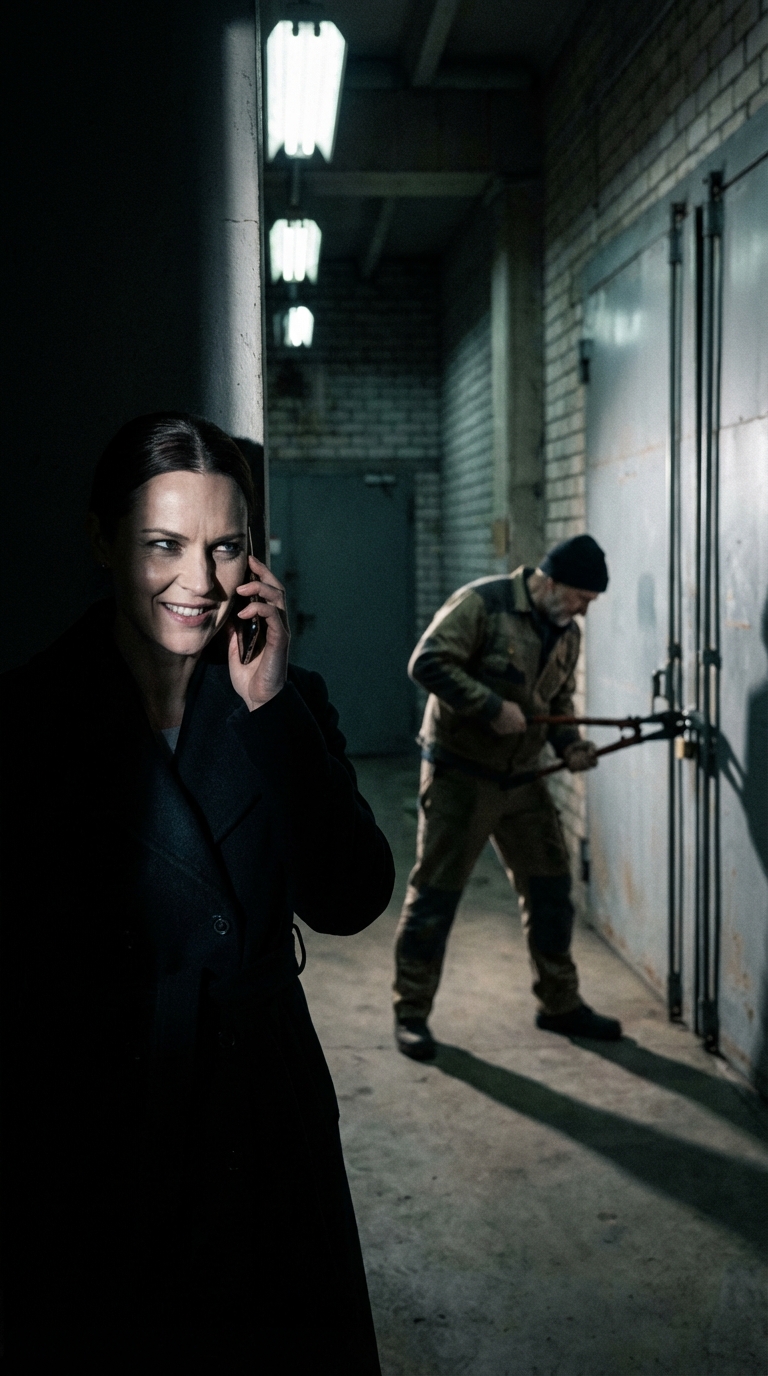
The call came while I was still in uniform, standing in the sterile, fluorescent-lit hallway of the command center. Outside, the base was humming with the regimented noise of afternoon drills, but when I pressed the phone to my ear, the world went very quiet.
“Ma’am, your stepfather is here.”
Thomas’s voice was tight, stripped of its usual slow, rhythmic cadence. He was an older man, a fixture at the storage facility since before I was born, the kind of man who treated keys like sacred objects.
“He has bolt cutters,” Thomas added.
For a moment, I didn’t breathe. Not because I was afraid, but because I had been waiting for this exact sentence for three years. The silence that stretched between us wasn’t empty; it was heavy with recognition. I could picture Robert standing in front of that downtown storage unit, his jaw tight, his hands shaking with the specific tremor of entitlement. He was convinced that whatever my father had left behind belonged to him now by right of marriage. He thought the heavy steel padlock was the last obstacle between him and a payday.
He had no idea that the lock was never the point.
“I didn’t raise my voice,” I said finally, my tone calm, contrasting sharply with the adrenaline spiking in my blood. “I didn’t tell the manager to stop him. I simply asked, ‘Did you call the police?’”
“They’re on their way,” Thomas replied. “I’ve got the cameras rolling.”
“Good. Do not intervene, Thomas. Let him cut it. Let him break the seal. We need the act to be completed.”
I hung up, reached into the bottom drawer of my desk, and touched the cold, smooth metal of the real key. It was heavy, brass, and ancient-looking. Robert would never find the key to what really mattered, because he was looking for value, not truth.
I have never told my mother what my father left me in that storage unit downtown. Not when he was alive, not in the shattered weeks after he died, and definitely not after she remarried. Some people think secrets are born from guilt or fear. Mine wasn’t. Mine was born from instinct. It was the same primal instinct that keeps you alive when you are serving overseas—the ability to read a room before anyone else does, to understand that silence is often just preparation for impact.
My father taught me that.
He was the kind of man who believed in paperwork, backups, and contingency plans that outlived volatile emotions. When I was younger, I thought it was paranoia. I used to roll my eyes when he’d laminate emergency contact lists or double-check the escapement on the windows. Now, I know it was love, expressed quietly. He never raised his voice, never made dramatic speeches about protection. He just prepared.
When he died, there was grief, of course—the massive, suffocating kind that sits heavy in your chest when you realize there are questions you will never get to ask. But amidst the funeral arrangements and the condolences, there was also a folder and a key. There were instructions written in my father’s careful, block-letter handwriting:
“Do not rush. Do not explain. Keep this private.”
The storage unit sat in the center of the city, tucked indistinguishably between a nail salon and a shipping warehouse. It was a standard 10×10 space, climate-controlled, utterly unremarkable. My mother thought it held old furniture, dust-covered books, and decades of tax returns. She once suggested cleaning it out to save the monthly fee.
“I’ll handle it when I have leave, Mom,” I had told her.
I never did. And then, two years after my father passed, she met Robert.
Robert introduced himself as charming but humble, a widower who “understood the language of loneliness.” He was a consultant of some sort—a job title that seemed to involve a lot of talking but very little explaining.
He brought flowers—lilies, my mother’s favorite. He fixed the loose hinge on the back gate. He complimented my service in the military with a kind of performative respect that felt rehearsed, like lines from a movie he hadn’t quite memorized.
“Your daughter’s uniform must make you proud,” he said during our first dinner, his smile tight. But I noticed his eyes lingered a second too long on the architecture of the house, assessing the crown molding, calculating the square footage.
I was stationed states away when they married. I attended the ceremony on a screen, standing in a quiet corner of the barracks with my cover tucked under my arm. I watched my mother smile in a way that looked hopeful but fragile, like thin glass. I told myself I was being unfair. I told myself that grief makes people suspicious, that I was projecting my own desire to protect my father’s memory onto this stranger.
Then Robert asked about the assets.
It was casual at first. A comment here, a question there, dropped into conversation like breadcrumbs. Did Dad leave a will? Were there any accounts still open that needed closing?
He asked my mother in front of me once, smiling like it was a joke, just “making sure everything is squared away.” That was when I knew. My father had taught me something else, too: People who have nothing to gain don’t count what isn’t theirs.
I didn’t confront him. I didn’t warn my mother, because she was already falling into the narrative he was spinning—that he was the protector, the organizer, the man stepping up. If I attacked him, I would look like the jealous daughter.
So, I smiled politely. I answered vaguely. And I went back to base with the weight of certainty settling into my bones.
Robert wasn’t curious. He was hunting.
From my bunk late at night, I replayed our conversations. The way he asked questions in a specific order. The way he framed concern as responsibility. The way he spoke about “family property” even when he meant things my father had bought twenty years before Robert even knew my mother’s name.
I began documenting. Not because I wanted revenge, but because I wanted clarity. I logged dates, phrases, emails, and text messages my mother forwarded without thinking—messages where she asked if I knew what Robert meant by “liquidating unused assets.”
I kept it all quietly, methodically stored on an encrypted drive. The storage unit became more than a secret; it became a test.
I arranged with Thomas—the facility manager, a man who had known my father for twenty years—that only I could access the unit. No exceptions. I updated the file, added notes to the account, and put a second, heavy-duty lock on the door. Then, at my father’s suggestion from years earlier, I installed something else—something invisible unless you knew exactly where to look.
Robert never did look. He was too busy looking at the big picture to see the details.
From the base, I received updates indirectly. My mother would mention that Robert had helped organize the paperwork, that he wanted to streamline the finances. Then, casually, she mentioned he’d offered to drive downtown one afternoon to “check the storage unit for me,” just to save me the trip.
“No,” I told her. My voice was firm, calm. “I have it handled.”
That was the first crack in the façade. After that, his tone changed. He started calling me less “daughter” and more “difficult.” He told my mother I was secretive. He suggested my service had made me rigid, paranoid, ungrateful.
I wrote it all down.
And I waited. Because my father had been clear: The truth doesn’t work unless it arrives on its own schedule.
When the call came that Wednesday afternoon, I didn’t rush home immediately. That’s the part people struggle to understand. They expect panic, anger, a desperate drive through the night. But panic is what people do when they are unprepared.
I wasn’t unprepared.
I stayed where I was, sitting on the edge of my bunk, listening to the hum of the base settling into the evening routine. I let myself think. This story didn’t start with bolt cutters. It started years earlier, in the quiet months after my father died, when the house still smelled like his aftershave and old books, and every room felt slightly off-balance, like a table missing a leg.
My father had always been a man of details. He kept receipts long after warranties expired. He labeled boxes with dates and contents. He believed that if you loved someone, you didn’t leave them confusion. You left them clarity.
The storage unit was his idea long before he ever got sick. He told me about it one evening while we were sitting on the back porch. The kind of conversation that feels casual until years later, when you realize it was a warning.
“Some things shouldn’t live in the house,” he’d said, watching the sunset. “Not because they’re shameful, but because they’re important.”
Inside that unit, he kept pieces of his life he didn’t want scattered or misunderstood. Legal documents, yes, but also context. Explanations. Proof of intent. He believed that paperwork without narrative could be twisted by the wrong hands. So, he left both.
When he died, the lawyer handed me a slim envelope and said, “Your father asked me to give this to you only when you were alone.”
Inside was the key and a single page of instructions. No melodrama. Just calm, deliberate sentences.
- Do not involve your mother unless you must.
- If someone asks about the unit, note the question.
- If someone tries to access it without you, let them reveal themselves.
Robert had finally revealed himself.
I requested emergency leave. Not because I needed to be home to stop him—the police had already done that—but because my presence would change the dynamic. Robert had built his story around my absence, around the idea that I was far away, unreachable, an abstract obstacle. He needed me to stay distant.
I packed lightly. Uniform pressed. Documents secured. The real key stayed where it always had—hidden, silent, patient.
I landed just after dawn. The city looked the same from the airport shuttle window—gray sidewalks, blinking traffic lights—but I felt different moving through it. I went straight to the storage facility.
Thomas was waiting for me in the small office near the front, a paper cup of coffee cooling in his hands. He stood when he saw me, relief plain on his face.
“I’m glad you came,” he said. “He’s been back twice.”
That didn’t surprise me. “How did he act?”
Thomas let out a slow breath. “Calmer. Which worried me more. He didn’t bring tools this time. He brought paperwork. He tried to bully the weekend girl, said his wife had the right to whatever was in the unit. Said he was just trying to prevent ‘family assets’ from being mishandled.”
“And when that didn’t work?”
“He smiled,” Thomas said, his mouth tightening. “He said he understood, and then he asked what time I got off work.”
I nodded. That fit. People like Robert switch tactics when force fails. They soften. They wait. They look for cracks.
“Did he say anything else?” I asked.
Thomas slid a printed still from the security footage across the desk. It showed Robert standing in front of my unit, head tilted slightly, as if listening to the silence inside.
“He said something that stuck with me,” Thomas said. “He told me, ‘Locks don’t protect what belongs to me. They just delay it.’“
I folded the paper carefully and slipped it into my bag. “Another piece,” I whispered. “Another brick in the wall.”
“Thank you, Thomas,” I said. “You did exactly what you were supposed to do.”
“You know,” Thomas said, lowering his voice. “I’ve worked here a long time. People try to get into units that aren’t theirs all the time. Usually, they panic, or they bluff, or they threaten. But him? He acted like the outcome was already decided.”
I understood that perfectly. Robert thought the story was already written. He thought he was the author. He was about to find out he was just a character.
I didn’t open the unit that morning. Instead, I drove home.
The house looked unchanged from the outside. Same porch light. Same rose bush my father planted. But the atmosphere shifted the moment I stepped inside. The air felt tight, controlled, like a held breath.
Robert was sitting at the kitchen table with my mother when I walked in. He stood immediately, surprise flashing across his face before he masked it with a smile.
“Well,” he said, spreading his hands. “Look who’s home.”
My mother rose more slowly. Her eyes searched my face, relief and apprehension tangled together. “You didn’t tell me you were coming,” she said.
“I wanted to see you,” I replied. “In person.”
Robert pulled out a chair. “Sit,” he said, like he was doing me a favor. “We were just talking about you.”
“I’m sure,” I said, remaining standing.
He cleared his throat. “There’s been some confusion about your father’s things. About the storage unit.”
“There hasn’t,” I said calmly.
My mother frowned. “Robert says the manager wouldn’t let him check on it. That he was treated like a stranger.”
“That’s because he is,” I said.
The word landed harder than I intended. My mother flinched. Robert’s smile thinned, the charm evaporating.
“You don’t get to decide that,” he said lightly, though his eyes were cold. “I’m your mother’s husband.”
“And I’m my father’s daughter,” I replied. “And he put the unit in my name.”
Robert leaned back, crossing his arms. “Marriage changes things.”
“Not legally,” I said.
My mother looked between us, sensing the sudden escalation. “Why are you both acting like this? Why is this unit such a problem?”
I took a breath. This was the edge of the moment my father had warned me about—the point where truth could either clarify or collapse.
“Because,” I said gently, looking at her, “someone tried to break into it.”
The room went very still. My mother’s hand flew to her mouth. “What?”
Robert’s reaction was faster. “That’s ridiculous,” he scoffed. “Who told you that?”
“The manager,” I replied. “And the security footage.”
He laughed sharply. “So now you’re accusing me of what? Being a criminal?”
“I’m stating facts. I said someone showed up with bolt cutters. You seem to know who it was.”
My mother turned to him. “Robert?”
He stood, his chair scraping violently against the floor. “I went there to protect what belongs to us!” he snapped, the mask slipping. “And I didn’t bring anything to break in. That’s a lie.”
“That is a lie,” I agreed.
I pulled my phone from my pocket and set it on the table. The still image stared up at us. Robert. Mid-motion. Tool bag open. The heavy, black handles of the bolt cutters clearly visible.
My mother stared at the screen, her face draining of color. “That’s… that’s you,” she whispered.
Robert didn’t look at her. He looked at me. And for the first time, there was no charm, only calculation.
“You think this gives you power?” he said quietly. “You think holding on to old junk makes you important?”
“It’s not junk,” I said. “And it’s not about power.”
“Then what is it about?” he demanded.
I met his gaze without flinching. “Control.”
He scoffed. “You’re projecting. You’ve always needed to be in charge. Military life did that to you.”
“Enough!” my mother said suddenly. Her voice shook, but it was loud. “Enough, Robert.”
He turned to her, stunned. “You’re taking her side?”
“I’m asking you to explain why you lied,” she said. “Why you went behind my back.”
He opened his mouth, closed it, then tried again. “I was trying to help.”
“By cutting a lock?” she asked.
Silence stretched. I watched something fracture in her expression. Not fully, not yet, but enough. Doubt had entered. Real doubt. The kind that doesn’t go away when someone simply says, Trust me.
“I’m going to the storage unit,” I said. “Today. And you are not coming.”
Robert stepped toward me. “You can’t stop me.”
I smiled slightly. “I already have.”
He stared at me, jaw clenched. And in that moment, I knew he understood. He’d lost the narrative. He’d lost the secrecy. He’d lost the advantage of acting unseen.
As I picked up my bag, my mother’s voice followed me. “What’s in that unit?”
I paused at the door. “The truth,” I said. “And you deserve to see it when it’s safe.”
I went back to the storage facility alone. That was deliberate. If Robert followed, I wanted it documented. If my mother insisted on coming, I wanted her safe at home, away from whatever reaction this might provoke.
Thomas buzzed me in without a word. The hallway smelled faintly of dust and cold metal. Every footstep echoed, steady and controlled. I stopped in front of the unit and stood there for a moment, my hand hovering near the lock. I thought of my father, of how he used to pause before opening doors, not out of hesitation, but respect—like every threshold deserved acknowledgement.
Then I turned the key.
The door rolled up smoothly, quietly, revealing exactly what it always had. A neat, unremarkable space filled with boxes labeled in my father’s handwriting. Winter coats. Books. Old tools. A cracked picture frame wrapped in brown paper.
Anyone else would have seen clutter, evidence of a life downsized and forgotten. That’s what Robert saw. But I knew the order of this place.
I stepped inside and moved straight to the back wall, sliding aside two boxes marked GARAGE MISC and TAX FILES (OLD). Beneath them was the metal cabinet bolted to the concrete floor, matte gray and unassuming. My father had once joked that it looked like something no one would bother stealing.
He was right.
I unlocked it and pulled the contents out, carefully laying them on the small folding table I’d brought.
First came the documents. The Trust Paperwork, executed years before my parents’ marriage even began to strain. It outlined in plain language the separation of assets. My father’s property, his accounts, his intent—clear, unambiguous, legally airtight. It contained a clause specifically excluding “future spouses” from claims to anything held in the trust. Robert had never known it existed.
Next came the Will. Updated twice, the last time just six months before my father died. It referenced the trust directly, reinforced it, and named me as executor. Not because he didn’t trust my mother, but because he knew exactly how grief could be exploited.
Then came the life insurance policy. Beneficiary: The Trust. Not my mother. Not a spouse. Not anyone who could be persuaded or pressured into signing something they didn’t understand.
Robert had been hunting blind.
And then there was the envelope. It was thicker than the rest, sealed with a strip of tape my father had pressed down carefully. On the front, in his familiar script, he’d written: “If someone tries to take this from you, read this first.”
I sat down before opening it. Inside were letters. Not many, just enough.
The first was addressed to me. He wrote the way he spoke—plain, deliberate, without ornament.
“You will know when someone is crossing a line because they will pretend it isn’t there. They will call your boundaries selfish. They will tell others you are difficult so they don’t have to be honest. If that happens, do not argue. Document. Wait. Let them reveal themselves.”
I swallowed hard and kept reading.
The second letter was addressed to my mother. It was gentler, softer. He wrote about love, about how loneliness can distort trust. He wrote about how wanting companionship doesn’t make someone weak, but ignoring red flags doesn’t make them kind, either. He asked me, if the time ever came, to show her this letter only when she was ready to see it.
The third letter was shorter, and colder. It wasn’t addressed to anyone by name. It listed dates, conversations, small financial decisions my father had noticed Robert asking about even before they were married. Requests framed as help. Questions framed as curiosity. Patterns that only become obvious when you line them up.
My father had been documenting, too.
I sat there for a long time, surrounded by his quiet foresight, feeling the weight of it settle into place. This wasn’t just protection. It was patience, written down.
I took photos of everything. Scanned the documents. Uploaded them to a secure drive. Then I repacked the cabinet exactly as it had been, except for one thing.
I removed the letters. Those were coming home with me.
As I rolled the door back down and locked the unit, my phone buzzed. A text from my mother.
Robert says you’re trying to turn me against him.
I didn’t answer right away. Then another message followed.
He says you showed the manager fake footage. He says you’re hiding money.
There it was. The pivot. The last attempt to regain control of the story.
I typed slowly. I’m not hiding anything. I’m bringing the truth home tonight.
Three dots appeared, disappeared, appeared again. What truth?
The kind that doesn’t need to be forced, I wrote. And the kind that explains why he needed bolt cutters.
I drove home as the sun dropped lower, the city shifting into evening. When I pulled into the driveway, Robert’s car was already there. He was waiting. I could see him through the front window—pacing, talking on the phone, gesturing sharply. The calm mask he’d worn for months was gone.
Good. Because when people lose their masks, they stop pretending. And pretending had been the only thing keeping him in the house.
I parked, grabbed the envelope from my bag, and stepped out of the car. Whatever happened next, I was done waiting.
Robert opened the door before I could reach it. He didn’t greet me. The anger was right there on his face, raw and impatient.
“We need to talk,” he said.
“I know,” I replied, stepping past him.
My mother stood near the living room window, arms folded tightly across her chest. She looked smaller than I remembered. When she saw the envelope in my hand, her eyes flickered with recognition—and fear.
“What is that?” she asked.
“Something Dad left,” I said. “For both of us.”
Robert laughed sharply. “More secrets.”
“No,” I said. “Evidence.”
I opened the envelope and took out the first letter, the one addressed to my mother. I held it up so she could see her name.
“He deserves to be heard,” I said.
Robert lunged forward. “That’s private!”
“So was the storage unit,” I replied.
He stopped, not because he was convinced, but because the doorbell rang.
Robert froze. I walked to the door and opened it. The officer on the porch nodded politely. Behind him stood Thomas.
“Ma’am,” the officer said. “We received a report regarding an attempted forced entry at a commercial storage facility.”
Robert’s mouth opened and closed. “This is a misunderstanding,” he said quickly, stepping forward. “Family matter.”
The officer’s eyes flicked to Thomas, who shook his head slowly. “We have video,” Thomas said. “And prior notice that this individual was not authorized.”
The officer turned back to Robert. “Sir, I’m going to need you to step outside.”
My mother’s voice cut through the room. “Robert. Go.”
He looked at her like he was seeing her for the first time. Not as an ally, not as leverage, but as an obstacle.
“This isn’t over,” he said to me as he passed.
I didn’t respond. I didn’t need to.
The house felt different the next morning. Not quiet, just honest.
Sunlight moved across the kitchen table where the papers had been laid out the night before. My mother sat there with a cup of tea she hadn’t touched, staring at the trust documents like they might rearrange themselves.
“I keep thinking about all the moments I ignored,” she said softly. “The little things.”
“That’s how it works,” I replied. “No one walks into a trap they can see.”
She reached for the letter my father had written her. “He knew,” she whispered. “He knew I’d be lonely.”
“He knew you had a big heart,” I said. “And he knew someone would try to use it.”
We spent the afternoon back at the storage unit. When my mother saw it—really saw it, not as a burden but as a space my father had built to hold context—she stopped.
“Oh,” she said. “This is him.”
I nodded. We rolled the door up and stood there, letting the smell of dust and old paper settle around us. She touched a box labeled in his handwriting and smiled through tears.
“I thought he was letting go,” she said. “I didn’t realize he was organizing.”
“He trusted the plan,” I replied. “And he trusted that you’d be ready to see it when it mattered.”
On the drive to the airport the next morning, my phone buzzed once. A message from an unknown number. Just three words.
You’ll regret this.
I didn’t reply. I blocked it, logged it, and kept driving. Because regret belongs to people who act without thinking. I had done the opposite. My father once told me that revenge is loud and short-lived, but boundaries are quiet and permanent.
What I did wasn’t revenge. It was restoration—of truth, of agency, and of a future that couldn’t be cut open with bolt cutters.