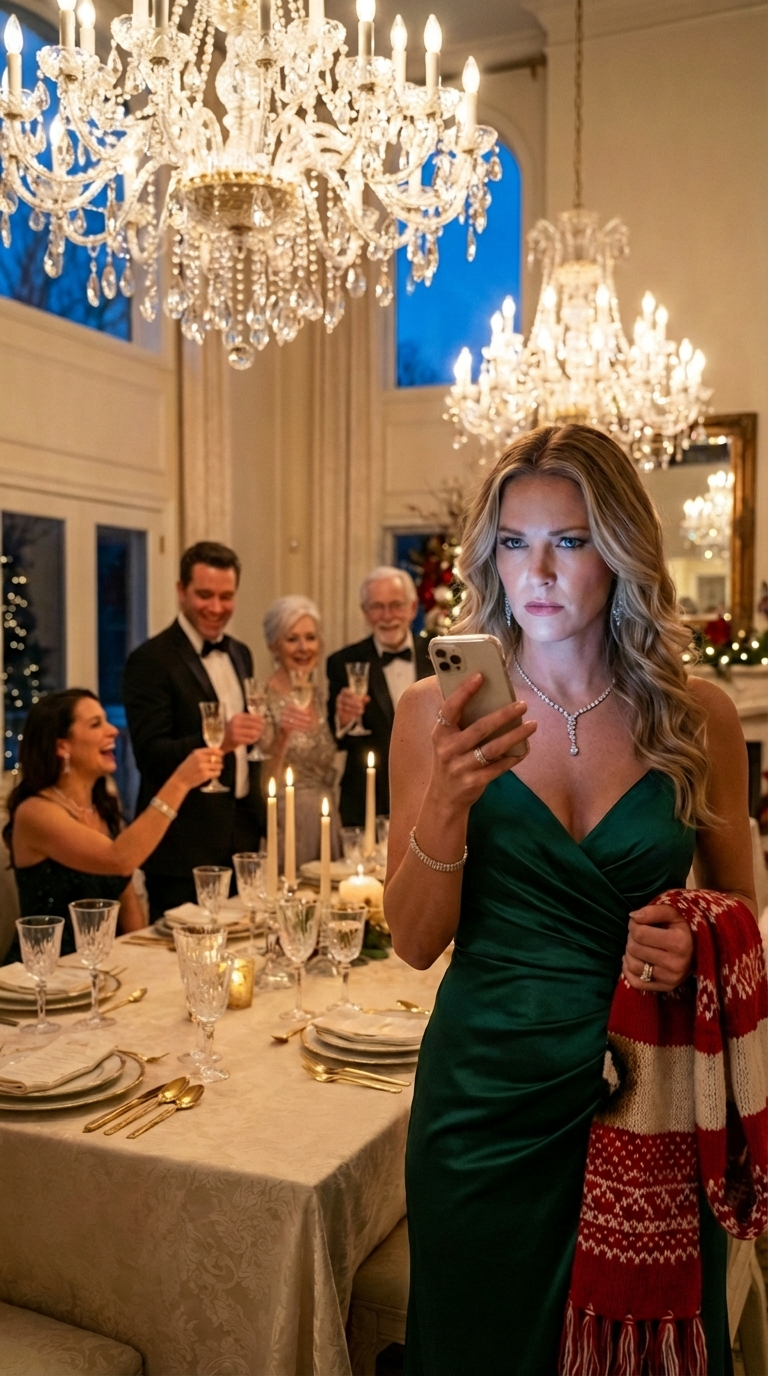
The silence of my loft in Tribeca was expensive. It was the kind of silence that cost four thousand dollars per square foot—a thick, insulating layer of triple-paned glass and soundproofed walls that kept the chaotic hum of Manhattan at bay. Standing in my walk-in closet, surrounded by racks of clothing color-coded by season and fabric, I looked at the woman in the floor-to-ceiling mirror.
To the world, or at least the slice of it that read TechCrunch and Forbes, I was the silent partner of Chimera Capital, the architect behind the algorithm that had predicted the last three market corrections with terrifying accuracy.
To my family, I was Elena the drifting artist. Elena the graphic designer who “doodled” for pennies. Elena, the disappointment.
I reached past a row of Saint Laurent blazers and pulled out a faded, oversized beige sweater from Target. It had a small pill on the left shoulder. It was perfect. This was my costume. This was the “Grey Rock” method made manifest—be boring, be small, be unthreatening. If I looked like I was struggling, they wouldn’t ask questions. If they didn’t ask questions, they couldn’t hurt me.
My phone buzzed on the marble island in the center of the closet. It was Sarah, my business manager.
“Elena, the two-million-dollar transfer to StreamLine is queued,” Sarah’s voice was crisp, professional, but laced with hesitation. “We just need your final biometric confirmation. Are you sure about this? I’ve looked at the deck again. Julian’s burn rate is catastrophic. His user acquisition costs are through the roof. Financially, this is suicide.”
I stared at my reflection. I practiced the slump of my shoulders, the way I would look down when my father spoke.
“It’s not an investment in the company, Sarah,” I said softy. “It’s an investment in him. It’s an investment in the brother who used to let me win at Mario Kart when we were seven. Before he became… this.”
“He won’t know it’s you,” Sarah reminded me. “The anonymity clause is ironclad. To him, you’re just ‘Angel Ventures.’”
“If he knew it was me, his ego would spontaneously combust. He needs a savior, Sarah, not a sister. Especially not a sister he thinks is a loser.”
“Proceeding with the transfer pending final authorization,” Sarah sighed. “Good luck, Elena. Happy Thanksgiving.”
I hung up. On the shelf next to my collection of Birkins—hidden behind a false panel—sat a plain cardboard box. I picked it up. Inside was a scarf I had spent the last month knitting. Forty hours of labor. The yarn was pure vicuña, softer than cashmere and worth more than gold by weight, but dyed a dark, unassuming charcoal. To the untrained eye, it was just a scarf. To me, it was a peace offering. A tangible thread connecting me to the family that had effectively severed me years ago.
I took the elevator down to the garage, bypassing the matte black Audi R8 that I loved driving. Instead, I unlocked the door of a dented, five-year-old Honda Civic I kept specifically for trips to Connecticut.
The drive was a slow transition from the world I owned to the world that owned me. As I pulled into the long, winding driveway of my parents’ estate, my stomach tightened—a physical recoil I hadn’t been able to outgrow.
And there it was. Blocking the entrance to the three-car garage was a brand new Porsche 911 GT3 in screaming yellow. The license plate read: FNDR. Founder.
I parked the Civic on the grass, the engine sputtering as I killed the ignition. I pulled my phone out. The screen glowed in the twilight: Transfer Pending: Awaiting Final Authorization.
I took a deep breath, clutching the device like a talisman. I had the power to save him. I held the keys to his kingdom in my pocket. Surely, that knowledge would be enough to armor me against whatever insults were waiting inside.
I stepped out of the car, the cold November wind biting at my face. As I walked toward the front door, I heard laughter erupting from inside—loud, raucous, and masculine. I reached for the handle, but before I could turn it, the door swung open. Julian stood there, a glass of scotch in one hand, looking through me as if I were a delivery driver. “You’re blocking the driveway,” he said, not as a greeting, but as an accusation. I slid my hand into my pocket, thumb hovering over the screen, unaware that the authorization he so desperately needed would never happen.
“Happy Thanksgiving to you too, Julian,” I said, stepping past him into the foyer. The house smelled of roasted sage, expensive cologne, and judgment.
“Move it, Elena,” he muttered, taking a sip of his drink. “I’m expecting a call. A big call.”
I walked into the kitchen. My mother, Linda, was arranging hors d’oeuvres on a silver platter. She didn’t look up. “There you are. Grab an apron, honey. The catering staff is short a server, and I need you to pass the stuffed mushrooms.”
“Hi, Mom,” I said, putting my gift box on the counter. “I can help, but I’d like to say hello to Dad first.”
“He’s in the living room with Julian. Talking business. Don’t interrupt them, Elena. You know how your father gets when he’s discussing strategy.”
Strategy. My father, Robert, had been a mid-level executive at a paper supply company for thirty years. He wouldn’t know a Series A round from a hole in the ground. But in this house, men talked business, and women passed mushrooms.
I tied the apron around my waist, over the pill-covered sweater. I was playing the role. I was the good daughter.
I walked into the living room with the tray. My father was sitting in his leather armchair, looking at Julian with a gaze of adoration he had never once directed at me.
“The burn rate is just the cost of doing business, Dad,” Julian was saying, gesturing wildly with his free hand. “You have to spend money to look like money. Investors want to see confidence.”
“Exactly,” Robert nodded. “Project strength.”
“Mushrooms?” I offered, my voice small.
Julian grabbed one without looking at me. Then, his pocket buzzed.
He pulled out his phone. The room went silent. I watched his eyes scan the screen. I knew exactly what he was reading. It was the Term Sheet from Angel Ventures. The preliminary offer. The promise of two million dollars.
Julian froze. Then, a grin broke across his face, wide and predatory.
“YES!” he shouted, punching the air. “Boom! It’s in!”
“The funding?” my father asked, sitting up.
“The Angel Fund came through!” Julian roared, holding the phone up like a trophy. “Two million dollars! Unsecured! I told you, Dad. They see the vision! They see StreamLine for what it is—a unicorn!”
Robert jumped up and hugged him. “That’s my boy! A tycoon in the making! I knew it. I told your mother, ‘Julian is going to change the world.’”
My mother ran in from the kitchen, wiping her hands. “Did it happen? Is it real?”
“It’s real, Mom,” Julian laughed, spinning her around. “We are liquid. We are going to the moon.”
I stood there, holding the tray of mushrooms, invisible in the corner. I felt a strange warmth in my chest. I had done this. I had caused this joy. Maybe, just maybe, this would be enough.
“That’s great news, Julian,” I said, stepping forward. “Really. I know how stressed you were about payroll next week.”
The room stopped. Julian turned to me, his smile dropping instantly. The warmth in his eyes was replaced by a cold, sneering amusement.
“Stressed?” he scoffed. “I wasn’t stressed, Elena. That’s the difference between us. You worry about rent. You worry about grocery bills. I worry about valuation. I worry about market cap.”
“I just meant…” I started.
“This investor,” Julian interrupted, turning back to our father, “whoever he is, he’s a shark. He’s a genius. He knows real talent when he sees it. unlike some people.” He cast a sideways glance at me. “He’s not counting pennies like you do with your… what is it you do again? Selling doodles on Etsy?”
“Graphic design,” I corrected softly. “I work with corporate branding.”
“Right. Doodles,” he dismissed. “This guy—the Angel—he’s the only person smart enough to understand the future I’m building.”
My father chuckled. “Don’t be too hard on her, son. Not everyone has your drive. Elena is doing her best, aren’t you, sweetie?”
“Yes, Dad,” I said. “I’m doing my best.”
The irony was a physical weight in my throat. He was calling the anonymous donor a genius while spitting on the woman standing right in front of him. He was idolizing his savior while handing her a dirty napkin.
“To the Angel!” Julian shouted, pouring more scotch into his glass, spilling it onto the mahogany table. He didn’t wipe it up. He looked at me, expecting me to do it.
I stared at the puddle of amber liquid.
“To the Angel,” I whispered.
Julian raised his glass high. “To the only person in the world who actually matters right now.” He downed the drink. I reached into my pocket and felt the cool metal of my phone. The banking app was still open. The button that said APPROVE was pulsing on the screen. I watched the scotch drip off the table onto the rug. “To the Angel,” I repeated in my head, but my thumb hovered over a different button now. Cancel? No. Not yet. I needed to see how far he would go.
Dinner was a masterclass in exclusion. The conversation revolved entirely around Julian’s brilliance, the new office space he planned to lease in SoHo, and the vacation to St. Tropez he was now planning for the summer.
“I’m thinking of upgrading the fleet,” Julian said, chewing on a piece of turkey. “The Porsche is nice, but a McLaren makes a statement. StreamLine needs to project dominance.”
“Absolutely,” my mother agreed, beaming. “You have to look the part.”
I pushed a pea around my plate. “Shouldn’t you use the capital to finish the beta version of the app?” I asked. “Sarah—I mean, I read that tech startups are failing because of high burn rates and low product viability.”
Julian dropped his fork. It clattered loudly against the fine china.
“You read?” He looked at our parents with mock surprise. “She reads, everyone! Stop the presses.” He turned his glare on me. “Stick to your knitting, Elena. Leave the finance to the adults. You don’t know the first thing about viability. You drive a Civic.”
“I’m just saying…”
“You’re just jealous,” he snapped. “It’s ugly, Elena. It’s an ugly look on you.”
Dinner wound down. The air grew heavy with the scent of coffee and the impending ritual of gift exchange. We moved to the living room, where a fire was roaring in the stone hearth.
“I have something for you, Jules,” I said. My heart hammered against my ribs. This was the test. The final test.
I picked up the box from the counter and slid it across the coffee table toward him.
“A gift?” Julian raised an eyebrow. “From you? What is it, a coupon book?”
He ripped the paper off. He opened the box.
He pulled out the scarf.
The charcoal wool caught the light. It was exquisite. Even a layman could feel the density, the softness, the incredible warmth of the vicuña. It was simple, elegant, and timeless.
“A scarf?” Julian scoffed. He held it up with two fingers, as if it were a dead rat.
“I made it,” I said, my voice trembling slightly. “It took about forty hours. It’s vicuña wool. It’s extremely warm. I know you hate the wind in the city.”
Julian looked at the scarf, then at me. His face contorted into a mask of pure disdain.
“You knitted this?” he laughed. “Jesus, Elena. I’m about to be a CEO of a multi-million dollar company. I can’t walk into board meetings wearing… homemade arts and crafts.”
“It’s practical,” I said. “It’s love.”
“It’s cheap,” Julian corrected. He stood up. “This is exactly what I’m talking about. You just don’t get it. We are on different levels. I wear Gucci. I wear Tom Ford. I don’t wear…” He gestured vaguely at me. “…whatever this is.”
He walked toward the fireplace.
“Julian, don’t,” I said. I stood up. “That’s not just wool. That’s my time.”
“We don’t need trash from a minimum-wage loser cluttering up the house,” he laughed.
“Julian!” I stepped forward, but I was too late.
He tossed the scarf into the flames.
“NO!” The word ripped out of my throat.
I watched the wool hit the logs. For a second, it resisted. Then, the delicate fibers caught. The charcoal turned to orange, then black. It shriveled. Forty hours of my life. My attempt to bridge the gap. My love. All of it, curling into ash in seconds.
“Why can’t you be successful like him?” my mother sighed from the couch, sipping her wine, watching the fire as if it were TV. “He’s building a future, Elena. You’re just… knitting.”
Something inside me broke.
But it wasn’t a loud break. It wasn’t a scream. It was a quiet, metallic click. Like the safety coming off a gun.
The sister died in that moment. The investor woke up.
I didn’t cry. I didn’t yell. I felt a strange sense of calm wash over me. The clarity of the balance sheet. Assets and liabilities. Julian was no longer an asset. He was a bad debt. And bad debts get written off.
I sat back down. I reached for my wine glass with my left hand. With my right, I pulled my phone from my pocket.
Julian turned back from the fire, dusting his hands off. “Now that we’ve cleared the clutter, let’s open the good cognac.” He didn’t look at me. He didn’t see the screen of my phone. He didn’t see my thumb hovering over the interface of the Angel Ventures admin panel. The fire reflected in his eyes, making him look demonic. I took a sip of wine. “The time for mercy is over,” I whispered to the glass.
The fire crackled, consuming the last thread of the scarf. The smell of burning hair—the wool—filled the room, acrid and sharp.
“To the future!” Julian shouted, reaching for the crystal decanter.
I stared at my screen.
App: Angel Ventures Capital (Admin).
Project: StreamLine (Series A).
Status: PENDING AUTHORIZATION.
I tapped the EDIT button.
I selected REVOKE FUNDING.
A dialogue box appeared: Are you sure? This will terminate the term sheet and lock the escrow account. This action is irreversible.
I looked at Julian’s back. I looked at my mother, who was smiling vacantly at the fire. I looked at my father, who was looking at Julian like he was a god.
I tapped YES.
A loading circle spun for a second—the longest second of my life. Then, a green checkmark appeared.
FUNDS WITHDRAWN. OFFER RESCINDED.
Ping.
The sound was sharp in the quiet room. It came from the coffee table, right next to the turkey carcass. Julian’s phone.
Ping. Ping. Ping.
It was a machine gun of notifications.
“Popular tonight, son,” my father chuckled.
“Probably the wire hitting the account,” Julian grinned, swaggering over to the table. “Or maybe it’s the bank manager calling to personally congratulate me.”
He picked up the phone.
I watched him. I watched the arrogance evaporate. It didn’t happen slowly. It was instant. His face went stark white. His mouth opened, but no sound came out. He swiped frantically at the screen, his fingers slipping.
“What…” He shook his head. “No. No, no, no.”
“What is it?” my mother asked, sensing the shift in the air.
“The… the capital,” Julian’s voice cracked. It was high and terrified, the voice of a child lost in a supermarket. “The term sheet. It’s been pulled.”
“What do you mean pulled?” Robert stood up. “We signed it.”
“It says…” Julian read from the screen, his hand shaking so hard the phone vibrated. “Due to a reassessment of the founder’s character and operational volatility, Angel Ventures is exercising its right to withdraw all support effective immediately. The escrow account is frozen.“
He looked up, wild-eyed. “Who? Who just pulled the capital? I need to call them! I need to fix this! My payroll checks go out tomorrow! If this money isn’t there, I bounce checks. I go to jail!”
He started dialing the emergency number for the fund.
Across the room, my phone buzzed.
I didn’t pick it up. I just let it buzz against the side of the wine glass. Bzzzt. Bzzzt.
Julian stopped. He looked at his screen, where it was ringing. He looked at my phone, vibrating on the table.
He looked at me.
The connection was impossible for him. It broke the laws of his universe. Elena the loser? Elena the doodle-seller?
“Why is…” Julian swallowed hard. “Why are you getting a call from the Angel priority line?”
I reached out and tapped DECLINE.
The room went dead silent. The only sound was the crackle of the fire eating my scarf.
“The account is frozen, Julian,” I said. My voice was steady. It was the voice I used in boardrooms in Tokyo and London. “And the offer is gone.”
“You?” he gasped. He dropped his phone into the gravy boat. He didn’t even notice. “You’re the donor? But… how? You… you drive a Civic.”
I stood up, smoothing my jeans. I took a slow, deliberate sip of my wine. I set the glass down with a soft clink.
“I drive a Civic because I don’t need a Porsche to know I’m important,” I said. “I knitted you a scarf because I thought you might value my time, since you clearly don’t value me.”
I looked him dead in the eye.
“The loser just saved herself two million dollars,” I whispered.
“You can’t do this!” Julian screamed, lurching forward. “I’m your brother! StreamLine dies without that money!”
“Then you better start selling your blood,” I said coldly. “Because you just burned the only asset you had left.”
I turned to leave. Julian lunged, grabbing my arm. “You’re lying! You’re just a jealous little bitch!” I ripped my arm away, and for the first time, I let the “Grey Rock” mask fall completely. I smiled—a cold, shark-like smile that looked exactly like the one the “Angel Investor” would wear. “Check the sender of the withdrawal email, Julian,” I said. “It’s signed with my biometric key.”
Panic is an ugly thing to watch. It strips away the veneer of civilization.
“Elena, wait!” My father knocked over his chair, scrambling toward me. “Let’s talk about this. You can’t just… destroy your brother’s company. We’re family! Think about what you’re doing!”
“I am thinking,” I said, picking up my purse. “I’m thinking about ‘minimum-wage loser.’ I’m thinking about ‘trash.’”
“We were joking!” my mother shrieked, clutching her pearls. “You know how Julian is! He’s just… high spirited! Fix this, Elena! Put the money back!”
“It’s not a piggy bank, Mother,” I said, walking to the door. “It’s a venture capital fund. And we have strict policies against investing in toxic assets.”
“I’m sorry!” Julian screamed. He was on his knees now, searching for his phone in the gravy boat, dripping with brown sludge. He looked pathetic. “I didn’t mean it! The scarf… I can buy you a thousand scarves! I’ll buy you a factory! Just put the money back!”
I paused at the door. I looked back at them—this tableau of greed and desperation.
“You couldn’t afford a single thread of that scarf, Julian,” I said softly. “Not anymore.”
“Elena!” my father roared, trying to use his ‘head of household’ voice. “If you walk out that door, don’t bother coming back for Christmas. You are cutting yourself off!”
“I didn’t cut myself off, Dad,” I said, opening the door to the cold night. “You cut me off years ago. I just finally stopped bleeding.”
I walked out. The wind hit me, but I felt incredibly warm. The adrenaline was fading, replaced by a profound, hollow peace.
I heard them shouting behind me. My mother was wailing. Julian was throwing things—I heard the shatter of glass. Probably the scotch.
I got into the Civic. It started with a reliable hum.
I backed out of the driveway. I saw my mother banging on the living room window, mouthing words of panic. Come back. Fix it. Give us the money.
I put the car in drive.
As I accelerated down the long driveway, leaving the “FNDR” Porsche behind, I looked in the rearview mirror. I saw the smoke rising from the chimney—the smoke from my burning scarf—drifting away into the black night sky. It thinned out and disappeared, dissolving into nothingness, just like my brother’s future. I turned on the radio and sang along to a pop song, my voice steady and strong.
Six months later.
The boardroom in Tokyo was bathed in sunlight. From the fiftieth floor, the city looked like a toy set, organized and clean.
“Ms. Vance?”
I turned away from the window. My assistant, Kenji, was holding a tablet. ” The board is ready for you. The acquisition of the solar grid project is approved. They just need your signature.”
“Thank you, Kenji,” I said. I adjusted my silk scarf—a vintage Hermès I had bought in Paris. It was beautiful, but it wasn’t vicuña.
I sat down at the head of the table. I opened my laptop.
I had a habit of checking my personal email once a month. It was a form of emotional self-harm I was trying to break, but today, I indulged.
There was one email in the folder I had labeled “Origin.”
Subject: Mom.
Date: Yesterday.
Body: Please call us, Elena. We haven’t heard from you in months. Julian is working at a dealership now. Used cars. It’s hard for him. He’s humbled, truly. We miss you. We miss… your help. Your father’s heart is acting up with the stress. Please. We’re family.
I looked at the words. We miss your help. Not we miss you. We miss the ATM. We miss the buffer.
I felt a phantom twinge of guilt, the old conditioning trying to resurface. The voice of the little girl who just wanted her dad to look at her the way he looked at Julian.
Then I remembered the fire. I remembered the smell of burning wool. I remembered the way Julian looked when he called me a loser.
He was right about one thing. We were on different levels.
I didn’t reply. I didn’t forward it to my therapist.
I moved the cursor to the Delete button.
Click.
The email vanished.
“Ms. Vance?” Kenji asked. “Is everything alright?”
“Yes,” I said, closing the tab. “Everything is perfect.”
I signed the contract for the solar grid. A hundred million dollars to power a city. Real power. Real impact.
I walked back to the window, looking out over the skyline that stretched to the horizon. Somewhere in a used car lot in Connecticut, Julian was probably trying to sell a sedan to a skeptical customer. I hoped he was wearing a warm coat.
“I hope you’re warm, Julian,” I whispered to my reflection in the glass.
I turned off the light in the office and walked out, leaving the past in the dark where it belongs.