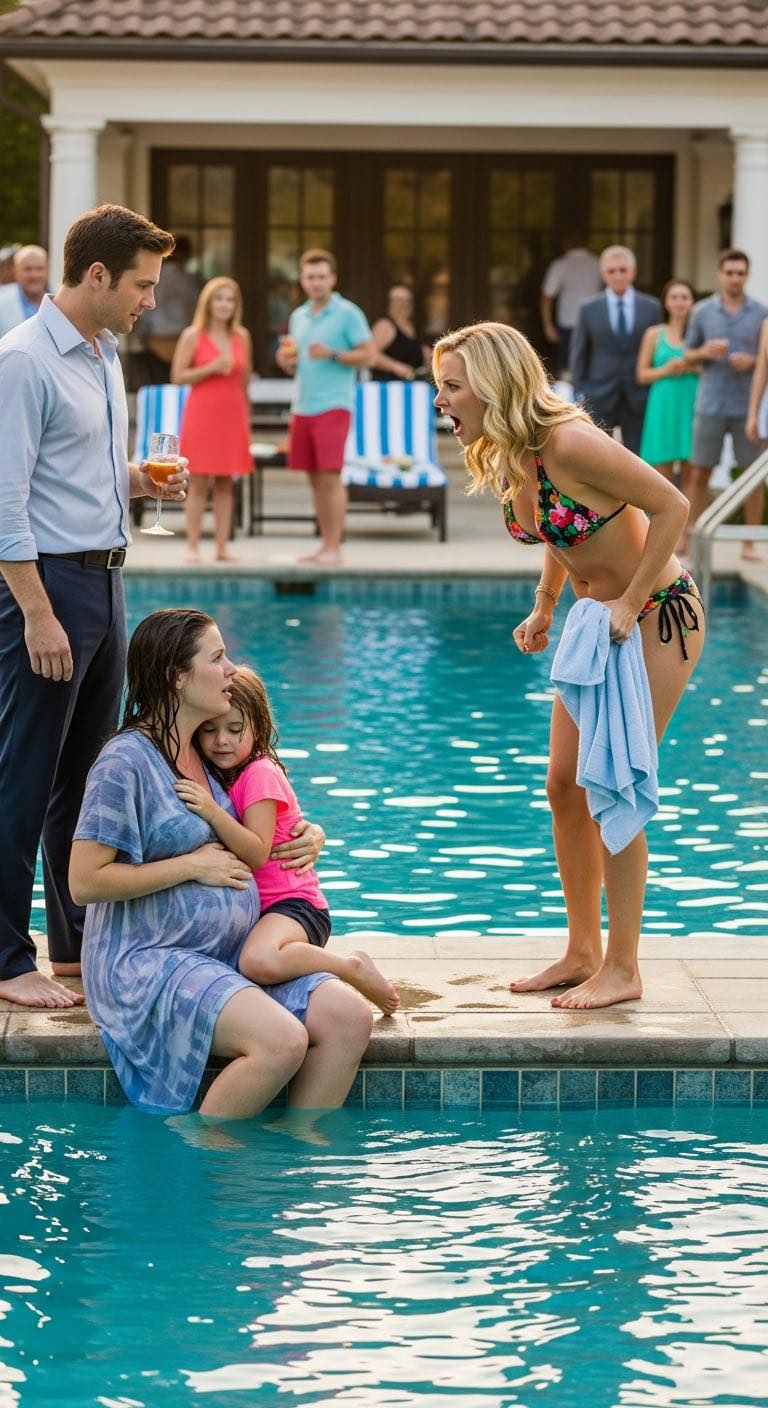
The water in the country club pool was unnervingly stagnant, a turquoise mirror that seemed to hold its breath, concealing the predators lurking beneath the surface of high society. I, Elena Vance, was eight months deep into a pregnancy that felt like carrying a boulder of pure anticipation. My ankles were swollen to the size of water balloons, and I sat perched on a designer lounge chair, acutely aware of the vitriolic, judgmental stares from the “trophy wives” who circled the perimeter like sharks in Chanel.
My husband, Julian Thorne, the enigmatically handsome CEO of Thorne Enterprises, was ostensibly occupied with a “critical business summit” at the poolside bar. I watched him from a distance—the way he tilted his head, the practiced ease of his charismatic smile. I had spent seven years believing that smile was my sanctuary.
Suddenly, a violent splash shattered the tranquility. It wasn’t the rhythmic sound of a playful dive; it was the dull, frantic thud of a body in distress. I scanned the deep end. A small girl, perhaps six or seven, was plummeting toward the drain like a discarded stone. Her tiny arms flailed in a desperate, silent prayer for oxygen.
No one moved. The lifeguard was transfixed by his smartphone, a digital zombie. The mothers around the pool remained frozen in their choreographed poses, mimosas poised halfway to their lips.
Before my conscious mind could process the risk, my maternal instinct took the helm. I launched myself into the water. The transition from the scorching afternoon heat to the biting cold of the pool was a physical assault. The weight of my unborn daughter, Luna, dragged me toward the bottom, but I swam with a ferocity I didn’t know I possessed—the rage of a lioness.
I reached the girl, hooked my arm around her waist, and kicked toward the shimmering light above. My lungs screamed for air, and Luna protested the sudden turbulence with a series of sharp kicks against my ribs. When we finally breached the surface, I was gasping, coughing up a lungful of chlorinated bile. I hauled the trembling child onto the concrete apron.
She spat out a mouthful of water and began to wail.
“Emma!” a blonde woman shrieked, sprinting toward us. She was draped in a bikini that cost more than a month of my mortgage and was clouded in a heavy mist of Jasmine Noir—a scent that had, on more than one occasion, clung to Julian’s lapels after a late night at “the office.”
I expected gratitude. I expected a mother’s relief. Instead, she looked at me with a primal, visceral loathing. “Don’t you dare touch her!” she bellowed, snatching the girl away with such force I nearly tumbled back into the pool. “You and your pathetic family are a plague! If she’s hurt, I’ll sue you into the Stone Age!”
I stood there, shivering in the sun, my mind a fractured mosaic of confusion. Julian appeared then, his face a ghostly mask of panic. But he didn’t run to me. He didn’t check on his pregnant wife who had just risked two lives to save one. He ran to the blonde.
“Tiffany, for the love of God, keep your voice down,” he hissed, his tone saturated with an intimacy that curdled the blood in my veins.
“Shut up, Julian!” she screamed, her eyes blazing. “You almost killed our daughter by insisting we come to this pretentious hellhole!”
The world didn’t just stop; it imploded. Our daughter. I looked at the girl, Emma. Beneath the wet matted hair, she had the same piercing green eyes as Julian. The same eyes I saw in the 4D ultrasounds of my own baby.
A sharp, jagged pain blossomed in my abdomen—a stress-induced contraction that signaled the beginning of the end. As I stood there, clutching my belly and trembling in the wake of the truth, I noticed a teenager nearby, their phone raised, capturing every agonizing second of the betrayal.
I didn’t know then that the digital record would become my greatest weapon. But as my phone buzzed in my bag with a series of urgent notifications, I realized the pool “accident” was merely the opening salvo in a war Julian had been planning for years.
The notification on my screen was a cold, digital execution: “Insufficient funds. Transaction declined: $12.50. Current balance: $0.00.”
Julian hadn’t just broken our vows; he was systematically dismantling my existence. While I sat in a sterile hospital bed later that evening, strapped to a fetal monitor to stave off premature labor, the magnitude of his malice came into focus. In the forty-five minutes following the pool incident, he had executed a scorched-earth financial strike.
He had siphoned $250,000 from our joint savings, liquidated the $50,000 investment fund intended for Luna’s education, and cauterized every credit card in my name. I was a prisoner of his wealth, now rendered a pauper by his whim. He was punishing me for discovering the secret he had buried for seven years, and he intended to leave me too broken and broke to fight back.
However, Julian had committed a catastrophic strategic error: he underestimated the velocity of a viral truth.
By the next morning, the video of the rescue had metastasized across TikTok and Twitter. Tens of millions of people had watched a heavily pregnant woman dive into the depths to save a drowning child, only to be met with the vitriol of an ungrateful mistress and the cowardice of a husband who prioritized his secret over his family. The public wasn’t just sympathetic; they were incensed. “Internet sleuths” began dissecting Julian’s life with surgical precision, unearthing the cracks in the Thorne Enterprises facade.
With no resources and a heart that felt like it had been put through a woodchipper, I retreated to the only sanctuary I had left: my sister Hannah’s cramped, one-bedroom apartment.
“You aren’t going to shed another tear for that sociopath, Elena,” Hannah declared, slamming a mug of herbal tea onto the table. “You’re going to sharpen your claws. We’re going to make him bleed gold.”
We were desperate for legal counsel, but the city’s top firms were all on Julian’s payroll. That was until my phone rang with a call from a private number.
“This is Patricia Caldwell,” a raspy, nicotine-stained voice enunciated. Patricia was the “Velvet Hammer,” the most formidable divorce attorney in the state. “I saw the footage, Elena. I watched that bastard abandon you in the water. I’ve spent thirty years hunting men like Julian Thorne. I’m taking your case pro bono. I don’t want your money; I want his head on a platter.”
Patricia’s investigation was a masterclass in forensic destruction. We weren’t just looking for a divorce settlement; we were hunting for the rot at the core of his empire. We found a silent ally in Marcus Webb, Julian’s minority partner, who had watched Julian’s ego swell with disgust for years. Marcus handed over a digital trail of breadcrumbs proving that Julian had been embezzling company capital to fund Tiffany’s luxurious lifestyle, labeling the hemorrhaging cash as “external consulting fees.”
But the most devastating blow came from the most improbable source: Tiffany herself.
A week after the pool incident, she requested a meeting. We met in a desolate park, far from the prying eyes of the country club set. Without her designer armor and professional makeup, she looked gaunt, haunted.
“He told me you were a basket case,” Tiffany whispered, unable to meet my gaze. “He said you were unstable, that the baby wasn’t even his. He promised me that once the child was born, you would… ‘have an accident.’ He said we’d be a real family then.”
She slid a thick manila envelope across the table. It was a compendium of horrors: receipts, emails, and voice recordings where Julian meticulously detailed his plan to declare me mentally unfit after the birth to seize full custody of Luna—not because he wanted her, but because it gave him leverage over the remaining assets.
“You saved my daughter, Elena,” Tiffany said, her voice breaking. “Emma told me you didn’t hesitate. Julian didn’t even get his shoes wet. I won’t let him kill you to keep his secret.”
I realized then that Julian hadn’t just betrayed me; he had played us both like instruments in a symphony of lies.
The morning of the emergency hearing arrived with the weight of a funeral and the tension of a ticking bomb. Julian swaggered into the courtroom, draped in a $5,000 Italian suit, flanked by a phalanx of high-priced legal mercenaries. He didn’t deign to glance in my direction, maintaining the arrogant posture of a man who believed he was still the architect of his own destiny.
His expression shifted, however, when he saw Marcus Webb and Tiffany sitting directly behind me. The blood drained from his face, leaving him looking sallow and small.
Patricia Caldwell was a force of nature. She didn’t just present a case; she orchestrated a massacre. She laid out the bank records showing the $0.00 balance, played the viral video on a massive screen, and submitted the sworn affidavits of financial fraud.
“Your Honor,” Patricia’s voice thundered through the chamber, “this isn’t merely a case of marital infidelity. This is a premeditated act of financial terrorism against a pregnant woman and her unborn child. Julian Thorne attempted to execute a social and economic assassination to protect a legacy built on sand and embezzlement.”
The judge, a man whose face was a roadmap of decades spent witnessing the worst of humanity, looked at Julian with a terrifyingly calm contempt. “Mr. Thorne,” he began, his voice dropping into a low, dangerous register, “in my thirty years on the bench, I have rarely encountered such a calculated, cold-blooded display of malice.”
The ruling was swift and merciless. He ordered an immediate freeze on all of Julian’s personal and corporate assets. He awarded me an emergency support payment of $15,000 per month—drawn directly from the offshore accounts Marcus had helped us locate—and referred the entire file to the District Attorney for a criminal investigation into fraud and embezzlement.
As the court adjourned, Julian tried to intercept me in the hallway. He was sweating, his polished facade cracking to reveal the panicked predator underneath.
“Elena, honey, please. We can talk about this,” he pleaded, his hand reaching out. “Think about Luna. Think about the family.”
I stopped and turned to him. My belly was a heavy weight, my back was screaming in protest, but I had never felt more upright. “I am thinking of her, Julian. That’s why I’m stripping you of everything. Not for the money, but to ensure she grows up in a world where men like you are nothing more than a cautionary tale.”
That night, the stress finally broke the levee. My water broke on Hannah’s kitchen floor.
It wasn’t the picturesque birth I had envisioned—the doting husband, the soft music, the shared joy. It was better. It was a battlefield. I was surrounded by Hannah, my best friend Rachel, and even Julian’s mother, Constance, who had disowned her son the moment she saw the viral footage of his cowardice.
Luna was born at 3:14 a.m., a tiny, screaming testament to survival. When they placed her in my arms, I looked into her green eyes—the same eyes as Emma, the same eyes as Julian—and I whispered a vow to her. Biology is not a prison. You will not inherit his rot. You will be a lioness.
By the time the sun rose, the headlines were already screaming: “CEO Arrested for Multi-Million Dollar Fraud Following Viral Pool Rescue.” Julian Thorne had traded his pinstripes for an orange jumpsuit. The justice wasn’t just served; it was televised in high definition.
Luna’s first year was a whirlwind of legal depositions, midnight feedings, and the slow, agonizing process of rebuilding a soul from the ashes. While Julian sat in a federal cell awaiting his trial—eventually pleading guilty to a litany of charges to secure an eight-year sentence—I was busy constructing a new empire.
I didn’t return to the quiet life of a non-profit worker. I had a platform now, a voice that had been forged in the fire of betrayal and amplified by millions of strangers. I founded The Luna Project. It started as a small support group but rapidly evolved into a national powerhouse dedicated to providing financial education and legal resources to victims of economic abuse.
My inaugural conference was held in a packed auditorium in the heart of Chicago. As I stepped onto the stage, I wore Luna in a carrier against my chest. Her rhythmic breathing was the only anchor I needed.
“My name is Elena Vance,” I began, my voice steady despite the tears pricking my eyes. “And a year ago, my husband tried to delete my existence with a single mouse click. I thought my value was tied to the numbers in our joint account. I was wrong. My true worth was revealed when the water closed over my head, and I chose to swim anyway.”
I spoke without a script. I talked about the crushing shame of being unable to afford diapers while my husband bought diamonds for another woman. I spoke about the “silent killer” of relationships—the economic tether that keeps women trapped in cycles of abuse. I spoke about the unexpected sisterhood that had saved me.
The response was a tidal wave. Women of all ages stood up, their faces etched with the same stories of hidden accounts and secret lives. I realized then that my trauma wasn’t an anomaly; it was an epidemic. And I was the cure.
But the most profound victory happened away from the cameras.
On a Sunday afternoon, two years after the pool incident, we gathered for a picnic. There was Hannah, Rachel, and Constance—who had become the most fiercely protective grandmother on the planet. And then, Tiffany arrived with Emma.
Seeing Emma, now nearly nine, approach Luna’s stroller was a moment that made the world go quiet. “Hi, Luna,” Emma whispered, gently touching her half-sister’s hand. “I’m your big sister. I’m going to teach you how to swim, but we’re going to use the bright orange floaties, okay? No more scary stuff.”
Tiffany and I exchanged a long, weighted look. We would never be best friends, and the scars of our shared history would always remain, but we were allies. We were mothers who had chosen to break a cycle of toxicity. We had refused to let Julian’s poison define our daughters’ future.
That evening, I received a final letter from the federal penitentiary. It was the first time Julian had written in months. I opened it with a detached curiosity.
“How is she?” was all it said. Five words.
I didn’t write back. I didn’t scream. I simply tore the paper into a hundred tiny pieces and let the wind carry them away into the trash. He had forfeited the right to know her the moment he decided she was a pawn in a financial game. Luna was thriving in a world of honesty and laughter. She didn’t need a ghost father; she had a tribe of steel.
Five years have passed since the turquoise mirror of the country club pool tried to swallow me whole.
I am standing on the edge of the Pacific, the salt air stinging my cheeks. Luna, now five, is a whirlwind of curls and chaotic joy, chasing the receding tide with reckless abandon. Emma, a tall, thoughtful twelve-year-old, follows her like a shadow, a hawk-eyed guardian.
“Don’t go too deep, Lu!” Emma calls out, her voice filled with a protective warmth that Julian never understood.
The water doesn’t terrify me anymore. It serves as a reminder of my capacity for salvation—both for others and for myself. Julian was released from prison last month, a hollowed-out version of the man he once was. He tried to reach out through his remaining lawyers, asking for a visitation schedule. Patricia Caldwell, still my faithful sentinel, crushed his request with a legal filing so thick it could have served as a doorstop. To Luna, he isn’t a father; he’s a footnote in a history book she hasn’t read yet.
I turn back to the picnic blanket, where Hannah and Tiffany are laughing over a shared secret. We have forged a family that is broken, patched up, and strangely beautiful. There are no offshore accounts here. No Jasmine Noir-scented lies. Just the raw, unfiltered truth of women who refused to drown.
I sit down on the sand and let the sun bake the last of the old chill from my bones.
“What are you thinking about, Elena?” Tiffany asks, handing me a glass of iced tea.
I smile, watching our daughters play at the water’s edge. “I’m thinking that the most important rescue I ever performed wasn’t in that pool,” I say softly. “It was rescuing myself from the delusion that I needed a man’s permission to be powerful.”
Life had hit us with the force of a tsunami, shattering the architecture of our old lives. But we didn’t just survive the wreckage. We learned to surf. And from the crest of the wave, the view is spectacular.