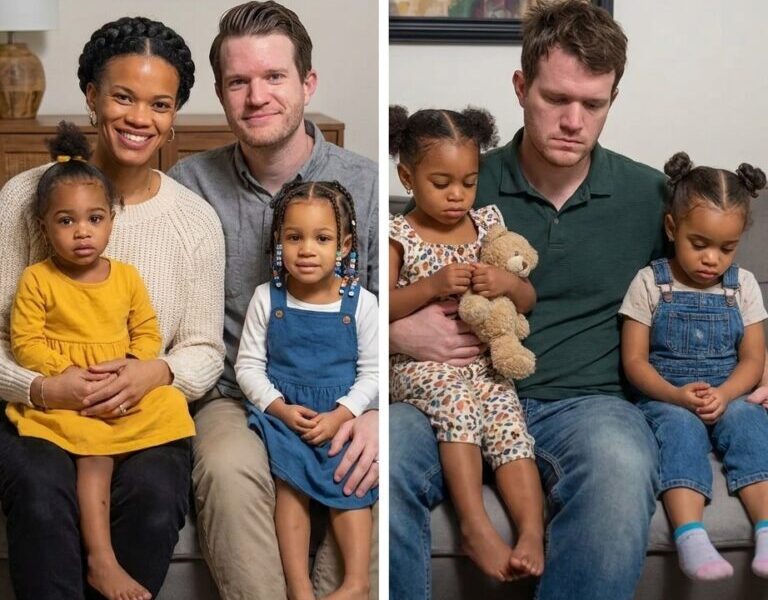
My name is Annabelle Thompson, and until four weeks ago, I was the invisible daughter. I was the background noise in the symphony of my family’s life—steady, reliable, and utterly unappreciated. But silence, as any musician knows, is not just the absence of sound. It is a pause. A breath. A gathering of tension before the crescendo hits.
Four weeks ago, my parents, Richard and Diane Thompson, sold my grandmother’s antique piano. It was an 1892 Steinway, a masterpiece of rosewood and ivory that she had promised would be mine since I was seven years old. They sold it for $95,000 while my grandmother, Eleanor Whitmore, lay dying in hospice care. They used every cent to buy my younger sister, Megan, a brand-new Mercedes-Benz.
They thought Grandma was too sick to notice. They thought I was too weak to speak. They were wrong on both counts.
To understand the magnitude of what happened at my mother’s 60th birthday party, you have to understand the piano. It wasn’t just furniture. It was the only place in that cold, sterile house where I had ever felt warm. While Megan was being groomed for society—hair pageants, tennis lessons, debutante balls—I was at the Steinway, pouring my heart into Chopin and Rachmaninoff.
The call that started the war came on a rainy Tuesday. My father’s voice was clipped, devoid of emotion. “Eleanor had another heart attack. She’s stable, but they’re moving her to hospice. Come to the hospital. We need to discuss logistics.”
When I arrived, the hierarchy was already established in the waiting room. My father stood with his arms crossed, a titan of local industry with a crumbling empire he tried desperately to hide. My mother clutched her Louis Vuitton bag like a shield. And Megan, fresh from a salon appointment, was scrolling through her phone, looking bored.
“Good, you’re here,” my father said, checking his watch. “We need to divide responsibilities. Diane and I have the business. Megan is in a critical phase with the Harrisons.”
Ah, yes. The Harrisons. Megan had been dating Daniel Harrison for eight months. He was the son of my father’s most important business partner, and my parents treated the relationship like a corporate merger.
“So, Annabelle,” my father continued, looking at me with the same disinterest one might show a housekeeper. “You’ll handle the daily visits. Your schedule is flexible. Music teachers don’t exactly work overtime.”
I wanted to scream. I wanted to tell him that I taught thirty-seven students a week, ran after-school programs, and that my time was just as valuable as his failing real estate deals. But the habit of silence is a hard one to break.
“Of course,” I said quietly. “I want to be with her anyway.”
“Perfect.” He turned his back on me.
As I walked down the corridor toward Grandma’s room, I heard my mother’s voice, a conspiratorial whisper meant only for Megan. “At least she’s useful for something.”
I didn’t turn around. I just kept walking, letting the antiseptic smell of the hospital burn my nose, fueling a small, hot spark in my chest that I didn’t quite recognize yet.
Grandma Eleanor refused to let her room smell like death. She surrounded herself with lavender sachets and stacks of old books. When I walked in, she looked frail, her skin like parchment paper, but her eyes were sharp—the blue steel of a woman who had survived seventy-six years of life on her own terms.
We spent the next two weeks talking. Not about the end, but about the music. One evening, her grip on my hand tightened.
“The Steinway,” she rasped. “My mother’s piano. It is yours, Annabelle. I told Richard and Diane last month. In front of witnesses. It belongs to you.”
“I know, Grandma. You don’t have to worry.”
“I do worry,” she said, her voice dropping to a fierce whisper. “There are some things more valuable than money, child. And there are some people who need to learn that lesson the hard way.”
I didn’t understand what she meant until the following Thursday.
I went to Grandma’s house to pick up some photo albums she requested. I still had a key. The moment I stepped into the foyer, the silence felt wrong. It wasn’t peaceful; it was hollow. I walked into the living room, and the air left my lungs.
The corner was empty.
Where the majestic instrument had stood for thirty years, there was only a rectangular depression in the plush carpet and a gathering of dust bunnies. It looked like a grave.
I called my mother. “Where is the piano?”
“Your father handled it,” she said, her tone breezy. “Adult matters, Anna. Don’t worry about it.”
“Handled it? It’s Grandma’s. It’s mine. Where is it?”
“I said drop it.” Click.
I drove to my parents’ house in a fugue state. My father opened the door, a glass of scotch in hand.
“You sold it,” I said. It wasn’t a question.
“Got $95,000 for it,” he said, taking a sip. “Good price in this market.”
“Grandma promised it to me.”
“Grandma is dying, Annabelle,” he said, bored. “She doesn’t need a piano. And neither do you. You live in a shoebox apartment. It wouldn’t fit.”
Behind him, the front door swung open. Megan walked in, dangling a set of keys, her face flushed with excitement. “Daddy, it’s beautiful! The leather smells amazing.”
“You bought her a car?” I whispered. “With Grandma’s piano money?”
“A Mercedes-Benz,” my father corrected, swelling with pride. “Megan needs to make the right impression on the Harrisons. Daniel’s family is particular about appearances.”
My mother appeared, crossing her arms. “Don’t be jealous, Anna. It’s ugly. Megan needed this for her future. If you had a real career, maybe you could afford nice things too.”
I looked at them—this triad of selfishness that I shared DNA with—and I felt something snap. Not a breaking, but a locking into place.
“Does Grandma know?” I asked.
“She’s on morphine,” my mother scoffed. “She doesn’t need to be upset. And if you tell her, Annabelle, if you cause her stress and she dies… that will be on you. Do you want to be responsible for killing your grandmother?”
I walked out into the night. I sat in my car, shaking, staring at the dark windows of the house they claimed was theirs. Does truth kill? I wondered. Or do lies just rot you from the inside out?
I made my choice at 3:00 AM. Grandma deserved the truth.
The next morning, I told her everything. The empty living room. The $95,000. The silver Mercedes. The threat my mother had made. I braced myself for her grief, for the heart attack that would surely finish her.
Instead, Eleanor Whitmore let out a long, slow sigh. She didn’t look shocked. She looked resigned.
“I knew this might happen,” she said softly. “I hoped he would change. I hoped he wouldn’t be the man I feared he was.”
“Grandma?”
She pointed to her bedside table. “Hand me my phone. Find Harold Jennings.”
She made the call on speaker.
“Harold,” she said, her voice stronger than it had been in days. “It’s time. They sold the piano.”
A deep, gravelly voice answered. “I’m sorry to hear that, Eleanor. But we are prepared. Sunday? The birthday party?”
“Sunday,” she confirmed. “Execute the protocol.”
She hung up and looked at me with a mischievous glint that defied death. “Annabelle, wipe your face. You have a role to play. Go to that party. Wear your best dress. And bring your patience. Justice is coming, and it’s going to be loud.”
What was the “protocol”? And why did Harold Jennings sound like an executioner readying his axe?
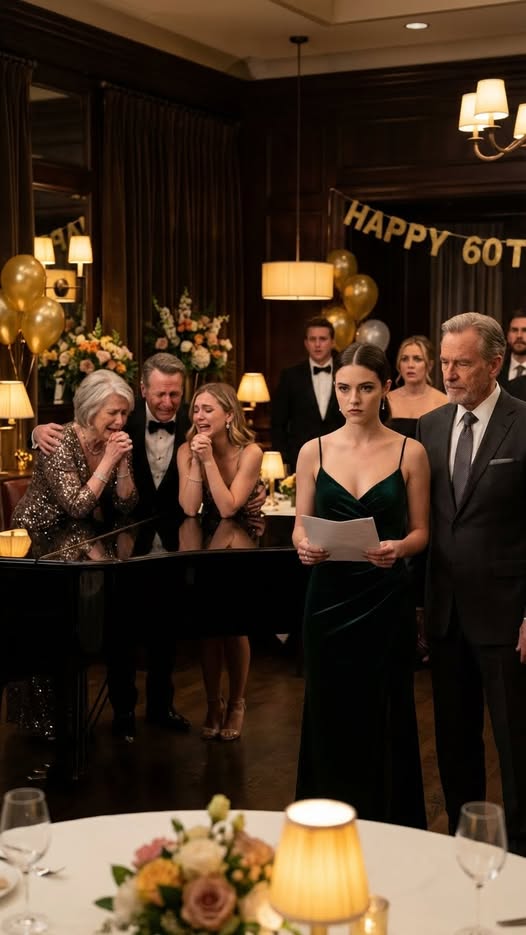
Sunday arrived with a sky the color of bruised iron. The air was crisp, biting. I pulled up to the house—Grandma’s house, though my parents had lived there for ten years—and saw the banner: Happy 60th Birthday Diane!
The driveway was packed. And there, center stage with a giant red bow on the hood, sat the silver Mercedes-Benz. It gleamed like a trophy of theft.
I wore a navy blue dress and the pearl earrings Grandma had given me. I felt like a soldier entering enemy territory under a flag of truce.
Inside, the house was buzzing. Thirty guests, mostly my father’s business associates and their wives, were drinking champagne. Megan was hanging on Daniel Harrison’s arm, preening. My father was holding court near the fireplace, and my mother was accepting compliments on the house she didn’t own.
In the corner where the piano used to be, they had placed a large, potted ficus tree. It was a pathetic attempt to fill the void.
Sitting quietly in a wingback chair near the back was an older man with silver hair and a briefcase on his knees. Harold Jennings. He caught my eye and gave a barely perceptible nod.
“Everyone!” my father shouted, clinking a spoon against his crystal glass. “Attention, please!”
The room quieted. My father wrapped an arm around my mother. “Today we celebrate sixty years of Diane. And we also celebrate the future. As many of you know, our Megan and Daniel have a bright future ahead.” He winked at Mr. Harrison, who smiled politely. “To celebrate, we have a surprise. A gift made possible by the generosity of my mother, Eleanor.”
He gestured toward the window, toward the car.
“She sold her antique piano to invest in her granddaughter’s happiness,” my father lied smoothly. “A legacy passed down.”
Applause rippled through the room. Megan squealed. I felt bile rise in my throat.
“Actually,” a voice cut through the applause. It wasn’t loud, but it had the weight of a gavel strike. “Eleanor did no such thing.”
The room froze. Aunt Margaret, Grandma’s sister, had stepped forward, her face pale with rage. But before my father could dismiss her, Harold Jennings stood up. The click of his briefcase opening was the loudest sound in the room.
“Who are you?” my father demanded, his smile Faltering.
“My name is Harold Jennings,” he said, walking to the center of the room. “I am Eleanor Whitmore‘s attorney.”
“My mother has an attorney?” my father scoffed. “Since when?”
“Since thirty years ago. I also represented your father. You would know this, Richard, if you had ever taken an interest in your mother’s affairs beyond her bank balance.”
Murmurs broke out among the guests. Mr. Harrison narrowed his eyes.
“I am here at Eleanor‘s specific instruction,” Harold continued, pulling a sheaf of documents from the folder. “She is fully lucid, and she is fully aware of the theft of her property.”
“Theft?” My mother shrieked. “We are her family! We live here!”
“Let’s clarify that,” Harold said calmly. He held up a document. “This is the deed to this property. Note the name. Eleanor Whitmore. It was never transferred to you, Richard. Never gifted. You have been living here for ten years rent-free as tenants at will.”
My father’s face went the color of ash. “She… she promised.”
“She promised you a roof over your head,” Harold corrected. “She did not promise you ownership. And under Pennsylvania law, you have made unauthorized modifications to a property you do not own. You have also misrepresented your assets to your business partners.”
Harold glanced pointedly at Mr. Harrison. I saw Daniel take a subtle step away from Megan.
“But that is the least of your problems,” Harold said, producing a second, thicker document. “Five years ago, suspecting that her kindness was being exploited, Eleanor created an irrevocable trust. She placed her most valuable assets into it to protect them from… financial misconduct.”
He looked directly at my parents.
“The house we are standing in. Her investment accounts. And all items of historical value, including the 1892 Steinway piano.”
He turned to me.
“The sole beneficiary of this trust is Annabelle Rose Thompson.”
The silence was absolute. Megan’s mouth hung open. My mother looked like she had been slapped.
“This is fraud!” my father roared, pointing a trembling finger at me. “You poisoned her! You manipulated a dying woman!”
“Sit down, Richard,” Harold barked. The authority in his voice made my father stumble back. “Every word you say is being witnessed. Now, regarding the piano.”
He turned a page.
“Since the piano was the property of the Trust, and Annabelle is the beneficiary, your sale of it constitutes theft of Trust assets. You have thirty days to return the $95,000 to the Trust. Failure to do so will result in immediate civil litigation and a criminal referral for elder financial abuse.”
“We spent it!” Megan cried out, tears streaming down her face. “It’s in the car!”
“Then I suggest you return the car,” Harold said coldly. “Though you will likely take a loss on the depreciation. You will have to find the difference elsewhere.”
“And the house?” my mother whispered. “What about our home?”
“It is not your home,” Harold said. “It is Annabelle‘s house. You are tenants. And effective immediately, your rent-free arrangement is terminated.”
All eyes turned to me. For the first time in my life, I wasn’t invisible. I was the sun, and they were the planets orbiting my decision.
My mother’s eyes were pleading, but underneath, I still saw the venom. “Anna, please. Tell him this is a mistake.”
I stepped forward. I looked at the empty corner where the piano should have been. I thought about the lessons, the scales, the music that had saved me. I thought about “At least she’s useful for something.”
“It’s not a mistake,” I said. My voice didn’t shake. “Grandma waited five years for you to prove her wrong. She waited for you to be decent. You weren’t.”
“We are your parents!” my father shouted.
“And she was your mother!” I yelled back, the anger finally breaking through. “And you stole from her while she was dying! You threatened me! You told me I would kill her with the truth!”
The guests gasped. Mr. Harrison turned his back on my father and began walking toward the door. Daniel followed him without looking back at Megan.
“I won’t kick you out today,” I said, lowering my voice. “Because unlike you, I don’t want to destroy family. But things are going to change. You will sign a lease. You will pay rent. And you will return every cent of that money to the trust.”
The party disbanded in shambles, but the real war—the quiet, agonizing war of a family dissolving—was just beginning.
The aftermath was a slow-motion car crash.
News travels fast in our social circle. By Tuesday, my father’s reputation was in tatters. The partnership with Harrison was dissolved. “I can’t do business with a man who swindles his own mother,” James Harrison reportedly said.
Megan had to return the Mercedes. The dealership gave her $80,000 for it. My parents had to liquidate their own retirement savings to cover the remaining $15,000 owed to the trust. Daniel broke up with Megan via text message three days later.
But the hardest part wasn’t the money. It was the silence.
I spent every remaining evening at the hospice. Grandma Eleanor held on for three more weeks. On the final night, she woke up and squeezed my hand.
“Did you do it?” she whispered.
“I did.”
“Are you okay?”
“I’m sad,” I admitted. “But I’m free.”
“Good,” she breathed. “Play for me, Annabelle. Even without the piano. Just play in your head.”
She died peacefully an hour later.
The funeral was awkward. My parents sat in the back row, wearing sunglasses, isolated from the rest of the mourners. They looked small. Diminished. Without the borrowed grandeur of Grandma’s house and reputation, they were just two bitter people in a pew.
They moved out two months later. They couldn’t stand living in a house where I held the deed. They bought a small condo across town. We didn’t speak.
Six months later, I moved into the house. It felt strange at first, ghosts lingering in the hallways. But I burned sage. I opened the windows. I let the light in.
I used a portion of the trust money to buy a new piano. Not a Steinway—I couldn’t bring myself to replace the irreplaceable—but a beautiful, black Yamaha grand. I placed it in the empty corner.
It fit perfectly.
One evening, as I was playing a Chopin Nocturne, my phone buzzed. It was Megan.
I let it ring three times before answering.
“Hello?”
“Hi, Anna.” Her voice was small. Different. “I… I just wanted to say I’m sorry.”
I stopped playing. My hands hovered over the keys.
“I’m in therapy,” she continued, rushing the words out. “I’m realizing a lot of things. About Mom and Dad. About how I treated you. It wasn’t okay.”
“No,” I said gently. “It wasn’t.”
“I’m working as a junior associate at a marketing firm now. Taking the bus. It sucks,” she laughed, a brittle, wet sound. “But… I think I’m finally learning what things actually cost.”
“That’s a good lesson, Megan.”
“Can I… can I come over sometime? Just to listen? You don’t have to talk to me. Just play.”
I looked at the Yamaha. I looked at the photo of Grandma Eleanor on the mantle, watching over me with that knowing smile.
“Maybe in a few weeks,” I said. “I’m not ready yet. But… maybe soon.”
“Okay. Thank you, Anna.”
I hung up and turned back to the keys.
The sun was setting, casting long shadows across the floorboards of the house that was finally, legally, and spiritually mine. I wasn’t just useful anymore. I was essential. I was the owner of my own life.
I pressed my fingers into the keys, and the music swelled—a dark, rich chord that filled the room, chasing the last of the silence away.
If you are reading this, and you feel invisible in your own family; if you are shrinking yourself to fit into their small boxes, stop. Silence doesn’t save you. The truth is a terrifying instrument, but it is the only one worth playing.
Play it loud.