Chapter 1: The Architecture of Silence
The boardroom smelled of lemon oil, old money, and older resentment. It was a scent I had grown accustomed to over the decades, though usually from the other side of a closed door. The table was mahogany, a slab of rainforest timber long enough to land a small aircraft on, surrounded by high-backed leather chairs that cost more than the average Canadian’s annual grocery budget.
And at the head of it all sat Richard Hartwell, my father-in-law.
He looked at me over the rim of his reading glasses with the specific, curdled expression one usually reserves for something scraped off the bottom of an Italian loafer. He was seventy-one years old, silver-haired, imperious, and wearing a bespoke suit that screamed authority. He thought he was the emperor of this domain. He thought I was the court jester, summoned for a final bit of amusement.
But I am getting ahead of myself. To understand the gravity of the paperwork currently resting in my briefcase—and the absolute devastation it was about to unleash—I need to rewind.
My name is Thomas Bennett. I am sixty-three years old. To the visible world, I am a retired factory shift supervisor who drives a 2015 Toyota Corolla and lives in a modest bungalow in North York, Toronto. It is a sixteen-hundred-square-foot box where the furnace grumbles like an old dog in the winter and you can smell the neighbors frying onions on Tuesday nights.
I have been married to Catherine Hartwell for thirty-seven years.
We met in 1985 at a community center fundraiser in Scarborough. The November wind was howling off the lake, cutting through the thin fabric of my coat, but inside, the air was warm. Catherine was twenty-four, volunteering at the coffee station. She handed me a Styrofoam cup with a smile that made the fluorescent lights feel like sunshine. I was twenty-six, working two jobs, wearing a tweed jacket with suede patches on the elbows that were there out of necessity, not fashion.
Catherine didn’t care about the patches. She didn’t care about the calluses on my hands or the fact that I took the bus home. She saw something in me—a quiet resilience, perhaps—that her family was constitutionally incapable of recognizing. We married six months later in a ceremony that could best be described as “intimate” and worst be described as “boycotted.”
Her parents did not attend. Richard Hartwell made his position crystal clear in a letter that Catherine burned before I could read it, though she couldn’t burn the tears it caused. He believed his daughter was marrying beneath her station, hitching her wagon to a mule when she could have had a thoroughbred. He wanted nothing to do with the wreckage he was sure our lives would become.
Catherine chose me anyway.
That choice defined us. It forged a bond that was impervious to the snubs, the cold shoulders, and the blatant disrespect that followed for nearly four decades. But there was a variable in this equation that Richard never calculated. A variable that even Catherine didn’t fully comprehend until the rain-slicked streets of Rosedale shattered our reality last month.
I wasn’t just a working-class kid from Scarborough.
My grandfather, Silas Bennett, had been a silent partner in the erratic, dangerous world of Northern Ontario mining. He was a ghost in the ledger books of the nickel and cobalt boom. When he died in 1983, the probate lawyers took two years to untangle the web of his assets. I inherited everything. Mineral rights, vast tracts of scrubland that turned out to sit atop veins of essential battery metals, and diversified investments that were just beginning to mature.
By 1987, my net worth was
43million∗∗.By1995,fueledbythetechboomandaggressivereinvestment,itsatcloserto∗∗43million∗∗.By1995,fueledbythetechboomandaggressivereinvestment,itsatcloserto∗∗200 million.
By 2010, just over $800 million.
Today, if you want to be precise—and my accountants certainly do—I am worth approximately $1.4 billion.
I never told a soul. Not the men I worked alongside at the manufacturing plant for thirty years, sharing ham sandwiches and complaining about management. Not my neighbors, who watched me mow my own lawn every Saturday. Not even my daughter, Claire, until she was old enough to understand the weight of it.
And especially not Richard Hartwell.
Richard owned Hartwell Properties, a commercial real estate development company that erected glass-and-steel monoliths across Ontario. Shopping centers in Burlington, office towers in Mississauga, mixed-use monstrosities in Markham. He had started it in 1972 with family money and decent instincts. By the time I married Catherine, he was worth maybe twelve million. He was comfortable. He was respected at the country club.
What Richard didn’t know was that starting in 1989, I began quietly acquiring shares in his company. I used a numbered corporation, routed through lawyers in the Cayman Islands and trusts in Zurich. I bought ten percent here, fifteen percent there. I bought when the market dipped and Richard was sweating. I bought when he overextended himself on ego projects.
By 2003, I owned 47% of Hartwell Properties.
I was the largest single shareholder. Every time Richard preened at a holiday gathering, boasting about a new expansion, he was bragging about a project I had greenlit. Every time the company faced a liquidity crisis and was miraculously saved by an “anonymous institutional injection,” that was me, writing a check to save my father-in-law’s ego.
Why?
Initially, it was just cold business logic. Hartwell Properties was undervalued, possessed solid land assets, and was positioned for growth despite Richard’s pompous management style. But as the years ground on, as the sneers at Thanksgiving dinners became a ritual, it became something else.
It became a silent insurance policy. A nuclear option. A trump card I kept up my frayed sleeve, never intending to play.
Until the phone rang last Tuesday.
Chapter 2: The Summons
It was Catherine. Her voice had that tight, brittle quality it adopted whenever she had to act as the diplomat between her heart and her bloodline.
“Dad wants to have dinner,” she said, the words rushing out. “All of us. He says it’s important.”
I paused, wiping grease from my hands with a rag—I’d been fixing the hinge on the back gate. “All of us?”
“Yes. You, me, and Claire.”
In thirty-seven years, Richard had invited us to exactly four dinners. Catherine’s mother’s funeral (which hardly counted as a social call), Claire’s graduation (where he critiqued the commencement speaker), Catherine’s 50th birthday (where he spent the evening networking with a zoning commissioner), and now this.
“Did he say why?” I asked.
“He mentioned something about the company. And the future.”
Our daughter, Claire, was thirty-five. She was a social worker in Regent Park, a woman who had inherited her mother’s empathy and my stubbornness. She drove a ten-year-old Honda Civic, lived in a shoebox apartment, and spent her days fighting for clients who had fallen through the cracks of the system Richard helped build. Richard considered her a disappointment—not wealthy enough, not ambitious enough, and distressingly uninterested in commercial square footage.
“When?”
“Saturday. Seven o’clock. The house in Rosedale.”
I looked at the oil stain on my thumb. I looked at the modest, comfortable life we had built. “We’ll go,” I told her. “Whatever this is, we’ll face it together.”
Saturday arrived with a weeping November drizzle that turned the city gray. I put on my best suit. It was a charcoal number I’d bought off the rack at a discount store ten years ago. It was clean, pressed, and fit reasonably well, though the cut was dated. Catherine wore a simple blue dress that matched her eyes.
We drove our Corolla through the winding, tree-lined streets of Rosedale, passing mansions that looked more like embassies than homes. We pulled into Richard’s circular cobblestone driveway. A gleaming white Tesla and a slate-gray Mercedes S-Class were already parked there, glistening in the rain.
The Mercedes belonged to Marcus, Catherine’s younger brother. Marcus was forty-two, the Vice President of Sales at Hartwell Properties. He was a man who had failed upward with breathtaking velocity, living off Daddy’s money while styling himself a “serial entrepreneur.”
We rang the doorbell. A housekeeper I didn’t recognize—Richard changed staff like he changed socks—ushered us into the formal dining room.
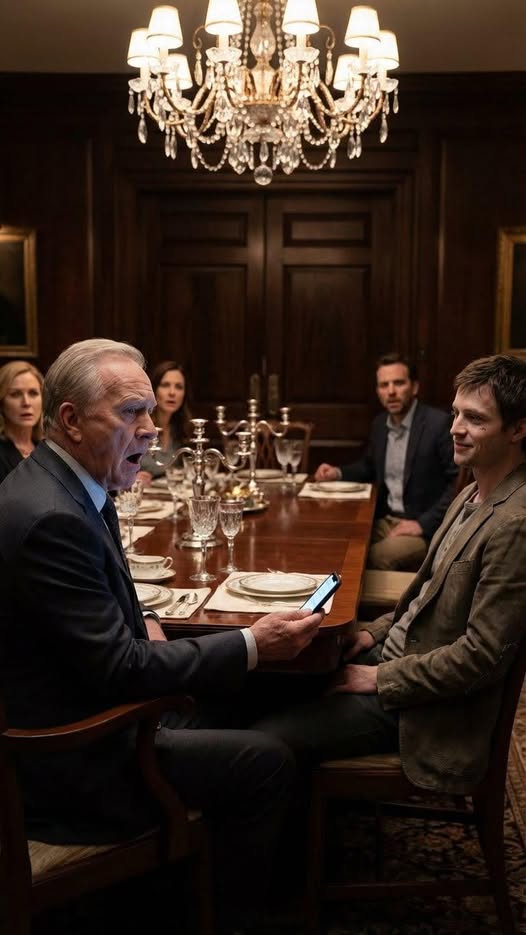
It was a cavernous space, dominated by a crystal chandelier that probably consumed more electricity than my entire house. The table was set for six. Richard sat at the head, naturally. His wife, Patricia, sat to his right. She was a woman who had long ago traded her voice for a life of comfort, her smile fixed and anxious. Marcus sat across from her, tapping furiously on his phone.
And there, at the far end of the table—the Siberian exile of the dining arrangement—were three empty seats for the disappointments.
“Catherine,” Richard said, standing up. He didn’t smile. “You look well.”
He turned his gaze to me. It slid over my face like I was a smudge on a windowpane. He didn’t nod. He didn’t speak. Thirty-seven years, and he still couldn’t bring himself to shake the hand of the man who loved his daughter.
Catherine kissed his cheek, a reflex of duty. I took my seat in silence.
“Where’s Claire?” Patricia asked, her voice fluttering. She was kind, in a vague, distracted way, but never kind enough to intervene when her husband sharpened his knives.
“She’s coming,” Catherine said, unfolding her napkin. “Client emergency. She’ll be here.”
Marcus snorted without looking up from his screen. “Typical. Some people just don’t understand the value of other people’s time.”
I bit my tongue. Marcus had never worked a real day in his life. His “sales” were deals Richard set up and let him sign. His “time” was valued at exactly what his father decided to pay him for breathing.
The housekeeper brought out the first course—French onion soup. It was the kind of meal designed to be difficult to eat quietly, a trap for the unrefined. We ate in a stilted silence, the only sound the clinking of silver against porcelain.
Then, the front door opened. Claire rushed in, breathless, her hair damp from the rain. She was still wearing her work clothes—comfortable slacks and a cardigan—and carrying an oversized bag stuffed with case files.
“Sorry I’m late,” she said, breezing past Richard to kiss her mother and squeeze my shoulder. “Crisis at the shelter. Someone lost their housing voucher.”
She took her seat. She didn’t apologize to Richard. That was my girl.
“Now that we are all assembled,” Richard said, setting down his spoon with a deliberate clatter. “I’ll get to the point.”
The air in the room changed. It grew heavy, charged with the static of imminent judgment.
“I am seventy-one years old,” Richard announced. “I built Hartwell Properties from dirt. I turned it into one of the premier firms in Ontario. But I am not going to live forever.”
Marcus leaned forward, his eyes gleaming with avarice. Catherine reached under the table and found my hand. Her grip was tight.
“It is time to formalize the succession,” Richard continued. “Marcus will take over as CEO when I retire next year. The transition creates a new hierarchy.”
Marcus tried to look humble and achieved a look closer to constipation. “I’m honored, Dad. Truly. I won’t let you down.”
“I know you won’t.” Richard turned his cold blue eyes toward Catherine and Claire. “This affects you as well. Patricia and I have updated our estate plans. When we pass, Marcus will inherit the controlling interest in the company. Catherine… you will receive a small percentage of non-voting shares. Perhaps five percent.”
I felt Catherine stiffen beside me. Five percent. After a lifetime of being the dutiful daughter, the one who actually remembered birthdays and visited hospitals, she was worth five percent.
“And Claire,” Richard said, shifting his gaze to his granddaughter. “You will receive a one-time cash settlement of $250,000.”
Claire didn’t blink. “Okay.”
“I considered making it contingent on you changing careers,” Richard added, a cruel smile touching his lips. “Get a real job. But your mother convinced me that would be… excessive.”
“How generous,” Claire said. Her tone was flat, but I knew her well enough to hear the razor blades underneath.
Richard missed the sarcasm entirely. He turned, finally, to me.
“And Thomas.”
The room went silent. Even the rain seemed to stop tapping against the glass.
“I assume,” he said, “that you have been unable to set aside significant funds for retirement, given your… employment history.”
“We’re comfortable,” I said quietly.
“Comfortable,” Richard repeated, tasting the word like sour milk. “Well, I’ve taken the liberty of arranging a position for you at Hartwell Properties. Entry-level facilities management. You’d be supervising the janitorial contractors.”
Marcus snickered.
“The salary is $35,000 a year,” Richard went on. “It’s not much, I know. But at your age, with your lack of transferable skills, you should be grateful for any employment. The pension benefits are adequate.”
The insult hung in the air, gross and heavy. He wasn’t just offering a job; he was offering humiliation. He was putting me in a uniform, asking me to clean up after his son.
Catherine’s chair scraped loudly against the floor. “Dad, Thomas doesn’t need—”
“It’s fine, Cat,” I said, squeezing her hand. I looked Richard in the eye. “Let him finish.”
“The position starts January 1st,” Richard said, looking pleased with his benevolence. “You’ll report to Marcus. I expect punctuality. Think you can manage that, Thomas?”
Thirty-seven years.
Thirty-seven years of walking into rooms and watching him turn away. Of listening to him apologize to guests for my presence. Of him treating my wife like damaged goods because she chose love over a ledger.
I had never wanted to do this. I had never wanted to flex the muscle I had spent decades building in the dark. But as I sat there, watching him throw scraps at me like I was a stray dog, something inside me clicked. The lock on the cage broke.
“That is very thoughtful, Richard,” I said. My voice was calm. eerily calm. “But I’ll have to decline.”
Richard’s eyebrows shot up toward his hairline. “Excuse me?”
“I’m not interested in the position.”
“Not interested?” Richard let out a sharp, barking laugh. “Thomas, you are sixty-three. You worked in a factory. You have no education. No leverage. I am throwing you a lifeline.”
“I appreciate the gesture. But I am quite comfortable with my current situation.”
Marcus jumped in, unable to help himself. “Tom, don’t be an idiot. This is a handout. Take it. Thirty-five grand is more than you’re worth.”
“I understand perfectly,” I said. “The answer is no.”
Richard’s face began to flush a dangerous shade of crimson. “Do you have any idea how many men your age would kill for this? You are being offered a chance to finally contribute to this family instead of being a parasitic burden on my daughter!”
“Richard, stop,” Patricia whispered.
“No! He needs to hear this!” Richard slammed his hand on the table. The silverware jumped. “Thirty-seven years, Thomas! Thirty-seven years of watching you drag Catherine down to your level! Living in that tiny, pathetic house! Driving that embarrassing car! And now, when I try to help you, you’re too proud to take it?”
Catherine stood up. She was trembling. “We’re leaving.”
“Sit down, Catherine!” Richard roared. “This doesn’t concern you!”
“Doesn’t concern me?” Her voice cracked. “You just insulted my husband. The man who has been more of a father to Claire than you ever were to me.”
“A father?” Richard sneered. “He couldn’t even provide for her! Do you know what the partners at the firm say? They laugh! They ask about my son-in-law, and I have to change the subject because I am ashamed!”
I stood up.
I moved slowly, deliberately buttoning my suit jacket. The dining room went deathly quiet.
“Richard,” I said. “I think there has been a misunderstanding.”
“There is no misunderstanding! You are an ungrateful—”
“Several misunderstandings, actually,” I interrupted, my voice cutting through his bluster like a diamond saw. “And it is time we cleared them up.”
“What are you talking about?”
I reached into my pocket and pulled out my smartphone. I tapped the screen once.
“I’m talking about Hartwell Properties,” I said. “Your empire. The one you built from nothing.”
“What about it?”
“That’s not exactly accurate, is it? You didn’t build it from nothing. You built it with considerable help from silent investors. Specifically, one investor who kept you afloat every time you were about to drown.”
Richard waved a hand dismissively. “We have institutional investors. That’s standard.”
“True. But one investor holds more shares than all the others combined. Forty-seven percent, to be exact.” I paused. “I’m curious, Richard. Have you ever wondered who that was?”
For the first time, a flicker of uncertainty crossed his face. The bully was sensing a shift in the wind. “That information is confidential. Blind trusts.”
“It is. But I can tell you who it is. Would you like to know?”
Marcus laughed nervously. “Tom, what are you doing? You’re embarrassing yourself.”
I turned my phone around and slid it across the polished mahogany table toward Richard.
“Check your email, Richard. It should have arrived about thirty seconds ago.”
He looked at the phone. Then he looked at me. Then, with a trembling hand, he reached for his own device lying next to his wine glass.
The subject line of the email was simple: NOTICE OF BENEFICIAL OWNERSHIP DISCLOSURE.
Richard went pale. It was a gray, sickly pallor that made him look all of his seventy-one years.
“What is this?” he whispered.
“That,” I said, “is a formal disclosure. As of this morning, Bennett Holdings Limited has filed the necessary paperwork with the Ontario Securities Commission to reveal its ownership stake in Hartwell Properties. Bennett Holdings owns forty-seven percent of your company, Richard.”
I leaned forward, placing my hands on the table.
“I am Bennett Holdings.“
Chapter 3: The Hostile Takeover
The silence that followed was absolute. It was a vacuum, sucking the air out of the room.
“That’s impossible,” Richard croaked.
“It’s not. I’ve been your largest shareholder since 2003. Before that, I held smaller positions going back to 1989.”
I began to list them. I didn’t need notes. I had memorized every dollar.
“The development in Markham in 2007? Funded with capital I approved. The office tower in Mississauga in 2012? My money. The shopping center in Burlington last year? Me. Every time you faced a cash flow crisis, my firm injected the funds.”
Marcus grabbed his father’s phone. He read the email, his eyes widening. “This is fraud! Tom doesn’t have this kind of money! It’s a scam!”
“Is it?” I pulled up another document on my phone—my banking app. I unlocked it and held it up for Marcus.
The number was green and long. $1,412,000,000.
“This is my portfolio, Marcus. Diversified investments in mining, tech, and renewable energy. Hartwell Properties represents approximately three percent of my total holdings. It’s a hobby investment.”
Catherine was staring at me. Her mouth was slightly open. She didn’t look angry. she looked stunned. “Thomas… why didn’t you tell me?”
I turned to her, softening my voice. “Because it didn’t matter, Cat. Money doesn’t change who we are. We were happy. We had everything we needed. I didn’t want this…” I gestured to the opulence around us. “I didn’t want this poison in our lives.”
“But you let him…” She pointed at her father. “You let him treat you like dirt.”
“I let him think what he wanted to think. His opinion was based on prejudice, not reality. Telling him I was rich wouldn’t have earned his respect; it would have just earned his envy.”
Richard found his voice again. “This is a trick. I would have known.”
“Would you? When was the last time you looked at the shareholder registry, Richard? Really looked at it? You assumed someone like me could never be someone like that. You were blinded by your own arrogance.”
I stood up straighter. The time for humility was over.
“The email you just received includes an invitation to an emergency board meeting tomorrow morning at 10:00 AM. As the majority shareholder, I am calling for a vote on the leadership structure.”
“You can’t do this!” Marcus shrieked. “Dad built this company!”
“He built it with my money, and he has been making increasingly poor decisions. The Oakville development is six months behind schedule. The expansion into Alberta was a disaster. And let’s not forget the sexual harassment lawsuits from three former female employees that the company settled quietly last year using my capital.”
Richard slumped in his chair. He looked deflated, a balloon pricked by a needle.
“You bastard,” he whispered. “I gave you a chance tonight.”
“A chance?” I laughed, harsh and dry. “Richard, I don’t owe you anything. You spent thirty-seven years making it clear I wasn’t good enough. Well, here is the truth: I have been subsidizing your lifestyle for two decades. That Tesla in the driveway? Dividends from my shares. This house? Refinanced in 2015 with a loan I approved. Your country club membership? Paid for by me.”
I looked at Marcus. “And you. You’ll be removed as VP of Sales pending a comprehensive audit of your actual performance versus the sales attributed to you by daddy.”
“We’ll sue you!” Marcus yelled.
“Sue me for what? Being a successful investor? Go ahead. My lawyers cost more per hour than you make in a month.”
I turned to Catherine and Claire. “I’m sorry you had to find out like this. I wanted to tell you, but the right moment never came. But I need you to know: would you have married me if you knew I was wealthy?”
Catherine wiped tears from her face. “Of course I would have.”
“Would you have stayed with me when he cut you off? When he made you choose?”
“Yes.”
“That’s why I didn’t tell you. I needed to know that we were real. That you chose me, not the bank account.”
She nodded slowly. “You’re right. I love you, Thomas. Rich or poor.”
I turned back to Richard. “I’m declining the janitor job. But I have a counter-offer. Resign. Gracefully. Tomorrow. Accept a consulting role. If you do that, I’ll ensure you keep your pension and your dignity. If you fight me, the board will vote you out, and I will make every failure of your tenure public record.”
I walked to the door. “We’re leaving now.”
Catherine and Claire followed me out into the rain.
Chapter 4: The Real Wealth
The drive home was quiet at first. The rain lashed against the windshield of the Corolla.
Finally, Catherine spoke. “$1.4 billion? Give or take?”
“Give or take,” I said.
“Our house is worth maybe five hundred thousand.”
“It’s worth a lot more than that to me.”
She started to laugh. Then she started to cry. Then she was doing both at the same time. “You really never cared, did you?”
“The money is a tool, Cat. It gives security. It lets me help people quietly. But it was never the point. The point was you. Claire. The Sunday mornings. The walks. That’s the real wealth.”
Claire piped up from the back seat. “So… what happens now?”
“Now,” I said, turning onto our street, “we see if your grandfather has any sense left.”
He did.
The next morning, at 8:00 AM, my phone rang. It was Richard.
“I’ll resign,” he said. His voice sounded old. “I’ll make the statement. But I need to ask… why wait? If you wanted revenge, you could have destroyed me years ago.”
“It wasn’t about revenge, Richard. It was about protecting my family. As long as you were just rude, I could take it. But last night… you showed Catherine she didn’t matter. You showed Claire she was a disappointment. That’s when silence stopped being an option.”
He paused. “For what it’s worth… I was wrong about you.”
“Yes,” I said. “You were.”
Richard resigned. Marcus was let go. We brought in a professional CEO, a woman with no family connections, and Hartwell Properties is thriving.
Catherine and I still live in the bungalow. We still drive the Corolla. But now, Catherine runs a massive scholarship fund for working-class girls. Claire opened a non-profit legal clinic for the homeless, funded entirely by an anonymous donor.
Sometimes, people ask me why I don’t buy a yacht or a mansion. They don’t understand.
Richard Hartwell spent his life chasing status, and he died a little inside every day. I spent my life chasing moments with the people I love.
I learned the difference between price and value a long time ago, in a drafty community center, from a girl serving coffee who made the winter feel like summer. And I’ve always known which one I’d rather be rich in.