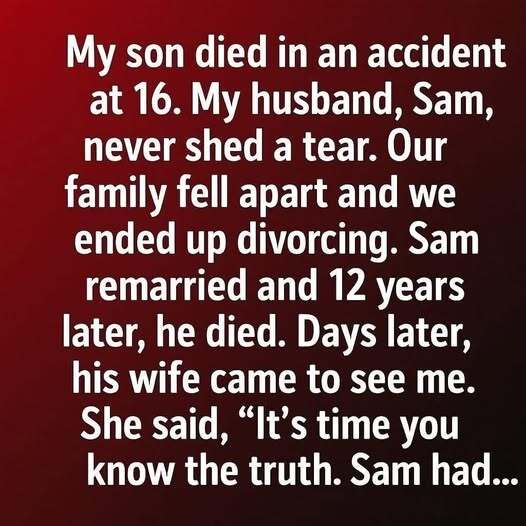
The day we buried our sixteen-year-old son, the world lost its color, but my husband, Sam, seemed to lose his humanity. While I was a jagged coastline of grief, constantly being eroded by waves of sobbing and disbelief, Sam was a monolith. He stood at the funeral with a posture so rigid it looked painful, accepting condolences with a distant, polished politeness that felt like an insult to the chaos in my heart. He didn’t cry. He didn’t tremble. Most unforgivably, he didn’t reach for me.
In the months that followed, the silence in our home became a predatory thing. It didn’t just sit there; it consumed. It ate the space where our son’s laughter used to be, and it swallowed the bridge of communication that had held our marriage together for two decades. I begged Sam to break. I pleaded with him to scream, to throw a plate, to admit that the world was ending. I needed his pain to validate mine. But he remained a fortress, his face an unreadable mask of stoicism. He went to work, he ate his meals, and he slept on his side of the bed as if he were merely waiting for a storm to pass, rather than living in the wreckage of one.
His composure felt like a betrayal. I began to view his silence as a lack of depth, and his lack of tears as a lack of love. Our family unraveled with a heartbreaking speed. Within a year, the “empty nest” we never asked for became two separate lives. Sam moved out without a fight, and not long after, I heard he had remarried.
The news of his new life acted as the final seal on my resentment. I convinced myself that Sam was a shallow man, someone who could simply replace a lost child and a discarded wife with a newer, less burdened model. For twelve years, I carried this bitterness like a shield. I visited our son’s grave every Sunday, meticulously tending to the grass and talking to the headstone, fueling my identity as the “only one” who truly remembered, the only one who truly cared. I lived in the past, while Sam, it seemed, had sprinted into a bright, unencumbered future.
Then, the phone rang. Sam was gone—a sudden heart attack at fifty-four.
At first, I felt a hollow, shameful sense of vindication. I expected to feel nothing, or perhaps just the quiet satisfaction of a grudge that no longer had an opponent. But a few days after the funeral—which I did not attend—Sam’s second wife, Claire, appeared at my door. She looked exhausted, her eyes swollen and mapped with red veins, holding a small wooden box bound with a simple leather cord.
“I think it’s time you understood,” she said, her voice barely a whisper. She handed me the box and left without another word.
I sat at my kitchen table, the same table where Sam and I used to help our son with his geometry homework, and I pulled the cord. Inside were hundreds of envelopes. They weren’t organized by date; they were stuffed in with a desperate, overflowing energy. Every single one was addressed to our son.
I opened the one on top. The handwriting was Sam’s—the familiar, slanted script that used to write out grocery lists and birthday cards.
“Hey, Kiddo,” it began. “I saw a boy today wearing a jersey just like yours. For a second, I forgot. I started to call your name across the parking lot. My lungs actually hurt when I had to pull the breath back in. Your mom is mad at me again. She thinks I don’t feel this. She doesn’t understand that if I let even an inch of this out, I will never be able to stop. I have to stay upright for her. If we both go down, who is left to hold the memory? I’m so sorry I’m not better at this.”
I felt the first sob catch in my throat, a physical lump that burned. I reached for another letter, dated three years later.
“You would have been nineteen today. I bought a cupcake and sat in the car behind the stadium where you used to play. I sang ‘Happy Birthday’ so softly I could barely hear myself. Claire asked why I was late for dinner. I told her it was traffic. I can’t tell her about you, son. Not because I don’t want to, but because talking about you makes you dead all over again. As long as I keep the words inside, you’re still just in the other room.”
I read for hours. I read through twelve years of secret anniversaries, unspoken apologies, and descriptions of mundane days Sam wished he could have shared with his boy. He wrote about the way the light hit the trees in autumn, the songs he heard on the radio that reminded him of their fishing trips, and the crushing weight of a grief that had no outlet.
Sam hadn’t moved on. He had been living in a private purgatory. Claire later told me that for over a decade, Sam would wait until the house was entirely silent, until he was sure she was deeply asleep, and then he would go into his study and weep until he was physically ill. He would write his letter, lock it in the box, wash his face with cold water, and emerge the next morning as the “composed” man the world expected him to be.
His second marriage wasn’t an escape; it was a desperate attempt at a life raft. He had been drowning in the middle of a crowded room for twelve years, and I had been standing on the shore throwing stones at him, calling him heartless because he didn’t drown the same way I did.
The bitterness that had defined my life for over a decade evaporated, replaced by a grief so heavy it felt like it might collapse my lungs. I realized that my insistence on a visible, loud mourning had blinded me to the profound, quiet agony of the man I had loved. Sam’s silence hadn’t been an absence of pain; it had been the absolute maximum capacity of it. He was a man holding a door shut against a flood, terrified that if he let a single drop through, the entire world would be swept away.
I spent the rest of the night with those letters spread across the table, a paper trail of a father’s unbroken heart. For the first time in twelve years, I didn’t feel like the only person who remembered. I felt Sam’s presence in the room, not as the “indifferent” ex-husband, but as the grieving father who had stayed in the trenches of loss until the very second his heart finally gave out.
I realized then that healing doesn’t always look like moving forward. Sometimes, it looks like looking back and realizing that the people we thought had abandoned us were actually walking right beside us in the dark, carrying a burden we were too blinded by our own light to see. Sam was gone, but through his hidden words, he had given me the one thing I had begged for all those years ago: he had finally let me grieve with him.