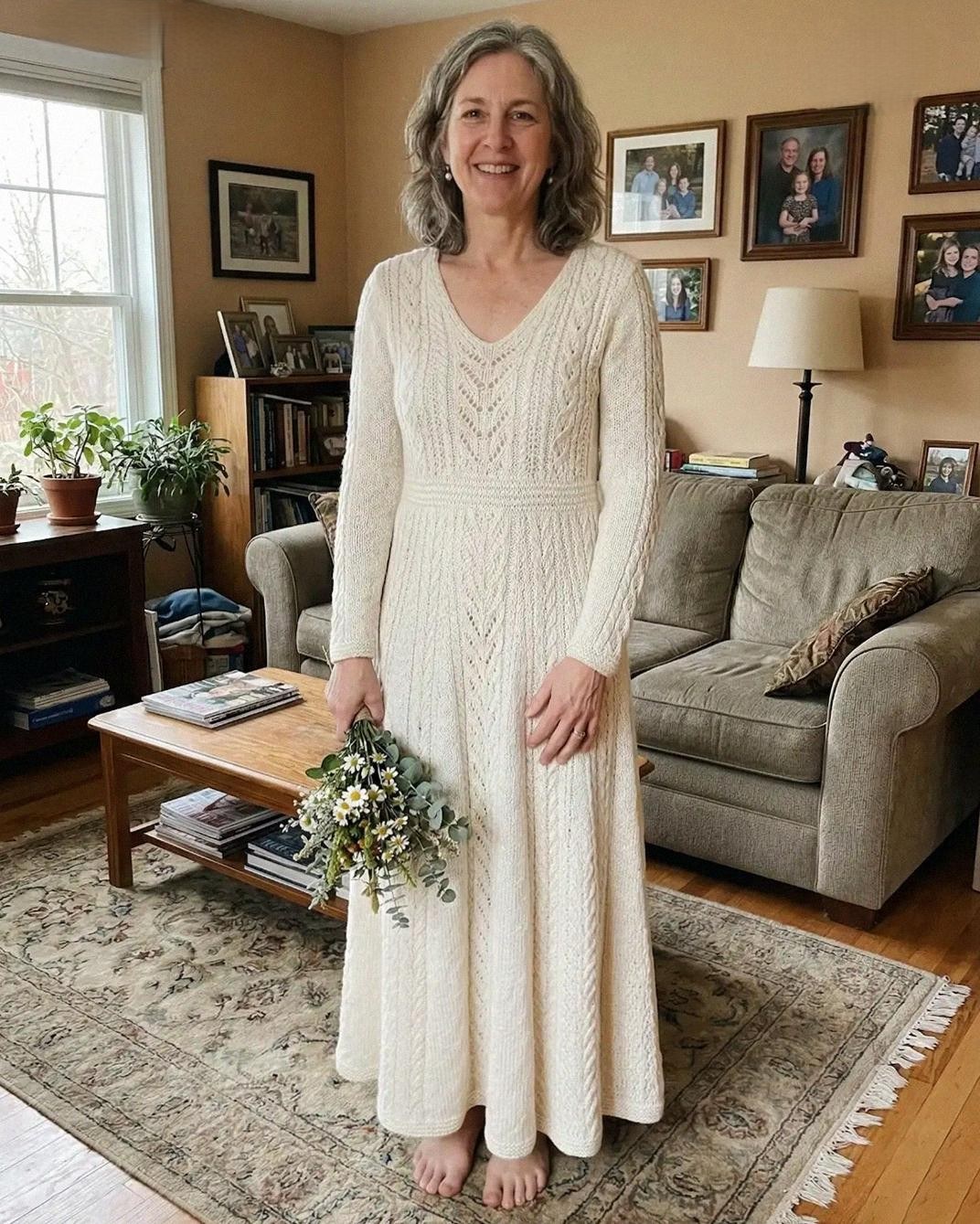
I spent almost a year secretly knitting my wife’s wedding dress for our 30th-anniversary vow renewal. It was a project born in the quiet sanctuary of my garage, fueled by a desperation I couldn’t put into words and a devotion I hoped the yarn could carry for me. Most people in our town saw me as the quiet type—Tom, the guy who fixes your leaky pipes or jump-starts your car in a blizzard without asking for a dime. I was “handy,” maybe a little “old-fashioned.” But to Janet, I was simply the man who had stood by her through three children and a year of an illness that had threatened to steal her away from me.
The idea took root when Janet was at her lowest. During the months of her treatment, when her headscarf would slip and her cheeks were the color of winter ash, I felt helpless. I couldn’t fix her cells, so I decided to fix my focus on something I could control: a tribute to the life we had built. I had learned to knit from my grandmother as a boy, a skill I’d kept sharp by making scarves and the occasional sweater vest. But a wedding dress? That was a different mountain entirely.
For months, the garage was my workshop. I’d wait until Janet was asleep or resting, then slip out to the clack-clack-clack of my needles, the sound rhythmic and soothing like a heartbeat. Every row of that ivory silk-blend yarn was a record of my hopes. I hid our children’s initials—Marianne, Sue, and Anthony—into the intricate lace of the hem. I borrowed a scallop pattern from Janet’s original 1996 wedding veil, a detail I was certain she had forgotten, and integrated lace that matched the very first curtains we’d bought for our cramped first apartment.
When my son, Anthony, caught me one afternoon, he just stared at the sea of ivory wool. “Dad, are you knitting a giant blanket?” he asked. I didn’t correct him. “Something like that,” I muttered. He called it a “weird flex” and walked away, but I knew that every stitch was a lifeline I was throwing out to a future where Janet was healthy enough to wear it.
Two months before the anniversary, Janet was finally in the clear. Over a quiet dinner, I asked her if she’d marry me again. She laughed, that beautiful, familiar sound that I had feared I’d never hear again, and said, “In a heartbeat.” When she started scrolling through designer websites for a dress, I knew it was time. I laid the garment across our bed—a delicate, weightless creation of lace and love. She ran her fingers over the initials in the hem and whispered, “You made this?” I told her she didn’t have to wear it if it wasn’t what she pictured. She pressed a hand to my cheek and said it was the only thing she would ever consider wearing.
The ceremony was a dream—sunlight filtering through the trees, our children standing tall, and Janet glowing in a way that had nothing to do with the silk and everything to do with her spirit. But the reception in the rented community hall was where the air changed.
It started with my neighbor, Carl, who joked about me trying to set a new “D.I.Y. trend.” I laughed it off, as I always do. But then my cousin Linda’s voice rang out across the room, sharp and uninvited. “A toast to Janet!” she cried, her glass raised high. “For being brave enough to wear something her husband knitted. I mean, it’s true love, because that dress is… well, it’s certainly ‘homemade,’ isn’t it?”
The room erupted. It was that awkward, cascading laughter that happens when people think they’ve been given permission to be cruel under the guise of “just teasing.” My brother-in-law, Ron, chimed in next. “Tom, did you run out of money? Did the yarn store have a closing-down sale, or were you just trying to save for the honeymoon?”
I felt the heat rise in my neck. These were people who had sat at my table, people whose basements I’d pumped out during floods, people who knew us. I looked down at my hands—the hands that had pricked and bled and cramped to make that dress—and felt a wave of humiliation. I tried to make a joke about the kitchen not being safe if I’d tried to bake a cake instead, but the laughter only got louder. Linda leaned in, asking Janet how much I’d “bribed” her to wear it.
Janet’s smile didn’t just fade; it transformed. She straightened her shoulders, her silhouette appearing regal in the very lace they were mocking. She reached for the microphone, and as she stood up, the room’s volume stumbled into a confused silence.
“You’re all laughing because it’s easier than acknowledging what this dress actually represents,” Janet said. her voice didn’t shake; it resonated. “Tom made this dress while I was fighting for my life. While I was too tired to even brush my own hair, he was in the garage, knitting hope into every single row. He thought I didn’t know, but I heard the needles. I heard the love.”
The silence in the hall became heavy, the kind that makes you hear your own heartbeat. Janet looked directly at Linda, then at Ron. “You call Tom when your cars won’t start. You call him when your pipes burst at midnight. He always shows up, and he never asks for recognition. He almost missed Sue’s birth because he was helping you with your plumbing, Linda. He’s the man who shows up for everyone, yet you think his kindness makes him a target for your jokes.”
She traced the lace at her waist. “You see yarn. I see our first apartment. You see a hobby. I see the initials of our three children hidden in this hem. You see ‘unflattering.’ I see a man who remembered the pattern of my mother’s veil from thirty years ago and recreated it with his own two hands because he wanted me to feel beautiful when I thought I was at my most broken.”
Linda’s face was the color of a beet. Ron suddenly found his wine glass very interesting. Janet didn’t stop. “What’s embarrassing today isn’t this dress. What’s truly embarrassing is being in a room full of people who are happy to receive a man’s labor but have no idea how to respect his heart.”
She set the microphone down. The silence lasted for what felt like an eternity until Mary, our old friend at the piano, began a slow, rhythmic clap. One by one, the guests joined in—not the raucous laughter from before, but a somber, respectful tribute. Anthony stood up and hugged me, his jaw tight with pride. “Nobody’s ever done anything that beautiful, Dad,” he whispered.
Janet walked over to me, took my hand, and whispered, “Dance with me, Tom.” We moved to the center of the floor, and as the music started, I felt the ivory silk against my hands—the material I had worried over for a year. It felt like the strongest substance on earth.
Later that night, at home, the house was filled with a peace that surpassed anything we’d felt in years. Janet carefully folded the dress into a pale tissue-lined box. She traced the tiny “M, S, and A” one last time. “Did you ever think we’d make it thirty years?” she asked. I kissed her forehead and told her I’d do every single day of it over again, even the hard ones.
People often look for love in grand gestures that can be bought or displayed. But that night, I realized that real love isn’t a purchase; it’s a million tiny, intentional stitches. It’s showing up when the world is laughing, and it’s building something beautiful out of nothing but a little bit of yarn and a whole lot of “forever.”