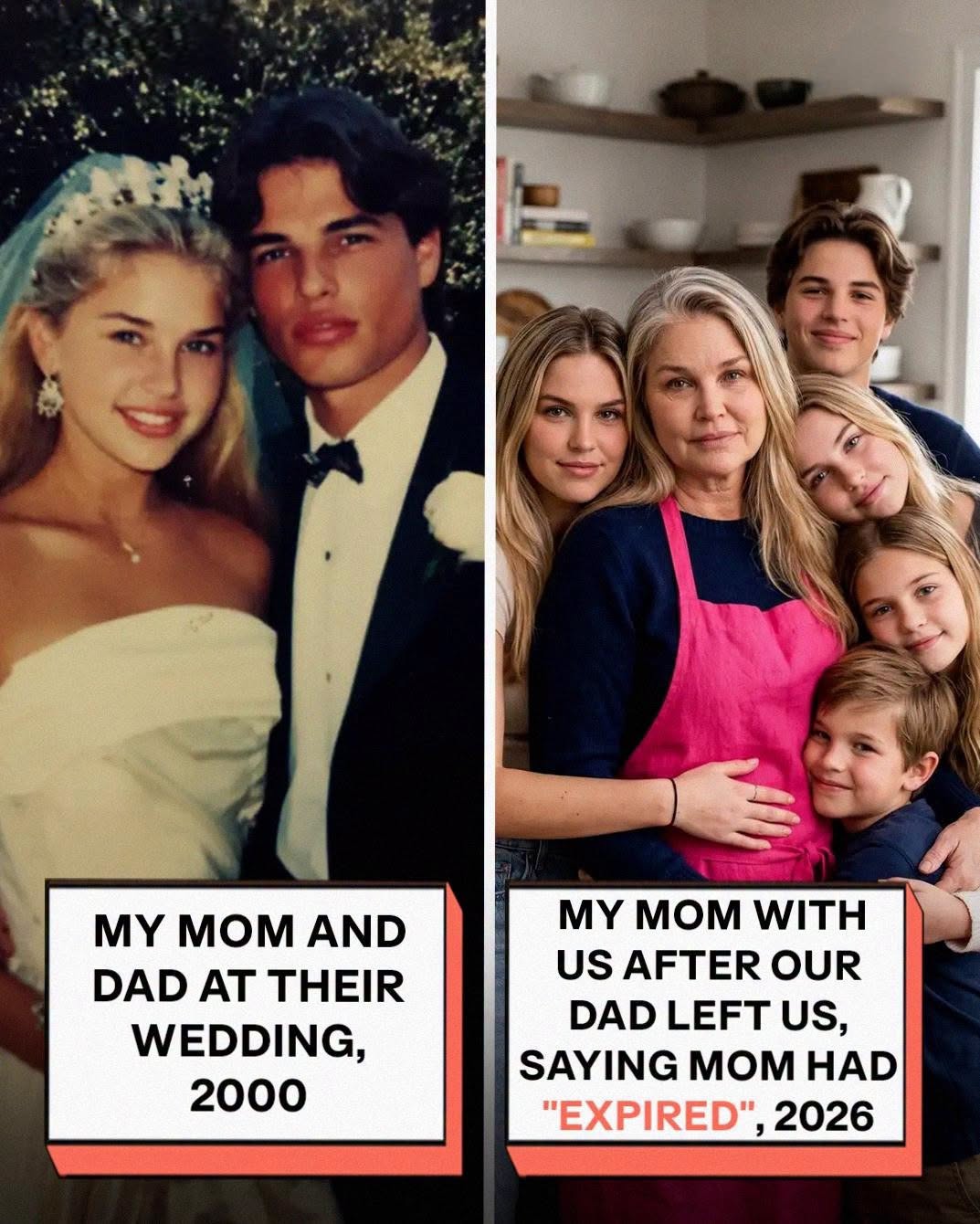
At my mother’s forty fifth birthday party, my father decided to perform a public execution of our family unit. All five of us kids were gathered around the dining table, a scene of domestic warmth that my mother had spent decades cultivating. My father sat at the head of the table, his shirt pressed with a precision that bordered on clinical. He had always been obsessed with appearances, viewing his family not as a living, breathing group of people, but as a collection of accessories that reflected his own perceived success. We had just finished singing to Mom—a simple, homemade celebration that she had insisted on—when Dad stood up, holding a folder wrapped in a festive ribbon. We smiled, expecting a surprise trip or a heartfelt gift. Instead, he raised his glass and delivered a speech that would haunt us for the rest of our lives. He told my mother that time changes things and that, unfortunately, she had reached her expiration date. He looked her in the eye and stated that he deserved someone who matched his own well preserved appearance, then slid the divorce papers across the table like a business contract.
The shock was absolute. In one breath, he had dismissed twenty years of shared history, five children, and a woman who had sacrificed her body, her sleep, and her career to build the life he demanded. He left that very night, packing a suitcase and stepping over the wreckage of his children’s lives without a second glance. Within weeks, he was a ghost on social media, haunting our feeds with photos of a woman named Tessa, who was barely older than I was. He whitened his teeth, bought a wardrobe that screamed midlife crisis, and frequented rooftop bars and beach resorts, documenting every hollow moment of his new “unexpired” life. Meanwhile, my mother was left to navigate the silence of a house built for seven. For a long time, she was a shell of herself, moving through the motions of motherhood with a blank, terrifying stillness. I watched her set the table for seven out of habit, only to realize with a jolt of fresh grief that the head of the table was now permanently empty.
But as the months passed, a shift occurred. It started when we, her children, stopped letting her carry the weight alone. When she mentioned a lawyer, my sister Nora grabbed the keys and refused to let her go alone. When she felt the sting of Dad’s digital betrayal, we were the ones who blocked his accounts for her. My mother eventually took a part time job with a local catering company, a move she initially viewed as a temporary distraction. But the owner, who recognized my mother’s innate ability to keep a kitchen moving with the efficiency of a general, soon put her in charge of entire wedding receptions. My mother began to change, but not in the way my father had predicted. She cut her hair, bought shoes that were for her own comfort rather than his approval, and began to build a financial and emotional independence that did not revolve around being “chosen” by a man. She was rebuilding her life on a foundation that was finally her own.
A year after the birthday that broke us, the phone rang. It was my Aunt Lydia, Dad’s sister, and her voice was shaking with a mixture of pity and frustration. She told us we needed to come to her house immediately. The drive was silent; we didn’t know if he was sick, injured, or simply crawling back. When we arrived, Lydia gestured toward the living room with a look of grim exhaustion. She explained that my father had spent the last twelve months obsessed with his own reflection. Every penny he had, every credit card limit he possessed, had been thrown at surgeons and dermatologists who promised to erase the passage of time. He had undergone hair restorations, skin tightenings, and experimental injections, chasing a fountain of youth that turned out to be a mirage. To make matters worse, Tessa had vanished the moment the money ran dry and the luxury vacations stopped.
When we stepped into Lydia’s living room, I genuinely did not recognize the man sitting in the recliner. His face was a map of vanity’s failures. His skin was pulled unnaturally tight around his mouth, his eyes were skewed by botched lifts, and his cheeks were a strange combination of artificial smoothness and sagging despair. He looked less like a man who had found youth and more like a man who had been dismantled and poorly put back together. He stood up when he saw Mom, his voice trembling as he tried to invoke the “us” he had so casually discarded a year prior. He spoke of mistakes and starting over, clearly expecting my mother to fall back into her role as his emotional safety net. He believed that because she had spent twenty years adjusting her world to fit his, she would do it one last time now that he was broken.
But the woman standing in that room was not the woman he had left. My mother didn’t scream, and she didn’t cry. She looked at him with a fierce, clinical clarity. She told him that there was no “us” left to discuss. She pointed out the hollow truth of his departure: he hadn’t left because she had expired; he had left because he was terrified that he eventually would. He had chased a version of himself that didn’t exist, and in the process, he had become a stranger to his own children and a caricature of the man he thought he was. He sat there in the wreckage of his own vanity, a small, foolish man with no script left to follow and no image left to maintain.
My mother drew a long, slow breath and told him that she hoped he survived the choices he had made, but she was not part of his solution. She turned and walked out of that house, her head held high, followed by all five of us. Outside, the night air was sharp and clean, a stark contrast to the stifling atmosphere of my father’s regret. My mother stood by the car for a moment, looking up at the sky with a smile that was the strongest thing I had ever seen. For the first time in my life, she wasn’t a wife, a caretaker, or an “expired” asset. She was a woman who had survived the worst thing a person can say to another, and she had come out on the other side whole. She had the last laugh not because he had failed, but because she had finally stopped needing him to succeed.