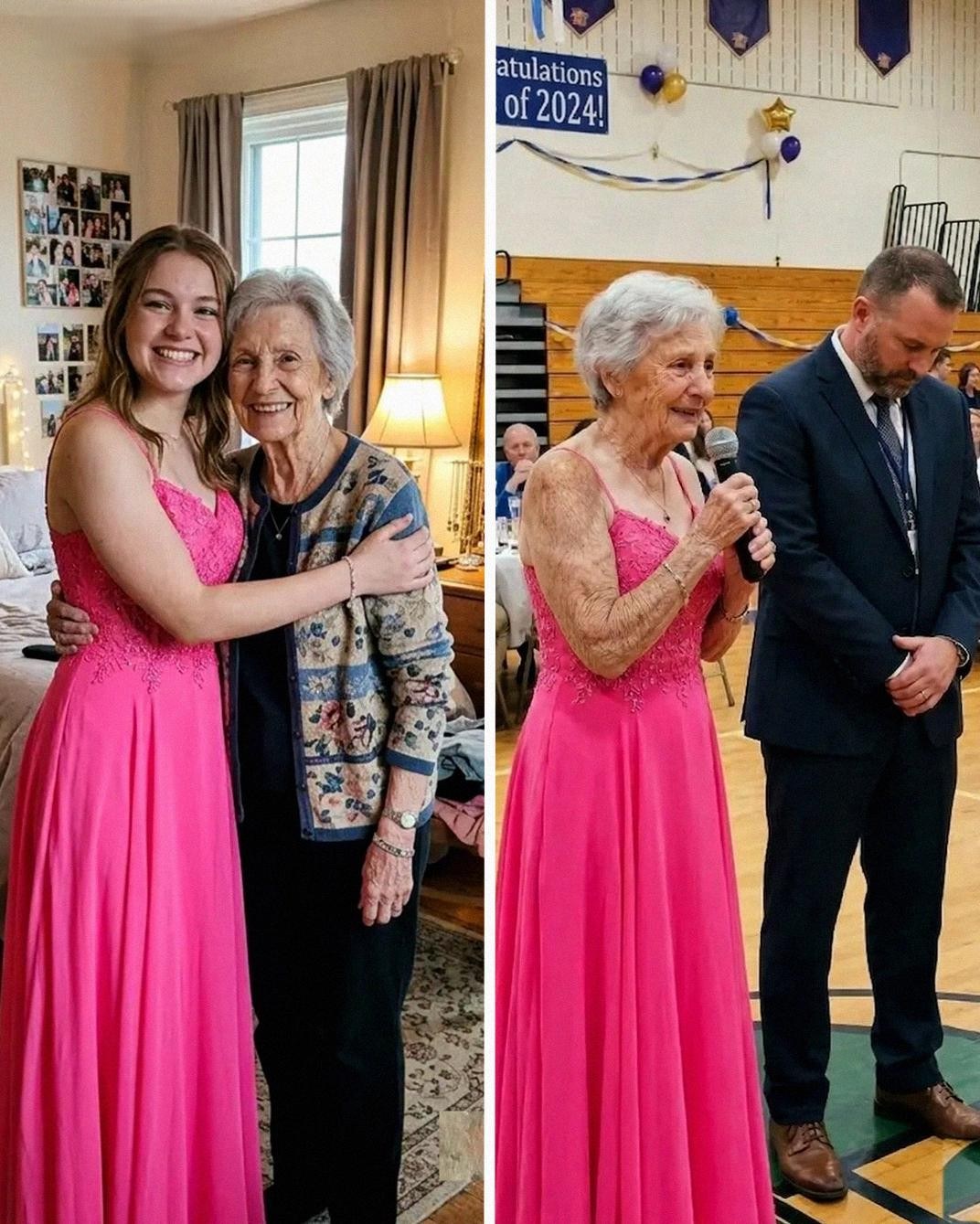
The arrival of my granddaughter Gwen’s prom dress on my front porch felt less like a delivery and more like an intrusion of grief. It appeared the day after we had laid her to rest, a cardboard box that held the physical manifestation of a future she would never inhabit. I carried it inside with trembling hands, setting it on the kitchen table where we had spent nearly a decade navigating the world together. For seventeen years, Gwen had been my singular focus. After her parents—my son David and his wife Carla—perished in a car accident when she was just eight, we became a closed circuit of two. I remembered sitting on the edge of her bed during those first dark months, my knees aching as I held her hand until sleep claimed her. Even then, as a child, she had tried to be my anchor, promising me we would figure everything out together.
We did figure it out, but our time was cut short by a tragedy that felt fundamentally impossible. The doctors called it an undetected rhythm disorder, claiming that stress and exhaustion had finally caused her heart to simply stop. In the weeks following her death, those words—stress and exhaustion—haunted me. I scrutinized every memory, searching for the signs of fatigue I must have missed. I felt the crushing weight of failure, convinced that I had been blind to my granddaughter’s suffering while she lived under my own roof.
When I finally summoned the courage to open the box, I found a garment of ethereal beauty. It was a shimmering fabric that captured the light like water, a dress she had spent months describing to me during our dinner conversations. To Gwen, prom wasn’t just a high school dance; it was a milestone of survival and a celebration of making it through the “terrible” parts of adolescence. Two days later, a strange, quiet impulse took hold of me. I stood in the living room, staring at the dress, and wondered if there was a way for Gwen to still go to prom. It was a gesture born of grief, a way to bridge the gap between the living and the dead.
I tried the dress on, expecting to feel a deep sense of absurdity. Instead, as the fabric settled against my shoulders and the skirt swirled around my ankles, I felt a sudden, electric proximity to Gwen. It was as if she were standing just behind me in the mirror, her phantom hand on my shoulder. It was in that moment that I made a decision that many would find eccentric, perhaps even macabre: I would attend her prom in her place, wearing her dress, as a final act of devotion.
On prom night, I pinned up my gray hair, put on my best pearl earrings, and drove to the high school. Walking into the gymnasium was like entering another world—one of glittering streamers, pulsing music, and the vibrant, chaotic energy of youth. My presence caused an immediate ripple of silence. Teenagers stared, and I heard the hushed whispers of “Is that someone’s grandma?” drifting through the air. I kept my head high, whispering to myself that this wasn’t for me, but for Gwen. She deserved to have this dress seen under these lights.
I was standing near the wall, observing the room, when I felt a sharp prick against my left side. I shifted, but the sensation remained—a persistent, localized irritation near my ribs. I slipped into the hallway and pressed my hand against the lining of the dress. There, hidden beneath the shimmering fabric, was a stiff, flat shape. I worked my fingers along the seam until I found a small opening, reaching inside to pull out a folded piece of paper.
I recognized the handwriting instantly. It was the same script that had filled countless grocery lists and birthday cards. It was a letter from Gwen, and the first line nearly caused my knees to buckle: “Dear Grandma, if you’re reading this, I’m already gone.”
I leaned against the hallway wall, my breath hitching as I read the words my granddaughter had hidden with such meticulous intent. She wrote that she knew I would be hurting, and she knew I would be blaming myself. She confessed that she had fainted at school weeks prior and that a doctor had warned her about her heart. But she had kept it from me. She had hidden the appointments, the tests, and the fear because she couldn’t bear to see me frightened. She knew I had already lost my son and his wife, and she didn’t want the last months of our life together to be shadowed by the looming specter of another loss.
Gwen had shouldered the burden of her own mortality alone to protect my peace. She had asked the dressmaker to sew the note into the lining, knowing that if she didn’t make it to prom, I was the only person who would ever cherish the dress enough to find it. “If I can’t be at prom,” she wrote, “the person who gave me everything should be.”
With the letter clutched in my hand, the grief that had felt like a leaden weight transformed into a sharp, clear mission. I walked back into the gymnasium, straight down the center aisle, and up to the stage where the principal was speaking. I gently took the microphone from his hand, my face set with a resolve that silenced the entire room. I told the sea of faces about Gwen. I told them about the shimmering dress she should have been wearing and the secret she had carried. I read her words aloud—her gratitude for the woman who had raised her and her wish for me to be the one to represent her at the finish line of her high school career.
The gymnasium, once a place of noisy celebration, became a cathedral of silence. Students wiped away tears, and parents stood in somber stillness as Gwen’s voice filled the room through my own. I realized then that I hadn’t come to prom to honor her; she had orchestrated this entire night to honor me. She had ensured that her final message to the world was one of love and selflessness, a legacy far more enduring than a shimmering skirt or a silver streamer.
The next morning, the dressmaker called to confirm what I had already discovered. She told me Gwen had visited the shop a few days before her death, insisting that the note be hidden where only I would find it. When I hung up the phone and looked at the dress hanging over the chair, the “stress and exhaustion” that had haunted me finally made sense. It wasn’t my failure; it was her strength. She had been braver than I ever imagined, navigating the end of her life with a grace that surpassed her years. Gwen was gone, but through that hidden letter, she had given me the one thing I needed most: the permission to stop blaming myself and the knowledge that, in our nine years together, we really had figured everything out.