Hannah was twenty-six years old when the final echoes of her uncle’s funeral faded, leaving the house draped in a silence that felt fundamentally different from any she had known. It was a heavy, stagnant quiet, the kind that signals the absolute end of an era. As the mourners dispersed, Mrs. Patel, their neighbor of two decades, approached Hannah. Her eyes were red-rimmed, her hands trembling as she pressed a thick, sealed envelope into Hannah’s lap. “Your uncle asked me to give you this only after he was gone,” the older woman whispered. “And Hannah? He wanted me to tell you he’s sorry.”
Hannah clutched the paper, her mind reeling. Sorry for what? Uncle Ray had been the architect of her entire world. She had been unable to walk since the age of four, a reality she had long ago accepted as the tragic fallout of the car accident that claimed her parents, Lena and Mark. Her memories of them were fragmented but vivid: the scent of her father’s peppermint gum and motor oil, her mother’s off-key singing in the kitchen, and her own pair of light-up sneakers that she’d worn with such pride.
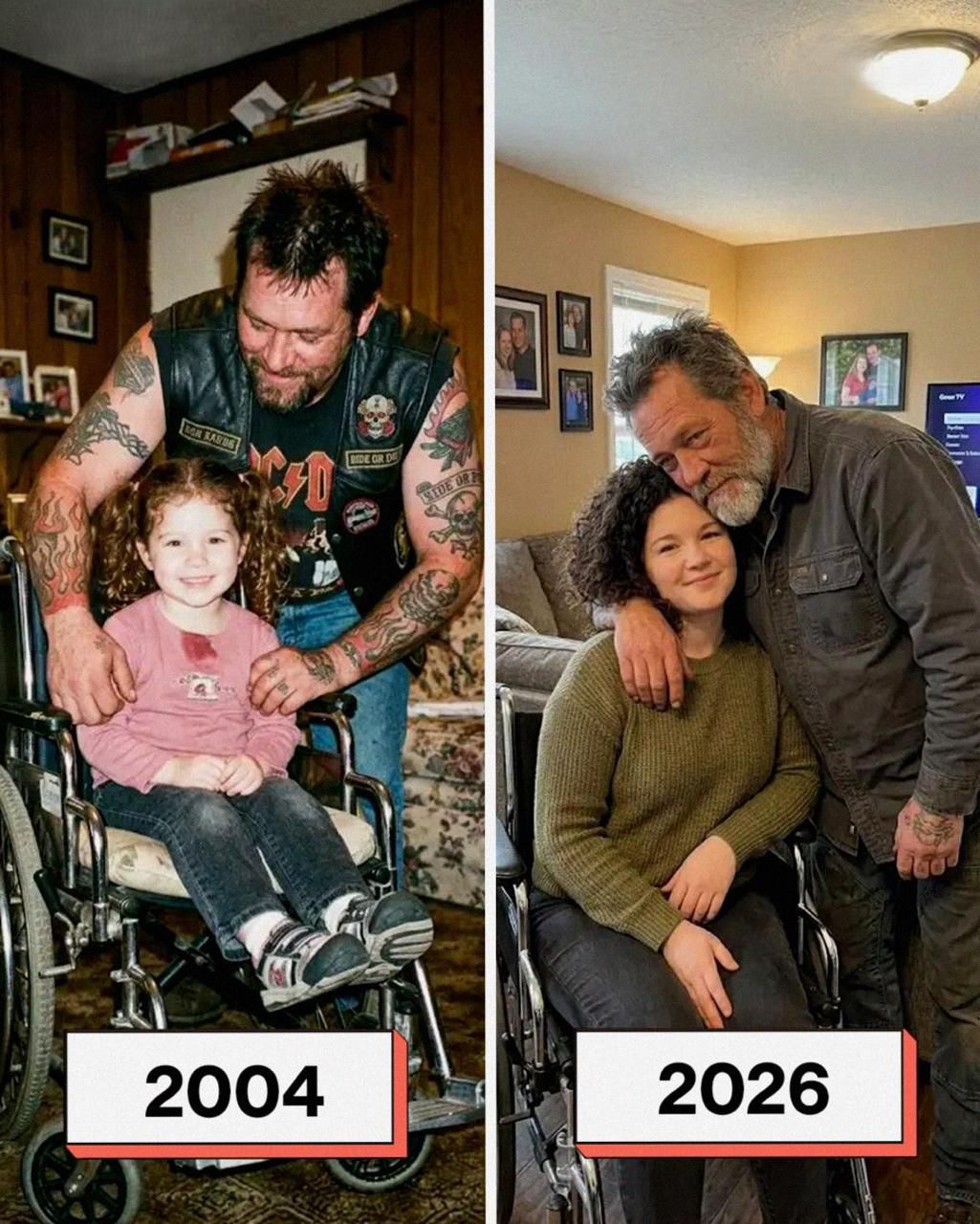
The story she had been told was a simple, brutal narrative of loss. After the crash, a social worker named Karen had stood by Hannah’s hospital bed, speaking in soft, clinical tones about foster care and “appropriate placements” for a child with such significant spinal injuries. Then, Ray had stormed into the room. He was a man built like a fortress—shoulders shaped by heavy labor and a face etched with a permanent, weathered frown. He didn’t ask permission; he issued a decree. “I’m taking her,” he had told the state. “She’s family. She’s mine.”
Ray had no experience with children, let alone a paralyzed four-year-old, but he brought her home to a house that soon became a makeshift sanctuary. He learned the logistics of her care with a terrifyingly focused intensity. He copied the nurses’ movements with surgical precision, filling a beat-up notebook with observations on how to lift her without causing pain, how to check for pressure sores, and how to reposition her fragile body. In those early years, Ray was a man possessed. He set his alarm for every two hours, shuffling into her room with sleep-deprived eyes to gently turn her. “Pancake time,” he would mutter, his rough hands moving with unexpected tenderness. When she cried, he didn’t offer empty platitudes; he simply whispered, “I’ve got you, kiddo.”
He was her fierce advocate in a world that wasn’t built for her. Ray constructed a plywood ramp over the front porch steps with his own hands. He spent hours on the phone with insurance companies, his voice rising in gravelly indignation whenever they denied a piece of equipment she needed. On the playground, when other children stared, Ray would crouch down and explain the mechanics of her injury with a blunt, respectful honesty that stripped away the stigma. He braided her hair with thick, clumsy fingers and learned the nuances of teenage girlhood through YouTube tutorials, determined that she would never feel “less than” because of her chair.
But then, the man who had always been a mountain began to crumble. At fifty-three, Ray began to slow. He would sit on the stairs to catch his breath; he burned meals he had made for years. When the diagnosis came—Stage IV cancer, already too far gone—the roles reversed. Hospice moved in, and Hannah watched the man who had carried her through life wither into the chair beside her bed. The night before he died, he looked at her with an expression of profound, aching regret. “I’m sorry,” he had whispered. “For things I should have told you a long time ago.”
Now, sitting in the hollowed-out remains of their home, Hannah broke the seal on the letter. The first line hit her with the force of a physical blow: “Hannah, I’ve been lying to you your whole life. I can’t take this secret with me anymore.”
The letter detailed the night of the accident, but it wasn’t the sanitized version she knew. Her parents hadn’t just been out for a drive; they had come to Ray’s house to drop Hannah off permanently. They were moving to a new city for a “fresh start” and had told Ray that they weren’t taking her with them, claiming their lives were too chaotic for a child. A violent, screaming match had ensued. Ray had called his sister selfish and his brother-in-law a coward. He knew Mark had been drinking, but in his blind rage, he didn’t take the keys or call a cab. He let them drive away angry because he wanted to win the argument.
Twenty minutes later, the car wrapped around a telephone pole. “When I saw you in that hospital bed,” Ray wrote, his handwriting jagged and uneven, “I saw my own pride and temper staring back at me. Taking you home was the only right choice I had left, but I spent every day since trying to pay a debt that could never be settled.”
The letter revealed that the money they had lived on wasn’t just his wages as an electrical lineman. He had hidden her parents’ insurance payout in a trust so the state couldn’t touch it, working dangerous double shifts to ensure she would eventually have enough to leave the room he had built for her. He had sold the house to fund her future, begging her in the final lines to forgive him—not for his peace, but so she wouldn’t have to carry his ghost.
Hannah sat in the silence for hours, the weight of the truth threatening to crush her. Ray was the reason her parents were dead, yet he was the only reason she was alive. He had spent twenty-two years punishing himself, transforming his guilt into wheelchair ramps, braided hair, and a basil planter box outside her window. He had walked directly into his mistake every single day for over two decades.
A month later, Hannah used the trust to enroll in a specialized, high-intensity rehabilitation center. Her physical therapist, Miguel, was blunt: the process would be brutal. Hannah didn’t flinch. “I know,” she said. “Someone worked a lifetime so I could be here. I’m not wasting it.”
The first time they strapped her into the harness over the treadmill, her legs buckled. Her knees shook, and tears of frustration blurred her vision. But in her mind, she heard Ray’s voice—the steady, gravelly command he’d used when she felt defeated. Last week, for the first time since she was four, Hannah stood. It was only for a few seconds, and her body trembled under the strain, but she was upright. She felt the solid, unforgiving floor beneath her feet.
Hannah’s forgiveness for Ray isn’t a simple, static thing. On some days, the anger burns hot, a resentment for the pride that cost her a mother and father. But on most days, she remembers the calloused hands that lifted her, the “you’re not less” speeches, and the man who turned his life into a living apology. Ray had carried her as far as his strength allowed; now, Hannah realizes, the rest of the journey is hers to walk. For the first time, the silence in the house doesn’t feel like an end, but a beginning.