My name is Adeline Spencer. I am twenty-five years old. And last month, my grandmother handed me a sealed envelope that didn’t just reveal a secret; it detonated the entire architecture of my reality.
For as long as my memory serves, my parents referred to me with a phrase that sounded benign to outsiders but felt like a quarantine to me: adopted in spirit. It was their shorthand for why my brother received galas for his birthdays while I received chore lists. It explained why he was gifted a car while I was gifted silence. It was the reason he was celebrated as the second coming, while I was treated like a ghost haunting the hallways of my own home.
I believed them for twenty-five years. I believed that my biology was the barrier to their love. I believed I wasn’t really theirs.
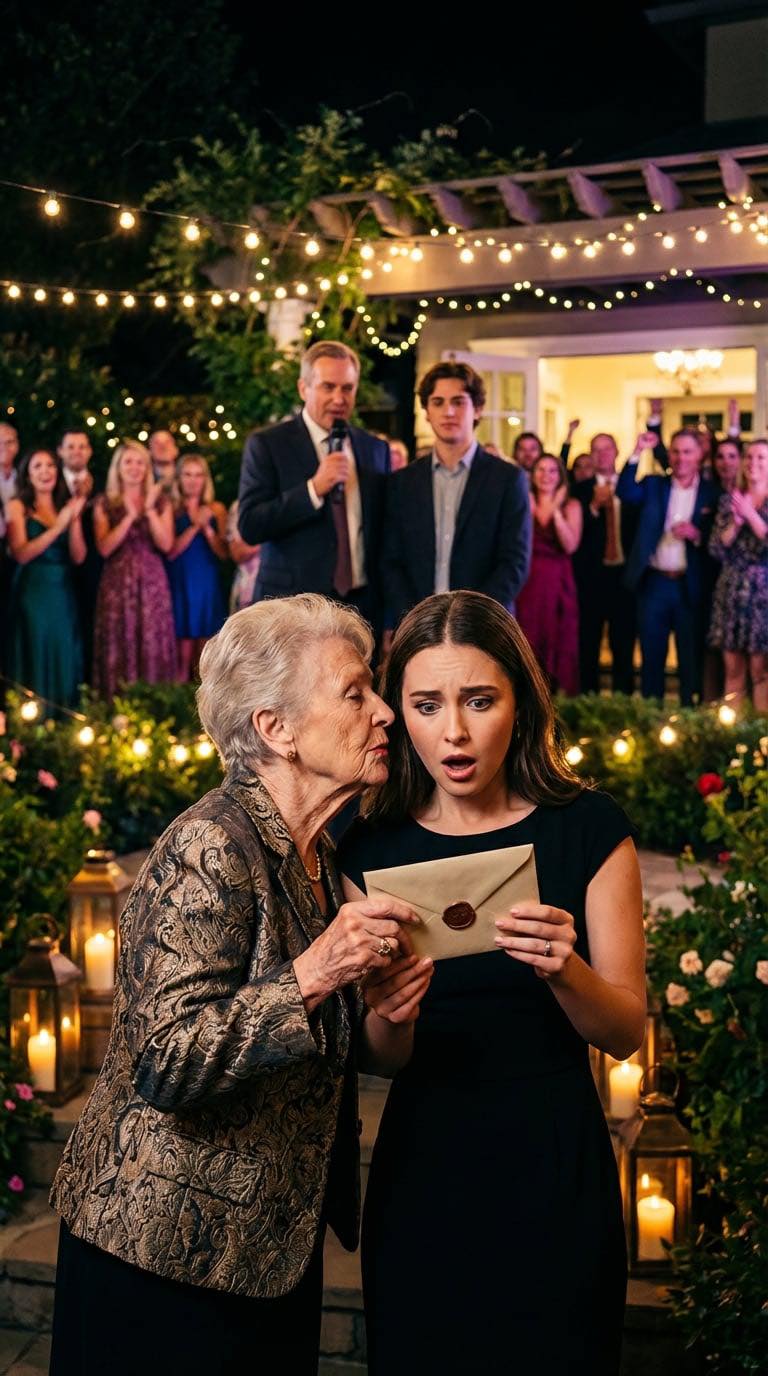
Then came my birthday—which my family had conveniently repurposed as my brother’s MBA graduation party. My grandmother pulled me into the shadows of the rose garden, pressed a heavy, cream-colored envelope into my trembling hands, and whispered a command that chilled my blood: “Don’t open this at home.”
I sat in my car for an hour, the engine idling, the envelope burning a hole in the passenger seat. When I finally broke the wax seal and read the first line, I whispered out loud to the empty parking lot, “No way.”
But before I tell you what was inside that envelope, I need to take you back to where the cracks in the foundation began. To the first time my father looked me in the eye and told me I was a stranger in his house.
I grew up in a sprawling Colonial-style house in the heart of suburban Greenwich, Connecticut. It was a structure of white shutters, manicured boxwoods, and a wraparound porch that looked like it belonged on the cover of Architectural Digest. My grandmother, Eleanor, had purchased it for my parents as a wedding gift. It was the kind of house that whispered of old money and stability, even if the emotional bank account inside was overdrawn.
There is a family portrait hanging in the living room, commissioned when I was seven. I am in it, technically. But if you look closely, you will notice the subtle geometry of exclusion. My parents and my brother, Derek, form a tight, cohesive triangle in the center. I am standing at the very edge of the frame, half a step behind everyone else, blurred slightly, like an afterthought the photographer almost cropped out.
The first time I heard the phrase adopted in spirit was a Tuesday. I remember the day specifically because my eighth birthday had been the Saturday prior. We hadn’t celebrated. Derek had a soccer tournament that weekend, and my father, Richard, had declared that the game was a “team commitment” that superseded individual milestones. My birthday was demoted to just another day. My mother, Margaret, promised we would celebrate the following week.
That week never arrived.
So, on that Tuesday, sitting at the long mahogany dinner table, cutting into a piece of chicken that tasted like sawdust, I asked a simple question.
“Why does Derek get the master suite on the second floor?”
My father didn’t even look up from his medium-rare steak. He sliced through the meat with surgical precision. “Because Derek is different, Adeline. You aren’t like us. Not really. You are… adopted in spirit.”
He paused to take a sip of wine, letting the words settle like dust. “We chose to keep you, to raise you, but that doesn’t mean you are entitled to the same legacy as your brother.”
I was eight. I didn’t understand the nuances of genetics or legalities. I just knew that the phrase made my chest ache, a physical pressure behind my ribs. Mom reached over and patted my hand, her touch light and fleeting.
“Your father loves you in his own way, sweetheart.”
I learned later that “his own way” was a euphemism for neglect. It meant silence. It meant servitude. It meant that for the next seventeen years, I would walk on eggshells, believing I was a charity case in a wealthy home.
Let me paint a picture of what adopted in spirit looked like in practice.
For Derek’s sixteenth birthday, Dad bought him a cherry-red Jeep Wrangler, fresh off the lot. They threw a gala for fifty people in the backyard, complete with a hired DJ and a three-tier chocolate cake from the French bakery downtown.
For my sixteenth birthday, we had a quiet family dinner. Dessert was a sheet cake from Costco. My name was misspelled as Adelne in generic blue icing because Mom had been in a rush. Dad forgot he had a client dinner and didn’t make it back in time to see me blow out the candles. I sat alone at the kitchen island, wishing for a family that wanted me.
When Derek left for college, both my parents took three days off work. They rented a U-Haul, drove him to campus, and Mom cried openly at the orientation.
When I left for college—a state school I had gotten into on a full academic scholarship because Richard refused to pay tuition for a “non-investment”—Mom handed me a Greyhound bus ticket.
“You can manage, right?” she asked, checking her reflection in the hallway mirror. “Derek needs the car this weekend for a fraternity rush event.”
I managed. I always managed.
But there was one person who never forgot me. Grandma Eleanor.
Every year on my actual birthday, a card would arrive in the mail. It was always on the same heavy, lavender stationery, smelling faintly of rosewater. The looping handwriting never changed.
Remember who you are, my darling. The truth always surfaces. Patience is the weapon of the righteous.
I didn’t understand what she meant. Not then. I thought she was just being eccentric. I didn’t know she was playing the long game.
Fast forward to last month. I was twenty-five, working as a staff accountant at a mid-sized logistics firm in Hartford. My salary was $52,000 a year. It wasn’t a fortune, but it was money I had earned without anyone’s help. I lived in a studio apartment that smelled of lemon polish and independence.
I was sitting at my desk, burying myself in quarterly spreadsheets, when my phone buzzed. A text from Mom.
Family celebration this Saturday. Derek’s MBA graduation. Don’t be late. Wear something appropriate.
No mention of my birthday, which was the same day. Of course.
I started typing a polite decline. I had plans. I was busy. I couldn’t bear another afternoon of being the invisible servant at Derek’s coronation.
Then my phone rang. The caller ID showed a number I rarely saw but always answered.
“Grandma?”
“Adeline. My darling.” Her voice was thinner than I remembered, fragile like dried paper, but the warmth was still there. “I need you to come home this Saturday.”
“I wasn’t planning to, Grandma. It’s just going to be the ‘Derek Show’ again.”
“I know,” she rasped, and I could hear the labor in her breathing. “But I have something important to give you. It has been twenty-five years in the making.”
Something in her tone made my stomach tighten. It wasn’t a request; it was a summons.
“What do you mean?”
“I set something aside for you the day you were born,” she said softly. “When I saw the way Richard looked at you—like you were a disappointment before you even opened your eyes—I knew then that I had to build a fortress around you. Come home, Adeline. Saturday. I will explain everything.”
That night, I booked a rental car. I told myself it was just for Grandma. I told myself I could endure one more day of indignity for her sake. But deep down, as I drove toward the wealthy enclave of Greenwich, I felt a vibration in the air. The barometer was dropping. A storm was coming.
Saturday arrived with a bright, mocking sun. I pulled into the driveway at noon. My modest sedan looked like a toy next to Derek’s gleaming BMW X5—a gift Dad had bought him last year for “working so hard” at his unpaid internship.
The house looked the same as always: white shutters, manicured lawn, the kind of suburban perfection that hid a rot deep within the walls. But today, a massive banner hung across the front porch: CONGRATULATIONS DEREK – MBA CLASS OF 2026.
Inside, the house was chaos. Caterers were setting up tables. Florists were arranging centerpieces of lilies—Derek’s favorite flower, and the one I was allergic to.
Mom spotted me in the foyer. She didn’t hug me. She thrust a clipboard into my hands.
“Oh, good. You’re here. Here’s the list. Tables need to be set up in the backyard. The guest bathroom on the first floor needs a scrub—the cleaning lady missed a spot. Oh, and direct the caterers; they keep trying to put the champagne tower on the uneven pavement.”
“Where’s Derek?” I asked, looking at the list of chores.
“In his room, resting before the party,” she said, as if it were the most natural thing in the world. “He needs his energy for networking.”
I stood there, holding that clipboard, feeling the familiar weight of invisibility settle onto my shoulders like a lead blanket. Then I saw it. On the hallway table, half-hidden under a stack of junk mail, was a lavender envelope with my name on it. Grandma’s handwriting. A birthday card.
It had been opened, read, and tossed aside. They hadn’t even bothered to give it to me.
By 4:00 PM, the backyard had been transformed into a celebration fit for royalty. White tents, twinkling lights, a jazz trio playing soft standards. Forty guests milled about in designer linen and silk, laughing, toasting, and pretending to care about business school metrics.
I stood by the catering tent, wearing the same black dress I’d worn to three other family events, watching my father command the room.
“Everyone, everyone!” Dad clinked his champagne flute with a silver fork. The sharp sound cut through the chatter.
“I want to propose a toast to my son, Derek. My legacy. My pride.”
The guests raised their glasses. Dad’s voice swelled with a theatrical emotion that made me nauseous.
“From the moment Derek was born, I knew he was destined for greatness. He is everything I ever hoped for in a son. Smart, driven, ambitious. And now, with his MBA, he is ready to conquer the world.”
Applause. Cheers. Derek stood beside Dad, beaming, wearing a bespoke Ralph Lauren suit that probably cost more than my car. Not a single word about me. Not even a mention that today was my birthday, too.
I tried to shrink into the background, but my Aunt Linda—Dad’s sister—spotted me.
“Adeline! Isn’t today your birthday, too?” Her voice carried over the lull in conversation.
Dad laughed—a short, dismissive bark. “Oh, we don’t really count that. She’s… different.”
The words hit me like a physical slap. Aunt Linda’s smile faltered. She leaned toward Uncle Robert and whispered, loud enough for me to hear, “Poor girl. Spiritually adopted. Whatever that means.”
Across the yard, I saw Grandma Eleanor. She sat alone in a wicker throne, her silver hair catching the sunlight. Her eyes were tracking everything. Watching. Waiting. When our eyes met, she gave me a microscopic nod. Just wait.
Dad wasn’t finished. He clinked his glass again.
“Now, I want to share some exciting news about the Spencer family future.” He draped a heavy arm around Derek’s shoulders. “As most of you know, Eleanor, my wonderful mother-in-law, holds the title to this beautiful estate. When she eventually passes—God bless her—we plan to liquidate the property. The proceeds will be used to seed Derek’s first venture capital firm.”
Derek nodded solemnly, as if this were already a done deal. The guests murmured their approval. How generous. What a legacy.
I felt something crack inside me. Not a break, but an opening.
“Excuse me?” My voice came out smaller than I intended, but in the silence, it carried. “What about me?”
Dad didn’t even turn his body toward me. He just cast a glance over his shoulder. “You’re an adult, Adeline. You’ve always been self-sufficient. Besides…” He paused, choosing his next words with cruel precision. “You aren’t technically family in the traditional sense. The assets follow the bloodline.”
The silence that followed was suffocating.
Then came the sound. Tap. Tap. Tap.
Grandma Eleanor rose from her chair with the slow, deliberate grace of a queen entering a war room. She walked across the yard, her cane striking the patio stones, guests parting like the Red Sea before her. She stopped directly in front of my father.
“Richard,” she said. Her voice was soft, wrapped in silk, but it held the weight of a guillotine blade. “I believe you have forgotten whose house you are standing in.”
The color drained from my father’s face. “Mother, I just meant—”
She ignored him. She turned to me, her eyes fierce and wet.
“Adeline, my darling. Come with me.”
We walked away from the party, past the stunned guests, to the rose bushes at the edge of the property. She reached into her cardigan pocket and pulled out the envelope. It was thick, cream-colored, sealed with red wax bearing a stamp I didn’t recognize: a pair of balance scales with the letters C & A.
“Happy 25th birthday, Adeline,” she whispered. “This is your future. Do not open it here. Go to your car. Read it alone. And then—only then—decide what you want to do.”
“Mother!” Dad’s voice cut through the garden. He was striding toward us, looking panicked. “What is this? Family matters should be discussed openly.”
“This is between me and my granddaughter,” Grandma snapped, her voice suddenly sharp as flint. “You have had twenty-five years to discuss family matters with her, Richard. You chose not to.”
I clutched the envelope. I ran to my car.
I drove three blocks away and parked in a church parking lot. My hands were shaking so badly I tore the envelope opening the flap.
I slid out the contents. Three documents.
The first was a birth certificate. Not a copy—the original. It had the raised seal of the State of Connecticut.
Mother: Margaret Louise Spencer (née Mitchell).
Father: Richard James Spencer.
Child: Adeline Marie Spencer.
I read it three times. No adoption records. No “amended” stamps. No footnotes. I was their biological daughter. I had always been their biological daughter. The “adopted in spirit” story wasn’t a clumsy way of explaining adoption; it was a lie. A psychological cage they had built to justify treating me like trash.
The second document was a handwritten letter on lavender paper.
My Dearest Adeline,
You are not adopted in spirit. You never were. Your father lied to justify his inability to love a daughter. He grew up in a household where women were currency, not people. When you were born, he looked at you with indifference. I couldn’t change him, but I could protect you.
I watched him treat you like a second-class citizen. I knew this day would come. I knew he would try to erase you from the future. So, I made sure twenty-five years ago that no matter what he did, you would have the ultimate trump card.
My hands were shaking, but now it wasn’t fear. It was a cold, clarifying rage.
I turned to the third document. It was a legal deed, stapled to a trust agreement titled The Adeline Marie Spencer Irrevocable Living Trust.
Grantor: Eleanor Anne Mitchell.
Beneficiary: Adeline Marie Spencer.
Condition: Beneficiary assumes full control of all Trust assets upon reaching the age of twenty-five.
Assets:
- Cash Holdings: $340,000.
- Real Property: 47 Maple Grove Lane, Greenwich, CT.
I stopped breathing. The house. The house my parents had lived in for thirty years. The house my father had just promised to sell to fund Derek’s business.
It wasn’t theirs. It had never been theirs.
Grandma had let them live there, yes. But according to this document—notarized, filed, and ironclad—she had never transferred ownership to Richard or Margaret. They were occupants. Guests.
And as of today… I was their landlord.
I pulled out my phone and dialed the number on the letterhead: Cole & Associates.
“Martin Cole, please. My name is Adeline Spencer.”
A warm baritone voice came on the line thirty seconds later. “Adeline. Your grandmother told me you would be calling.”
“Mr. Cole… is this real? Can they contest this?”
“Completely real, and completely incontestable,” Martin said. “Your grandmother was meticulous. The Trust has been waiting for this exact date. As of this morning, you have full legal authority over the property.”
“My parents don’t know.”
“No. They believe Eleanor owns it and will leave it to them in her will. They are unaware the deed is already in the Trust.” Martin paused. “Your grandmother has requested a formal reading of the estate documents next Saturday. I have already sent the invitations. She wanted the truth to come out in a setting where there could be no denial.”
One week. I just had to survive one week.
The harassment started Monday.
Dad called first. “Adeline, we need you back this weekend. Grandma is getting her affairs in order, and the house needs to be prepped for sale. We need you to clear out the attic.”
“Prepped for sale?” I asked, keeping my voice steady.
“Yes. We need to be liquid the moment she passes. It’s just business.”
Then Mom called on Tuesday. “Your father is under a lot of stress, sweetheart. Be a good daughter. Come help us.”
Wednesday brought an email from Dad with an attachment: Spencer Family Asset Acknowledgement Form.
I opened it. It was a waiver. By signing, I would confirm that I had no legal claim to any assets of the Spencer or Mitchell estates. They were trying to erase me legally before the hammer dropped.
I called Martin.
“Do not sign that,” he ordered. “It’s a preemptive strike. They suspect Eleanor might leave you a token sum, and they want to block it.”
“I’m not signing anything,” I said.
Friday night, there was a knock on my apartment door. Mom stood in the hallway, holding a bouquet of chrysanthemums—Derek’s favorite flower, not mine.
“Can I come in?”
She sat on my second-hand couch, her Chanel bag looking ridiculous against the worn fabric.
“Adeline, I know your father can be… harsh. But he loves you in his own way. Signing that form would keep the peace.”
“Keep the peace,” I repeated. “Mom, do you even know what’s in Grandma’s estate?”
“It doesn’t matter. What matters is family. Families don’t fight over money.” She squeezed my hand, her eyes pleading. “Besides, your grandmother is old. She gets confused. If she told you something strange at the party… well, senility is a terrible thing.”
I looked at my mother. I looked at the woman who had watched me scrub floors while my brother played video games. The woman who handed me a bus ticket while she handed her son the world.
“I’m not signing it, Mom.”
Her mask slipped. Her eyes went cold. She collected her bag and left without another word.
That night, I couldn’t sleep. I went to my closet and pulled out a navy blue suit I had bought for a job interview I’d been too scared to attend. I tore the tags off.
Tomorrow, I wasn’t walking into that room as the forgotten daughter. I was walking in as the owner.
Saturday morning, 9:00 AM. The offices of Cole & Associates occupied the penthouse of a glass tower in Hartford. Martin Cole was exactly what I expected: silver-haired, sharp-eyed, a man who ate conflicts for breakfast.
“Ms. Spencer.” He shook my hand. “Your family is in the conference room. Are you ready?”
“I am.”
We walked in. Dad was sitting at the head of the table, naturally. Mom and Derek flanked him like royal guards. None of them looked at me.
“Martin,” Dad said, extending a hand. “Good to see you. Let’s get this formality over with. We all know how Eleanor wanted things handled.”
“Please, have a seat,” Martin said, his face a mask of neutrality.
I sat across from them. My folder rested on my lap.
“So,” Dad said, checking his Rolex. “Standard distribution, I assume? The house to us, the savings to the estate?”
Derek pulled out his phone. “Dad, if we list the house next week, I can put the deposit on the office space by the first.”
“Let’s not get ahead of ourselves,” Dad smiled. He thought he had already won.
Martin opened his folder. “The estate of Eleanor Anne Mitchell consists of the following assets: One residential property at 47 Maple Grove Lane. One savings account containing $340,000.”
Dad nodded, doing the math.
“However,” Martin continued, “these assets are not distributed through the will.”
The room went silent.
“What?” Dad frowned. “If they aren’t in the will, then where are they?”
“These assets were placed in an Irrevocable Living Trust in 1999,” Martin said calmly.
“A Trust?” Dad’s voice rose. “Mother never told me about a Trust. Who is the beneficiary?”
Martin took off his glasses and cleaned them slowly. “That is the question, isn’t it?” He turned to me. “Ms. Spencer? Would you like to do the honors?”
All eyes shifted to me. Dad’s face was pale. Derek’s mouth hung open.
I stood up. I placed my folder on the table and opened it.
“The sole beneficiary of the Trust,” I said, my voice ringing in the silence, “is me. Adeline Marie Spencer.”
Dad shot to his feet. “That’s impossible! She wouldn’t! You… you’re not even real family!”
“Actually,” I said, pulling out the second document. “I am.”
Martin projected the birth certificate onto the wall screen. The names were undeniable. Mother: Margaret. Father: Richard.
“There is no adoption record,” Martin said. “Adeline is your biological daughter. You lied to her, and to everyone else, for twenty-five years.”
Dad slammed his hand on the table. “This is fraud! You manipulated an old woman!”
“It’s not manipulation, Dad. It’s documentation.” I pointed to the screen. “Notarized. Filed. Twenty-five years ago.”
“The house is ours!” Dad screamed. “We’ve lived there for thirty years! We paid the taxes!”
“Paying taxes on a property you don’t own makes you a tenant, Mr. Spencer,” Martin interjected. “A tenant without a lease.”
The word tenant hit my father like a bullet. He slumped back into his chair.
“Adeline,” Mom sobbed, reaching for me. “We can fix this. We’re family.”
“No,” I said, pulling my hand away. “You spent twenty-five years telling me I wasn’t family to justify your neglect. You don’t get to use that word now because you need something.”
Derek stood up. “Come on, Addie. This isn’t fair. I need that capital for my business.”
“Then get a job, Derek,” I said coldly. “Like I did.”
I looked at my father. He looked small. Defeated. And terrified.
“I’m not going to throw you out today,” I said. “You have ninety days to vacate the premises. That is more consideration than you ever gave me.”
“Ninety days?” Dad whispered. “After everything we’ve done for you?”
“You did nothing for me,” I said. “And now, neither will I.”
I gathered my papers and walked out of the conference room. I didn’t look back. The silence that followed me wasn’t empty; it was heavy with the wreckage of their lies.
Ninety days later, a moving truck pulled up to 47 Maple Grove Lane. I wasn’t there to watch, but my neighbor Mrs. Patterson told me Dad refused to speak to anyone as they loaded the boxes. They moved into a two-bedroom apartment in downtown Hartford.
Derek’s business never launched. His BMW was repossessed three months later.
As for me? I kept the house.
I walked through the rooms where I had once been a ghost and I reclaimed them. I painted the walls. I replaced the furniture. I took down the family portrait where I was standing on the edge.
In its place, right over the fireplace, I hung a new photo. It’s just me and Grandma Eleanor, sitting on the porch, laughing over cups of tea.
Dad works part-time as a consultant now because their retirement savings can’t cover their new rent. Mom sent me a letter apologizing, admitting she should have been braver. I haven’t answered it yet. Forgiveness is a door I might open someday, but not today.
I am sitting in my living room now—my living room—watching the sunset turn the walls gold. I used to dream about the day my father would tell me he loved me. I used to think that would make me whole.
I don’t dream about that anymore. I realized I didn’t need a seat at his table. I have my own table now. And there is plenty of room for the people who actually want to be there.
That is the only kind of family worth having.