Chapter 1: The Tuesday That Never Ended
Life, as I’ve come to learn, doesn’t give you a warning before it shatters. It doesn’t tap you on the shoulder and suggest you hold your breath. For me, the shattering began on a Tuesday evening—a mundane, drizzly Tuesday that should have ended with a shared meal and a debate over whose turn it was to put Maddie to bed. Instead, it ended with a phone call from the Mercy General Trauma Center that turned my world into a blurred sequence of sirens and sterile white hallways.
My husband, Joel, had been driving home from his office at the architectural firm. A truck driver, distracted by a phone or perhaps just chasing a yellow light that had long since turned red, tore through an intersection and slammed into the driver’s side of Joel’s sedan. The impact was catastrophic. When I arrived at the hospital, they wouldn’t let me see him. He was in the operating room for nine hours—five hundred and forty minutes of me pacing the linoleum floor, counting the patterns in the ceiling tiles, and praying to a God I hadn’t spoken to in years.
When the lead surgeon, Dr. Aris Cook, finally emerged, she looked like she had aged a decade. Her scrubs were stained, her eyes heavy with a mixture of professional detachment and genuine pity. She told me the words no wife ever expects to hear: Severe traumatic brain injury. Diffuse axonal shearing. We don’t know if he will wake up. You need to prepare for the possibility that he might never come back.
For three weeks, the Intensive Care Unit became my sanctuary and my prison. I lived in a plastic chair that groaned every time I moved. I held Joel’s hand—warm, yet terrifyingly still—and spoke to him until my voice grew hoarse. I told him about our eight-year-old son, Maddie, who was staying with my mother. I recounted Maddie’s latest soccer highlights, his struggles with long division, and the way he asked every night if Daddy was still sleeping. I read the sports section of the Daily Chronicle aloud, mocking the local basketball team’s losing streak because Joel loved to argue with me about their defense. I played his favorite blues records on my phone, hoping the soulful guitar riffs might act as a tether, pulling him back from the gray abyss of his coma.
On the fourth day of this vigil, the silence of the room was punctured by a presence I had hoped to avoid. Frank, Joel’s older brother, stood in the doorway. He didn’t rush to the bedside. He didn’t weep. He stood there, silhouetted by the harsh hallway lights, looking at the hum and hiss of the machines keeping his brother alive.
“How is he?” Frank asked. His voice lacked the tremor of grief; it sounded clinical, almost impatient.
“He’s fighting, Frank,” I whispered, not looking away from Joel’s pale face.
Frank stepped further into the room, but his gaze didn’t linger on his brother. Instead, it swept across the private suite, noting the high-end equipment. “Joel always was a high-earner,” he mused. Then, with a jarring lack of tact, he asked, “What’s the status of his life insurance policy? And the firm’s partnership buyout clause? We need to know where things stand.”
A coldness settled in my chest. “I am not discussing money while my husband is lying here in a coma, Frank. Please leave.”
He scoffed, a dry, grating sound. “You’re being naive, Elena. Someone has to think about the practicalities. Joel has significant assets—the house, the investment accounts, the firm. If he… well, if he doesn’t make it, we need to ensure the legacy is managed properly.”
I didn’t argue. I didn’t have the energy. I simply pointed to the door. He left, but I could feel the shadow he cast remaining in the room. I didn’t know then that the vulture was only just beginning to circle.
Chapter 2: The Vulture’s Gambit
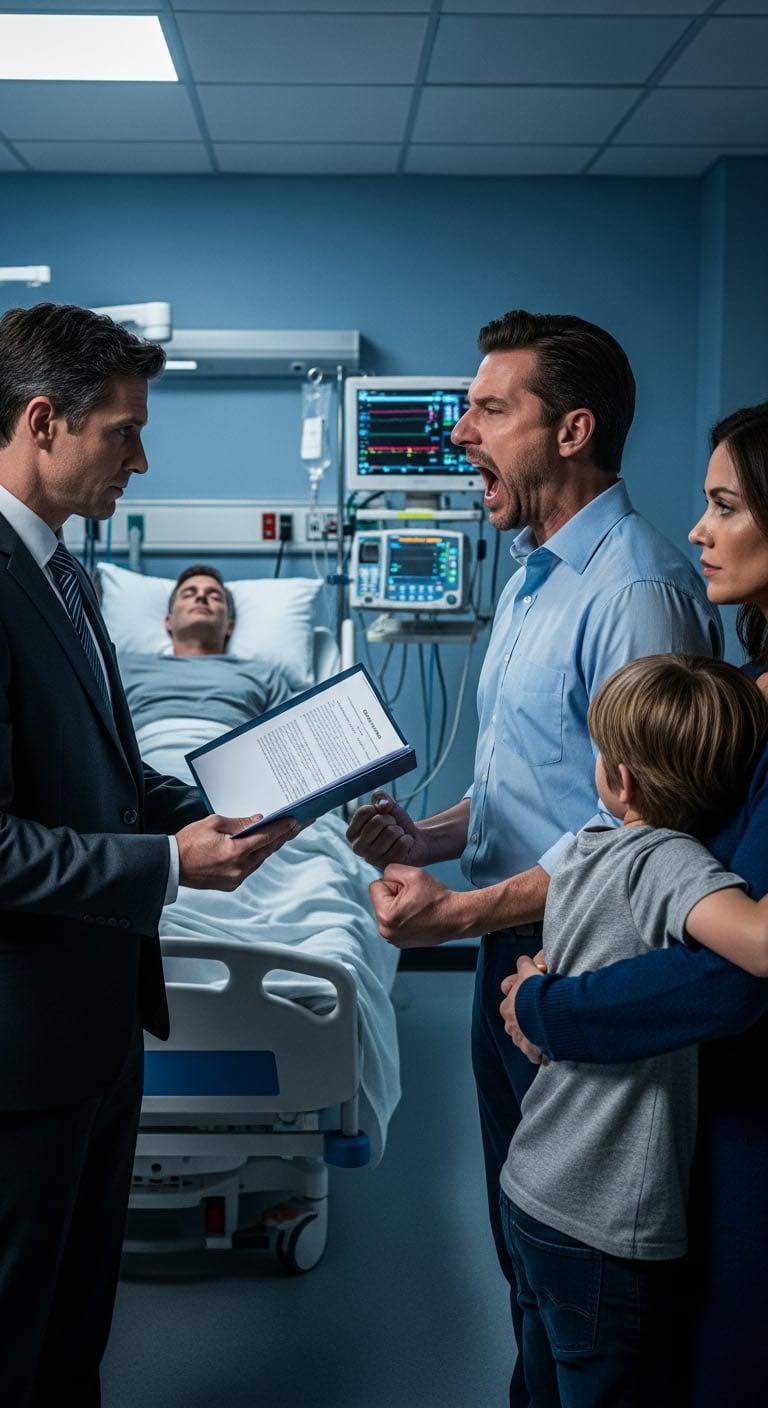
Three days later, Frank returned. This time, he wasn’t alone. He carried a leather-bound briefcase and a smirk that suggested he had found a secret weapon. He didn’t even pretend to check on Joel. He pulled out a chair, sat across from me, and laid out several sheets of legal bond paper.
“I’ve spent the last seventy-two hours consulting with my legal counsel,” Frank began, his voice taking on a predatory edge. “As Joel’s only sibling and his closest blood relative, I have a responsibility to the family estate. And I have some… concerns.”
“Concerns about what, Frank? The medical bills? Because I have that handled,” I said, my temper fraying.
“No,” he said, leaning in. “Concerns about the line of succession. Specifically, concerns about Maddie.”
I felt the blood drain from my face. “What could you possibly have to say about an eight-year-old boy?”
Frank let out a sigh that was performatively weary. “Let’s be honest, Elena. Maddie doesn’t look like a member of this family. He has that dark, curly hair, those amber eyes. Joel is fair-skinned and blue-eyed. I’ve always found it suspicious how quickly you fell pregnant after you two started dating. You were a waitress at that diner, Joel was a rising star in the architecture world… it’s a classic story, isn’t it? The honey trap.”
I stood up so fast the chair clattered against the wall. “How dare you. How dare you say that while your brother is lying three feet away from us?”
“I’m protecting his legacy!” Frank shouted back, his face reddening. “Joel worked twenty years to build what he has. I won’t stand by and watch his hard-earned wealth be siphoned off by some woman and her bastard child when there’s no proof he’s even a blood relative.”
The word bastard hit me like a physical blow. It was a word from a darker, crueler century, spat out with such venom that I felt sick.
“I am demanding a DNA test,” Frank stated, sliding a document toward me. “If you refuse, I will take this to a judge. I’ll argue that you’re a fraud, and I’ll have myself named as Joel’s next of kin. I’ll take control of the estate, the accounts, and this house. If that boy isn’t a blood-match, you’ll both be out on the street before Joel’s heart stops beating.”
I looked at my husband, then at the man who shared his DNA but none of his soul. I realized then that Frank wasn’t just greedy; he was convinced of his own righteousness. He truly believed he was the victim of a long con.
“Get out,” I said, my voice dangerously low. “Get out before I have security drag you through the lobby in front of everyone.”
Frank stood up, smoothing his suit. “You have forty-eight hours to sign the consent forms, Elena. Otherwise, I’ll see you in court. And believe me, the truth won’t be kind to you.”
As he walked out, my phone buzzed in my pocket. It was a text from my mother: Maddie just asked if he could give Daddy his new drawing. He misses him so much. I collapsed into the chair, clutching Joel’s hand, realizing that I was now fighting two wars—one for my husband’s life, and one for my son’s identity.
Chapter 3: The Verdict of the Blood
The following weeks were a blur of legal motions and medical updates. Frank’s lawyer, a man who seemed to specialize in high-stakes spite, filed a petition for a paternity injunction. He argued that there was “reasonable doubt” regarding Maddie’s lineage and that the “integrity of the estate” was at risk. My lawyer, Gregory Vance, a man with a calm demeanor and a sharp mind, told me the judge had granted the request.
“It’s a low bar to set for a ‘reasonable doubt’ case when an estate is this large, Elena,” Gregory explained. “The judge wants to be thorough. We do the test, we prove him wrong, and we shut this down.”
I agreed. Not because I was afraid, but because I wanted to end this circus. I wanted to see the look on Frank’s face when his carefully constructed house of cards collapsed.
The day of the testing was surreal. A technician from Global Genomics Lab came to the hospital. They took a buccal swab from Maddie—who was confused and scared, thinking he had done something wrong—and a blood sample from Joel. Frank insisted on being present, standing in the corner of the ICU room like a grim reaper in a cheap suit, watching the needles and the swabs with a triumphant glint in his eyes.
Two weeks later, we gathered in a wood-paneled conference room at Gregory’s office. The air was thick with the scent of old paper and expensive coffee. Frank sat across from me, his arms crossed, his leg bouncing in anticipation. He looked like a man who had already spent the money he hadn’t yet won.
Gregory opened the manila envelope. The silence in the room was absolute, save for the ticking of a grandfather clock in the corner. He scanned the document, his expression unreadable, then looked directly at Frank.
“The results from Global Genomics are definitive,” Gregory said. “There is a 99.97% probability of paternity. Joel is, without any shadow of a doubt, the biological father of Maddie.”
The color drained from Frank’s face so quickly I thought he might faint. He lunged across the table, snatching the paper. “Let me see that! There’s a mistake. The lab… they must have swapped the samples. This is impossible. Look at the boy! He doesn’t have the features!”
“The DNA doesn’t care about ‘features,’ Frank,” Gregory said coldly. “It cares about markers. And the markers match.”
I could have left it there. I could have walked out and savored the victory. But Gregory wasn’t finished. He reached into his briefcase and pulled out another folder.
“While we were preparing for this ridiculous challenge,” Gregory continued, “I did a deep dive into Joel’s filings. You mentioned a will from four years ago, Frank? The one where you were named as a 40% beneficiary?”
Frank looked up, his eyes narrowing. “Yes. That’s the legal document on file.”
“No,” Gregory corrected, sliding a fresh document across the table. “That was the document on file. After Maddie was born, and after your… shall we say, ‘disagreements’ over the family business, Joel executed a codicil. He updated his entire estate plan eighteen months ago. He moved everything into a private trust.”
Frank’s hands started to shake as he read the new terms.
“In this version,” Gregory said, “you aren’t getting 40%. You aren’t getting 10%. In fact, there is a specific clause stating that due to ‘irreconcilable personal differences and a lack of familial support,’ you are to receive nothing. The entire estate—the house, the firm, the investments—passes directly to Elena and Maddie. You’ve been completely disinherited, Frank.”
Frank’s briefcase fell to the floor with a heavy thud. He stood up, his mouth working but no sound coming out. He looked small. He looked pathetic. He turned and stumbled toward the door, stopping only for a second to look back at me. I saw no remorse in his eyes, only the bitter realization that his greed had left him truly alone.
But as the door clicked shut, my phone rang. It was the hospital.
Chapter 4: The Ghost in the Room
“Mrs. Miller? This is Dr. Cook. You need to get to the ICU immediately. There’s been a change.”
The drive to the hospital was a frantic, heart-pounding blur. I ignored red lights and speed limits, my mind screaming. Please don’t let him be gone. Not now. Not after we won.
When I burst into the room, I expected to see a flatline or a flurry of nurses performing chest compressions. Instead, I found a strange, vibrating stillness. Dr. Cook was standing by the monitors, her eyes fixed on the EEG readouts.
“What happened?” I gasped, clutching the doorframe.
“His intracranial pressure has dropped significantly,” she said, her voice filled with a hushed excitement. “The swelling in the frontal lobe is receding. Look at the monitor, Elena.”
I looked. The jagged lines of his brain activity were no longer sluggish. They were spiking, responding to the environment.
“We want to start weaning him off the heavy sedation,” Dr. Cook explained. “It’s a delicate process, and there’s no guarantee he’ll respond to the ‘wake-up’ call, but the window is opening.”
The next few days were a different kind of torture. It was the torture of hope. I sat by his side, whispering to him that the wolf was gone, that our son was safe, that he just had to open his eyes.
But then, reality bit back.
Olivia, the hospital’s financial coordinator, called me into her office. She was a kind woman, but her job was the grim mathematics of survival. She laid out the spreadsheets. Even with our premium insurance, the “out-of-network” specialists, the 24-hour ICU nursing, and the upcoming long-term rehabilitation costs were staggering.
“We’re looking at an out-of-pocket estimate of $45,000 for the first phase of rehab alone,” Olivia said softly. “And that’s assuming he stabilizes soon.”
I looked at the numbers and realized how close we had come to ruin. If Frank had won—if he had frozen the accounts or successfully challenged my status—I wouldn’t have been able to pay for the very care that was currently saving Joel’s life. He would have let his own brother die just to claim a bigger slice of the pie.
That night, I received a call from an unknown number. I answered, thinking it was the hospital.
“Elena?” It was Frank. His voice was thick, slurred. He sounded like he’d been drinking. “I just… I wanted to say I was scared. Joel was always the golden boy. I thought if he died, I’d be nothing. I panicked.”
“You called my son a bastard, Frank,” I said, my voice like ice. “You tried to steal his future while his father’s body was still warm. There is no ‘panic’ that excuses that.”
“Is he… is he getting better?” Frank asked.
I realized then that the family had cut him off. He was in the dark. “He’s fighting,” I said. “And he’s going to win. And when he does, he’ll know exactly who stayed by his side and who tried to bury him.”
I hung up before he could respond. I didn’t need his apologies. I needed my husband.
Chapter 5: The First Spark
Ten days after the sedation was reduced, it happened.
I was reading him a review of a new Italian restaurant—one we had planned to visit for our anniversary—when I felt a twitch. It wasn’t the involuntary spasm of a nerve. It was a deliberate, rhythmic pressure.
Joel’s hand, which had been a heavy weight in mine for weeks, squeezed back.
“Joel?” I whispered, my heart hammering against my ribs. “Joel, if you can hear me, squeeze again.”
A second pass. Firm. Undeniable.
His eyelids fluttered, then slowly, painfully, they opened. His eyes were bloodshot and unfocused, darting around the room in a panic. He tried to speak, but the ventilator tube in his throat turned his voice into a haunting, metallic wheeze.
“Easy, honey. You’re okay. You’re at Mercy. I’m here. You’re safe,” I sobbed, tears blurring my vision.
Dr. Cook and the nursing team rushed in. They performed a series of neurological tests. Follow the light. Wiggle your toes. Squeeze the doctor’s hand. He passed every single one. He was weak—his left side showed signs of significant motor delay—but he was there.
The following day, they removed the ventilator. His first words were barely audible, a sandpaper rasp that broke my heart.
“Maddie?”
“He’s okay, Joel. He’s at home with my mom. He’s waiting for you.”
“The… the truck…” Joel whispered, his brow furrowed as the memories began to mesh together.
“Don’t worry about the truck. Don’t worry about work. Just breathe,” I told him.
But the joy of his awakening was tempered by the trauma that followed. When I finally brought Maddie to the hospital a few days later, I expected a cinematic reunion. I thought Maddie would run into his arms.
Instead, my son stopped at the threshold of the room. He looked at his father—hooked up to monitors, his head partially shaved and scarred, his voice sounding like a stranger’s—and he began to tremble. Maddie didn’t see his hero; he saw a broken man who reminded him of the death he had been fearing for months.
Maddie turned and ran. I found him in the waiting room, sobbing into his hands. “That’s not him, Mommy. That’s not my Daddy.”
I spent that night holding my son, realizing that bringing Joel back was only half the battle. We were a family of three, but we were all strangers to one another now, reshaped by the trauma of the last few months.
Chapter 6: The Long Road to the Porch
The next two months were a grueling marathon of physical and cognitive therapy. Joel had to relearn how to swallow, how to brush his teeth, and how to stand without the world spinning into a kaleidoscope of vertigo.
Our friend Mariana and Joel’s mother, Lily, became our life support system. Lily moved into our guest room, taking over the cooking and the laundry, allowing me to focus entirely on Joel’s appointments and Maddie’s emotional recovery.
“You can’t carry the world on your shoulders, Elena,” Lily told me one night as we sat on the back porch. “Frank is a fool, and he’s gone. But you have to let us help you with the rest.”
I finally listened. I let Mariana organize a meal train. I let the school counselor work with Maddie. Slowly, the house began to feel like a home again, rather than a triage center.
Joel’s progress was measured in inches. One day he could walk to the end of the hallway with a walker. A week later, he could manage a flight of stairs with assistance. His left arm remained stubborn, a constant reminder of the “permanent mobility limitations” Dr. Cook had warned us about. But his mind was sharp.
One afternoon, while we were sitting in the living room, Joel asked about Frank. I had kept the details of the legal battle from him, fearing the stress would hinder his recovery. But he saw the look in my eyes.
“He tried something, didn’t he?” Joel asked, his voice stronger now.
I told him everything. The life insurance questions. The “bastard” comment. The DNA test. The disinheritance.
Joel sat in silence for a long time, his gaze fixed on a photo of him and Frank from when they were children. “I always knew he envied what I had,” Joel said quietly. “But I never thought he would try to erase my son.”
“He came to the hospital to apologize,” I said. “He’s been in therapy, apparently. He wants to see you.”
Joel looked at his scarred hands. “I’m not ready for forgiveness, Elena. Maybe I’ll never be. He didn’t just attack me; he attacked the two people I love most. He stays away. That’s the price of his ‘panic.’”
Chapter 7: The Morning of the Bus
Six months to the day after the accident, the sun rose over a world that felt, for the first time, stable.
The house had been modified. There were grab bars in the bathroom and a ramp leading to the front door. The medical bills were a mountain we were slowly chipping away at, thanks to the trust Gregory had secured.
Maddie was no longer afraid. He had spent weeks in therapy with a specialist named Clara, learning that his dad was still the same man inside, even if the “outside” was a bit different. They had a new ritual: building complex Lego sets together, a task that helped Joel with his fine motor skills and gave Maddie a way to connect without words.
That Tuesday morning, Joel didn’t use his walker. He gripped a polished wooden cane in his right hand. He dressed himself—a slow process involving a lot of deep breaths—and walked to the front door.
“You sure about this?” I asked, watching him.
“I’m sure,” he said.
Maddie was waiting on the porch, his backpack slung over his shoulders. He reached out and took his father’s free hand. Together, they walked down the driveway. Joel moved with a slight limp, his pace measured and careful, but his head was held high.
They reached the corner where the yellow school bus squealed to a halt. I watched from the window, my heart full in a way I hadn’t felt since before that fateful Tuesday. I saw Joel lean down, awkward but determined, and pull Maddie into a hug. I saw Maddie squeeze back, burying his face in his father’s chest.
When the bus pulled away, Joel stood there for a long time, waving until it disappeared around the bend.
As he walked back toward the house, he stopped at the mailbox. He pulled out the letters, sorted through them, and paused at one. Even from the window, I could see the return address. It was from Frank.
Joel didn’t open it. He didn’t tear it up in a fit of rage. He simply tucked it under his arm and continued his walk back to our door.
He stepped inside, smelling of the morning air and the promise of a new day. He handed me the mail, kissed my forehead, and looked around at our modified, scarred, and beautiful life.
“We’re okay,” he said.
“We’re more than okay,” I replied.
We had survived the vulture. We had survived the crash. We had learned that blood doesn’t just bind you by birth; it binds you by the sacrifices you make to keep it flowing. And as I watched my husband sit down at the kitchen table to help our son with his homework later that afternoon, I knew that the legacy Frank had tried to steal was safer than it had ever been.
The truth had set us free, but it was our love that had brought us home.