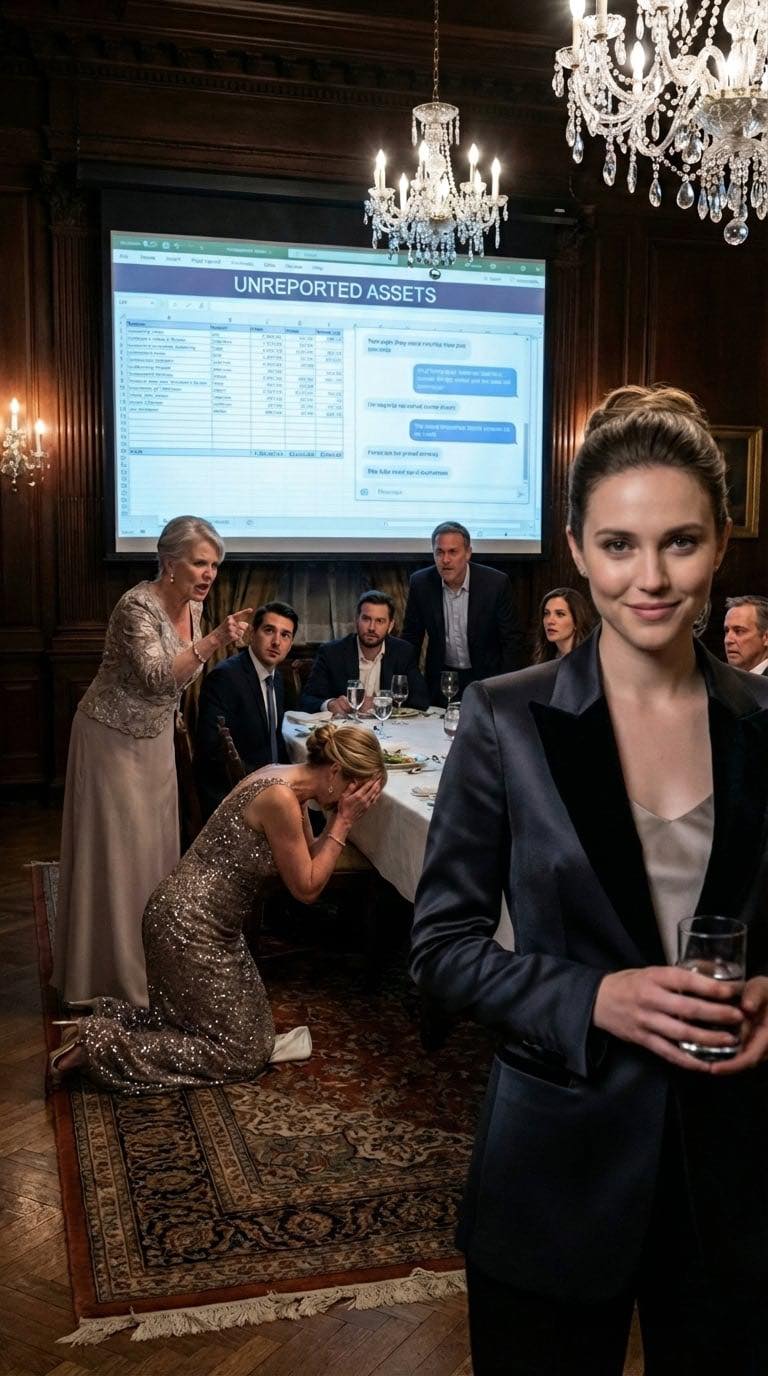
My name is Bianca Moore, and for twenty-eight years, I was the outlier in a family that traded in perfection. I am a financial analyst at a mid-sized firm in Boston, a profession chosen because numbers possess a purity that people do not. Numbers do not possess agendas; they do not harbor favorites; they do not lie to your face while stabbing you in the back. Or so I believed until last Mother’s Day, when my mother, Linda Moore, sent an itemized invoice for my existence to forty-eight members of our extended family.
The subject line was a jagged blade: The Cost of Raising a Disappointment.
The total at the bottom of the spreadsheet was $347,000. It was carbon-copied to every aunt, uncle, and distant cousin from the rocky coasts of Maine to the sun-bleached suburbs of California. My mother expected me to dissolve. She expected an apology, a public penance, a return to the state of quiet, shrunken compliance I had occupied since childhood.
She didn’t account for the fact that I had been auditing her for three years. I didn’t cry. I didn’t scream. I simply hit “Reply All” with a single attachment. By the following morning, forty-seven of those relatives had blocked her. The forty-eighth—my Grandma Eleanor—did something far more devastating.
But to understand the ending, you must understand the architecture of the lie.
—————
I live in a six-hundred-square-foot apartment in Somerville. It is modest, cramped, and entirely mine. I have paid every cent of my rent since the day I turned twenty-two. My sister, Vicki, who is three years my senior, recently closed on a sprawling four-bedroom colonial in Wellesley. My parents gifted her the eighty-thousand-dollar down payment, a gesture wrapped in a bow of “we’re just so proud of you.” I learned this not from a phone call, but from an Instagram post.
This was the Moore family ledger. Vicki was the investment; I was the overhead.
When Vicki made junior partner at her law firm, there was a catered gala with vintage champagne. When I graduated magna cum laude from Boston University with a finance degree, I received a text message from my mother three weeks late. No exclamation point. Just a period that felt like a closing door.
“Your mother just has a harder time expressing herself with you,” my father, Richard Moore, would say, patting my shoulder with a hand that never quite possessed the strength to defy her. “She means well.”
I used to believe that. I used to believe that if I just worked harder, stayed quieter, and minimized my “cost,” she would finally look at me with the same effervescent pride she reserved for Vicki. But working in finance teaches you a singular, brutal truth: if the books don’t balance after years of trying, it’s not because of a math error. It’s because someone is stealing from the till.
Three years ago, I began to look for the missing funds. It started with a rejected apartment application. My credit score was a five-hundred-and-twenty—a financial catastrophe for a twenty-two-year-old who had never even owned a credit card. I began digging, opening a clandestine folder on my laptop I titled “Insurance.”
Inside were screenshots, PDFs, and wire transfer records. I was collecting a different kind of invoice. And then came the invitation to the Mother’s Day Reunion. Forty-eight people at Grandma Eleanor’s farmhouse in Connecticut. My mother’s message in the group chat was saccharine: “Let’s make this Mother’s Day special. Family is everything.”
I stared at the screen, my boyfriend Marcus watching me from the kitchen. “You don’t have to go, Bianca,” he said softly.
“I know,” I replied, my fingers hovering over the Insurance folder. “But I think I’m finally ready to settle the accounts.”
As I packed my bags for the farmhouse, I didn’t know that I was walking into an execution—I just didn’t realize yet who would be holding the blade.
—————
I arrived at Grandma Eleanor’s at 7:00 AM. The dew was still clinging to the grass of the Connecticut countryside, the white colonial house standing like a monument to a legacy that was about to be dismantled. For four hours, I played the role of the dutiful daughter. I cooked, I scrubbed, I arranged forty-eight cloth napkins with the precision of a soldier.
Vicki arrived at noon in a cream silk dress, carrying peonies that cost more than my weekly groceries. She kissed my mother on both cheeks. “Everything looks perfect, Mom,” she cooed, ignoring the flour on my apron. “You really outdid yourself.”
“I had a little help,” my mother replied, her eyes sliding past me as if I were a piece of furniture she was considering replacing.
Lunch was a grand affair. Toasts were made to the sanctity of motherhood. My aunts wept over the sacrifices women make. My mother sat at the head of the table like a queen regent. Then, she stood up, the light catching the lavender silk of her dress.
“Being a mother is the hardest job in the world,” she began, her voice practiced and warm. “I have two daughters. One who has made me proud every day, and one who has… tested the limits of my grace.”
The room went cold. I felt forty-eight pairs of eyes pivot toward me.
“I’ve prepared a gift,” she said, pulling her phone from her pocket. “A reminder of what motherhood truly costs. I want everyone here to see the reality.”
Forty-eight phones chimed in a terrifying, digital chorus. Ding. Ding. Ding.
I looked down at my own device. There it was. An itemized spreadsheet of my life.
Hospital birth: $12,400.
Diapers (Years 1-2): $2,800.
Braces: $8,000.
College Room & Board: $48,000.
The final tally: $347,000.
“Orthodontia,” my mother read aloud, her voice ringing across the silent lawn. “Did she ever say thank you? Birthday parties: twelve hundred dollars over eighteen years. Did she ever appreciate a single one? This is what a thankless child costs. This is the price of a disappointment.”
She had even framed a copy of the bill in a gilded frame, hanging it above Grandma Eleanor’s mantle next to the family portrait. She turned to me, a smirk playing on her lips. The room waited for me to burst into tears. They waited for me to shrink into the back row, to apologize for the crime of being born.
But my pulse was steady. I stood up, the chair scraping against the hardwood like a challenge.
“Since we’re sharing numbers today, Mother,” I said, my voice cutting through the silence like a scalpel, “I think it’s only fair that I share mine. Keep your phones handy, everyone. I’m about to balance the books.”
I hit ‘Send’ on the email I had drafted three nights ago, and the air in the room didn’t just chill—n froze.
——————-
The second wave of notifications hit the room like a physical shock. My mother’s smirk didn’t just fade; it curdled.
“Bianca, sit down,” she hissed, her voice a low-frequency threat. “This is not the time.”
“Actually,” I said, stepping into the center of the room, “it’s the perfect time. You’ve presented your bill. Now, let’s look at your debts.”
I looked around the room as my relatives opened the three attachments I had sent. I had organized them with the cold efficiency of a forensic accountant.
“Attachment one,” I announced. “My college fund. Mother, you charged me forty-eight thousand dollars for room and board in your bill. But we all remember Grandma Eleanor and Grandpa Harrison setting up education trusts for both Vicki and me, don’t we? Eighty-nine thousand dollars each.”
I swiped on my phone, projecting the PDF to the family group chat. “My trust was emptied on August 3rd, 2016—one month before I started university. The funds were transferred to a private account belonging to Linda Moore. One week later, she purchased a new Lexus in cash. I graduated with sixty-seven thousand dollars in student loans. I am still paying for a car my mother drove for five years.”
A gasp rippled through the aunts. Richard, my father, stood up, his face ghostly. “Linda? What is she talking about?”
“Attachment two,” I continued, my voice gaining strength. “Tax fraud. From 2018 to 2024, my mother claimed me as a dependent on her federal taxes. I have lived on my own, paid my own rent, and filed my own returns since I was twenty-one. By claiming me illegally, she netted over thirty-two thousand dollars in fraudulent tax benefits. That is a federal crime.”
Uncle George, a retired accountant, adjusted his glasses, his face grim. “Linda, this is… this is very serious.”
“But the pièce de résistance is attachment three,” I said, turning to my sister. “Vicki, stand up.”
My sister froze, her cream silk dress suddenly looking like a shroud.
“In 2016, three credit cards were opened in my name and social security number. They were maxed out within eighteen months. Forty-seven thousand dollars in debt for designer handbags, electronics, and jewelry. For years, I couldn’t rent an apartment because my credit was destroyed.”
I pulled up the shipping receipts. “The billing address was mine. The shipping address? Vicki’s apartment in Wellesley. I have the delivery confirmations with Vicki’s signature. Vicki, you wore my stolen identity to your engagement party. That diamond on your finger? It was bought on a card that nearly landed me in a homeless shelter.”
Vicki’s husband, Derek, stared at her hand as if it were infected. The silence was no longer uncomfortable; it was lethal.
“Everything I did, I did for this family!” my mother screamed, her voice cracking. She reached for my father’s arm. “Richard, tell them! I was just trying to keep us afloat!”
My father didn’t touch her. He looked at her as if she were a stranger he’d accidentally met on a train.
“There is one more file,” I said softly. “The one I’ve held for three years. The one that explains why you’ve hated me since the day I was born.”
My mother lunged for my phone, her eyes wild with a terror I had never seen before, but Uncle Robert stepped between us.
——————-
“Don’t,” I said, my voice a whisper that carried further than her scream. “It’s already in their inboxes.”
The final attachment was a screenshot. A text message from my mother to Vicki, dated three years ago. I had seen it on Vicki’s phone when she left it on the counter during a holiday.
The text read: ‘This one isn’t Richard’s biological child. Don’t tell anyone. If he finds out, he’ll divorce me and I’ll lose everything.’
The farmhouse porch became a vacuum. I watched my father—the man who had taught me to ride a bike, who had helped me with my geometry homework, who had been the only quiet harbor in my storm—collapse into a chair.
“Richard,” my mother gasped, her voice a ragged plea. “I was seventeen. It was one time. I was scared.”
“You weren’t scared of the truth, Linda,” I said, the tears finally pricking my eyes. “You were scared of the consequences. So you spent twenty-eight years punishing me for being the evidence of your mistake. You made me the disappointment so that if the truth ever came out, no one would value me enough to listen.”
Grandma Eleanor rose from her seat. She did not go to her daughter. She walked to the mantle, grabbed the gilded frame containing the three-hundred-and-forty-seven-thousand-dollar bill, and threw it into the stone fireplace.
“I suspected,” Eleanor said, her voice like iron. “I suspected for years that something was rotting in this family. But I never imagined the depth of your depravity, Linda.”
“Mama, please—”
“Leave,” Eleanor commanded. “Take your ‘Golden Child’ and leave this house. You are no longer welcome on this land.”
The exodus was swift. Forty-seven relatives rose in a wave of collective revulsion. I watched through the window as cars began to pull out of the driveway, one by one. My mother and Vicki were left standing in the gravel, their designer dresses fluttering in the wind, two women who had traded their souls for a lifestyle they could no longer afford.
My father was the last to leave. He walked to me, his eyes red-rimmed. He didn’t say anything about DNA. He just pulled me into a hug that lasted for an eternity.
“You’re my daughter,” he whispered into my hair. “That is the only number that matters.”
As his car disappeared down the long farmhouse drive, Grandma Eleanor handed me a thick cream envelope—a secret she had been keeping for me.
——————-
“I tried to give this to you six years ago,” Grandma Eleanor said, sitting me down in the quiet of her study. “Your mother told me you refused it. She said you wanted to prove you didn’t need our help.”
I opened the envelope. Inside was a check for fifty thousand dollars, dated 2020. It was the graduation gift I never received.
“I’ve spent the morning with my attorney,” she continued, her face set in a mask of grim determination. “My will has been redistributed. Your mother was set to inherit thirty-five percent of this estate. Now? She gets five percent—just enough to ensure she cannot contest it in court. Your share, Bianca, has been tripled.”
The money didn’t matter as much as the validation. For the first time in my life, the ledger was not just balanced; I was in the black.
Two months later, I sat in my new apartment in Cambridge. It has high ceilings, a kitchen with actual counter space, and a view of the river. Marcus was hanging a painting on the wall when the mail arrived.
Among the bills and flyers was a letter with no return address, postmarked from Ohio.
Dear Miss Moore, it began. I received your DNA profile through a genealogy site. My name is Michael. I believe I am your biological father. I am not seeking money or a place in your life. I just thought you should know that you were never a mistake. You were the result of a summer I have never forgotten.
I stared at the letter for a long time. I thought about the thirty years of lies. I thought about the woman in Boston who was currently facing an IRS audit and a looming divorce.
I picked up my pen and began to write. Not an invoice. Not a confession.
I wrote a greeting.
—————–
My name is Bianca Moore, and I am no longer a disappointment.
My credit score is 748. My student loans are a memory. Every Sunday, I have dinner with my father—Richard Moore—and we talk about things that have nothing to do with biology and everything to do with love. Vicki has tried to call me twice, but some debts are too large to be forgiven with a phone call.
My mother once sent me a bill for three hundred and forty-seven thousand dollars. She calculated the cost of my diapers, my braces, and my birthday parties.
But she forgot to calculate the cost of a daughter who knows how to do the math.
I am paid in full. And for the first time in my life, I don’t owe anyone a single thing.
As I finished the letter to Michael, my phone buzzed. It was a message from an unknown number, but the area code was from Wellesley.
“Bianca, you think you won, but Mom didn’t tell you everything about the trust fund. There wasn’t just eighty-nine thousand. There was a second account Grandpa hidden. And you’re not the only one who found the password. If you want it back, you’ll have to meet me where it all began.”
It was Vicki. And the audit was just beginning.