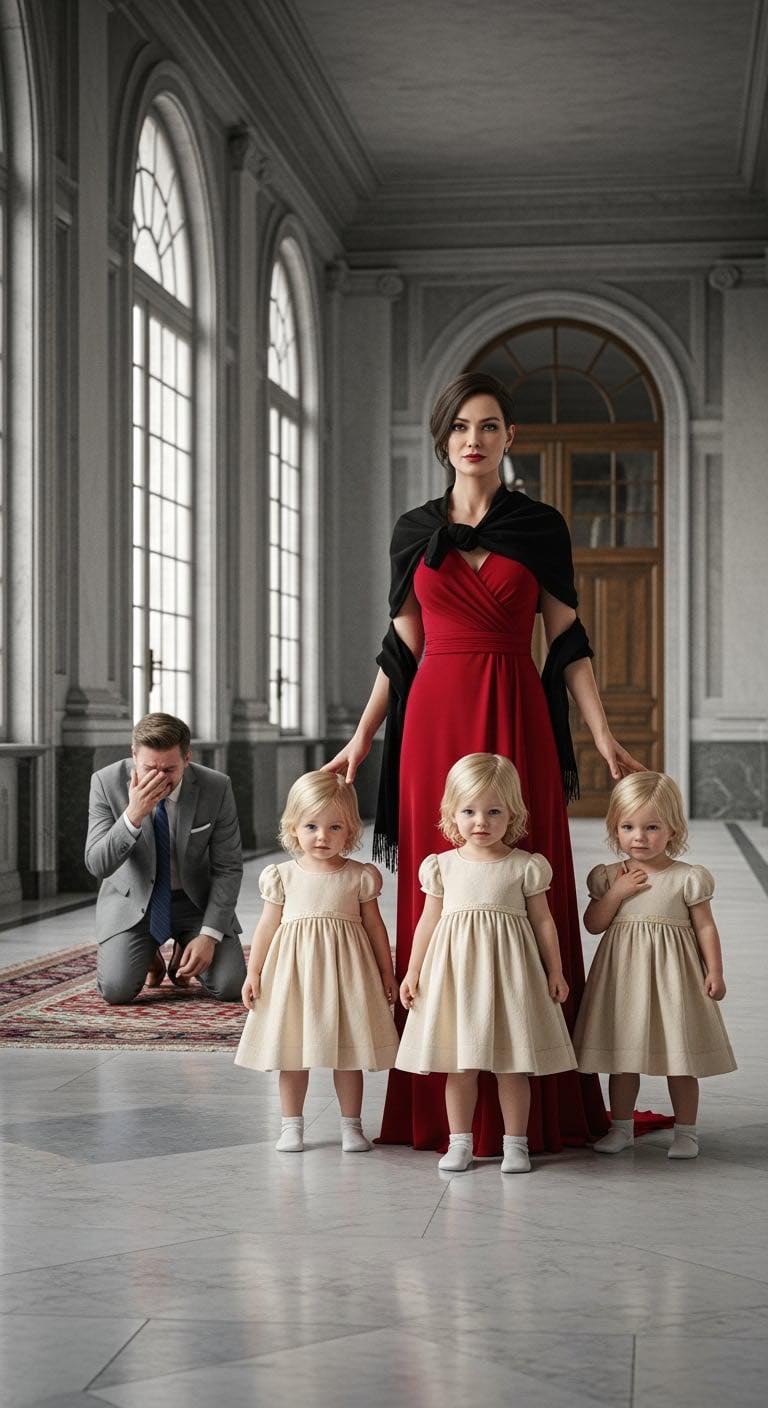
The Silent Variable: How I Erased the Man Who Erased Me
The ink on the divorce papers dried in a hospital hallway that smelled of industrial antiseptic and the metallic tang of blood. Behind the double doors of the surgical unit, I lay unconscious, my body stitched back together after an emergency C-section that had saved three premature lives but nearly extinguished my own.
Machines hummed. Red lights blinked in the dim twilight of the ICU. Somewhere inside that sterile fortress, a nurse whispered a prayer over my monitors.
Outside, Grant Holloway adjusted the cuffs of his Italian suit, took the pen from his lawyer, and signed his name without a tremor of hesitation.
Ten minutes earlier, I had flatlined. Grant didn’t ask if his children were breathing on their own. He didn’t ask if the woman he had vowed to love until death was going to wake up. He only asked the lawyer one question: “How fast can this be finalized?”
The answer was simple, immediate, and silent. Exactly how he liked his business dealings.
A doctor stepped out, exhaustion carved deep into the lines of her face. “Mr. Holloway? Your wife is critical,” she said, pulling down her mask. “She needs—”
“I am no longer her husband,” Grant interrupted, sliding the leather folder closed with a snap that echoed like a gunshot in the quiet corridor. His voice was calm, bored even. “Update her family.”
“I… I don’t understand,” the doctor stammered. “There is no other family listed.”
Grant paused for half a second, checking the time on his Patek Philippe watch. Then he nodded, as if that solved everything. “Then update the file.”
He turned and walked away, his polished leather shoes clicking rhythmically down the corridor, passing framed photos of smiling newborns and hopeful parents that mocked the transaction that had just occurred. Behind him, three infants fought for air in clear plastic incubators, already fatherless.
By morning, I would wake up divorced, uninsured, and legally powerless. Grant, meanwhile, rode the elevator down to the underground garage where his black Mercedes waited, engine purring.
He checked his phone. A message from Bel Knox lit the screen: Is it done?
He typed back one word: Yes.
As the car pulled into the thick Manhattan traffic, Grant allowed himself a thin smile. The timing was perfect. No messy custody battles, no medically fragile wife slowing him down. In six weeks, his company would enter its most important funding round. Investors wanted strength, not sentiment. They wanted a man who cut ties cleanly.
Up in the ICU, a nurse gently placed my trembling, unconscious hand against the glass of an incubator. The babies were alive, but barely. My lips moved in my sleep, a silent apology to children I hadn’t yet met.
What no one in that hallway knew—not the doctors, not the lawyers, not even Grant himself—was that the moment he signed those papers, he triggered a chain of consequences that would dismantle everything he believed he owned. The woman he had just erased was about to become the most dangerous mistake of his life.
I woke to the sound of an alarm I didn’t recognize and a hollowness in my body that felt wrong, as if something vital had been stolen. My throat was sandpaper dry, my head throbbed with a chemical haze. For a terrified moment, I couldn’t remember where I was or why I couldn’t move my legs.
Then the pain rushed back—a sharp, tearing ache through my abdomen that forced a gasp from my cracked lips.
A nurse hurried to my side, her face kind but guarded. “Easy,” she whispered. “You’ve been through a lot.”
“My babies,” I rasped, my voice raw from the breathing tube. “Where are my babies?”
The nurse hesitated. Not for long, but long enough for terror to spike in my chest. “They’re in the NICU,” she said softly. “They’re alive. Fighting. Very small, but stable for now.”
Relief flooded me so violently it made the room spin. Tears slid hot down my temples and soaked into the pillow. “Can I see them?”
The nurse looked away, busying herself with the IV drip. “There are… some things we need to go over first.”
A man I had never seen stepped into the room. He wasn’t a doctor. He held a tablet instead of flowers and wore a hospital badge that identified him as Administration.
“Mrs. Parker,” he began, then corrected himself without a shred of empathy. “Miss Parker. Room 202.”
The correction landed harder than the surgery.
“There has been a change to your marital status,” he continued, his voice flat, professional, reciting a script. “Your divorce was finalized early this morning.”
I stared at him, certain the morphine was making me hallucinate. “That’s not possible,” I whispered. “I was unconscious.”
“Yes,” he replied, tapping the screen. “But the paperwork was valid. Pre-signed contingencies.”
My heart began to hammer against my ribs, a frantic bird trapped in a cage. “Grant wouldn’t…”
“He did.” The man turned the tablet toward me. Grant’s signature stared back, bold, arrogant, familiar. My own name appeared beneath it—printed, authorized, executed. The date, the time—everything precise. Everything final.
“You are no longer covered under Mr. Holloway’s insurance,” he went on, oblivious to the world collapsing around me. “Hospital administration has reassigned your room. Your children’s medical decisions are currently under review pending custody and financial clarification.”
My fingers curled into the thin sheets, clutching them until my knuckles turned white. “Those are my children. Is he…”
“That’s being determined.”
The room began to tilt. “Where is he?” I demanded, my voice rising. “I want to see my husband.”
The man met my eyes for the first time, his expression blank. “Mr. Holloway has declined further involvement.”
After he left, the nurse returned—not with comfort, but with a wheelchair.
I was transferred to a smaller room on a different floor. No windows. No cardiac monitors. No warmth. I was given a thin, scratchy blanket and a clipboard of financial forms I could barely read through the tears blurring my vision.
Hours later, an orderly wheeled me past the NICU. I saw them through the glass wall. Three tiny bodies wrapped in wires and plastic, fighting battles I couldn’t fight for them. Their chests rose and fell in jerky, mechanical rhythms. I reached out, pressing my palm against the cold air, but the wheelchair kept moving.
That was when I finally understood the truth. I hadn’t just been divorced. I had been discarded. Erased.
As I lay alone that night in the dark, clutching the plastic hospital bracelet Grant had paid to remove, a soft knock sounded at my door. It wasn’t a nurse. It wasn’t a doctor. It was a knock that would change everything I believed about how alone I truly was.
Grant Holloway stood in front of the mirror in his Park Avenue penthouse, adjusting the silk tie of his custom suit. Sunlight poured through floor-to-ceiling windows, illuminating a world that bowed to his will. Manhattan stretched below him—sharp, obedient, and expensive.
His phone buzzed on the marble counter. Calendar Alert: Investor Breakfast, 9:00 AM.
He took a sip of black coffee, scrolling through overnight messages. Congratulatory notes on the upcoming funding round. A few cautious inquiries about the triplets, which he deleted without reading. No resistance. No backlash.
The divorce had been surgical. He felt lighter than he had in months. No more hospital visits. No more emotional landmines. No more explanations.
Lynn had become a liability the moment the pregnancy turned complicated. High-risk meant high stress, and Grant Holloway didn’t do stress. He eliminated it. Three premature babies were not a blessing in his world; they were an anchor. And Grant was a man designed to soar.
He grabbed his phone and dialed a number he had memorized long before the ink on the divorce papers dried.
“It’s done,” he said when Bel answered.
She laughed softly on the other end, the sound bright and relieved. “I told you it would work out. You just needed to be decisive.”
“I always am.”
Bel was waiting for him at The Plaza later that night. A strategic appearance. Nothing public yet—just enough to plant the idea. A fresh start. A new image. A woman who fit beside him, sleek and uncomplicated, instead of a wife dragging him down into domestic chaos.
As he stepped into the elevator, Grant allowed himself a moment of pure satisfaction. The narrative was his to control now. He was the CEO who made hard choices. The man who didn’t let personal weakness interfere with professional growth. No one would ask where Lynn went. In New York, people disappeared every day.
By mid-morning, he sat at the head of a glass conference table overlooking Wall Street, his fingers wrapped around a Montblanc pen. He spoke to potential investors with a magnetic confidence.
“This company is entering its strongest phase,” Grant said smoothly. “No distractions. No instability.”
The men across from him nodded, impressed. Then, his assistant slipped into the room, her face pale. She leaned close to his ear.
“Sir,” she whispered. “There’s an issue with one of the funding channels.”
Grant frowned, keeping his smile fixed for the room. “Which one?”
“The Parker Hale Trust.”
The name barely registered. “We don’t work with them.”
“Not directly,” she murmured. “But their capital influences two of our secondary partners. They’ve paused pending review.”
Grant leaned back, masking a flicker of irritation. “That’s temporary.”
“Yes,” she replied, her voice trembling slightly. “But they’ve requested updated disclosures on personal risk exposure.”
Grant’s jaw tightened. “I’ll handle it.”
The meeting resumed, but the air in the room had shifted. For the first time that day, Grant felt a faint, cold edge of unease. He pushed it away. He had lawyers. He had advisors. He had influence. This was nothing.
Outside, his phone buzzed again. Unknown number. He ignored it.
He didn’t know that the message waiting on his screen was the first crack in the dam. He didn’t know that the system he trusted was already turning its gears against him. And he certainly didn’t know that the woman he had left in a windowless room was about to become the silent variable he could no longer control.
The transfer happened without ceremony. I woke from a shallow, drug-induced sleep to the sound of wheels rolling and voices I didn’t recognize. My chart was lifted from the foot of my bed. The IV pole rattled as it was disconnected and reattached.
“Where are you taking me?” my voice was thin, unsteady.
A nurse avoided my eyes. “Administration orders.”
They moved me from the private recovery wing Grant had insisted on months earlier to a general postpartum floor on the far side of the hospital. The lighting was harsher here. The walls were bare beige. The room smelled faintly of bleach and old coffee instead of lavender sanitizer.
My new bed squeaked when I shifted, and the blanket was so thin I could feel the chill of the AC unit rattling in the window.
An hour later, a billing coordinator appeared. She wore a practiced smile that didn’t reach her eyes and held a clipboard full of numbers that looked like a prison sentence.
“We just need to review your coverage,” she said brightly.
I swallowed, my throat tight. “My husband…”
The woman’s fingers paused over the paper. “Your former husband terminated authorization this morning.”
The words settled slowly, like dust after a building collapse.
“So, what does that mean?” I asked.
“It means,” she replied, lowering her voice to a conspiratorial whisper, “that extended NICU care for your children will require alternative arrangements.”
My heart slammed against my ribs. “They’re premature. They need machines to breathe.”
“Yes,” she said gently, closing the folder. “Which is why we need confirmation of payment responsibility.”
Payment responsibility. The words felt obscene when spoken about three infants fighting for every breath.
That afternoon, I dragged myself out of bed. I was wheeled past the NICU again—this time intentionally. I begged the orderly to stop, just for a moment. He hesitated, seeing the desperation in my eyes, and slowed the chair.
I pressed my palm against the glass. Three incubators. Three lives. One of them twitched weakly, a tiny hand curling around a tube.
“I’m here,” I whispered, though the glass was thick and they couldn’t hear me. “I’m not leaving you.”
“Miss Parker.”
I turned. A hospital administrator stood behind me, her tone clipped. “We need to discuss discharge planning.”
Panic flared hot in my chest. “Discharge? I can barely walk. I had surgery three days ago.”
“Medically,” the woman replied, checking her watch, “you are stable enough to recover at home.”
“I don’t have a home,” I said, the shame burning my face. “He took the apartment.”
The administrator nodded once, as if checking a box. “You’ll need to arrange temporary accommodation immediately.”
The cruelty wasn’t loud. It didn’t shout. It moved through paperwork and policy, through signatures and silence. By evening, my meals were downgraded. My pain medication was reduced. Visiting privileges were restricted due to “capacity.”
I lay alone, listening to the distant cries of other newborns down the hall, wondering if my children cried the same way, and if anyone was there to hold them.
Across the city, Grant Holloway signed off on the final insurance cancellation with the same efficiency he applied to his quarterly reports. It wasn’t personal, he told himself. It was necessary hygiene.
Back in my room, I stared at my phone, scrolling through the dozen messages I had sent Grant. None delivered. All blocked. My hands trembled as I typed one final plea I knew would never be read: They need me. Please.
I didn’t send it. instead, I curled onto my side, protecting a body that had already given everything it had, and let the truth settle fully. Grant hadn’t just left. He was actively ensuring I couldn’t survive without him.
But as the lights dimmed and I closed my eyes, unaware that eyes were already watching this injustice closely, a single decision was being made somewhere else in the hospital. One that would quietly undo Grant’s careful cruelty.
The decision was made in a cramped office at the end of the ICU corridor, far from the administrators and their polished clipboards. Dr. Naomi Reed stood with her arms crossed, staring at the medical chart glowing on her computer screen.
Three patient IDs. Three premature infants. All born under extreme conditions, all requiring advanced respiratory support, and all suddenly flagged for “financial review.”
She had seen this before. Not often, but enough to recognize the stench of it. Power stepping in where compassion should have been. The system never called it cruelty; it called it “policy.”
A junior nurse knocked lightly on the open door. “Dr. Reed? Administration wants confirmation on the Parker triplets.”
Naomi looked up, her eyes sharp behind her glasses. “Confirmation of what?”
“That we’re prepared to… downgrade intervention if coverage lapses,” the nurse said quietly, shame flickering across her face.
Naomi’s jaw tightened. “Absolutely not.”
She stood and walked briskly toward the NICU, her heels echoing with purpose. The room was dim, filled with the steady rhythm of ventilators. She stopped at the first incubator, watching the baby’s chest rise and fall.
“They’re stable,” Naomi said aloud. “Fragile, but stable.”
She pulled up my file. Marilyn Lynn Parker. 31. Emergency C-section. Severe blood loss. No next of kin listed. Divorced hours after surgery.
Naomi walked back to her office and opened a secure file folder she hadn’t touched in years. Inside were copies of incident reports and legal guidance she had saved after a similar case nearly destroyed a young mother’s life a decade earlier.
She picked up her phone and dialed a number from memory.
“Ethan Cole.” A man answered after two rings.
“It’s Naomi Reed,” she said. “I need legal counsel. Not for the hospital. For a patient.”
There was a pause. “That’s a rare call,” Ethan replied, his voice deepening. “What’s happening?”
Naomi explained everything. The divorce, the insurance termination, the attempt to leverage medical decisions based on money. When she finished, the line was silent for a long moment.
“Do you know who Marilyn Parker is?” Ethan finally asked.
“No,” Naomi said honestly. “Just that she’s being crushed.”
Ethan exhaled slowly. “Then listen carefully. Do not let them move those babies. Document everything. Every conversation, every request, every signature.”
Naomi’s pulse quickened. “Why?”
“Because,” he said, his voice grave, “this isn’t just a custody dispute. That name is connected to a trust that hasn’t surfaced in over a decade.”
Naomi returned to the NICU and spoke to her team with calm authority. “No changes to treatment plans without my direct approval. If anyone pressures you, send them to me.”
That evening, Naomi visited my room herself. I looked up, eyes hollow with exhaustion.
“I’m Dr. Reed,” she said gently. “I oversee the NICU.”
I struggled to sit up. “Are my babies…?”
“They’re alive,” she said, taking my hand. “And they will stay that way. They are trying to take them from you, but not without a fight.”
As she left, she sent one final email marked Confidential, attaching every documented irregularity. Somewhere across the city, a legal mechanism long dormant began to stir.
The knock came just after midnight. Soft but deliberate.
“Yes?” I whispered.
The door opened. A man in his early forties stepped inside. He was tall, wearing a charcoal coat that smelled of cold air and expensive wool. He didn’t look like hospital staff; he looked like someone who lived in courtrooms.
“My name is Ethan Cole,” he said quietly. “I’m here because Dr. Naomi Reed asked me to come.”
“Is something wrong with the babies?” Panic flared instantly.
“No,” Ethan said quickly, raising a hand. “They’re stable. This isn’t about their condition. It’s about your name.”
I frowned. “You already know my name.”
“Yes,” he replied, pulling a metal chair closer to the bed. “But I don’t think you know what it means.”
I let out a bitter, jagged laugh. “It means I trusted the wrong man.”
Ethan didn’t smile. He opened his briefcase and removed a single sealed envelope, thick and yellowed with age. “It means Parker.”
The word hung in the air. “My mother’s maiden name,” I said slowly. “Why?”
“Because your grandmother, Eleanor Parker Hale, built one of the most private, fortified investment trusts on the East Coast. And you are listed as her sole surviving beneficiary.”
I stared at him, certain exhaustion had finally pushed me into delirium. “That’s not possible. My grandmother died years ago. If there was money, someone would have told me.”
“They tried,” Ethan said gently. “But the trust was locked in litigation. Family disputes, challenges from distant cousins. It has been frozen for twelve years.”
“So why now?”
“Because of a clause,” Ethan replied. “One that activates only after the birth of legitimate heirs. Multiple heirs, to be exact.”
My breath caught in my throat. “My children?”
“Yes.”
The room felt suddenly too small. “So… what does that mean? I have access to it?”
Ethan shook his head. “Not immediately. There is a mandatory review period. Ninety days. Until then, the assets remain inaccessible.”
Hope flared, then died. “So it doesn’t help me,” I whispered. “Not now. I have nowhere to go.”
“It helps you more than you realize,” Ethan said, leaning forward intently. “Because from the moment that clause was triggered, you became legally protected. Your ex-husband’s actions—cutting insurance, interfering with medical care—are now documented as attempts to leverage financial harm against a protected beneficiary.”
My hands trembled. “Grant didn’t know any of this.”
“No,” Ethan said, a dangerous glint in his eye. “And that is going to be his fatal mistake.”
Tears slid down my cheeks—not from despair, but from something sharp and unfamiliar. Validation. Proof that I wasn’t crazy to feel erased.
“So what happens now?” I asked.
Ethan stood up, snapping the briefcase shut. “Now, we wait. We make sure you and your children survive long enough to collect what was always meant to be yours. And from this moment on, everything Grant does will be watched.”
The ninety-day review period sounded reasonable on paper. In reality, it felt like a prison sentence.
I was discharged two days later with a prescription I couldn’t afford to refill and instructions that assumed I had a home waiting for me. I didn’t. I left the hospital in a borrowed coat, my bag lighter than when I arrived. No babies in my arms. Just paperwork and pain.
I had forty-seven dollars in my account. Enough for an Uber to a cheap studio on the edge of Queens. It smelled of mildew and old frying oil, but it had a bed.
Every morning, I took the subway back to the hospital, my C-section stitches burning with every step. I stood outside the NICU glass for hours, memorizing the rhythm of the monitors. I learned the sound of each baby’s breathing.
Grant never came.
On day five, a letter arrived, forwarded by the hospital. Official. Heavy. Grant had filed for emergency custody, citing “maternal instability and lack of financial capacity.”
My hands shook as I read it. I called Ethan.
“He’s trying to take them,” I choked out.
“I know,” Ethan replied calmly. “He filed the moment he realized the trust was involved. He knows something is up, but not enough.”
“What do I do?”
“You meet Julian Cross.”
Julian was a strategist. He met me in a nondescript office in Midtown. He was calm, unflashy, and offered me something better than pity: leverage.
“I’m not here to rescue you,” Julian said, sliding a folder across the table. “I’m offering you structure. Silence. Time.”
Inside were documents for temporary housing near the hospital and a modest stipend labeled as a “consultancy retainer.”
“Why?” I asked.
“Because I don’t like bullies who mistake patience for weakness,” Julian replied. “Do not react to Grant. Let him think you’re cornered. Let him overplay his hand.”
So I did. I moved into the small apartment Julian arranged. I ate full meals. I touched my babies skin-to-skin.
Grant filed motions. He leaked stories to the press about my “breakdown.” He waited for me to scream, to fight back publicly. I gave him nothing. Silence.
Grant Holloway decided it was time to be seen. If I wasn’t cracking, he needed to prove he was winning.
The charity gala at The Plaza was his stage. He arrived with Bel Knox on his arm, cameras flashing. He spoke about “resilience” and “hard choices.” He felt untouchable.
But in the middle of a toast, his phone vibrated. A message from his CFO: We have a problem. One of our anchor investors has paused. They cited exposure concerns tied to a legacy trust review.
Grant frowned. Which trust?
Parker Hale.
The corridor felt suddenly too warm. Grant returned to the ballroom, smiling, laughing, but the music sounded sharper. The room felt smaller.
He tried to regain control the only way he knew how—by squeezing harder. He reached out to me, asking for a meeting “for the sake of the children.”
I agreed.
We met in a neutral conference room. Grant looked concerned, regretful—a performance calibrated perfectly.
“This doesn’t have to be a war,” he said, sliding a settlement proposal across the table. It was generous, on the surface. But it required me to waive all future claims.
“I’m so tired, Grant,” I said softly, lowering my eyes. “I just want peace.”
He relaxed. He thought he had won. He pushed a Montblanc pen toward me.
I signed.
What Grant didn’t notice was the second document beneath the settlement—an addendum, perfectly legal, triggered only by the activation of a protected trust. By signing the settlement, Grant acknowledged the existence of the trust and unknowingly admitted to financial coercion.
He walked out smiling. He had just signed his own confession.
The Boardroom on the 42nd floor was a glass throne room where Grant had always ruled. Today, the air was different.
Grant stood at the window, watching the traffic. The board had called an emergency meeting. When he turned, the room was full. Advisors. Lawyers.
And me.
I walked in wearing a simple navy dress. No armor. Just clarity. Grant’s face went white.
“What is she doing here?” he snapped.
“She is here at my invitation,” Julian Cross said, stepping in behind me.
“I won’t take much time,” I said, my voice steady. “I’m not here to discuss our marriage. I’m here to clarify risk.”
I laid the documents on the table. “The Parker Hale Trust has completed its activation. While assets remain restricted, beneficiary protections are fully enforceable. Any entity financially entangled with actions deemed coercive is subject to secondary review.”
Grant looked at the board. “She’s bluffing.”
“I’m not,” I said. “You signed the acknowledgment yourself last week.”
A screen lit up. Dates. Filings. Grant’s own signatures, now reframed as evidence of liability.
The Board Chair cleared his throat. “We are invoking the contingency clause. Effective immediately, the board will appoint an interim CEO.”
Grant laughed, sharp and humorless. “You’re sidelining me because of a personal matter?”
“We’re protecting the company,” the Chair replied. “From you.”
Grant looked at me one last time. “You planned this.”
“No, Grant,” I said, meeting his gaze. “I survived it.”
The fallout was quiet. There were no sirens. Just a calendar stripped bare. Meetings cancelled. Calls ignored.
Bel Knox found out her invitations had stopped coming. She went to Grant’s penthouse to find him staring at the city, a glass of whiskey in his hand.
“You should have told me things were falling apart,” she snapped.
“You stood beside power,” Grant said coldly. “Now you’re realizing it wasn’t yours.”
She left him that night.
Grant tried to see me one last time at the hospital. He found me holding my son, the monitors finally quiet.
“I’ve lost the company,” he said, his voice stripped of arrogance. “I never meant for it to go this far.”
“That’s the problem,” I said softly. “You never thought it would.”
“We could fix this,” he pleaded. “For the kids.”
“You don’t get to use them now,” I said. “You walked away before they could breathe.”
“I made mistakes.”
“Yes. And mistakes have consequences.”
He left, defeated.
The custody hearing was short. Dr. Reed testified. The financial records spoke for themselves. I was awarded full physical and legal custody.
Ninety days ended. The trust unlocked.
I didn’t buy a mansion. I paid off every medical bill in that hospital. I set up a fund for other preemies. And then, I went home.
Months later, on a quiet Sunday, Julian Cross knelt on my living room floor, playing with three healthy, gurgling babies. He looked up at me.
“Will you build a life with me?” he asked.
“Yes,” I said.
We were married in a small garden overlooking the Hudson. No press. Just the people who showed up when it counted.
Across the city, Grant Holloway sat in a small, rented office, watching a news alert about a leadership award given to someone else. He had believed power protected him. He had been wrong.
I stood by the window of my new home, my husband’s hand in mine, watching my children sleep. I smiled. Not because I had destroyed Grant. But because I had survived him.
The greatest justice wasn’t his fall. It was my peace.