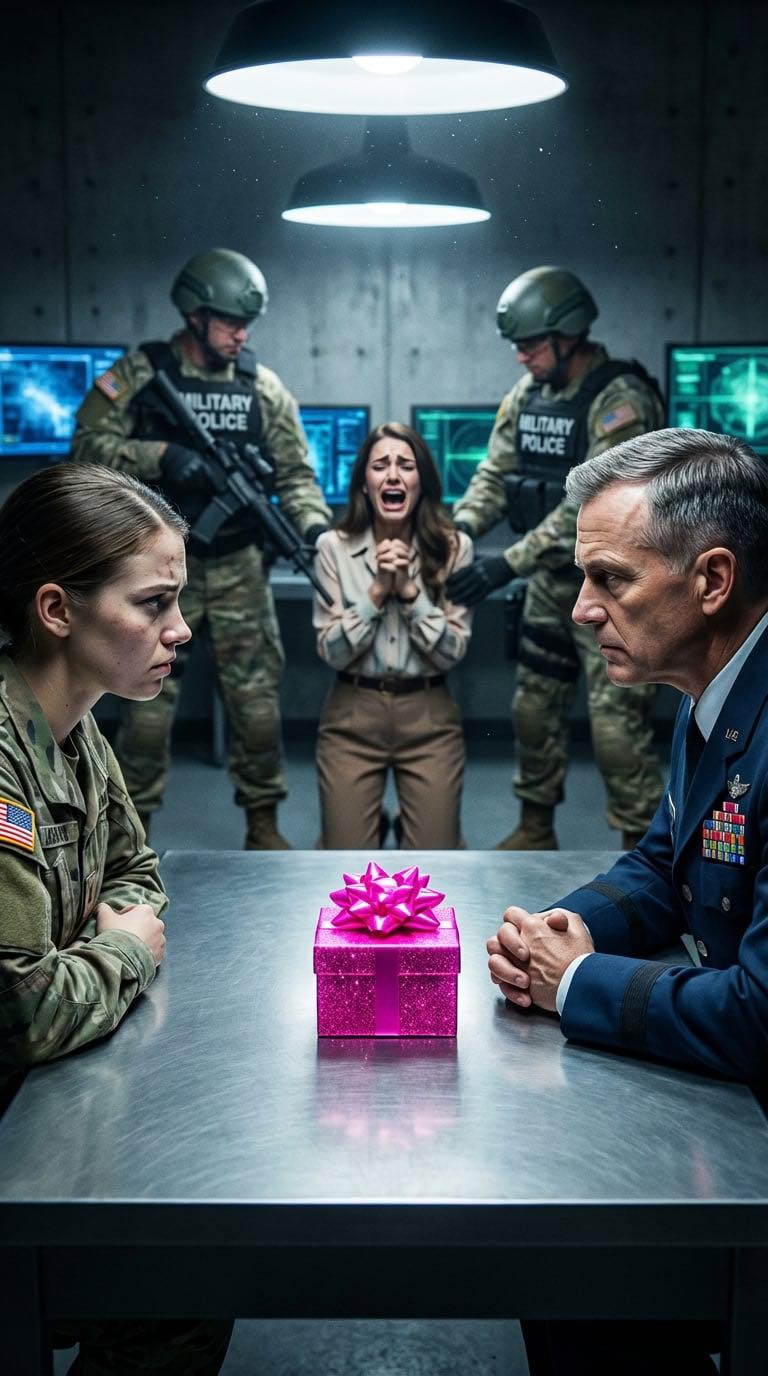
The atmosphere in a Secure Compartmented Information Facility—a SCIF—has a specific weight. It presses against your eardrums, a silence that isn’t empty but is instead dense with secrets. When Colonel O’Neal placed the evidence bag on the steel table, the room shifted. It wasn’t a physical tilt, but the sudden, vertiginous drop of my two separate lives colliding violently.
“Colonel, she doesn’t…” I started, the instinct to protect kicking in before my brain could catch up.
I stopped myself. The air conditioner hummed, a low, indifferent drone.
He turned toward me. His face was a landscape of deep lines and granite patience, illuminated by the harsh fluorescent strips overhead. “We both know intent isn’t the point, Lieutenant.”
Lieutenant.
My title was still fresh, the silver bar on my collar barely a month old. Hearing it in that clipped, gravelly tone brought a terrifying clarity. This wasn’t about my sister’s sense of humor. It wasn’t about a misunderstanding at a family barbecue. It was about protocol. And once a machine as vast and unforgiving as the Department of Defense moves into motion, there is no casual way to stop it.
The truth settled in with a cold finality, heavier than the reinforced concrete walls surrounding us. Sophia had no idea what she had set in motion. She thought the world was a stage for her amusement. She was about to learn that some stages have trapdoors.
I looked at the package in the bag. Bright, obnoxious pink wrapping paper. A glittery bow. And a return address that screamed carelessness.
“No, sir,” I said, my voice finding the flat, steady timbre I used for mission briefings. “Intent is irrelevant. The trigger has been pulled.”
————-
To understand why I didn’t reach for the phone to warn her, you have to understand the strange, bifurcated life you learn to live in this field.
In one world, I am Aaron Scott, the quiet daughter at the end of the family table. I am the footnote in conversations dominated by Sophia’s latest marketing campaign, her new Audi, or her “influence.” In that world, I am beige. I am the one who passes the salt while my parents gaze adoringly at my sister, their faces lit by the glow of her charisma.
In the other world, I am Lieutenant Scott, call sign Echo 12. I am a lead analyst for a specialized threat detection unit. My job is to scan rivers of encrypted data for the subtle, rhythmic disturbances that signal a coming storm. I interpret the whispers of warlords and the digital footprints of ghosts.
These two worlds were designed never to touch.
The last time I saw my family before the package arrived was Christmas. The house in Connecticut smelled of cinnamon, pine, and expensive perfume. Music drifted from the living room, where Sophia was holding court. She had her phone angled just so, the ring light reflecting in her eyes, as she filmed a story about getting a soda company’s hashtag to trend globally in forty minutes.
My parents leaned in, smiling like they were front-row VIPs at the only show that mattered.
“She’s a genius,” my mother whispered, clutching her wine glass.
I waited until the recording stopped and the applause died down. I cleared my throat. “I actually got some news too,” I said. “I scored in the top percentile on the Cryptologic Aptitude Assessment. It’s… well, it’s a test that usually takes seasoned analysts weeks to pass. I did it in four hours.”
The pause was brief, polite, and devastating.
My father gave a distracted nod, his eyes drifting back to Sophia’s screen. “That’s nice, honey. Really. But you know what truly makes a difference in this world? Results you can see. Things people can like and share.”
Sophia laughed, reaching over to pat my hand. “It’s adorable, Aaron. You and your little puzzles. It keeps you busy.”
And just like that, my reality vanished. I was erased.
But in my real world—the one behind retina scanners and armed guards—there is no applause. There is only the steady thrum of cooling fans and the cascade of code. Weeks before that Christmas, I had caught a “puzzle.” It was a subtle jitter in a transmission from a high-threat region in Eastern Europe. Most analysts would have brushed it off as atmospheric static.
I knew better.
Within twenty minutes, I had traced the intrusion, flagged the IP, and written a threat assessment that went straight to Colonel O’Neal’s secure terminal. He had appeared at my workstation an hour later, tablet in hand. He didn’t smile. He didn’t pat my hand.
“Good catch, Echo 12,” he had said.
That was it. No fanfare. Just the pure, unadulterated respect of a superior who knew that I had just saved a dozen undercover operatives from exposure.
Now, thanks to Sophia’s package, the gap between those two worlds was closing hard. She thought she was mailing me a joke, a gag gift to remind me that I would never be as important or as interesting as she was. She wanted to invade my workspace with her brand of chaotic glitter.
What she didn’t know was that the system she had tripped didn’t care about bloodlines. And as I stared at the evidence bag, I realized something terrifying: neither did I.
By the time the package cleared the initial radiological and chemical scans, the base was already under a restricted movement order. Doors that usually swung open with a badge swipe now required biometric double-authentication. Security teams moved in pairs, their hands resting near their sidearms.
Colonel O’Neal called me into the briefing room—the one with no windows and a single camera blinking in the corner like a reptile’s eye.
“Here is the situation,” O’Neal said, sitting down. “The phrase written on the card inside the package, paired with the classified address, triggered a Red Alert Protocol.”
Red Alert. The words hung in the air.
The system assumes hostile intent until proven otherwise. It wasn’t a suggestion; it was a mandate written in federal law. Once engaged, it pulled resources from the FBI, the NSA, and Homeland Security. It initiated deep-dive background checks that would unearth every parking ticket and deleted text message. It demanded a mandatory custodial interview with the sender.
O’Neal leaned back, studying me with eyes that had seen wars start and end. “I can classify this as a non-credible domestic incident, Lieutenant. The report disappears. I burn the package. No one has to know.”
It was a lifeline. A golden ticket. Most people would grab it without hesitation. Bury the mistake. Protect the family name. Save the sister from embarrassment.
But I didn’t move.
The years of being minimized rose up in my throat. The “little spy” comments. The dismissal at the dinner table. The arrogance of a woman who thought the world was hers to play with.
“She’ll never understand if we make this vanish,” I said finally. My voice sounded strange to my own ears—cold, detached, powerful.
His gaze held mine, weighing the soul of the officer sitting across from him. “You’re sure? This isn’t a bell you can un-ring.”
“Yes, sir,” I said. “The process was triggered by data, not opinion. We finish it.”
He gave a slow nod, the decision settling between us like a signed death warrant for my old life. “Then you will compile the preliminary investigation file. You know the drill. Treat her as a Subject of Interest.”
“Understood.”
I stood up, walked to a secure terminal, and began feeding the system every open-source detail about Sophia Langford. Her job, her social media activity, her travel history. I uploaded every post where she had mocked my job, every geo-tagged photo. I wasn’t inventing anything. I was simply holding a mirror up to her trail of carelessness.
When I hit Submit, I felt a vibration through the floorboards. The machine was waking up.
Two days later, the chain of custody ended. I stood behind the one-way glass of Interrogation Room 3, watching the door open. Two Military Police officers escorted Sophia in. She was still wearing the sleek navy dress I’d seen on her Instagram that morning, but her confidence was beginning to crack. She looked around the grey box, annoyed, waiting for an apology. She had no idea that the person watching her wasn’t her sister, but an analyst dissecting a threat.
Interrogation Room 3 was designed to strip a human being of their defenses. It was a perfect grey cube. No windows. No clock. The ventilation system hissed with a white noise that made silence feel heavy, pressing against the skin.
I watched from the darkened observation room. The monitors in front of me displayed Sophia’s biometrics: heart rate elevated, pupil dilation normal, skin temperature rising.
She sat down with practiced poise, crossing her legs and smoothing her skirt. She checked her watch. She sighed loudly, performing impatience for an audience she couldn’t see.
The heavy steel door clicked shut, locking with a magnetic thud.
She glanced at the mirrored wall. She fixed her hair. She practiced a smile—the “charming but confused” look that usually got her out of speeding tickets. She thought this was a misunderstanding. She thought some middle manager in a uniform would walk in, apologize for the inconvenience, and ask for a selfie.
The door opened.
Colonel O’Neal stepped in. He didn’t look like a middle manager. He looked like a weapon. His posture was a wall in itself—straight back, squared shoulders. He carried a single metal chair, placed it opposite her, and stood. He didn’t sit.
“Sophia Langford,” he began. His voice was stripped of all humanity. “You are the sender of a package that triggered a Level Four Security Alert at this facility.”
Sophia laughed. It was short, sharp, and dismissive. “It was a birthday gift for my sister. This is ridiculous. Do you know who I am?”
O’Neal didn’t blink. He didn’t acknowledge the interruption. “The package contained a phrase used by a known foreign intelligence network to initiate contact with compromised assets.”
Her smile faltered. The corners of her mouth twitched. “What? No. It’s an inside joke. Ask Aaron. She’ll tell you. Is she here? Can you get her?”
He didn’t glance toward the glass. “Our concern is determining whether you acted under coercion, as a willing participant in espionage, or out of reckless disregard for national security.”
Those terms—coercion, willing participant, espionage—hit her like physical blows. These were words she heard in movies, not in her life.
“Espionage?” Her voice jumped an octave. “I work in marketing!”
“I saw the moment the reality landed. Her shoulders stiffened. The color drained from her face, leaving her makeup standing out like war paint on a corpse.
And then, as if on cue, O’Neal stepped aside.
“Enter,” he said.
I opened the door and walked in.
I was not wearing the beige sweaters of Aaron Scott. I was in full Service Dress Blue. The uniform fit perfectly, tailored to the millimeter. My ribbons were aligned. The lieutenant’s bars on my shoulders caught the harsh overhead light. In my hand, I carried a thick folder stamped CLASSIFIED / NOFORN.
I stopped beside O’Neal, facing her directly for the first time in months.
Her eyes widened. Recognition flooded in, followed instantly by shock, and then, finally, fear.
“Aaron?” she whispered.
I didn’t smile. I didn’t rush to hug her. The chair across from her stayed empty. A deliberate absence.
“Sir,” I said to O’Neal, keeping my eyes fixed on the wall above her head. “Preliminary threat assessment on the individual is complete.”
I let the formality hang there. Individual. Not sister. Not Sophia. Individual.
She blinked, her gaze bouncing frantically between O’Neal and me. “Aaron, stop it. This is insane. Tell them it’s a mistake. Tell them it’s a joke!”
I opened the folder on the table. I slid a single page forward.
“The phrase you wrote on that card,” I began, my tone clinical, the voice of Echo 12. “Matches a recognition signal used by a sleeper cell we have been tracking for eighteen months. It is deployed to confirm a compromised asset is ready for extraction.”
Her mouth opened, then closed. She looked small. “I… I saw it on a show. I thought it sounded funny. I’ve called you ‘my little spy’ for years.”
“In this environment,” I replied, cutting her off, “jokes like that get agents pulled from the field. Your package, sent to this secure address at this specific time, nearly collapsed an active counter-intelligence operation. It forced us to extract three deep-cover officers from hostile territory because we couldn’t be sure the channel hadn’t been burned.”
It was a lie—partially. The operation hadn’t collapsed, but the risk was real. The extraction protocols had spun up. The cost was in the millions.
Her hands were fidgeting in her lap now, fingers twisting the expensive fabric of her dress until her knuckles turned white.
O’Neal stepped closer to the table. “Lieutenant Scott is the Lead Analyst for the division you are currently under investigation by. She put your name in that report herself. Because it was her duty.”
That was the breaking point.
I saw the hierarchy of our entire lives shatter. The years she had spent brushing me aside, treating me like a prop in her main-character energy, crumbled under the weight of the reality of who was actually in control.
“You’re enjoying this,” she whispered, tears pooling in her eyes.
“No,” I said. My voice was quiet, but it filled the room. “I am simply making sure you understand that actions have consequences. Something you have managed to avoid your entire life.”
For a long moment, no one spoke. The hum of the ventilation was the only sound in the world. This was my arena. These were my rules.
O’Neal closed the folder. He signaled to the MPs outside.
“We’re done here for now. Process her for the NDA.”
The MPs entered without a word, one at each side of her chair. Sophia looked at me like she wanted to speak—an apology, an excuse, a plea for the sister she used to ignore.
But I didn’t give her the chance. I turned on my heel, a sharp pivot, and walked out the door before she could say a word.
Six hours later, the door to the holding area opened. Sophia stepped out, clutching a National Security Letter and a Non-Disclosure Agreement that would bind her to silence for the rest of her life under threat of federal prison. She scanned the busy corridor until she found me. I was standing with my team, discussing satellite telemetry. She took a step toward me, her lips parting. I met her gaze for one second—cool, professional, distant—and then I turned my back.
That night, the base settled into its nocturnal rhythm. My desk lamp cast a pool of gold over the mission briefs. The hum of electronics was comforting, a lullaby of logic and order.
I could still picture Sophia in that hallway. She looked stripped. Not just of her makeup or her poise, but of her certainty. For the first time, she had walked into a room where her charm was not currency.
In the weeks that followed, the investigation concluded exactly as I knew it would. There were no criminal charges filed—intent does matter in a court of law, if not in protocol—but she now had a permanent file. She was flagged in the system. Her Global Entry would be revoked. Her background checks for employment would now come with a “Pending Review” flag.
The system had done its job. And I had done mine.
Six months later, I stood in the secure auditorium. The rank on my shoulders felt heavier, but familiar now. Before me sat a room of forty new intelligence analysts, fresh from the Farm, their notebooks open and pens ready.
On the massive screen behind me was a case study labeled simply: DOMESTIC ORIGIN ANOMALY – CASE 91A.
I walked them through it step by step. I didn’t frame it as a personal grievance. I framed it as a lesson in vigilance.
“We analyze patterns,” I told them, pacing the stage. “But sometimes the anomaly comes from the places we feel safest. You will see how a careless phrase on a package can mimic a kill code. You will see how our duty does not bend for blood or friendship.”
I showed them the timeline. The trigger. The extraction cost.
When I finished, the room was silent. They looked at me with something I recognized from my mirror: focus.
Colonel O’Neal was waiting at the back of the room as the recruits filed out.
“Well done, Lieutenant,” he said.
The praise was simple, direct, and worth more to me than any hollow compliment I had ever chased at a Thanksgiving dinner. I realized then that I had stopped needing my family’s approval. My respect, my place in the world, my identity—it was already mine. I had earned it.
It was late on a Tuesday, raining hard against the reinforced glass of my office, when her name appeared in my inbox.
From: Sophia Langford
Subject: I’m sorry.
For a moment, I just stared at the notification. My cursor hovered over the subject line.
Six months ago, those words would have set my pulse racing. I would have clicked instantly, desperate to read them, desperate to believe that she finally saw me. I would have wanted to fix it, to smooth it over, to go back to being the beige sister who made things okay.
Now, I looked at it with the same detachment I used for a satellite report on crop yields in a non-hostile region.
I opened it.
The email was long. A wall of text. She wrote about how she never knew what I really did. She wrote about how the joke was harmless in her mind, but she “got it” now. She wrote about how the investigation had terrified her, how she had lost a contract because of the background check flag. She apologized for the way our parents were devastated.
I didn’t know, Aaron. I just didn’t know.
I skimmed the first few lines. It was a performance. Even in text, she was centering her own fear, her own consequences.
My hand moved to the mouse.
I didn’t reply. I didn’t forward it to my parents. I didn’t print it out to cry over.
Without a second thought, I clicked Archive.
It wasn’t cruelty. It was clarity.
I had spent years trying to earn recognition from people who had no interest in seeing me. I had been paying a debt I didn’t owe. The ledger between us was closed. Paid in full.
I stood up and walked to the window. Below me, the base was alive with activity. Armored vehicles moving in convoy. Antenna arrays turning slowly to listen to the sky. A week later, O’Neal called me in. “We have a briefing with the Oversight Committee,” he said. “Senators. Defense officials. They want to hear about Case 91A.” I nodded. I grabbed the file. I was ready to tell the story again.
Three weeks after I archived Sophia’s email, I moved into my new office. It was a space with a wide window overlooking the entire complex. From here, I could see the guarded gate, the communications tower, and the training field where new recruits were running drills under the pale morning sun.
It was the kind of vantage point I had never imagined having when I first walked onto this base years ago as a nervous junior analyst.
The desk held only what I needed: a mission binder, my encrypted laptop, a secure phone, and a small wooden box.
I opened the box. Inside lay a brass compass. It had belonged to my grandfather—the only person in my family who had ever looked at me and seen something other than a quiet girl. He had taught me that direction mattered more than speed. That true north didn’t change just because you were lost.
The needle swung steady, pointing true.
My days were fuller now, layered with responsibilities that didn’t leave space for the old doubts. I was writing operational plans. I was mentoring analysts. I was sitting in briefings that shaped the scope of national security for months ahead. People sought my judgment not because of my name, but because I was right.
One afternoon, as I wrapped up a debrief, a message popped onto my secure line.
O’Neal: Briefing at 1400. Bring Case 91A. Visiting delegation.
We met in the closed conference room. The table was mahogany, polished to a mirror shine. Around it sat senators, senior defense officials, people whose faces most of America only saw on the evening news.
They listened intently as I laid out the sequence. The package. The trigger phrase. The protocol. The resolution.
When I finished, the room was quiet.
One of the senators, a woman with silver hair and a sharp gaze, leaned forward. She tapped her pen on the file.
“Lieutenant Scott,” she said. “This file indicates the Subject of Interest was a direct family member. Your sister.”
“Yes, Senator,” I replied.
“Was it difficult?” she asked. “To follow through on a case involving your own blood? To let the system treat her like a hostile?”
I looked at the Senator. I thought about the Christmas party. I thought about the “results you can see.” I thought about the interrogation room, and the look in Sophia’s eyes when she realized I wasn’t there to save her, but to assess her.
“No, Senator,” I said. My voice was steady. “It wasn’t difficult.”
“Why not?”
“Because,” I said, “intelligence work is about seeing the world as it is, not as we wish it to be. My sister sent a package to remind me who she thought I was—someone small, someone insignificant. Instead, she forced herself to see who I have become.”
I paused, glancing out the window where the security light blinked in a steady, precise rhythm.
“Loyalty isn’t about blood, Senator. It’s about shared purpose. The system protects those who respect it. She didn’t. I do.”
The Senator nodded slowly. “Thank you, Lieutenant.”
I gathered my files. I walked out of the conference room and into the hallway. The air was cool and smelled of ozone and floor wax.
I didn’t check my personal phone. I didn’t wonder what they were doing in Connecticut.
I walked toward the Operations Center, the compass in my pocket, the needle pointing forward. I was Echo 12. And I was exactly where I belonged.