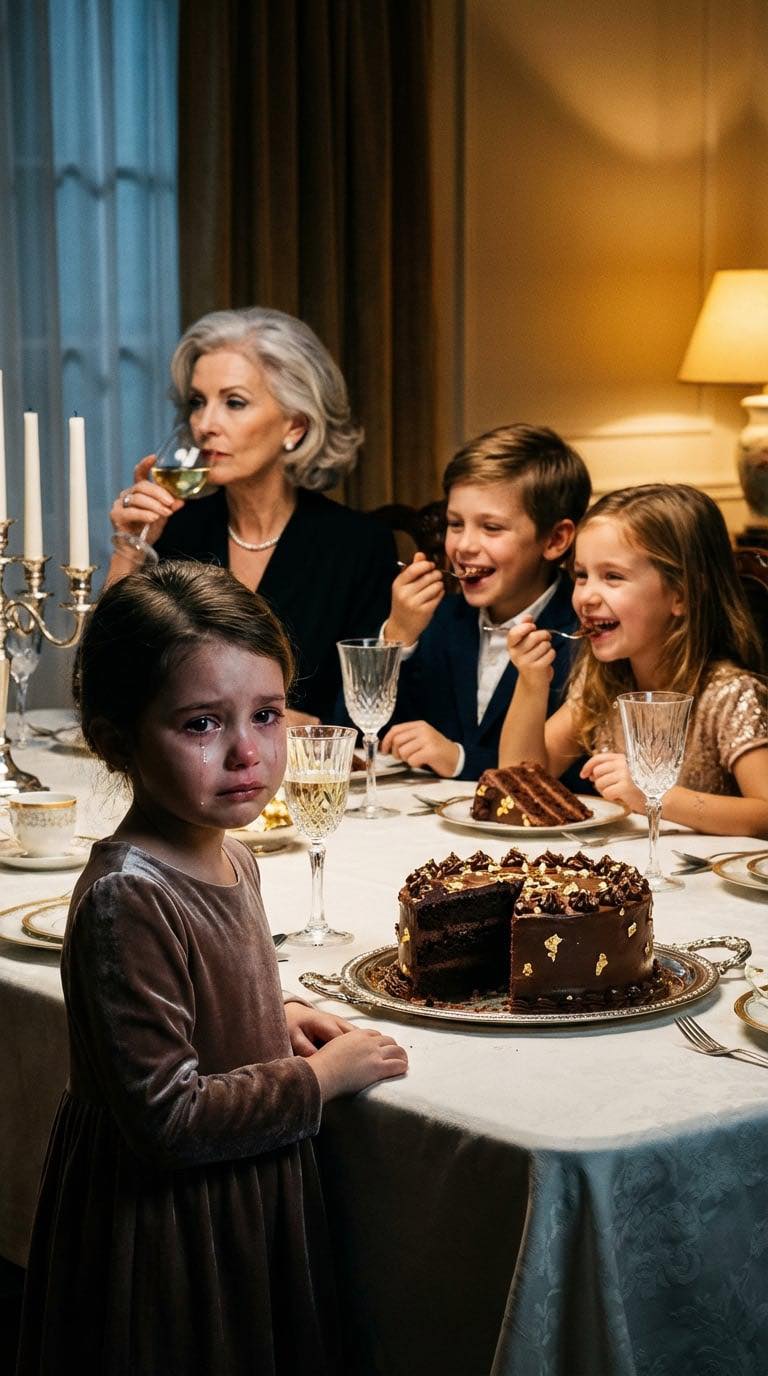
The Sunday dinner table was a minefield set with Mom’s best bone china. The floral patterns on the plates seemed to mock the tension in the room, delicate pink roses blooming beneath the weight of pot roast and unsaid resentments. My daughter, Emma, six years old and small for her age, sat on a stack of cushions, her legs swinging nervously. She had barely touched her glazed carrots, her eyes fixed on the crystal cake stand on the kitchen counter.
Inside the dome sat a decadent, three-layer dark chocolate cake, dusted with gold leaf. It was a masterpiece of a dessert, likely ordered from the French bakery across town that charged five dollars for a croissant.
“Grandma,” Emma asked, her voice a soft, polite chime in the clatter of silverware. “Can I have some cake, please?”
Mom didn’t even look up from her wine glass. She took a slow sip of her Chardonnay, savoring the oaky finish, before delivering the blow.
“Premium treats are for premium grandkids, sweetheart.”
The table went silent. Not a casual lull in conversation, but a vacuum. For exactly three seconds, the air left the room.
Then, my sister Jennifer laughed.
It was a sharp, jagged sound that broke the tension everyone else was pretending didn’t exist. “Mom, that’s hilarious,” Jennifer said, reaching over to cut herself a thick, generous slice. “Emma, honey, maybe next time. You know how it is.”
My brother Michael nodded, his mouth full of beef. “Yeah, kiddo. We saved the good stuff for a special occasion.”
Emma’s face fell. It wasn’t a tantrum; it was a quiet implosion. She looked at me, her large brown eyes swimming with confusion, trying to calculate the mathematics of why she wasn’t special enough for a slice of cake. My daughter didn’t know the history. She didn’t know that I had been the family punching bag for fifteen years. She didn’t know that her grandmother had spent the last six years making subtle, poison-tipped comments about Emma’s father leaving us, about my career choices, about how I had “ruined my potential.”
I felt a heat rise in my chest, distinct and dangerous. It wasn’t anger. It was clarity.
I reached for Emma’s hand. “We should go.”
Mom set down her glass with a deliberate clink against the table. “Don’t be ridiculous. You just got here two hours ago. I think we’ve had enough family time for today, don’t you?”
“I think we have,” I said, keeping my voice level. Pleasant, even. The kind of pleasant that masks a declaration of war.
Jennifer smirked at Michael. “So sensitive. It was just a joke, Sarah. God, you’re always so dramatic.”
I stood up and helped Emma into her jacket, taking my time with each button, my fingers steady despite the adrenaline coursing through me. Mom watched from her chair at the head of the table, that familiar expression of vague disappointment etched into her features. It was the same look she’d given me when I chose State College over the Ivy League acceptance letter. The same look when I married David, a mechanic. The same look when I kept Emma after the divorce instead of “giving her up to have a fresh start.”
“You’re really leaving over cake?” Mom asked, arching a sculpted eyebrow.
“We’re leaving because my daughter asked a simple question and got humiliated instead of an answer,” I said. I picked up my purse, feeling the weight of it on my shoulder. “Come on, Emma.”
My father, Robert, finally spoke up from his end of the table. He was a man who had spent forty years letting his wife narrate his reality. “Don’t be dramatic, Sarah. Your mother didn’t mean anything by it.”
I looked at him. Really looked at him. “She never does,” I said softly. “That’s the problem.”
The drive home was quiet. The city lights blurred past us, streaks of neon in the rainy darkness. Emma stared out the window, processing something no six-year-old should have to process: the hierarchy of love.
I had spent my whole life trying to be good enough for them. The right grades. The polite manners. The silence. And still, I was the punchline. Still, I was premium-adjacent at best.
We stopped for ice cream on the way home. I bought Emma a double scoop of strawberry with rainbow sprinkles. We sat in the car and ate it, and I promised myself, right then and there, that she would never beg for a seat at a table where she wasn’t welcome.
At 11:47 PM, my phone buzzed on the nightstand.
A text from Mom.
I’ve been thinking about the house situation. Your name is still on the deed from when Dad put all three kids on the title for tax purposes years ago. We need to discuss transfer options before the estate planning meeting next month. It’s cleaner if you sign off now.
I stared at the message. The blue light of the screen illuminated the dark room.
Transfer options. Sign off.
She thought I was dormant. She thought I was the same Sarah who accepted the scraps.
I opened my secure documents folder on my phone. I scrolled past the photos of Emma and found the PDF I had been sitting on for three weeks. The purchase agreement. The title transfer papers. The closing documents from the real estate attorney.
I attached all six files to a reply text.
The house was sold seventeen days ago. Closing was last Tuesday. You should receive the formal notice from the title company via courier tomorrow morning. The new owners take possession in forty-three days.
I hesitated for a moment. Then, with a thumb that didn’t tremble, I added one more line.
Premium property for premium people.
I hit send. Then I turned off my phone, pulled the duvet up to my chin, and went to sleep.
Cliffhanger:
The silence of the night was heavy, but for the first time in years, it felt like peace. I slept deeply, unaware that across town, a notification pinged on my mother’s phone, initiating a sequence of events that would burn the family tree to the ground.
The next morning started with seventeen missed calls.
The phone on my kitchen counter vibrated aggressively against the granite, dancing toward the edge like a frantic beetle. I ignored it. I made Emma breakfast first—scrambled eggs with cheese, sourdough toast, and fresh strawberries cut into hearts. We ate together while I braided her hair for school, weaving ribbons into the plaits.
“You look beautiful,” I told her, kissing her forehead.
“Do I look premium?” she asked innocently.
My heart cracked, just a hairline fracture. “You are priceless, Emma. There is no price tag high enough for you.”
My phone rang again at 8:15 AM. It was Mom. Again.
I finally picked up.
“What did you do?” Her voice was shrill, panicked in a way I had never heard before. The polished veneer was gone; this was raw fear.
“I exercised my legal rights as a property owner,” I said calmly, pouring myself a second cup of coffee. “The house had three owners on the deed: Dad, you, and me. Under the Joint Tenancy agreement, any owner can initiate a partition action if they provide proper notice to co-owners.”
“You can’t just sell our house!” she screamed.
“I didn’t sell your house,” I corrected. “I petitioned to sell my third. But since no buyer wanted a partial interest in a private residence, the court-ordered partition sale went through. You were notified via certified mail six weeks ago to the address on file. Did you not check the post office box you insist on using?”
“I… we haven’t checked it in a month,” she stammered.
“That sounds like an administrative error on your part,” I said, taking a sip of coffee. “It’s all legal. My attorney, Patricia, made sure of it.”
“This is insane, Sarah! Where are we supposed to live?”
I leaned against the counter, watching a cardinal land on the birdfeeder outside. “I assume you’ll live in the same place you expected Emma and me to live when you refinanced the property eight years ago and took out that second mortgage without telling me. You know, the one that nearly destroyed my credit score when you missed four payments in a row?”
Silence. Thick, heavy silence.
“How did you…”
“I’m not stupid, Mom,” I said, my voice dropping an octave. “I’m just quiet. There’s a difference.”
I checked the microwave clock. “I need to get Emma to school.”
“Your father wants to talk to you.”
“I’m sure he does,” I said. “Have him call my lawyer.”
I hung up.
The title company called at 9:32 AM to confirm that all parties had been formally notified of the transfer. The sale price was
847,000∗∗.Aftersplittingitthreewaysandpayingofftheliensandthemortgagemyparentshadsecretlytakenout,myportioncameto∗∗847,000∗∗.Aftersplittingitthreewaysandpayingofftheliensandthemortgagemyparentshadsecretlytakenout,myportioncameto∗∗186,000.
I had already deposited the check. It was sitting in a high-yield savings account, earning 4.5% interest.
Jennifer called next.
“You’re really going to make Mom and Dad homeless?” she hissed. “How do you sleep at night?”
“They have sixty-three days to find new housing,” I replied. “That is significantly more notice than Mom gave Emma before humiliating her at dinner.”
“It was a joke about cake, Sarah! Get over yourself.”
“No,” I said. “It wasn’t cake. It was fifteen years of jokes. Fifteen years of being treated as ‘less than.’ Fifteen years of watching my daughter be treated like a second-class citizen because her mother doesn’t meet the family aesthetic. It ends now.”
“You’re being vindictive.”
“I’m being fair. They own a third of the proceeds. They can buy a condo. Or maybe you and Michael can take them in? Since you’re the premium children.”
Jennifer sputtered. “I can’t take them in! I have the twins! And Michael has his loft!”
“Sounds like a scheduling conflict,” I said. “Good luck with that.”
Michael’s text came through at 10:15 AM.
Dad’s having chest pains. Mom says you’re giving him a heart attack. If anything happens to him, it’s on you.
I forwarded the message to Patricia with a note: Document this attempted emotional manipulation.
Patricia called me at 11:00 AM. She sounded tired but amused. “Your father’s attorney reached out. They want to negotiate.”
“Negotiate what?” I asked. “The sale is closed.”
“They want you to use your portion of the proceeds to help them buy a new house. They want you to co-sign on a new mortgage.”
I laughed. A loud, genuine laugh that startled a pedestrian as I waited at a stoplight. “No.”
“I told them you’d say that,” Patricia said. “Now, brace yourself. They are threatening to sue for the full property value, claiming you undervalued it in the partition sale.”
“The property was appraised by a court-appointed assessor at $820,000,” I reminded her. “We sold for $847,000. Above market value.”
“I know,” Patricia said. “They don’t have a leg to stand on. But Sarah… there’s one more thing.”
My hand tightened on the steering wheel. “What?”
“They found out about the other properties.”
I froze. “How?”
“Public records. Your brother Michael apparently knows how to use a search engine. He ran a comprehensive asset search on your name.”
Of course he did.
The family group chat exploded at 1:47 PM.
Michael: You own FOUR rental properties?
Jennifer: This whole time you’ve been pretending to struggle as a single mom?
Dad: We need to talk about this immediately. Sarah, call home.
I pulled over into a parking lot. I took a deep breath. I typed one response.
I bought my first rental property twelve years ago with the money Grandma Rose left me. You know, the grandmother you all forgot about after she got sick? The one I visited at the nursing home every single week for three years while you were all ‘too busy’? She left me $40,000. I invested it. I’m good at investing.
Mom: You let us think you were barely making it!
I am a single mother who lives modestly. I am also smart enough to build assets. Those things aren’t mutually exclusive.
Jennifer: This is unbelievable. You’ve been hoarding wealth while we helped you with…
Helped me with what, Jennifer? You haven’t bought Emma a birthday present in three years. You charged me for gas the one time you drove me to the airport.
Michael: What have you been doing with all that money?
Oh, right, I typed. Spending it on premium things.
I blocked the group chat.
I thought blocking them would buy me peace. I was wrong. Desperation makes people bold, and entitlement makes them dangerous. Two days later, my phone rang. It was the principal of Emma’s elementary school. “Mrs. Anderson,” she said, her voice tight. “Your mother is here. She’s in the front office, and she’s refusing to leave until we release Emma to her custody.”
My tires screeched as I pulled out of the parking lot. The speedometer crept past the limit as I navigated the suburban streets toward the school. My hands were shaking, not from fear, but from a cold, primal rage.
“She absolutely does not have permission,” I had told the principal. “She is not on the approved pickup list. Do not let her near my daughter.”
“She’s quite… insistent,” the principal had replied. “She’s causing a scene.”
“Call the police if she doesn’t leave,” I said. “I’ll be there in ten minutes.”
When I burst through the double doors of the elementary school, the reception area was tense. The secretary was typing furiously, eyes downcast. Standing by the counter, looking impossibly small in her Chanel coat, was Mom. She was arguing with the principal, Mrs. Gable.
Mom turned when she saw me. Her face crumpled into a mask of victimhood.
“I just wanted to see my granddaughter,” she wailed, playing to the audience of two other parents waiting in the lobby. “Is that a crime?”
“The granddaughter who isn’t premium enough for cake?” I asked. My voice wasn’t loud, but it cut through the room like a razor.
I walked past her to Mrs. Gable. “Where is Emma?”
“She’s in the nurse’s office, safe,” Mrs. Gable said. “We didn’t let her come out.”
Mom reached out a hand to touch my arm. “Sarah, please. Can we just talk? I didn’t mean to upset anyone. I just… we’re losing the house. I needed to see family.”
“We can talk through lawyers,” I said, stepping back out of her reach. “You are not safe for her. You treat people like possessions. You think because you’re losing control, you can just come here and take her?”
“I’m her grandmother!”
“You’re a stranger who shares her DNA,” I said. “Stay away from my daughter.”
Mrs. Gable stepped forward, her authority finally overriding her politeness. “Mrs. Anderson, I’m going to have to ask you to leave the premises immediately. If you return, I will issue a criminal trespass warning.”
Mom looked at me, shocked. She had lived her entire life believing that rules were for other people, for “common” people. Being evicted from a grade school lobby was a reality she couldn’t process.
She gathered her purse, her dignity in tatters. “You’re ruining this family, Sarah,” she whispered as she passed me.
“I’m saving what’s left of it,” I replied.
That night, the house felt quiet, but safe. I tucked Emma into bed, pulling the duvet up to her chin. The glow of her nightlight cast soft shadows on the walls.
“Mom?” she asked sleepily. “Why did Grandma come to school?”
I smoothed the hair back from her forehead. “Sometimes adults make mistakes, Emma. And sometimes they don’t know how to fix them.”
“Is Grandma sorry?”
“I don’t know, baby. Maybe.”
“Are you still mad about the cake?”
I paused. “I’m not mad about cake,” I said softly. “I’m mad that someone made you feel like you weren’t good enough. You are always good enough. Always.”
Emma thought about this for a moment. “Do we have enough money now? From selling the house?”
She was a smart kid. Too smart. She noticed everything.
“We’re going to be just fine,” I promised.
“Can we get a dog?”
I smiled, the tension in my shoulders finally releasing. “Maybe. We’ll see.”
The silence from the family lasted for two weeks. I assumed they were busy moving, packing up thirty years of accumulation into whatever condo they could afford with their share of the money. I focused on my work, on my rentals, on Emma.
Then, the formal dinner invitation arrived via certified mail.
It was heavy cardstock, embossed. The Anderson Family requests the pleasure of your company for a Reconciliation Dinner. Mom wants to apologize. The whole family will be there. Please bring Emma.
I read it twice. Then I threw it in the recycling bin.
I declined via email. One word: No.
Mom showed up at my office three days later.
Building security called up. “A Mrs. Anderson is here to see you. She says it’s urgent.”
I sighed. “Send her up. But tell her she has five minutes.”
When she walked into my office, she looked different. The armor was cracked. Her hair wasn’t perfectly coiffed. She looked smaller. Older. Defeated.
She sat in the guest chair without waiting for an invitation. She didn’t look at the view; she looked at her hands.
“I’m sorry,” she said.
“For which part?” I asked, typing an email on my other screen. “The cake? The years of criticism? The second mortgage? trying to kidnap my daughter from school?”
She twisted her wedding ring. “All of it. Your father and I have been talking. We’ve been… terrible.”
“Yes,” I said. “You have.”
“I don’t expect forgiveness,” she continued, her voice trembling. “I just wanted you to know that I see it now. I see how we treated you. How we treated Emma.”
She reached into her purse and pulled out an envelope. She slid it across the desk.
“We found a condo,” she said. “It’s smaller. Much smaller. We’re downsizing like we should have done years ago. We sold the boat. We sold some jewelry.”
I looked at the envelope.
“This is a check for Emma’s college fund,” she said. “It’s $25,000. It’s not enough. It’s not anything close to enough to make up for fifteen years. But it’s a start.”
I didn’t touch it.
“I’m not asking you to cash it,” she said quickly. “I’m asking you to consider letting us try again. To let us earn a place in her life.”
“Why now?” I asked.
“Your father had a health scare last week,” she whispered. “A real one. Not the manipulation Michael texted you about. He had an arrhythmia. We spent the night in the ER. It made us realize… we’ve wasted so much time being proud. Being judgmental. I don’t want to die having my granddaughter think she isn’t ‘premium’ enough.”
Tears leaked from her eyes. Real tears. Not the performance art she usually displayed.
I looked at the check. $25,000. It was a lot of money. It was also guilt money.
“Emma has therapy on Thursdays now,” I said. “Because of the cake incident and everything that came after. She’s six years old, and she’s in therapy to understand why her family doesn’t value her.”
Mom’s face crumbled. She put a hand over her mouth to stifle a sob.
“If you want back into our lives,” I said, standing up, “you start there.”
“Start where?”
“You pay for the therapy,” I said. “And you attend the family sessions the therapist recommends. You do the work. You don’t buy your way back in with a check. You earn it by sitting in a room and listening to how much you hurt us.”
She looked up at me. For the first time, I saw respect in her eyes. Not love, not yet. But respect.
“Okay,” she said. “Okay. We’ll do it.”
“Your five minutes are up,” I said.
She nodded. She stood up, collecting her purse. At the door, she turned back.
“You were right to sell the house,” she said softly. “We never appreciated what we had. Any of it.”
She left the office. I sat alone in the silence, staring at the check on my desk. It was a peace offering, but was it a truce or a trap? My phone buzzed. A text from Michael. Mom says she talked to you. Are we really doing therapy? This is ridiculous. I smiled, picked up the phone, and typed my reply. You don’t have to do anything, Michael. But the bus to redemption leaves in five minutes. I suggest you be on it.
I deposited the check into Emma’s 529 College Savings Plan that afternoon. I didn’t call Mom back. Not yet.
The following Thursday, I sat in the waiting room of Dr. Aris’s office. The door opened, and my parents walked in. Dad looked frail, leaning on a cane I hadn’t seen before. Mom looked nervous.
They sat on the opposite couch. We didn’t hug. We didn’t exchange pleasantries.
“Ready?” Dr. Aris asked, opening her door.
We walked in.
It took six months. Six months of uncomfortable conversations, of tears, of my father admitting he had been a coward, of my mother admitting she projected her own insecurities onto me. Jennifer and Michael never came. They stayed in their bubble of entitlement, convincing themselves that I was the villain. That was fine. I didn’t need everyone. I just needed the people who were willing to grow.
One Sunday in late spring, I hosted dinner at my place. It wasn’t a sprawling estate; it was a comfortable, sun-drenched colonial I had bought with my rental income.
The table wasn’t set with bone china. It was set with colorful ceramic plates Emma had picked out.
Mom sat at the table. She looked at Emma, who was happily devouring a hot dog.
“Emma,” Mom said.
Emma looked up, wary.
“I brought dessert,” Mom said.
She reached into a box and pulled out a chocolate cake. It wasn’t the gold-leaf masterpiece from the French bakery. It was a lopsided, homemade chocolate cake with messy frosting and sprinkles that were clearly applied by a shaky hand.
“I made it myself,” Mom said. “It’s not perfect. But I think… I think it’s good.”
She cut a massive slice—the biggest one—and placed it on Emma’s plate.
“For my premium granddaughter,” Mom whispered.
Emma looked at the cake. Then she looked at me. I nodded.
Emma took a bite. Chocolate smeared on her cheek. She grinned. “It’s good, Grandma.”
Mom exhaled, a sound of pure relief.
I sat back, sipping my iced tea. We weren’t a perfect family. We were scarred and stitched back together. But as I watched my daughter laugh with her grandfather, I knew we had finally redefined what “premium” meant.
It wasn’t about the price tag. It was about the effort. And for the first time in my life, the price had been paid in full.