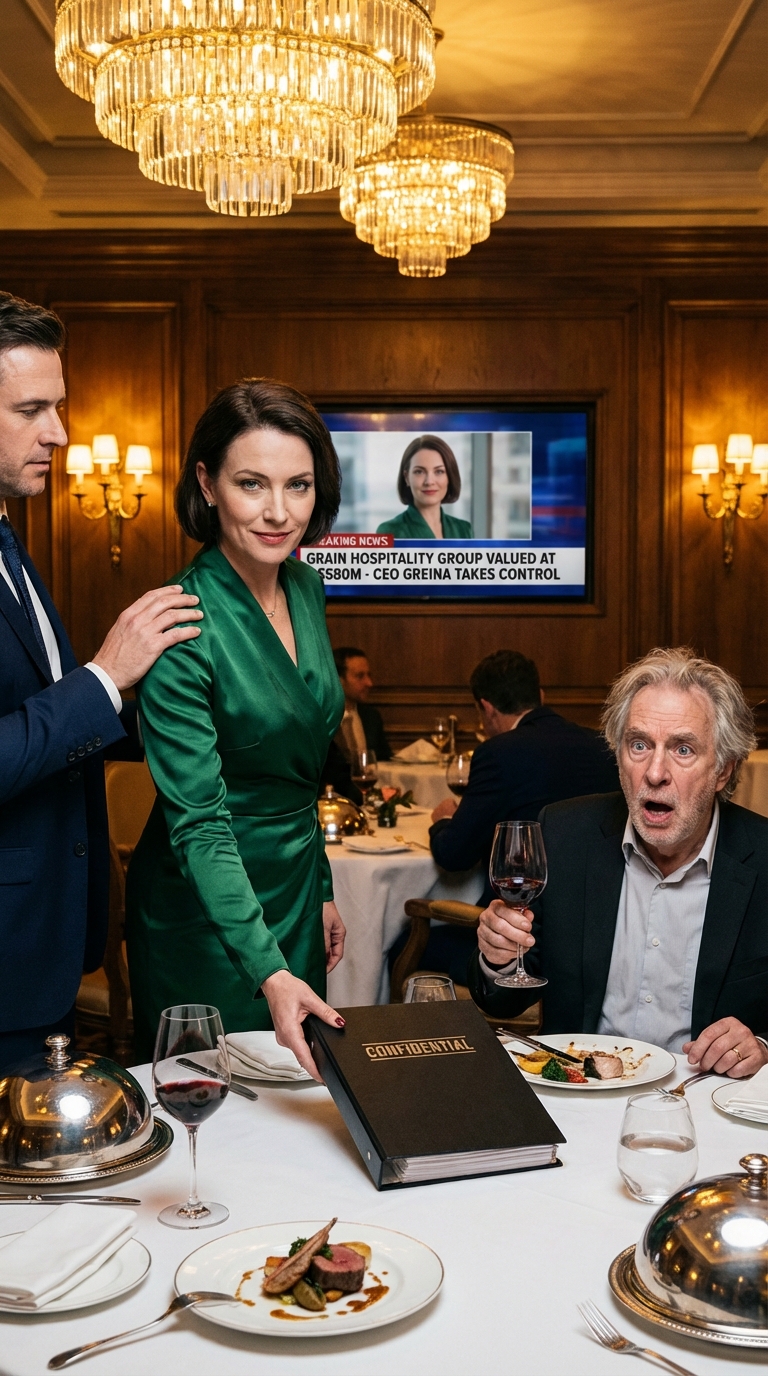
“You have five minutes to sign over your hotel empire, Greina. Five minutes, or I make the call to have you involuntarily committed for a severe mental breakdown.”
My father didn’t even blink as he threatened to lock me away in a padded room just to steal my company. He sat at the head of the mahogany table, swirling his vintage Bordeaux, looking at me with the same dispassionate gaze one might use when deciding which horse to put down. He thought he was holding a gun to my head. He thought I was the same trembling twenty-four-year-old girl he had exiled five years ago.
He did not realize I was the one holding the bullets.
I waited for him to finish his sip—the last expensive thing he would ever drink on his own dime—and set my silver fork down with a deliberate, echoing clink.
“You are mistaken, Dad,” I said, my voice steady, betraying none of the adrenaline coursing through my veins. “I didn’t come here to negotiate a surrender. I came to serve an eviction notice.”
I reached under my chair, my fingers brushing the cold leather of the heavy legal binder I had been hiding, and slammed it onto the table between us. The sound was like a gunshot in the silent dining room.
But to understand how we got to this moment—the moment the king fell—you have to go back four hours.
Four hours earlier, the only thing on my mind was the ticker running across the bottom of the Bloomberg screen in my office. Grain Hospitality Group, valued at $580 million.
I stood by the floor-to-ceiling windows of my Boston headquarters, looking down at the city that finally knew my name. I am twenty-nine years old, and I spent the last five years clawing my way up from the dirt to build this view. I started with a crumbling bed-and-breakfast in the South End and turned it into a portfolio of twenty luxury boutique hotels across the East Coast.
Then, my phone buzzed on the mahogany desk, vibrating against the glass surface like an angry hornet.
It was not a congratulatory call. It was a text from Edward Ashford.
Family dinner. 7:00 p.m. Urgent. Don’t be late.
No hello. No “I saw the news.” No “I’m proud of you.” Just a command. As if I were still his property.
My stomach tightened—a phantom reflex from a time when his disapproval could physically crush me. Five years ago, Edward had locked the iron gates of the Ashford estate in my face. He had called my fiancé, Julian, a “parasitic draftsman” and told me that if I married a penniless architect, I was dead to the Ashford legacy.
He cut off my access to the family trust. He blacklisted me from his social circles. He even canceled my health insurance. He wanted us to starve. He wanted the cold reality of poverty to break my spirit so I would come crawling back, begging for his forgiveness and his checkbook.
He did not know that hunger is a hell of a motivator.
Julian and I lived on instant noodles and panic for two years. We slept on a mattress on the floor of a studio apartment that smelled like damp plaster and stale cigarettes while we renovated our first hotel with our own bleeding hands. Edward thought he was breaking me. He was actually forging me into something he could not control.
I picked up the phone, my thumb hovering over the delete button. Why go? I didn’t need him. I certainly didn’t need his “urgent” drama.
But then, I remembered the notification from my encrypted messaging app, Signal.
I opened the secure chat with Lucas, my younger brother. He was the only one still trapped in the mansion, playing the role of the obedient son while secretly feeding me intel. Two days ago, he had sent a blurry photo of a crumpled document he had fished out of Edward’s library trash can.
It was a final notice of default from a private equity firm called Cerberus Capital.
I knew them. They specialized in high-risk bridge loans. They were, for all intents and purposes, legalized loan sharks for the desperate elite.
I zoomed in on the numbers in the photo. The debt wasn’t just a missed mortgage payment. It was $28 million in toxic loans, personally guaranteed by Edward Ashford, due in full within forty-eight hours.
The realization hit me like a shot of adrenaline to the heart. My father wasn’t calling me for a reunion. He wasn’t calling to apologize. He was calling because he was drowning, and he had seen my valuation on the news. He saw me not as a daughter, but as a life raft. He thought he was inviting a naive girl to dinner to bully her into a bailout.
He didn’t realize who was actually coming to the table.
I didn’t call Julian. I didn’t call my therapist. I called my lead counsel, Marcus.
“Buy it,” I told him, staring at my reflection in the window.
“Buy what, Greina?” Marcus asked, confused.
“The debt. The shell company holding the note on Ashford Financial. Pay whatever premium Cerberus wants. Just get that paper in my name before 6:00 p.m.”
When I walked out of my office and into the elevator, I checked my reflection in the chrome doors. The scared girl was gone. Tonight, I wasn’t going home to visit my father. I was going to visit my debtor.
The dining room of the Ashford estate felt less like a place for a family meal and more like a crypt where affection went to die. The air was frigid, the silence heavy enough to choke on.
My mother, Constance, sat to my right. She was twisting her linen napkin until her knuckles turned white, her eyes fixed on the tablecloth. She would not look at me. She had spent thirty years perfecting the art of invisibility to survive Edward’s temper.
Lucas sat opposite me, staring intently at the floral pattern on the fine china. He gave a barely perceptible nod, his foot tapping nervously against the parquet floor. His silence was a loud, clear signal: He knows. Be careful.
And then there was Edward.
He sat at the head of the table, blocking the light from the fireplace. He didn’t offer a greeting. He didn’t ask how I had been for the last five years. He just reached for the crystal decanter and poured himself a glass of a vintage Bordeaux that retails for $3,000 a bottle. Money he definitely didn’t have.
As he tipped the bottle, I saw it. A microscopic tremor in his hand. The crystal neck rattled against the glass rim—clink-clink-clink. He set the bottle down too hard to mask it.
He wasn’t calm. He was terrified.
“I saw the news,” he said, slicing his steak with unnecessary violence. The knife screeched against the porcelain. “Beginner’s luck is a dangerous drug, Greina. It makes amateur girls think they are actually businesswomen.”
He took a long sip of wine, his eyes drilling into mine. “And how is the draftsman? Still playing with his crayons while you do the heavy lifting?”
He meant Julian. He always called Julian the “draftsman,” spitting the word like it was a slur, refusing to acknowledge him as an architect or a husband.
Five years ago, those words would have made me shrink into my chair. I would have stammered, tried to defend us, tried to beg for his respect.
Tonight, I just watched him. I watched the sweat beading on his upper lip despite the chill in the room. I watched the way his eyes darted involuntarily to the grandfather clock against the wall, measuring the time he had left before his world imploded.
He wasn’t a king holding court. He was a cornered animal baring its teeth because it had no other defense. I didn’t feel anger. I felt the cold, clinical detachment of a pathologist looking at a tumor. I was just waiting to make the cut.
“We need to protect the family assets,” he said, his voice dropping to a register that feigned paternal concern. “I have been speaking with specialists. You are obviously under a tremendous amount of strain, Greina. The expansion, the media attention… it is making you erratic. Unstable.”
He reached into his jacket pocket and slid a thick manila envelope across the mahogany table. It stopped inches from my plate.
I opened the folder. The top document was a draft petition for Emergency Conservatorship. Beneath it were three psychiatric evaluations detailing my “severe nervous breakdown,” my “paranoia,” and my “inability to manage complex finances.”
All signed, sealed, and ready to be filed with the probate court the moment I refused to cooperate.
I glanced at the signature on the top evaluation. Dr. Aerys Vance. A man I hadn’t seen since I was twelve years old.
“Vance signed this?” I asked, keeping my voice flat. “He hasn’t treated me in decades. He hasn’t even seen me. He would lose his medical license for perjury before the ink dried on this page.”
Edward smiled. A cruel, thin stretching of his lips that didn’t reach his eyes.
“Vance isn’t worried about his license, sweetheart. He is worried about the $200,000 in gambling debts I covered for him in Atlantic City last winter. He writes exactly what I tell him to write.”
The realization hit me with the weight of a stone. He wasn’t just a bully. He was a puppet master who collected people’s sins and used them as leashes. He truly believed he could lock me away in a facility and steal my life just because he held a marker on a degenerate gambler.
He thought this was his checkmate.
He leaned forward, the smell of wine and arrogance rolling off him. “You sign the transfer of control to me voluntarily, or Dr. Vance files these in the morning. Your stock tanks, your investors flee, and I take over anyway to ‘save’ you. It is your choice.”
I looked at the manila envelope, then up at him. He looked triumphant, a man who had just played an Ace. He expected me to crumble. He expected the old Greina to beg him not to ruin her reputation.
But I just had one question left. A loose thread I needed to cut before I tightened the noose.
“Why?” I asked, my voice barely above a whisper.
Edward raised an eyebrow. “Why what?”
“Not the business. Not the money. Why Julian? He is a brilliant architect. He treats me like gold. Why did you hate him enough to try to starve us?”
Edward chuckled, the sound wet and ugly. He took another sip of wine, relaxed now that he thought he had won.
“Hate him? I don’t hate him, Greina. I don’t think about him at all. He was just a necessary casualty.”
He leaned back, spreading his hands. “You needed to learn that you couldn’t survive without me. So, I made a few calls. Boston is a small town for people with my influence. I told the top five architecture firms that if they hired your husband, Ashford Financial would pull every construction loan we held with them.”
He smiled, remembering it like a fond memory. “I heard you two were living in a basement in Southie for a while. Eating ramen. Wearing second-hand coats. I admit, I checked your credit reports occasionally, just to see how close you were to breaking.”
My blood ran cold. “You checked our credit reports?”
“I wasn’t being cruel, sweetheart,” he said, dismissing my horror with a wave of his hand. “I was being a father. I had to let you hit rock bottom so you would remember who holds the ladder.”
There it was. The confession.
He didn’t just watch us struggle. He engineered it. Every night I cried myself to sleep worrying about rent. Every time Julian came home defeated from another rejected interview. Every meal we skipped so we could buy paint for the hotel lobby. Edward had orchestrated it all from this dining room table. He viewed our poverty as his parenting strategy.
The last microscopic grain of guilt I felt for what I was about to do evaporated instantly.
I reached out and slid the envelope with the fake psychiatric evaluations back across the table. It hit his wine glass with a sharp tink.
“You love leverage, Dad,” I said, my voice hardening into steel. “So, let us talk about yours.”
“What are you doing?” he snapped, his smile faltering. “You sign those papers or Vance files in the morning!”
“Dr. Vance can file whatever he wants. It won’t matter. Because you are not negotiating with the CEO of Grain Hospitality anymore.”
I opened the heavy legal binder I had placed on the table. Inside wasn’t a merger agreement. It was a stack of transfer documents stamped with the seal of the Commonwealth of Massachusetts.
I turned the binder around so he could read the cover page.
“You took out a $28 million bridge loan six months ago from a private equity firm called Cerberus Capital. High interest. Short-term. Backed by your personal guarantee and secured by fifty-one percent of your voting shares in Ashford Financial.”
Edward’s face went gray. “That is confidential. How do you know that?”
“Cerberus Capital was a shell company,” I interrupted. “They were looking to offload their high-risk bad debt last week. They thought you were going to default, so they sold the note for pennies on the dollar.”
I leaned forward, locking eyes with him.
“I bought the note, Dad. I own the shell company. I own the debt. And most importantly, I own the default clause.”
He stared at the document, his mouth opening and closing like a fish on a hook. The realization washed over him in a slow, terrifying wave. He wasn’t sitting across from a daughter he could bully with fake doctors. He was sitting across from his sole creditor.
“I am calling the loan,” I said. “Full repayment. Twenty-eight million dollars. Due immediately.”
Edward’s face darkened to a sickly purple, a vein hammering at his temple. He shot up so fast his knees slammed the table, silverware jumping, and his heavy oak chair crashed backward onto the floor.
“This is fraud!” he bellowed, spit snapping from his mouth. “You can’t do this! I’ll tear it up!”
He lunged for the binder.
Lucas sprang up, his chair screeching. “Dad, stop!”
Edward shoved him hard. My brother stumbled into the sideboard, knocking a crystal decanter to the parquet. It exploded into glittering shards.
“Sit down, you coward!” Edward roared, eyes wild as he clawed at the binder’s pages, ready to rip my win into confetti.
I didn’t move. I didn’t flinch. I simply picked up my phone. My thumb hovered over a pre-drafted message to Marcus. One word: Execute.
I watched my father wrestle the heavy binding, breathing ragged, dignity gone, like a man fighting a ghost. Then I hit send.
“Go ahead,” I said, my voice slicing through his panting. “Tear it up. Burn it. Eat it if you want.”
Edward froze, pages crumpled in his fists. He looked up at me, chest heaving.
“It doesn’t matter,” I said, locking my screen and setting the phone down. “That binder is a courtesy copy. My legal team was waiting for my signal. They just electronically filed the Confession of Judgment with the Suffolk County Clerk. It’s on the docket now.”
I tapped the table once. “Public record, Dad. The debt is called. The default is registered. The clock already ran out.”
He let the binder drop with a heavy thud. “You can’t… I have assets. I have the house.”
“The house takes time to foreclose,” I corrected. I didn’t want the house. I wanted speed.
I rose, smoothing my dress as if we were discussing seating arrangements, not a collapse. “That’s why I reviewed the collateral agreement you signed with Cerberus. To get that bridge loan, you pledged your controlling stake in Ashford Financial as security.”
I stepped around the table until I was directly in front of him. He smelled like sour wine and fear.
“Under UCC Article 9, a secured creditor can seize voting rights immediately upon default to protect the asset.” I leaned closer. “I’m the creditor.”
My voice dropped to a whisper. “I just exercised that right. I own your shares, Edward. I control the board. I control the building. I control you.”
His phone started buzzing in his pocket. Then mine. Then Lucas’s—an ugly little chorus of alerts announcing the end.
“That’s probably the Board Secretary,” I said calmly. “They’ve been notified of the change in control.”
I held his gaze. “Congratulations on your retirement, Dad. You’ve just been fired from your own company.”
Edward stared at his screen as if it were written in a language he’d never learned. The color drained from his face so fast it looked like gravity stole it. He sagged into his chair—which Lucas had uprighted—with a sound like air rushing out of a punctured tire.
For years, decades, he’d been a giant in my life. The man who controlled the weather in our house. Now? He looked small in his expensive suit. A mean old man who borrowed too much to buy affection he never earned.
He turned to my mother. “Constance,” he rasped. “Tell her. Tell her this is insanity.”
My mother didn’t move. Normally, she’d jump in, soften, soothe, explain away his rage. Tonight, she wasn’t looking at him. She was looking at me, eyes wide with terror and something else. Awe.
You could see the math happening in her head. The realization that the daughter she pitied had just taken the crown off the king without breaking a sweat.
She took a sip of water. Said nothing. That silence was louder than his screaming. It was the sound of loyalty shifting.
I looked at Lucas. He lifted the wine glass he hadn’t touched all night and took a long, slow drink. Then he set it down and met my eyes. The corner of his mouth twitched—microscopic but unmistakable. A salute.
“You have thirty days,” I said, letting the words settle over the room like a heavy blanket. “Thirty days to vacate the CEO suite at the Prudential Tower. I’ve already instructed building security to revoke your access pass effective midnight tonight. Tomorrow, you can go in with an escort to collect personal effects. Photos, plants. Leave the files.”
Edward made a strangled sound. “I built that office! And you leveraged it to cover your bad bets!”
I replied, “Now it’s mine. My team audits the books on Monday. If I find more misappropriated funds, I won’t just fire you, Edward.” I held the pause like a blade. “I will prosecute you.”
I didn’t call him Dad. I couldn’t. That man was gone.
I picked up my purse. I expected to feel heavy, crushed under the enormity of what I’d done. Instead, I felt light. Almost weightless. Like the air had finally returned to my lungs.
“Greina,” my mother whispered. “Where are you going?”
“Home,” I said. “To my husband.”
I walked out, heels clicking a steady, unbothered rhythm across the parquet.
Behind me, a chair scraped. “You ungrateful witch!” Edward screamed, raw and broken. The last gasp of a tyrant out of ammunition. “I made you! You’re nothing without me!”
I didn’t stop. I didn’t turn around. I kept walking past portraits of ancestors who would have hated me. Through the museum-quiet foyer and out the heavy oak front door.
The night air hit my face—cold, sharp, clean. I breathed in like the oxygen finally belonged to me. I went down the stone steps to my waiting car and didn’t look back.
You don’t look back at a burning building once you’ve made it out alive.
———
My penthouse was quiet when I got home. No fanfare, no victory music. Just the hum of Boston below and the smell of garlic and basil drifting from the kitchen.
Julian stood at the stove, stirring pasta sauce in an old paint-stained t-shirt, humming off-key to a jazz record. He turned, spoon in hand, and smiled like this was any other night.
“Hey,” he said warmly. “I made your favorite. Cheap noodles, expensive wine. Tradition.”
He didn’t ask if I’d won. He didn’t ask what I’d destroyed. He just offered me dinner.
I set my purse down and crossed to him, pressing my face into his neck. He smelled of soap, sawdust, and safety. The tension holding my spine upright for hours finally snapped. I didn’t cry, but I let out a breath that felt like I’d been holding it for five years.
“It’s done,” I whispered. “He’s gone.”
Julian wrapped his arms around me and held me steady. No gloating, no celebration. Just grounding.
“We’re free,” he said softly.
We ate on the balcony, watching the city lights blink on like fireflies. We talked about the new hotel design, where to put the rooftop pool, whether we should get a dog. We didn’t talk about Edward. We didn’t talk about the money. We talked about our life, the one we built brick by brick without anyone’s permission.
Three months later, I stood in the corner office at the Prudential Tower. The name on the door read Greina Ashford, CEO. The sign on the building had changed, too. Ashford Financial was gone, replaced by the sleek logo of Grain Hospitality Group.
My assistant knocked. “The architects are here for the renovation walkthrough.”
“Send them in,” I said.
I turned back to the window and caught my reflection. Still me, but sharper. Stronger. I touched the pearl earrings at my ears. They weren’t new. They were my grandmother’s—the only thing I’d taken from that house.
A week after the dinner, my mother mailed them with a note. She would have wanted you to have these.
I didn’t keep them for sentiment. I kept them as a reminder. They say you can’t choose your family, but you can choose to fire them.
Julian walked in, rolling blueprints across my desk. He glanced up and grinned, his eyes crinkling at the corners.
“Ready to build something new?”
I smiled back. “Always.”