Have you ever wondered what it truly feels like to have a billionaire father? Trust me, it is not the fairy tale you are imagining. It is a gilded cage where the bars are made of platinum, but they are bars nonetheless.
My father is Richard Ashford, one of the most ruthless real estate moguls in New York City. He essentially owns half of Manhattan. He walks through life with the unshakeable confidence of a man who believes—truly, deeply believes—that money makes him God. He planned my entire existence before I had even taken my first step. Which elite prep schools, which Ivy League university, which high-powered career, and most importantly, which husband.
When I was sixteen, sitting in his mahogany-paneled library while he smoked a cigar worth more than a teacher’s weekly salary, he told me, “Love is a luxury for poor people, Fiona. You are an Ashford. You marry for strategy.”
For twenty-seven years, I listened. I was the perfect doll in his dollhouse. Until six months ago.
That was when I broke his cardinal rule. I fell in love with a man my father called “trash from Queens,” a mechanic with grease permanently etched into his fingerprints. And at my own wedding, in front of three hundred of New York’s elite, my father stood up and disowned me. He thought he was delivering the final, crushing blow to my spirit.
What he didn’t know was that the “trash” he was mocking was about to become his biggest regret.
Let me take you back eight months, to the night I told my father I was marrying a man he had never vetted.
The penthouse of the Ashford Tower on the Upper East Side had floor-to-ceiling windows that looked down on Central Park with a possessive glare. That Thursday evening, the atmosphere was suffocating. We sat around the twelve-seat walnut dining table imported from Italy—a fact my mother, Eleanor, reminded guests of at every dinner party. The Hermès place settings gleamed under the crystal chandelier, cold and sharp.
My father sat at the head of the table, his Patek Philippe watch catching the light every time he raised his glass of 2010 Château Margaux. At fifty-eight, Richard Ashford commanded every room he entered. He was a force of nature, albeit a destructive one.
“I’ve arranged a meeting for you this Saturday,” he said, slicing into his filet mignon without looking up. “Harrison Wells III. His father and I are finalizing the merger. It would be beneficial for the two of you to get… acquainted.”
I set down my silver fork. The metal made a sharp clink against the china.
“I can’t make Saturday,” I said.
He finally looked up, his eyes narrowing. “Excuse me?”
“I have someone I want you to meet,” I continued, my heart hammering a frantic rhythm against my ribs. “Someone I’ve been seeing for six months. His name is James.”
“Who?” My father’s voice cut through the room like a serrated blade. “What family? Wells? Montgomery? Don’t tell me it’s one of the Heartley boys.”
“You don’t know him.”
The silence that followed was heavy, pressing against my eardrums.
“You’ve been seeing someone for six months,” he said slowly, dangerously quiet. “That I haven’t vetted? That I haven’t approved?”
“I don’t need your approval to date someone, Dad.”
He leaned back, his jaw tight. “In this family, Fiona, marriage is a merger. Who is this person who dared approach my daughter without going through me first?”
I took a deep breath. “I met him at a coffee shop in Brooklyn. He’s a mechanic. He owns a small repair shop in Queens.”
My mother dropped her fork. It clattered loudly onto her plate. My brother, Derek, let out a short, mocking laugh.
“A mechanic?” Derek scoffed. “Is this a joke?”
“He’s a good man,” I said, my voice trembling but firm.
My father stood up. He didn’t yell. He didn’t throw his wine glass. He simply looked at me with a terrifying calmness. “You will end it. Immediately.”
“No.”
“Fiona,” he said, walking to the window to look out at the city he thought he owned. “I had the best private investigator in the city dig into this James Carter the moment you mentioned a ‘friend’ last week. Do you know what he found? Nothing. No debts, no scandals, no skeletons. Just… nothing. A completely unremarkable man with a garage worth less than my watch.”
“Maybe that’s exactly what I want,” I shot back. “Unremarkable. Real.”
He turned, his eyes cold dead weights. “You are an Ashford. You don’t get to be unremarkable. End this now, before you embarrass this family further.”
I stood up, my legs shaking. “He doesn’t want anything from me, Dad. He doesn’t care about the money or the name. That’s what you can’t understand.”
My father laughed, a sharp, bitter sound. “Everyone wants something, Fiona. The only question is when they reveal the price tag.”
I walked out of that penthouse without another word. I thought the worst was over. I thought I had stood my ground. But I had no idea that my father wasn’t just angry. He was preparing a siege.
James proposed on a Sunday morning three days later. We were in his Queens apartment—small, but spotless, filled with morning light that streamed through windows he cleaned himself. He handed me a simple velvet box across the kitchen counter.
“I know I’m not what your family expected,” he said quietly, his brown eyes searching mine. “I know I can’t give you penthouses or private jets. But I can give you this: I will never try to control you. I will never make you feel small. And I will spend every day trying to make you happy.”
I said yes before he finished speaking.
The retaliation began immediately.
The first strike came at Kleinfeld Bridal. I had scheduled an appointment to try on wedding dresses—nothing extravagant by Ashford standards, just a classic Vera Wang I’d admired for years. The consultant, a woman who had served my mother for decades, greeted me with a tight, pained smile.
“I’m so sorry, Miss Ashford,” she whispered, leaning in so the other brides wouldn’t hear. “But there seems to be an issue with your account.”
“Try it again,” I said, confused.
“I did. It declined. Then the backup card. Then the emergency card your mother authorized.”
I called the bank from the fitting room floor, surrounded by tulle and silk I suddenly couldn’t afford.
“I apologize, Miss Ashford,” the banker’s voice was robotic. “But your accounts have been frozen. The primary account holder removed your authorized user status this morning.”
The primary account holder. My father.
I sat there in my slip, staring at my reflection. He hadn’t just threatened me; he had initiated a financial blockade. I was twenty-eight years old, and for the first time, I realized I had no access to money that was truly mine.
James found me an hour later, still sitting in the fitting room lobby, trying to compose myself. I had texted him through tears I refused to let fall in public.
“Let me help,” he said, reaching for his worn leather wallet.
“No,” I snapped, my pride making the words sharper than I intended. “I can’t. I need to figure this out myself.”
But he pulled out a stack of cash anyway. Thick folds of hundred-dollar bills, held together with a simple rubber band. It was at least two or three thousand dollars.
“I want to,” he said simply. “Let me.”
I looked at that stack of bills—too thick, too casual for a mechanic to carry around for lunch money—and something flickered in the back of my mind. A question mark. But I was too overwhelmed to examine it closely.
“Thank you,” I whispered.
The social fallout was next. Within a week, my phone went quiet. Friends I’d known since prep school suddenly had scheduling conflicts. Lunch dates were canceled. Group chats went silent.
Then came the texts. Always apologetic. Always cowardly.
So sorry babe, but mom says we shouldn’t be seen together right now. You know how business works. XO.
Hey Fee. This is awkward, but my dad does a lot of deals with Ashford Properties. I can’t risk it. Good luck.
Twenty-eight years of friendships, and every single one of them came with a price tag I could no longer pay.
At Ashford Properties, where I’d worked in marketing for three years, colleagues avoided eye contact. The whispers followed me through every hallway like a toxic fog.
HR’s email arrived on a Friday afternoon: Your position is being evaluated due to restructuring. Please refrain from client-facing activities until further notice.
They didn’t fire me. They just made sure I knew I was worthless.
Through all of it, one person kept reaching out. A lawyer named Margaret Smith. She had been my grandmother’s attorney before Grandma Maggie passed away two years ago. I ignored her voicemails. I was too busy drowning to notice the life raft being thrown my way.
One week before the wedding, my father appeared at our apartment in Queens.
He stood in our modest doorway, his Tom Ford suit looking ridiculous against the peeling paint of the hallway. He looked at our living room like it might be contagious.
“I’m here to make you an offer,” he said, not bothering with greetings.
James stood beside me, silent and watchful.
My father pulled out a checkbook. “$5 million. Cancel the wedding. Come home. We’ll pretend this little rebellion never happened.”
I stared at the check. Five million dollars. Enough to start fresh anywhere in the world.
“No.”
“Ten million,” he countered, his pen hovering. “Final offer.”
“I’m not for sale, Dad.”
His face twisted into something ugly. “Then you’re a fool. And when this marriage fails—because it will—don’t come crawling back. You will have nothing. No inheritance, no trust fund, no shares. You’ll be nobody, just like him.”
He gestured at James with open contempt.
James, who hadn’t said a word, stepped forward. His expression was calm, almost bored.
“Mr. Ashford,” James said quietly. “I think you should leave.”
“Oh, the mechanic speaks,” my father laughed. “Enjoy her while you can, son. When the shine wears off and she realizes what she’s given up, she’ll resent you for it.”
“I don’t think she will.”
My father sneered. “Enjoy your poverty.”
He turned and walked out.
“He’ll make the wedding hell,” I whispered, trembling.
James took my hand. His grip was iron-strong. “Let him try.”
Our wedding was supposed to be small. Fifty guests. An intimate ceremony at a restaurant in Brooklyn with a garden patio.
We arrived to find two hundred and fifty extra guests.
They filled every corner of the restaurant, spilling out onto the sidewalk. Women in Chanel and Oscar de la Renta. Men in bespoke suits. My father’s world, uninvited and unapologetic.
My mother sat in the front row, dabbing her eyes with a handkerchief, playing the role of the grieving mother. Derek sat next to her, scrolling through his phone, looking bored. And there, at the center of it all, stood Richard Ashford.
“Surprise, sweetheart,” he said, kissing my cheek before I could pull away. “I promised you a wedding you’d remember.”
I looked around at the sea of faces—Manhattan’s elite, society columnists with their phones ready—and realized what he had done. He had turned our celebration into a spectacle. A stage for my humiliation.
“We can leave right now,” James whispered in my ear. “Say the word.”
I looked at my father’s triumphant smile. “No,” I said, straightening my spine. “We’re getting married today. Whatever he’s planning, we face it.”
The ceremony was a blur of tension. But the real show began at the reception.
My father rose from his seat, a glass of Dom Pérignon in hand. The room fell silent. Three hundred guests turned to watch him like spectators at a gladiator match.
“A toast,” he announced, his voice booming. “To my daughter… and her husband.”
The pause before “husband” dripped with venom.
“I built everything I have from nothing,” he continued, pacing slowly. “And I dreamed that one day, my daughter would marry someone worthy of that legacy. Someone with ambition. Power.”
He stopped in front of our table, looking down at James like he was examining a stain on the carpet.
“Instead, she chose this. A grease monkey from Queens. A parasite with nothing to offer but calloused hands and empty pockets.”
Gasps rippled through the crowd. Phones were raised, recording every second.
“So, I am here to make an announcement,” my father’s voice hardened into steel. “From this moment forward, Fiona Ashford is no longer my daughter. She is hereby removed from my will, cut off from her trust fund, and stripped of any claim to the Ashford name. Let this be a lesson: When you choose poverty over family, you get exactly what you deserve.”
He drained his glass, set it on our table with a heavy thud, and smiled. “Congratulations, sweetheart. You’re finally getting everything you asked for.”
The silence was deafening.
James didn’t flinch. He rose slowly from his chair, straightening his tie—a simple navy blue, nothing designer—and faced my father.
“Thank you for coming, Mr. Ashford,” James said, his voice steady, clear, and oddly amused. “And thank you for your blessing.”
My father snorted. “Blessing? I just told you you’re getting nothing.”
“I heard you,” James said, stepping closer until they were face-to-face. “And I want you to know: We don’t need it.”
“You don’t need it?” Richard laughed, harsh and mocking. “You own a garage. You live in a shoebox. What exactly do you have to offer my daughter?”
James smiled. It was a private, dangerous smile that sent a chill down my spine.
“Something more important than money, Mr. Ashford. I have her.”
Somewhere in the crowd, an older man stood up. Silver-haired, distinguished. I recognized him vaguely—Senator Mitchell. He was watching James with a look of intense respect. My father didn’t notice.
“Real wealth isn’t measured in bank accounts, Mr. Ashford,” James added, his voice dropping so only we could hear. “But you’ll understand that soon enough.”
My father stormed out, my mother and Derek trailing behind him. About thirty guests followed. But nearly two hundred and seventy stayed.
The air in the room shifted instantly. The tension broke. Someone started clapping—a genuine, warm sound. The DJ started the music. And just like that, the wedding became ours again.
But as we danced, I couldn’t shake the feeling that James was holding back a secret. He had stood toe-to-toe with a billionaire and hadn’t blinked. Who was my husband, really?
The honeymoon period lasted about six weeks. Not the romance—James and I were solid. But the reality of my new life hit hard.
I applied to forty-three marketing positions. Every single one came back rejected. The Ashford name, once a golden key, was now a scarlet letter. Nobody wanted to offend Richard Ashford by hiring his outcast daughter.
Our savings dwindled. I insisted on paying half the bills, burning through the cash in my personal checking account. James never complained, never pushed. But late at night, I would wake up to find his side of the bed empty.
Through the cracked bedroom door, I’d see him in the living room, phone pressed to his ear, speaking in hushed, urgent tones.
“The quarterly projections need adjustment… No, don’t push it to Williams. I’ll handle the technical review myself.”
Technical review? For a muffler replacement?
One morning, the final blow arrived. A letter on heavy cream paper.
Dear Ms. Ashford-Carter,
This letter serves as formal notification that Richard Ashford has executed amendments to his Last Will and Testament. You have been permanently removed as a beneficiary. Your previous designation to receive 20% of Ashford Properties holdings (estimated value $200 million) has been reallocated.
Two hundred million dollars. Gone with a signature.
I sat on our tiny balcony, the letter crumpled in my fist, watching the sun set over Brooklyn. I felt stripped bare.
James found me there. “I saw the envelope,” he said softly.
“I don’t care about the money,” I said, tears sliding down my face. “I just… I hate that he can erase me like I never existed.”
James sat beside me, taking my hand. “I have something to tell you,” he said. “Something I’ve been waiting for the right time to share.”
My stomach tightened. “What?”
“In three months, there’s an event. A gala. I need you to trust me until then.”
“What kind of event?”
“The kind that will change everything.” He met my eyes, and for the first time, I saw a flicker of nervousness in his composure. “Can you wait that long?”
“I trust you,” I said. And I did.
The next day, I finally returned Margaret Smith’s call.
Her office was in a brownstone on the Upper West Side, smelling of old paper and leather.
“Thank you for coming, Mrs. Carter,” she said, emphasizing my new name. “Your grandmother would be very proud of you.”
She slid a folder across the desk. “Before she passed, Margaret Thornton established a separate trust, independent of your father. She instructed me to inform you of it only after you married someone of your own choosing, without your father’s approval.”
I stared at her. “She knew?”
“She knew exactly who her son-in-law was. She wanted to ensure you had options.” Margaret opened the folder. “The trust contains $500,000. It became yours the day you said ‘I do’.”
Half a million dollars. It wasn’t a fortune by Ashford standards, but it was freedom.
I used it to launch Thornton Creative, my own marketing firm. I started small—coffee shops, bookstores, local businesses. Word spread. Not through Manhattan’s elite, but through real people who valued hard work.
Then came the email that confused me.
Subject: Partnership Inquiry from NexusAI.com
Nexus AI Technologies is interested in discussing a potential marketing partnership…
Nexus AI. The tech giant everyone was talking about. They were looking for a real estate partner to build a massive data center on the East Coast—a $50 million deal my father was desperate to land.
“Did you see the news about Nexus AI?” James asked that night, a strange glint in his eye.
“Yeah. Why?”
“Just interesting that your father wants it so badly. He just wants to win.” James sat beside me. “What would you say if I told you he’s not going to win?”
“How do you know?”
“Because I know who runs Nexus AI.”
A cold feeling trickled down my spine. “James… who runs it? Nobody knows. It’s a phantom founder.”
“There’s a gala next month,” he said, ignoring my question. “Nexus AI is the sponsor. The CEO is making a rare public appearance. I want you to come with me.”
“I don’t have anything to wear to a gala like that.”
“Yes, you do.”
The night before the gala, James presented me with a dress—a vintage black Valentino, elegant and devastatingly expensive.
“Are you angry?” he asked quietly. “That I didn’t tell you sooner?”
“I don’t even know what you’re telling me yet,” I whispered. “You lied to me.”
“I withheld information to protect something important: the chance to be loved for me, not my portfolio.” He kissed my forehead. “Tomorrow, you’ll understand. And whatever you decide then, I won’t blame you.”
The Metropolitan Museum of Art had been transformed into a palace of light. Five hundred of the most powerful people in technology, finance, and media mingled beneath the Temple of Dendur.
I walked in on James’s arm, terrified. But James moved through the crowd like a king returning to his court.
“James Carter,” a familiar voice boomed. It was Senator Mitchell, the man from our wedding. He shook James’s hand with deferential warmth. “Looking forward to the announcement.”
“Thank you, Senator,” James replied smoothly.
We made it to the bar just as I spotted them. My father, mother, and Derek.
Richard Ashford looked tired, but his eyes were still predatory. He spotted us and strode over, a smirk plastering his face.
“Fiona,” he sneered. “What a surprise. I didn’t realize they let the help into these events.”
James said nothing. He just watched my father with that unsettling, calm gaze.
“Don’t tell me you crashed the party,” Richard laughed, looking around for an audience. “Security should really do a better job.”
A woman with a headset appeared at my father’s elbow. “Mr. Ashford? The CEO of Nexus AI will be speaking in five minutes. You requested a seat at the sponsor table?”
“Yes, yes,” he waved her off. “I have a very important meeting with him after the speech. I’m going to close the deal of the decade.”
He looked at James one last time. “Enjoy the free drinks, son. It’s the closest you’ll ever get to success.”
The lights dimmed. A hush fell over the Great Hall. The massive screens flickered to life with the Nexus AI logo—a sleek silver ‘N’.
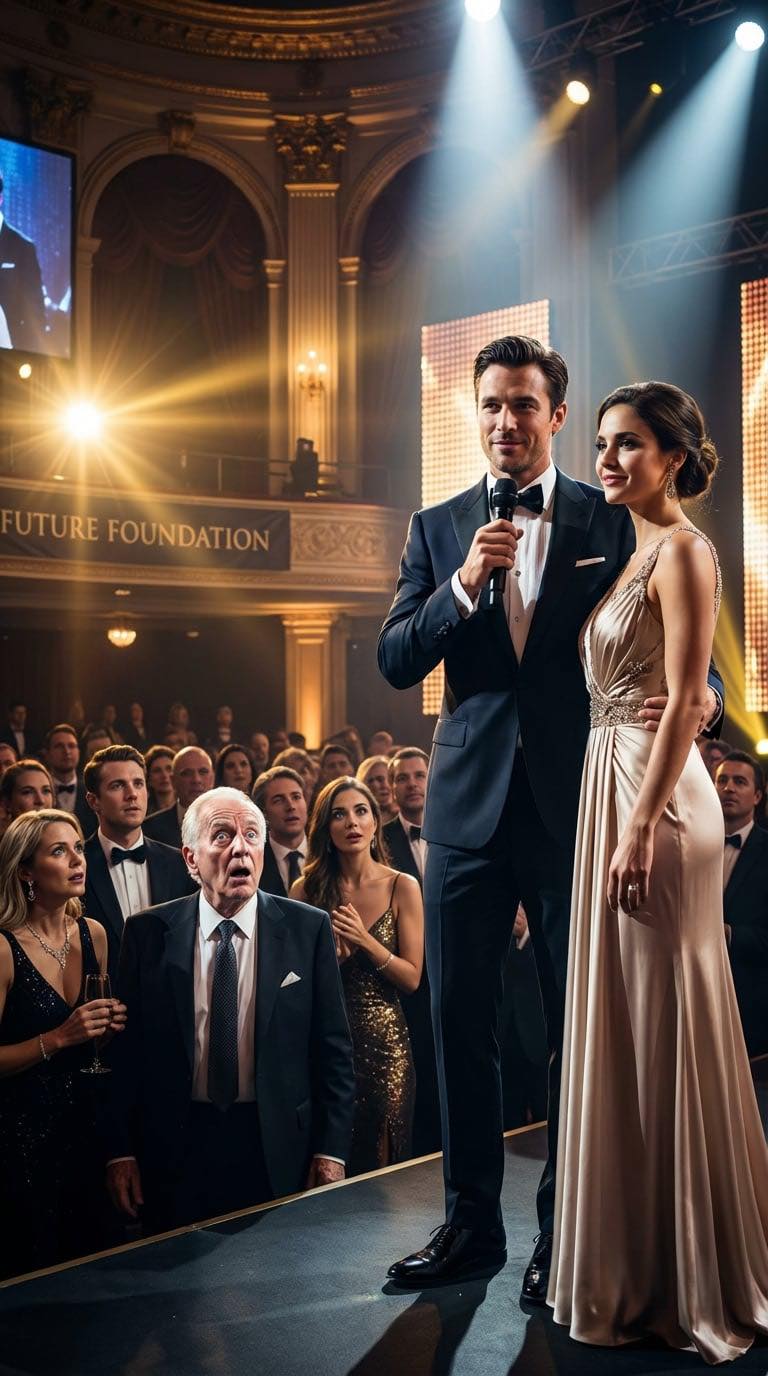
“Ladies and gentlemen,” the MC’s voice echoed. “Tonight marks a historic moment. Please welcome the founder and CEO of Nexus AI Technologies, valued at $4.7 billion… James Carter.”
The room erupted.
My father’s champagne glass froze halfway to his lips. My mother’s mouth fell open in a perfect ‘O’.
And James—my James, the mechanic, the “trash”—let go of my hand. He winked at me. “Just for me,” he whispered.
He walked onto that stage like he owned the very air in the room.
The screens behind him lit up with his face. James Carter, CEO.
I looked at my father. His face had gone completely, utterly white. It was the face of a man watching his entire reality shatter. Derek had stopped breathing.
James spoke for twenty minutes about the future of AI. He was brilliant, commanding, magnetic. But I barely heard a word. I was too busy watching my father’s arrogance dissolve into pure terror.
When James finished, the standing ovation was thunderous. He walked off the stage and came directly to where my father was standing, frozen.
“Mr. Ashford,” James said, his voice pleasant and professional. “I believe you wanted to discuss a business partnership.”
My father looked up. His mouth opened and closed like a fish on dry land. “You…” he choked out. “You’re the CEO?”
James pulled out a business card. Heavy stock. Embossed. James Carter, Nexus AI.
“Perhaps you’ve heard of us,” James said.
Forbes would later confirm what everyone in the room was calculating: James was worth $4.7 billion. He was twice as rich as my father.
My father recovered, his businessman mask sliding back into place. “James!” He extended his hand, sweating. “I had no idea! This is… wonderful news! I always told Fiona she had excellent taste!”
The lie was so blatant I almost laughed.
James looked at the extended hand. He didn’t take it.
“You told me I was trash, Mr. Ashford,” James said, his voice carrying clearly over the crowd. “You called me a parasite. You said I had nothing to offer your daughter.”
“That was… you have to understand, I didn’t know!”
“Whether I fixed cars or ran companies, I was the same person,” James said coldly. “The only thing that has changed is your perception of my utility to you.”
James pressed his own business card into my father’s palm.
“Let’s discuss the data center deal,” my father stammered, desperate now. “I’m sure we can come to an arrangement.”
“I’ve already made my decision,” James said. “Nexus AI will not be partnering with Ashford Properties.”
“What? Why?”
“Because I don’t do business with people who treat their families like assets to be traded.” James stepped back, wrapping his arm around my waist. “Your daughter chose love over money. You punished her for it. I don’t reward that kind of behavior.”
The fallout was swift and brutal.
By midnight, the video from our wedding—the toast where Richard called James a “grease monkey”—was trending alongside the video of the Gala reveal. The internet loves karma.
Headlines screaming: Real Estate Tycoon Mocks Secret Billionaire Son-in-Law. The $50 Million Mistake.
Within a week, three of my father’s major investors pulled out, citing “poor judgment.” The board of Ashford Properties opened an inquiry into his leadership.
My brother Derek showed up at our door three days later.
“James, man,” he said, shifting uncomfortably. “I wanted to apologize. We’re family, right? Think about the synergy between our companies.”
James opened the door wide. “You made your choice six months ago, Derek. We’re not family. We’re just people who share a relative.”
He closed the door in Derek’s face.
My mother called, crying about how she “always supported me in silence.” I sent her a screenshot of an email she’d written to Dad, urging him to cut me off to “teach me a lesson.” I blocked her number.
And then, my father came.
He came alone. No driver. No entourage. He stood in our Brooklyn doorway—we hadn’t moved yet—looking older. Smaller.
“I’ve lost the company,” he said quietly. “The board voted me out this morning.”
“I’m sorry,” I said. And I meant it. Not because he didn’t deserve it, but because it was sad to see a man destroyed by his own pride.
“I was wrong,” he said, staring at his shoes. “About James. About you.”
“I don’t need your apology, Dad,” I said. “I just need you to understand one thing. I’m happy. Not because my husband is rich. I was happy when he was a mechanic. I’m happy because I’m respected.”
He looked at me, really looked at me, for the first time in years. “I’m trying to understand.”
“Then keep trying,” I said. “But do it from a distance.”
We moved to Connecticut a few months later. James still spends weekends working on cars—it keeps him grounded. I run Thornton Creative, which is now one of the top boutique agencies in the state.
My father calls sometimes. We talk about the weather. It’s not perfect, but it’s real.
If you take anything from my story, let it be this: Never let anyone define your worth by a bank account. Not even family. Especially not family. Real wealth isn’t what you have in the bank. It’s having the courage to walk away from the gold-plated cage and build a life that is actually your own.
And sometimes, just sometimes, the “trash” you throw away turns out to be the treasure you were looking for all along.