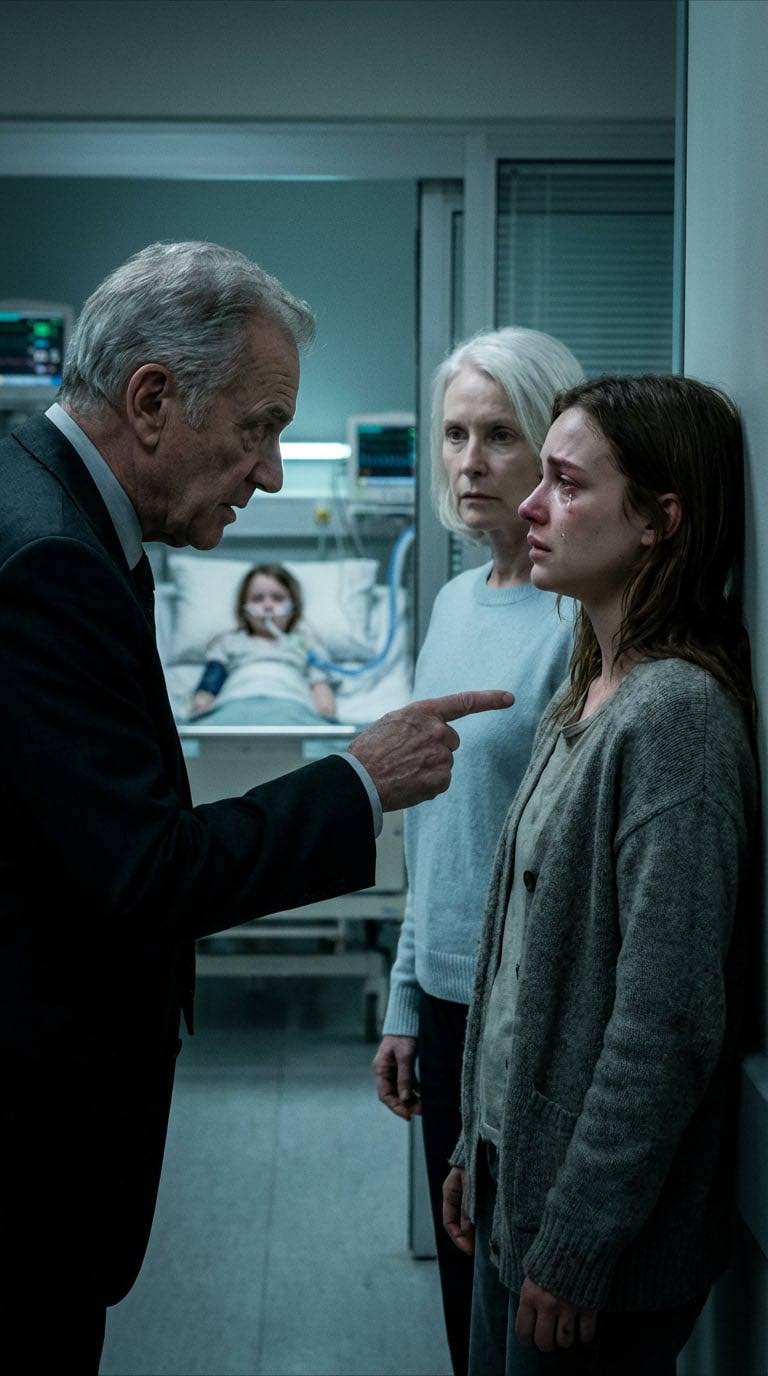
“She’s not our granddaughter, and we don’t care if she dies. You are on your own.”
I am standing in the Intensive Care Unit at 2:47 A.M., and the only sound louder than the rhythmic, mechanical hiss of the ventilator is the question screaming in my mind: How do you survive watching your child fight for her life while the people who raised you walk away like she is already a ghost?
Laya is seven years old. She possesses my eyes, wide and inquisitive, and her father’s stubborn, jutting chin. She has a laugh that sounds like windchimes caught in a summer breeze. Three days ago, she was riding her bicycle down our suburban street, singing a Taylor Swift song, off-key and beautiful, her hair streaming behind her like a banner of pure joy.
Now, she is a landscape of trauma. Intubated. Sedated. Wrapped in wires and gauze. There is a silence in this room that makes you forget how to breathe your own air.
The accident happened with the violence of a thunderclap. A driver ran a stop sign. Metal met metal. By the time I arrived at the hospital, running through the sliding doors with my heart hammering against my ribs like a trapped bird, she was already in surgery. By the time she came out, I had ceased to be Naomi, the daughter, the sister, the employee. I had become a mother who understood that love and terror are the exact same thing when your child’s heartbeat depends on a machine.
I called my mother first. Doris.
I don’t know why I expected her to sound different. Perhaps I thought crisis was a solvent that dissolved old resentments. I thought she would cry. I thought she would pray. I thought she would tell me she was already in the car.
Instead, she said, “We’ll be there soon.” She used the same flat, administrative tone she uses to confirm a dentist appointment or order deli meat.
I called my father next. Frank. He said even less. Just, “Okay, Naomi. Hang tight.”
My brother, Evan, didn’t even pick up. He texted back two hours later: Praying for you guys.
And that should have been my first clue. Not praying for Laya. Not praying for her recovery. Praying for you guys. As if Laya and I were a distant concept, a vague situation happening to someone else on the news. But I was too exhausted to read between the lines. I was too focused on the doctor’s words—Critical but stable. Next 48 hours. We’ll know more soon—to notice the frost creeping in through the phone lines.
They arrived the next morning.
I saw them through the smudge-proof glass doors of the ICU waiting room. Doris in her navy coat, the stiff wool one she wears to church to judge the sermon. Frank in his work boots, dusting the sterile floor with drywall powder. Evan trailing behind, hands deep in his pockets, eyes glued to the linoleum.
I stood up. My legs felt like lead. I thought I would hug them. I thought they would hold me up.
But Doris walked past me. She walked straight to the nurse’s station with the determination of a woman returning a defective appliance. I heard her voice before I processed the words.
“Excuse me,” she said, loud enough to cut through the hum of the machinery. “We’re here about the child in Room 12.”
The nurse, a kind woman named Claudia, looked up, confused but professional. “Are you family?”
And Doris said it. Without hesitation. Without lowering her voice. Without a single tremor of shame.
“She’s not our granddaughter.”
I don’t remember what happened in the seconds immediately following. I mean, I do—I remember every frame, but my brain has filed it under Things That Cannot Be Real. Things that belong in nightmares or soap operas.
Nurse Claudia blinked. “I’m sorry?”
Doris repeated herself. Slower this time. Enunciating, as if the nurse were the one who was slow. “She is not our granddaughter. We are not responsible for her care. We are here for our daughter, Naomi. But the child…” She waved a hand dismissively toward the room where my daughter lay fighting for every breath. “We have no tie to her.”
She didn’t finish. She didn’t have to.
Frank stood behind her, nodding. His silence was a flying buttress, supporting her cruelty. Evan looked at me once—a fleeting, terrified glance—and then looked away, studying a crack in the wall.
They turned and left.
No goodbyes. No explanations. No glance through the glass at the little girl whose heart was only beating because electricity was forcing it to. They just walked out.
I stood there in the middle of the ICU, surrounded by the cacophony of beeping monitors and the faint, stinging smell of antiseptic, and I realized the truth. They didn’t come to support me. They came to make sure the hospital knew that Laya wasn’t theirs to save. They came to protect their wallets from a bill that hadn’t even been printed yet.
I watched the elevator doors close on them, and I felt the floor drop out from under my life.
Chapter 1: The Anatomy of Abandonment
If you have ever been abandoned in a crisis, you know it doesn’t feel like anger at first. It feels like confusion. It feels like a glitch in the matrix. You replay the scene over and over, thinking, Surely I misheard. Surely they meant something else.
I replayed it for hours. Sitting in that hard plastic chair beside Laya’s bed, holding her small, limp hand, I replayed Doris’s words until they stopped sounding like language and started sounding like a sentencing.
She’s not our granddaughter.
But she was. She is.
Laya was born when I was twenty-two. Her father, Marcus, was a man my parents despised. He was an artist, free-spirited and financially unstable. He left before Laya took her first breath, unable to handle the pressure. My family didn’t approve of him, and by extension, they didn’t approve of me. But they had shown up to the hospital when she was born. Doris had held her. Doris had even cried, tears that I now realize were likely frustration rather than joy.
For seven years, I thought we had moved past it. I thought we had built a bridge over the disappointment. But I was wrong. The bridge was a hologram.
The truth is, my family tolerated Laya. They tolerated me. And the second things got hard—the second the “investment” of family required a payout of emotional or financial support—they didn’t just step back. They erased her.
I didn’t cry that first day. I didn’t have the luxury.
The doctors came in every few hours with updates that felt like blows to the head. Brain swelling. Induced coma. Tibia fracture. Every piece of news was a terrifying variable. I clung to the monitors like they were religious texts.
But at night, when the nurses dimmed the lights and the hallway quieted to a low hum, I let myself feel it. The abandonment. The cruelty. The kind of rejection that doesn’t come with a reason, only an exit wound.
They didn’t call. They didn’t text. They didn’t ask if she was still alive.
Two days later, Nurse Claudia pulled me aside. She had kind eyes, rimmed with red, and a firm handshake.
“Ms. Hale,” she said quietly, pulling me into a private alcove. “I need to let you know something. Your family contacted hospital administration this morning.”
My stomach turned over. “Did they ask how she is?”
Claudia hesitated. “No. They called to ensure they have removed themselves from all emergency contact lists. They have also formally declined any financial or legal responsibility for the patient in Room 12.”
I stared at her. “What does that mean?”
“It means they have opted out,” she said, her voice laced with a professional fury she was trying to hide. “Like she was a subscription service they wanted to cancel. They wanted it noted in the chart that they are not kin.”
Opted out.
Claudia’s expression softened. “I’m so sorry, Naomi. I thought you should know. We’ve logged the interaction.”
I nodded. I didn’t trust my voice. But inside, something shifted. The confusion evaporated. The shock dissolved.
This wasn’t grief clouding their judgment. This wasn’t panic. This was intentional. This was a strategic maneuver to avoid liability for a dying child.
And somewhere beneath the exhaustion and the terror, a new feeling started to grow. It wasn’t anger. It was clarity. Cold, hard, diamond-sharp clarity.
The only person who stayed was Micah.
Micah Boone. My best friend since high school. The guy who held my hair back when I got the flu in college. The guy who fixed my sink and never asked for a dime. He walked into the ICU on day three carrying a duffel bag, a phone charger, and three cups of coffee.
“One’s for you,” he said, setting them on the bedside table. “One’s for later. And one’s for when you realize the first two weren’t enough.”
I tried to smile. I failed. My face felt like it was made of cracked plaster.
He sat down beside me and didn’t say a word. He just sat there. Solid. Present.
After an hour, I told him. I told him what Doris said. I told him what they did.
Micah went very still. It was the kind of stillness that happens in the woods before a predator strikes.
“They said what?” His voice was quiet, dangerous.
“They told the nurse she wasn’t their granddaughter.”
“While she was in here dying?”
“She’s not dying,” I whispered fiercely. “She’s fighting.”
Micah looked at me. “You’re allowed to be angry, Naomi. You’re allowed to burn it down.”
“I can’t,” I said. “I don’t have room for anger. I only have room for her.”
But the universe, it seemed, was about to make room for me.
Chapter 2: The Hidden Legacy
On day six, the atmosphere in the room changed.
I was dozing in the chair, my neck cramped, when a hospital administrator walked in. She wasn’t a nurse. She was wearing a suit. She held a clipboard and looked efficient.
“Ms. Hale,” she said. “I need to confirm some paperwork with you regarding the billing and the estate.”
I blinked, rubbing grit from my eyes. “Billing? I gave you my insurance.”
“This isn’t about insurance,” she said. “This is about the Trust. We have records showing that Laya Hale is the primary beneficiary of a irrevocable trust established in her name. The Trustee has reached out to us to cover all medical expenses directly.”
I froze.
I had forgotten.
Two years ago, Marcus’s mother—Laya’s paternal grandmother, Iris—had passed away. Iris was a formidable woman. She had only met Laya a handful of times, but she had seen something in her. She had also seen something in my parents. She had looked at Doris and Frank with a discerning, critical eye.
When Iris died, a lawyer had contacted me. He said there was a small estate. Some savings, a property in Oregon. He said it was left entirely to Laya, held in trust until she was twenty-five, but accessible for medical emergencies. I signed the papers because I was told to. I didn’t understand the magnitude of it. I thought it was maybe ten or twenty thousand dollars.
“Is that correct?” the administrator asked. “Is the contact information for the Trustee, a Ms. Miranda Cross, current?”
“Yes,” I said slowly. “That’s correct.”
“Good. Ms. Cross has authorized full coverage for the best neurological care available. You don’t need to worry about the cost, Ms. Hale.”
She left.
I sat there, staring at the wall, as the pieces slammed into place.
Doris didn’t just walk out because she disapproved of Laya. She walked out because she thought Laya wouldn’t survive. And if Laya didn’t survive, and if there was no will… the intestate laws of our state meant that I would inherit Laya’s assets.
And if I inherited, Doris and Frank knew they could manipulate me. They could guilt me. They could take it.
They weren’t mourning a death. They were positioning themselves for a payout.
Chapter 3: The Return of the Vultures
One week after the accident, Doris, Frank, and Evan walked back into the ICU.
I saw them coming down the hallway. The scene was almost comical in its falseness. Doris was wearing a softer, pastel coat. Frank was freshly shaved. Evan was holding a bouquet of grocery store carnations that were already wilting.
They smiled. They walked with the confidence of people who had checked the weather and decided the storm had passed.
Doris sat down across from me, folding her hands on her lap like we were having tea.
“Naomi, sweetheart,” she cooed. “We’ve been so worried. We wanted to give you space, but we need to talk about logistics.”
“Logistics?” I asked. My voice was flat.
“Documents,” Frank grunted. “Accounts. We know about Marcus’s mother. We know there’s… an estate.”
“We just want to make sure things are in order,” Doris added quickly. “If the unthinkable happens… God forbid… we need to be prepared. We want to help you manage it. You know you’re not good with numbers, Naomi.”
Evan set the flowers on the table. “We’re family, Nay. We should do this together.”
And for the first time in a week, I felt it.
The anger.
It wasn’t hot. It wasn’t a fire. It was absolute zero. It was the vacuum of space.
They weren’t here to help. They were here to harvest.
I stood up slowly. I walked to my bag. I pulled out a folder I had been carrying for two days, ever since Miranda Cross, the trustee, had faxed it to the hospital.
“Actually,” I said, “I have something for you.”
I placed the folder on the table between us.
Doris reached for it immediately. Her eyes lit up. She opened it like it was a menu at a high-end restaurant.
Then, her face changed. The color drained out of her cheeks so fast it looked like a magic trick.
Frank leaned over. He read the first paragraph. He went gray.
Evan’s hands started to shake.
It wasn’t a will. It wasn’t bank details. It wasn’t access codes.
It was a legal notification. A formal triggering of the “Bad Actor” clause in Iris’s trust.
The letter was clear. Any family member who denied, abandoned, or attempted to claim assets from the minor beneficiary through fraudulent means or negligence would trigger an automatic investigation and immediate disinheritance from any potential claim.
And there, in the second paragraph, were their exact words, captured in the hospital incident report filed by Nurse Claudia on the night of admission.
“She is not our granddaughter.”
The letter continued: Due to the explicit verbal disavowal of kinship recorded by hospital staff on [Date] at [Time], the parties identified as Doris and Frank Hale are hereby classified as hostile parties. Layla’s trust is now frozen to all external family claims. Any further attempts to access, contest, or manipulate her estate will result in criminal charges for attempted fraud. The investigation has already begun.
Doris tried to speak. Her mouth opened and closed like a fish on a dock.
“This…” Frank sputtered, pushing back from the table. “This is a misunderstanding. We were… we were emotional.”
“No,” I said quietly. “You weren’t emotional. You were precise.”
“Naomi,” Evan pleaded, looking panicked. “We didn’t mean it like that.”
I looked at my brother. “You meant every word. You opted out. You cancelled the subscription.”
Doris stood up, her voice rising to a shrill pitch. “We were scared! We didn’t want to be stuck with the bills if she died! You know we don’t have that kind of money!”
“You weren’t scared,” I said. “You were calculating. And you miscalculated.”
I pointed to the door.
“Leave.”
“You can’t do this,” Doris hissed. “We are your parents.”
“No,” I said. “You’re strangers. You told the nurse yourself. She’s not your granddaughter. Which means I’m not your daughter. Not anymore.”
They left without the flowers. They left without another word. And this time, I knew they wouldn’t be back. Not because they didn’t want the money, but because the money was gone.
Chapter 4: The Recovery and The Silence
Laya woke up on Day 19.
Her eyes fluttered open, confused and scared, and the first thing she whispered was, “Mama?”
I grabbed her hand, weeping. “I’m here, baby. I’m right here.”
Micah, who had been sleeping in the corner chair, stood up and wiped his eyes. “Welcome back, kid,” he choked out.
The recovery was brutal. Physical therapy. Speech therapy. Nightmares where she woke up screaming about headlights. But she was alive. And she was ours.
Two months later, my phone rang. It was Doris.
I answered. I don’t know why. Maybe I needed to hear the defeat.
“Naomi,” she said. Her voice was small. “We need to talk.”
“No,” I said. “We don’t.”
“You can’t just shut us out,” she said, her voice gaining a little of that old entitlement. “We made a mistake.”
“You made a choice,” I corrected. “You looked at my dying child and saw a liability. Then you looked at my surviving child and saw a paycheck. There is no conversation that fixes that.”
I hung up. And then I blocked the number. I blocked Frank. I blocked Evan.
People ask me sometimes if I regret it. If I feel guilty for cutting off my blood.
The answer is no.
Because I learned that Iris, a woman I barely knew, loved my daughter more in death than my parents did in life. She protected her. She put a shield around her that activated the moment the wolves showed their teeth.
Three months after Laya came home, I received a cease and desist letter from a lawyer my parents had hired. They were claiming I had “defamed” them and interfered with their relationship with their grandchild.
I called Miranda Cross.
She laughed. It was a dry, sharp sound. “They’re bluffing, Naomi. No lawyer will take this case to court. The evidence is overwhelming. They abandoned a minor in critical care. It’s on the record. Let them waste their money.”
They eventually gave up. The silence that followed was the most peaceful sound I have ever known.
Epilogue: Fireflies and Fortresses
Laya is eight now.
She is sitting on the porch as I write this, watching Micah catch fireflies in a jar. She is laughing—that windchime laugh is back, stronger than ever. She has a scar on her leg, but she runs on it just fine.
Last week, she asked me if she was rich.
“Emma at school said her grandma left her money,” she said, twirling spaghetti on her fork. “Do I have money?”
I paused. “You have a Trust,” I said. “Grandma Iris left you something to keep you safe. For college. For your future.”
She thought about this. “Is that why Grandma Doris doesn’t visit anymore? Because of the money?”
Children are perceptive. They see the things we try to hide.
I could have lied. I could have protected her from the ugliness of it. But I decided a long time ago that truth is the only legacy worth leaving.
“Grandma Doris made some choices,” I said carefully. “She made choices that hurt us. And I decided that we deserve people who choose us back. Does that make sense?”
Laya nodded slowly. “Like how Micah chooses us?”
“Exactly like that.”
She smiled, satisfied, and went back to her dinner.
I realized then that she is going to be okay. Not because she has a fortress of money protecting her, though she does. But because she knows her worth. She knows that love is an action, not a biological obligation.
If you are reading this, and you are standing in a hospital room, or a courtroom, or a living room, watching the people who are supposed to love you walk away… let them go.
Do not chase them. Do not beg them. Do not bargain with your dignity.
The people who matter are the ones who stay when the monitors are beeping and the outcome is uncertain. The people who matter are the ones who bring you coffee at 3:00 A.M. and sit in the silence.
My family tried to opt out of my daughter’s tragedy. In doing so, they opted out of her triumph. That is their punishment. My reward is sitting right there on the porch, chasing fireflies, alive and whole and loved.
And that is all the inheritance I will ever need.