Part I: The Party, The Package, and The Purge
Welcome to the chronicle of my own coup d’état. It didn’t start with a boardroom takeover or a declaration of war. It started with a nine-year-old’s birthday party, a cardboard box, and a kitchen trash can.
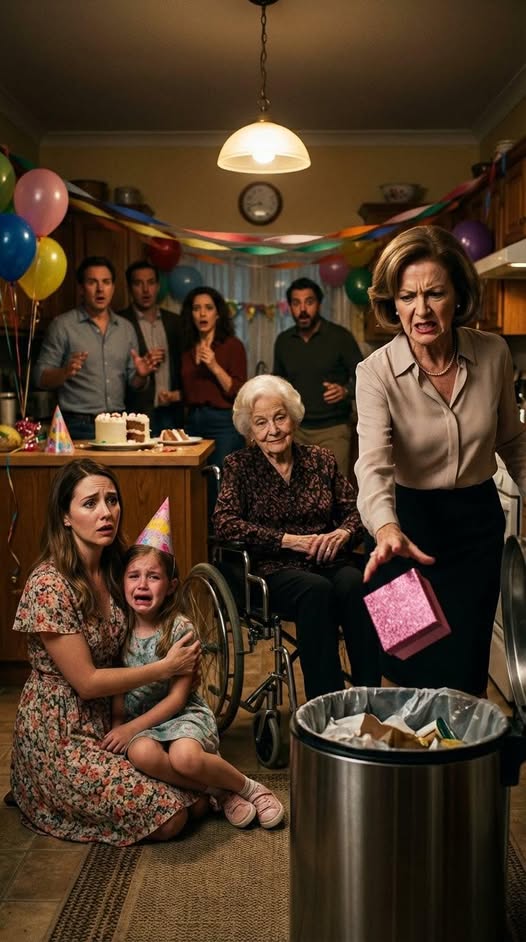
Ruby’s ninth birthday was in full swing at my house, which meant two indisputable facts. One, my living room looked as though a party supply store had violently exploded, raining confetti and plastic chaos upon the carpet. Two, my kitchen smelled like a volatile mixture of buttercream frosting and maternal panic.
I am not one of those Instagram-perfect mothers who construct color-coded balloon arches and hand-paint matching party favors. I am more of a pragmatic survivalist: we have cake, we have candles, and nobody has gone into anaphylactic shock, so we are already winning.
“Mom!” Ruby was buzzing. She had been vibrating with adrenaline since breakfast, bouncing between piles of gifts like they were sacred artifacts. Wrapping paper carpeted the floor, mixed with plastic rings, tubs of neon slime, and those insidious little squishy toys that seem to multiply when you aren’t looking. Kids were thundering through my hallway with the energy of a stampede.
Then, the atmosphere shifted. My parents arrived.
My mother and father walked in with that specific, heavy energy they bring to every family event—an air that suggests their presence is a benevolent favor, and the rest of us should be quietly grateful they made room in their schedule. Trailing behind them was my sister, Rebecca, and her daughter, Isabella.
Isabella is ten, a year older than Ruby, and looks like Rebecca’s “mini-me” in that uncanny way some family genetics copy and paste themselves with aggressive pride. She had Rebecca’s hair, Rebecca’s smile, and Rebecca’s posture—that specific tilt of the chin that says, I am used to being the most important person in the room. Even as a child, she carried herself like the world should adjust its lighting to better suit her complexion.
I noticed the dynamic the moment they crossed the threshold. Rebecca didn’t do anything openly rude. Isabella didn’t do anything overtly mean. But the adults’ attention drifted to them like iron filings to a magnet.
“Oh my gosh, look at Isabella,” my mother cooed, bypassing the birthday girl. “She’s so mature. She’s really going places.”
Ruby got plenty of smiles, too, but they were the kind of perfunctory smiles you give a cute puppy before turning back to the prize-winning show dog. I told myself I was imagining it. I always told myself that. It was the survival mechanism of the scapegoat: pretend the disparity doesn’t exist so it doesn’t hurt as much.
Anyway—cake, candles, singing “Happy Birthday” with too many people and not enough rhythm. Ruby made her wish, cheeks puffed out, and blew out all nine candles like she was personally defeating the darkness.
That was when the package arrived.
It wasn’t a dramatic delivery. No fanfare, no violin music. Just a standard brown box placed by the door like every other Amazon delivery in America. But Ruby saw her name on the label and lit up like someone had handed her a map to El Dorado.
“It’s for me!” she squealed, already tearing at the packing tape.
“It’s from your Great Grandma,” I told her, recognizing the script. My grandmother—my dad’s mom—had a way of writing names that looked like she was blessing the paper.
Ruby hugged the box to her chest for a second before opening it, as if she could absorb the love through the cardboard. Inside was a pink treasure box. It was glittery, child-magical, the kind of object a kid claims immediately with their whole soul.
Ruby’s hands were gentle as she lifted it out. “Mine,” she whispered.
Before Ruby could even properly show us what was inside, my mother stepped in. She didn’t move slowly or kindly. She moved with the urgency of someone snatching a hot pan before a child gets burned.
“No, no,” she said, her voice sharp and fast. “You don’t touch that.”
Ruby blinked, her smile faltering. “Why?”
My mother’s tone shifted into her favorite mode: Practical Authority. It is the voice she uses when she wants sheer control to sound like common sense.
“It’s garbage,” she said, loud enough for the room to hear. “She sends weird things. It could be dangerous.”
Dangerous? Like my ninety-year-old grandmother had mailed a live raccoon or a box of anthrax?
Ruby froze. Her fingers tightened around the little pink box. She looked at me, and I watched her joy stumble and fall like she’d tripped over a crack in the sidewalk.
Then, my mother did the unthinkable. She reached out, took the entire treasure box—contents and all—and walked into my kitchen. She pressed the foot pedal of the trash can, the one filled with half-eaten cake plates and wet napkins.
“It’s just the old woman’s garbage,” she announced.
She dropped the box into the filth. The trash lid slammed shut with a hard, final sound. Like a door closing.
Ruby stood frozen for half a heartbeat. Then, her face crumpled. It was a look of confusion, embarrassment, and deep, stinging hurt—the kind of hurt kids get when the world suddenly changes the rules and nobody warned them. The room went weirdly silent. Kids stopped moving. Adults glanced at each other, paralyzed by the social breach. Someone’s kid dropped a plastic fork, and nobody laughed.
Rebecca didn’t say anything. Isabella just watched, eyes wide but curious, like this was a reality show she hadn’t expected but didn’t want to miss. My dad stood there the way he always does: present, but absent. He looked at the trash can, then at the cake, then at Ruby, clearly hoping the universe would resolve this awkwardness without him having to pick a side.
Ruby’s eyes went to me. They weren’t accusing or angry. They were just small. Did I do something wrong?
I didn’t cry. I didn’t yell. I didn’t give my mother the satisfaction of a scene. I went cold and steady because Ruby was watching me. I moved my body between Ruby and my mother like a shield. Not dramatic, just instinct.
“Go with the kids for a minute, sweetheart,” I told Ruby softly. “Go show them your other gifts.”
Ruby hesitated, staring at the trash can like her treasure might crawl out on its own. Then she nodded and shuffled away, trying to be brave, trying to act like she wasn’t shattered.
The moment she was out of earshot, I turned back to my mother. My voice was calm, flat, and dangerous.
“You need to leave.”
My mom laughed, a short, dismissive sound. “You’re really doing this right now? Over some garbage?”
I didn’t argue. I didn’t explain. I didn’t debate whether humiliating my child was a matter of garbage or principle. I repeated it.
“Get your things. Leave.”
My dad’s eyes flicked to mine. I could see him considering the old pattern: Smooth it over. Keep the peace. Don’t upset your mother. Then he did what he always does. He followed her out. They left together. Rebecca stayed. Isabella stayed. The party continued because kids don’t know what to do when adults rupture the air, and parents are trained to plaster smiles over disasters.
But the feeling had changed. Ruby laughed less. She kept glancing toward the kitchen like the trash can was a monster holding her happiness hostage.
Later, when the guests were gone and the house was quiet, I tucked Ruby into bed. I pulled the covers up with extra softness, as if my hands could undo what my mother had done. After Ruby was asleep, I went to the kitchen.
I opened the bin. I dug past the frosting-smeared plates and the wet napkins. I pulled out the treasure box from the dirty garbage. I cleaned it off with disinfectant wipes until it sparkled again. Only then did I open it properly for the first time.
Inside, I found a booklet.
It wasn’t a toy. It contained banking language, Ruby’s name, and the kind of paperwork grown-ups fight over. I didn’t know exactly what it meant yet, only that my mother had reacted to this object with immediate, visceral hostility.
I put it aside and stared at it until my eyes felt dry as sand. I didn’t know it yet, but that booklet was the key to a vault of secrets my family had been keeping for years.
Ten hours later, the police were involved.
Part II: The Bank, The Fraud, and The Betrayal
To understand why I went to the authorities, you have to understand the hierarchy of my family.
My grandma is my dad’s mom. That is an important detail because my mother has always acted like this biological degree of separation means everything my grandma does is optional. Optional love, optional gifts, optional respect.
When I was little, my grandma used to send small things. Birthday cards with cash taped inside. “Little for later” envelopes. Not huge money, just the kind of careful, old-fashioned generosity that says, I thought of you.
My mom always opened them first.
I have a memory I can replay like a home video. I’m ten. I’m in the hallway. I spot my grandma’s handwriting on an envelope. Before I even touch it, my mom’s voice cuts through the air. “Give it here.” Not let me help. Not let’s open it together. Just a command. She peels the tape, counts the bills, and says, “We’ll keep it safe.” Like the money belongs to her the second it enters the house.
When you’re ten, you can’t prove anything. You just learn the rules. My dad used to soften it. He’d hand me the empty card later and say, “Just call her, okay?” Like he was trying to keep peace in a house that didn’t allow peace. He never fought my mom head-on. He just tried to smooth the edges after she cut them.
Rebecca, my sister, was different. She could do no wrong. If she wanted something, my mom called it smart. If I asked a question, my mom called it “starting trouble.” By high school, Rebecca had become my mom’s right hand. I can still picture it: Rebecca sitting next to my mom on speakerphone for bank stuff, writing down confirmation numbers like it was a job. My mom would say, “Don’t worry. I handle these things.” And Rebecca would nod like that was a compliment, not a warning.
This dynamic didn’t stop when we grew up. It inherited. When Rebecca had Isabella, the favoritism transferred seamlessly. If there was one good chair, Isabella landed in it. If there was one extra slice of pie, it drifted her way. Ruby wasn’t mistreated; she was managed. A quick smile, a pat on the shoulder, and then attention moved on.
So, when that pink treasure box showed up for Ruby—something clearly meant for Ruby’s future—it wasn’t just a gift. It was a bright, undeniable moment where my mom couldn’t pretend she was being neutral. And when she threw it away, it wasn’t an accident.
The next morning, I dropped Ruby off at school. I performed stability with the skill of a seasoned actor, smiling and waving. “I’m okay,” I told her. “You’re okay.” She nodded, but her eyes were still wary.
Then, I drove to the bank named on the booklet.
I walked up to the counter and handed the booklet over like it was nothing, as if I were asking about a savings account with twenty dollars in it.
“Can you tell me what this is?” I asked.
The teller typed something in. Her face did a quick shift—the professional mask slipping for half a second. It was subtle. If I hadn’t spent my whole life reading my mother’s micro-expressions to avoid trouble, I might have missed it.
She asked for my ID. I handed it over. She didn’t tell me anything, just said, “One moment,” and disappeared into the back.
I waited. It was too long. Long enough to consider whether I’d accidentally walked into a felony. People in the line kept glancing over. A second employee appeared, looking at a screen, then at me. Something was off. I sat there trying to look calm, but inside, my mind was racing. Is this a scam? Did I just walk into someone else’s account? Is this why my mom called it dangerous?
Then, the police walked in.
I was still sitting in the lobby chairs when two officers approached me. They were calm, but they blocked the exit. My stomach dropped through the floor. I kept thinking, This is Ruby’s birthday booklet. What did I walk into?
The officer asked for my ID again. He looked at the photo, looked at my face, checked the document carefully, like he was making sure I was real. I could feel my heartbeat hammering against my throat.
He asked basic questions, measured and practiced. “Where did you get this booklet? Why did you come in today? Have you ever had an account here before? Has anyone asked you for your documents or tried to use your identity?”
I answered truthfully. “It was in a birthday gift for my daughter. My mom threw the whole thing in the trash. I pulled it out later. I came in because I didn’t know what it was.”
The officer listened without reacting. Then he told me the only thing he would confirm without giving a lot of details.
“The bank flagged this account for potential identity fraud. Someone has been attempting to impersonate an authorized person tied to the account to make unauthorized changes. Because you are here with the documents, we needed to verify you are who you say you are.”
“Would you like to file an identity theft report?” he asked.
I just stared at him. Identity theft? From a child’s birthday gift? My brain tried to reject it like a bad email attachment, but I heard myself say yes. He took a brief statement, gave me a case number, and then he left. Just like that. No handcuffs, no dramatic reveal, just a paper trail and the hollow feeling that someone had been wearing my name like a mask.
Once the police left, the bank staff’s energy changed completely. They were overly polite, careful, almost relieved. A manager brought me into an office and apologized in that careful corporate way.
“We had to verify who you were because of the suspicious activity,” he explained.
He tapped the booklet. “This is a 529 College Savings Plan your grandmother opened for Ruby.”
He turned the monitor so I could see. “Now that we’ve verified you, I can show you the status.”
He printed a summary sheet and slid it across the desk. I saw the balance for the first time.
$194,000.
My first thought wasn’t greed. It was shock. That was a real amount of money. That was a degree. That was a down payment on a life. That was not garbage.
“On the printout,” the manager said, pointing to a list of red text, “you can see the attempted action lines. Requests that were submitted and denied due to signature mismatch or security question failures.”
One line jumped out so hard my vision narrowed.
Attempted Change of Beneficiary.
I read the name tied to that attempted change, and my blood went cold. I didn’t know whether it was my mom or Rebecca who pushed the buttons, but I knew it was family. Because the attempted beneficiary name pointed straight into the heart of my own family.
They had tried to delete my daughter, Ruby.
And in her place, they had tried to insert my niece, Isabella.
Part III: The Call and The Cut
I walked out of the bank in a daze, clutching the printout like it was radioactive.
I went home stunned and heartsick. I always knew my family was difficult—narcissistic, favoring, cold—but I didn’t think they were criminals. I didn’t think they were capable of trying to steal Ruby’s future to pad the life of the golden grandchild.
The betrayal wasn’t a feeling anymore. It was a line item on a bank statement.
For three days, I waited. Nothing came. No calls, no emails, no magical resolution. Just the sick feeling of knowing. Ruby was quiet, too. On the third night, I found her on her bed with the pink treasure box on her lap, tracing the glitter.
“Did I do something to make Grandma mad?” she asked without looking up.
My chest tightened. “No, baby.”
She finally lifted her eyes. “Then why did she look at me like that? Like I was dumb?”
“Grandma’s feelings are not your responsibility,” I said, sitting on the edge of the bed.
“But she likes Isabella more.”
There it was. The thing kids notice long before adults admit it. I took a breath. “Sometimes grown-ups have favorites. And sometimes, they are wrong for that. It doesn’t mean you aren’t enough. You are more than enough. You are my kid, and that is everything.”
“So I didn’t lose?” she whispered.
“No,” I said fiercely. “You didn’t lose. And nobody gets to decide your value in my house. Nobody.”
Four days after the bank visit, my phone rang.
“Mom.”
I stared at the screen. I felt like I was standing on the edge of a cliff, looking down into the jagged rocks of my childhood. I picked up.
“Did you call the police on me?” she snapped instantly. No hello. No preamble.
“You told them I impersonated you!”
My grip tightened on the phone. “I didn’t tell them anything,” I said, my voice shaking but holding. “I brought the booklet in because Ruby’s name was on it. The bank called the police.”
“Don’t play innocent,” she hissed. “Your grandmother told me what she was sending. She told me! I raised you! This is how you treat your family?”
I felt something in me finally move from shock into clarity. The fog lifted.
“So,” I asked the question that mattered. “Did you impersonate me?”
She didn’t deny it. Innocent people deny things with confusion. Guilty people deny things with justification.
“No,” she said. “I’m your mother. You wouldn’t exist if it weren’t for me.”
That wasn’t an answer. It was a claim of ownership.
“Someone tried to change the beneficiary from Ruby to Isabella,” I said. “It was either you or Rebecca.”
There was a beat of silence—thick, heavy silence that proved she knew exactly what I was talking about. Then, she pivoted.
“Do you think it’s fair?” she screamed. “Do you think it’s fair that your daughter gets everything and Isabella gets nothing? Isabella is so talented! You know how expensive a good education is. You can’t take it away from her just because your grandmother is going senile!”
“So it was you.”
“You don’t understand!” she argued, sounding like she was the victim. “That money belongs to the family. Isabella is your niece!”
“And Ruby,” I said, my voice dropping to a whisper, “is your granddaughter.”
“It’s different,” she snapped. “Don’t twist things.”
“Different how?” I asked.
Silence. Not the silence of contemplation. The silence of someone who has run out of lies.
I hung up.
I didn’t need to hear more. I had clarity, and it hit me like grief. It wasn’t just that they tried to steal money. It was that they tried to erase Ruby. They looked at a gift meant for my child and decided she didn’t deserve it, that it should be stripped from her and given to the one they actually loved.
So, I did what I should have done years ago. I cut them off.
First, I went to my bank app. I had been sending my parents $200 a month for years. I made decent money, and I wanted to be a good daughter. It was routine. I cancelled it. My finger hovered over the confirmation button because muscle memory is powerful, but then I pressed it.
Next, I called Ruby’s school. “I need to update the authorized pickup list. I need to remove my mother and my sister Rebecca. Under no circumstances are they allowed near my child.”
When I finished, I stood in my kitchen feeling strange. Numb. Shaky. I had just amputated the family I was born into. I stared at my phone, thinking about calling my grandma. She was ninety-one. I didn’t want to scare her. I didn’t want to be the reason her heart raced.
I was still holding the phone when there was a knock at my door.
I froze. Are they here?
I opened it. It wasn’t my parents.
My grandmother was standing there.
Part IV: The Will and The Verdict
My grandmother rarely left her house, let alone appeared at mine unannounced. But there she was, ninety-one years old, standing on my porch like she owned the air. Next to her stood a young man in a suit holding a briefcase.
She stepped inside, small and steady. Ruby came running downstairs.
“Great Grandma!” Ruby yelled, launching herself into the old woman’s arms.
They hugged—a warm, grounding moment of affection. My grandma stroked Ruby’s hair like she was smoothing out something frayed. I watched them and felt something soften in my chest that I didn’t realize had turned to stone.
After a minute, Grandma looked at me. Her eyes were clear and sharp.
“Can we talk alone?” she asked.
I sent Ruby to play in her room. Grandma sat at the dining table. The young man stood beside her.
“This is my attorney,” she said. “And a good friend.”
She didn’t waste time. “The bank called me,” she said. “They told me everything.”
My stomach dropped. “Grandma, I didn’t mean to cause trouble—”
She held up a hand. “You did nothing wrong.”
She paused, looking at her hands. They were trembling slightly, not from age, but from rage contained within a very small frame.
“I decided not to press charges,” she said.
My breath caught.
“It’s family,” she said, her voice cracking just slightly. “But I am heartbroken. And I am betrayed.”
She looked at me, studying my face, making sure I understood the difference between mercy and forgiveness.
“That treasure box,” she said, “was only one piece of my estate.”
I swallowed.
“I had planned to split things fairly,” she continued. “I believed in being fair. But after what your mother and Rebecca tried to do… after they tried to steal from a child…”
She didn’t shout. She didn’t rage. She pronounced it like a judge delivering a verdict.
“Your mother gets nothing,” she said.
My mouth went dry.
“Your father gets nothing,” she added. “He has watched this favoritism for years and called it peace. He is an accomplice.”
“Rebecca gets nothing.”
I stared at her, shocked by the precision of the excision. Then she added one moral nuance that made my throat tighten.
“Isabella isn’t at fault,” she said. “She’s a child. She mimics what she is taught.”
The attorney opened the folder.
“My attorney has set aside a trust of $200,000 for Isabella,” Grandma said. “She can access it when she is twenty-one. Her mother cannot touch it. It is for her education.”
She said it like she was building a fence. Generous, but controlled. Then, my grandma looked at me.
“The rest,” she said, “goes to you and Ruby.”
She took my hand. Her grip was stronger than it had any right to be. “You are the only decent family I have left.”
I forced a smile, wanting to support her. In my head, I was doing math. I expected maybe another hundred thousand dollars. A life-changing amount, sure.
The attorney slid a paper toward me.
I stopped breathing.
It wasn’t a few hundred thousand.
$1.2 Million.
I just stared. “Are you sure?” I whispered. “That’s… that’s a lot.”
My grandma nodded once. “Yes.”
Then she leaned closer, her voice dropping to a conspiratorial whisper. “And you will keep it secret. No fighting. No retaliation. No begging at your door.”
“The paperwork is already signed and in motion,” the attorney added quietly. “It is an irrevocable trust.”
“The truth is set in ink,” Grandma said.
I realized something then. Ruby wasn’t just protected. The people who chose favorites had lost access. The door my mother slammed on my child’s birthday didn’t just close. It locked.
Part V: The Sharks Return
Three years passed.
We had no contact with my parents or Rebecca. Ruby was twelve now—taller, braver, still Ruby. We lived comfortably in a nice house. Not flashy, but solid. Safe. It was the kind of home where you don’t flinch when the doorbell rings.
Except one day, there was a knock.
I opened the door. It was my mom, my dad, and Rebecca.
I still don’t know how they found my address. They stood there, trying to be friendly, acting as if three years of silence was just a quirky misunderstanding.
“Hi, honey!” my mom said, smiling too brightly.
Their eyes drifted past me, scanning the foyer, the furniture, the space. Their faces changed. They hadn’t expected me to be well-off. They expected me to be struggling without their “help.”
“Where does all this come from?” my mom asked, her voice tight with suspicion.
“That’s none of your business,” I said, blocking the doorway.
They made small talk for about two minutes—the way sharks circle before biting. Then, they slid into it.
“We’ve made some bad investments,” my dad mumbled, looking at his shoes.
“We need a temporary loan,” my mom said, regaining her confidence. “Just until we get back on our feet. We’re family.”
I said, “No.”
The mask dropped immediately. My mom’s face twisted into the ugly expression I remembered from the birthday party.
“That money probably came from your grandma!” she spat. “It should belong to all of us! You stole our inheritance!”
“Leave,” I said. “Now.”
I closed the door in their faces. I locked it. I watched them through the peephole as they stormed back to their car, muttering about family rights and legal claims.
Later that week, I visited my grandma. She was still alive, living in a nice assisted living facility, sharp as ever. Ruby and I visited every Sunday.
Before I could even bring up the knock at my door, my grandma beat me to it.
“They came here,” she said.
My stomach tightened. “Who? Mom?”
“Rebecca too,” she said. She looked amused. “Three years. Not a card, not a call, not a visit. Then they see your house, and suddenly they remember I’m alive.”
Ruby sat beside her on the couch, drinking tea, listening without really listening.
My grandma took a slow sip. “They tried to act polite. Like three years of silence was nothing. Like you were the one being dramatic.”
I felt the bitterness rise. “What did they want?”
“They wanted to know where your money came from,” she said. “And then they wanted to know if I could still change my will.”
“Of course they did.”
“They tried to pressure me,” she said calmly.
“What did you say?”
My grandma set her cup down gently. “I told them it’s in an irreversible trust. It cannot be changed. Even if I wanted to.”
She smiled, a small, deadly smile. “I told them: ‘I was planning to split everything equally once. Then you showed me who you were.’”
I pictured them standing in her small apartment, their fake smiles crumbling as they realized the money—the control—was gone forever. They had played a game of favoritism for decades, assuming they held all the cards. They didn’t realize the dealer had been watching the whole time.
“They left defeated,” Grandma said, shrugging like it was just the weather.
Ruby climbed closer to her, and my grandma reached for Ruby’s hand like it belonged there. Like Ruby was the whole point.
The three of us drank tea together, quiet and happy. The toxic legacy had ended with them. We had the one thing they could never buy, steal, or manipulate.
We had each other. And for the first time in my life, that was finally enough.