My name is Avery Lane, and for twenty-two years, I was a ghost in my own home. I grew up in a red-brick colonial on the fringes of Kansas City, a house where the air was always thick with the scent of mown grass and the unspoken tally of a scoreboard that never tipped in my favor. In that house, love wasn’t a given; it was a limited resource, and every drop of it was funneled toward my brother, Travis.
The night I finally severed the tether was my mother’s sixty-first birthday, but to understand the coldness of that departure, you have to understand the years of frost that preceded it.
The driveway of our childhood home was a jagged map of Midwest winters, cracked and unforgiving. Inside, my mother, Judith, ran the household like a high-stakes athletic department. Every victory belonged to Travis. He was the golden boy, the pitcher whose left arm was treated with the reverence of a holy relic. The refrigerator was a shrine to his box scores; the hallway was a gallery of his action shots.
I remember my eighth birthday with the clarity of a fresh wound. I walked home from school, my head filled with the modest hope of a grocery-store cake—the kind with the neon-blue frosting that stains your teeth. Instead, I found an empty kitchen and a scrawled note: Travis has extra practice. Order pizza if you’re hungry. Money is in the jar.
I ate generic-brand cereal standing over the sink, watching the milk drip onto the linoleum, listening to the silence of a house that didn’t realize I was in it. When my father, Harold, returned later that evening, he didn’t apologize. He merely ruffled my hair with a hand that smelled of office toner and sighed. Harold was a man of spreadsheets and silence, a ghost who lived in the den and whose only contribution to the family dynamic was a series of passive nods. If Judith was the storm, Harold was the cellar—he just stayed underground and waited for it to pass.
Travis’s birthdays, however, were local events. The block would be lined with SUVs. One year, Judith rented a professional-grade bounce house; the next, she hired a pitmaster to grill ribs that made the whole neighborhood salivate. She would stand on the patio in a floral sundress, holding a glass of Chardonnay like a scepter, telling anyone who would listen how Travis had “struck out the side” in the seventh.
I would sit on the porch steps, counting the cars and realizing that in the grand narrative of the Lane family, I wasn’t even a secondary character. I was the stagehand, expected to move the furniture and then disappear into the wings.
“Travis is going places,” Judith would say, her eyes bright with a reflected glory. “He’s our investment. You need to support him, Avery. That’s what family does.”
Support meant surrendering my Saturdays to sit on splintering bleachers. Support meant handing over my meager allowance to cover the shortfall in his baseball fundraisers. I did it because, in that house, compliance was the only way to avoid the sharp edge of my mother’s tongue.
But beneath the surface, in the quiet spaces Judith never bothered to look, I was building something of my own.
I didn’t know it then, but the “trash” I was collecting in the basement would one day become the foundation of a kingdom Judith couldn’t even imagine—and the first brick was laid by the only person who actually saw me.
——————-
The only crack in the monolithic indifference of my family was Aunt Eileen. Harold’s younger sister was a whirlwind of flour-dusted clothes and sharp intuition. She lived in a cramped apartment above a bakery across town, and she was the only one who noticed the way I looked at the world—not as a scoreboard, but as a series of systems to be understood.
Eileen would arrive on random Sundays in her battered Honda, her trunk overflowing with “extra” groceries. While Judith was distracted, Eileen would slip an envelope into my backpack. Inside would be fifty, sometimes a hundred dollars, folded tight with a rubber band.
“For the library,” she’d whisper, tapping her nose. “Or for whatever makes your brain fire, kiddo.”
I didn’t spend it on candy. I spent it on knowledge. I walked to the community center and bought a premium library card that allowed me to check out technical manuals without limits. While Travis was practicing his curveball, I was hunched over books on C++, Python, and network architecture.
One afternoon, when the house was empty because the “real” family had driven to St. Louis for a tournament, Eileen knocked on the back door. She didn’t ask why I’d faked a stomach ache to stay behind. She simply handed me a bus pass.
“There’s a coding club at the downtown tech center,” she said. “Go. See what the rest of the world is building.”
The tech center smelled of burnt coffee and ozone. It was beautiful. For the first time, I saw kids my age who didn’t care about batting averages. They cared about logic. The instructor, a man with a faded NASA shirt, showed me how to write a simple script. When the screen blinked and printed Hello, Avery, I felt a tectonic shift in my soul. I wasn’t a ghost anymore; I was a creator.
I began scavenging. I found a discarded laptop behind a gas station—cracked screen, missing keys, and a battery that was more of a suggestion than a power source. I dragged it into the storage room under the basement stairs, a narrow closet filled with holiday decorations and Harold’s rusted golf clubs.
I sat there on a card table, illuminated by a single buzzing bulb, prying the casing open with a butter knife. I cleaned the motherboard with isopropyl alcohol and jump-started the power supply. When the cursor finally began to pulse on the screen, my heart hammered harder than it ever had in the bleachers of a baseball stadium.
Judith found my “lab” a few weeks later. She stood in the doorway, clutching a box of Christmas ornaments, her face twisted in a mask of disgust.
“What is all this junk, Avery?” she snapped, kicking a stray Ethernet cable. “This place is a landfill. Travis needs this space for his new weight bench. Pack it up.”
I didn’t argue. I didn’t cry. I simply moved my table further into the shadows, behind a stack of old paint cans where the light barely reached. I learned to work in the dark. I learned that if you’re quiet enough, the world forgets you’re there—which gives you the perfect opportunity to plan your escape.
As I tucked my acceptance letter from UNC Charlotte inside my calculus textbook, I realized that the hardest part wasn’t going to be the 900-mile move—it was going to be the dinner where I told them I was no longer an ‘investment’ in Travis’s future.
——————
The letter arrived on a Tuesday—the same day Travis received a letter of intent from a mid-tier scout. The kitchen counter was a battlefield of envelopes, but mine was the only one that mattered. Full ride. Computer Science. Research stipend.
I waited until the meatloaf was served. The atmosphere was celebratory; Judith was already talking about which professional cities had the best shopping for when Travis “made the show.”
“I got into UNC Charlotte,” I said, my voice cutting through the chatter about batting rotations. “Full scholarship. I leave in January.”
The silence that followed was heavy and cold. Harold kept chewing his meatloaf, his eyes fixed on the gravy boat. Travis didn’t even look up from his phone. It was Judith who broke the quiet, her voice dropping into a register of sharp, calculated disappointment.
“Charlotte? That’s halfway across the country, Avery. Don’t be ridiculous. Travis has his senior showcases coming up. He needs you here to handle the schedule, to help with his physical therapy notes. You can take classes at the community college.”
“I’m going, Mom,” I said. “The papers are already signed.”
“You’re being selfish,” she hissed, leaning over the table. “Everything we’ve done, we’ve done for this family. For Travis’s future. And now, when he’s on the verge of success, you want to run away to play with calculators? Your future is helping us. If you walk out that door, don’t expect a dime. Don’t expect a home to come back to for the holidays.”
I looked at Harold. “Dad?”
He wiped his mouth with a napkin and looked at the wall. “It’s a long way, Avery. Ask your mother.”
That was the moment the last string snapped. I realized they didn’t want a daughter; they wanted an appliance.
On the day of my departure, the house was silent. No one helped me with my duffel bags. No one offered a ride to the airport. I stood on the curb at 4:00 AM, my breath fogging in the frigid Kansas City air, watching the dark windows of the house where I had spent eighteen years being invisible.
Headlights cut through the gloom. It was Eileen. She popped the trunk of her Honda and hugged me so hard I could feel her heart beating.
“Build something big, Avery,” she whispered. “Build something they can’t ignore.”
As the plane took off, watching the grid of Kansas City shrink into a scattering of embers, I didn’t feel sad. I felt light. I was 30,000 feet above the scoreboard, and for the first time in my life, I was the one holding the pen.
Charlotte was supposed to be my fresh start, but within six months, a shattered ankle and a pile of medical bills would force me to choose: would I crawl back to the red-brick house in Kansas City, or would I turn my wreckage into a revolution?
——————
Charlotte in the winter was a landscape of gray skies and damp, bone-deep cold. My scholarship covered tuition, but the “stipend” was a joke once rent and groceries were factored in. By my sophomore year, I was a creature of the night, working double shifts at a medical supply warehouse on the industrial edge of the city.
The warehouse was a labyrinth of steel shelving and buzzing fluorescent lights. I spent my nights operating an electric pallet jack, moving crates of syringes and bandages for hospitals that were perpetually undersupplied. I was exhausted, my grades were slipping, and my diet consisted mostly of vending machine crackers and determination.
Then came the accident.
It was 3:00 AM, triple-time pay during a flu-season surge. I was maneuvering a heavy pallet of ventilators when a wheel caught on a stray piece of plastic. The jack tipped, and a tower of crates began to cascade. I jumped, but my foot slipped. The metal edge of the pallet slammed into my ankle with the sound of a dry branch snapping.
I hit the concrete, the world spinning into a haze of white-hot pain.
“Don’t move!” a voice barked.
It was Logan, a guy from my Advanced Algorithms class who I’d seen working the loading docks. He knelt beside me, his face grim, and used his belt as a makeshift tourniquet. “Easy, Lane. I’ve got you.”
The hospital visit was a blur of X-rays and sterile smells. A clean fracture. A heavy boot. A bill that made my stomach churn. The warehouse fired me a week later—”safety violation,” they called it. The diner where I waitressed cut my hours because I couldn’t carry a tray on crutches.
I sat in my cramped dorm room, staring at the ceiling, the silence echoing the Kansas City house. I had no money, no job, and a crooked ankle. I called Eileen, who wired me her last three hundred dollars. I didn’t call Judith. I knew exactly what she would say: I told you so. Come home and help Travis.
Logan showed up two days later with a stack of printouts and a large pepperoni pizza.
“I’ve been looking at the shipment logs from the warehouse,” he said, sitting on the edge of my second-hand desk. “The inventory system is garbage, Avery. They’re losing millions because they can’t predict when a hospital is going to surge. But you… you’ve got the data from the night of the accident. You saw the rush orders.”
We spent the next six weeks in a fever dream of code. Logan brought the hardware; I brought the logic. We were joined by Drew, a senior in bioinformatics who looked like he hadn’t slept since 2015. We lived on energy drinks and the raw ambition of the desperate.
We built a prototype we called Biopredict AI. It wasn’t just an inventory tracker; it was a neural network that analyzed public health data, weather patterns, and hospital procurement histories to predict shortages before they happened.
The first time the algorithm accurately predicted a PPE shortage in a rural South Carolina clinic, Drew cried. Logan high-fived the air. I just sat back, feeling the phantom ache in my ankle, and realized that my “junk” had finally found a purpose.
The seed round was six figures. The buyout offer two years later was eight. But as I sat in my new office, looking at the TechCrunch headline with my face on it, I realized the real test was yet to come: an invitation to a birthday party in Kansas City.
—————–
Success came with the suddenness of a lightning strike. We sold Biopredict AI to a global healthcare conglomerate in a deal that saw the three of us walking away with enough money to buy our own zip codes.
I bought a villa on Lake Norman. It was a masterpiece of glass, steel, and reclaimed oak, with floor-to-ceiling windows that looked out over water as blue as a dream. I filled the house with light. I bought a dining table—a massive, ten-foot slab of solid wood—and I sanded it myself. I wanted a table where everyone had a seat, where no one was an “investment,” and where the only scoreboard was the sunset.
I became a regular in the Charlotte tech scene, a woman who spoke at conferences and funded scholarships for girls who looked like they were hiding in basements. I had a new family now—Logan, Drew, and my neighbor Raphael, a single dad who taught me how to fish off my own dock.
Then, the gold-foiled envelope arrived.
Judith Lane’s 60th Birthday Celebration.
The return address was the red-brick house. I stared at it for an hour. My first instinct was to shred it. My second was to go. Not out of love, but out of a clinical need for closure. I wanted to see the scoreboard one last time.
I flew to Kansas City in a blazer that cost more than my mother’s car. I rented a sleek, black SUV and drove the familiar streets. The neighborhood looked smaller. The red-brick house looked tired—the paint was peeling, and the lawn was patchy.
Travis was there, leaning against the garage. He had a beer gut and a faint look of confusion, as if the world hadn’t quite delivered the “pro” career he’d been promised. He’d washed out of the minors three years ago and was now “consulting” at a local gym.
“Avery,” he said, his voice thick. “Heard you hit the lottery.”
“I built a company, Travis,” I corrected. “There’s a difference.”
The party was a parade of ghosts. Old neighbors who didn’t recognize me. Relatives who whispered about my “luck.” Harold stood by the grill, looking older, his silence now tinged with a weary defeat.
Judith was in her element, holding a glass of wine, presiding over the patio steps. She saw me and didn’t smile. She just nodded, as if my presence were an expected tribute.
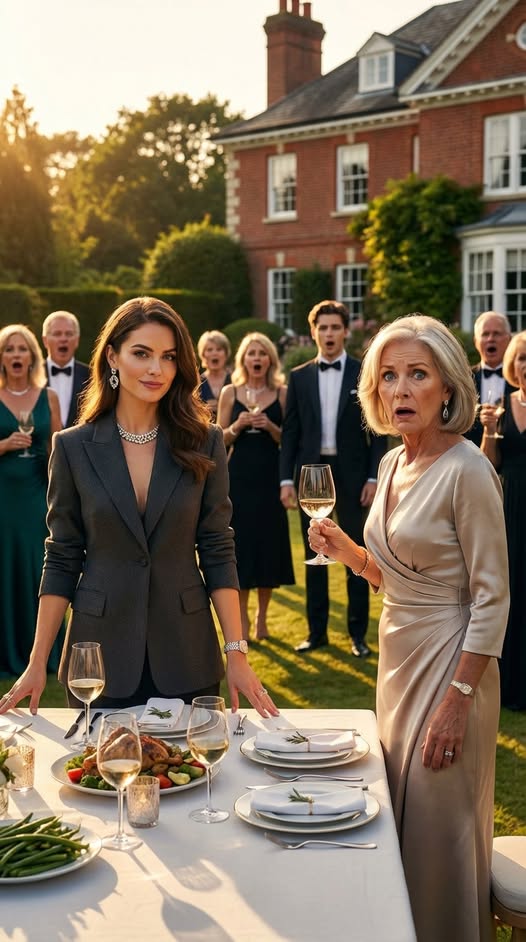
As the sun set, she raised her glass. The chatter died down.
“Some kids make you proud every single day,” she began, her eyes locked on Travis. “They are the heart of the family. Others… well, others you just wish you didn’t have to see them at all. You wish they’d just disappear.”
Laughter rippled through the crowd. Travis grinned, basking in the familiar warmth of her approval.
The air shifted. I felt the old coldness rising, but this time, it didn’t freeze me. I stood up, my glass of sparkling water catching the light.
“Good news, Mom,” I said, my voice steady and clear. “Your wish just came true. I’ve been gone for six years, and after tonight, I’m staying gone. I live in Charlotte now. I have a life you wouldn’t understand and a table where you aren’t invited.”
I set my glass down on the stone ledge. The music kept playing, but the silence around the patio was absolute. Judith’s smile froze into a mask of porcelain. Travis coughed into his beer.
I walked through the house, past the hallway where my kindergarten art had been replaced by Travis’s trophies, and I didn’t look back. That was the last family party I ever attended.
I thought that was the end of the story, but three months later, a desperate phone call from an unknown number would prove that blood doesn’t just keep you stuck—it tries to pull you down into the grave with it.
—————
Life in Charlotte was vibrant. My foundation—The Avery Lane STEM Initiative—was officially launching. We were providing full-ride scholarships and mentorship to thirty students in our first year. I spent my mornings on the dock and my afternoons in boardrooms, building a legacy that had nothing to do with baseball.
The phone rang on a Tuesday evening while I was prepping for a dinner with Eileen, who had recently moved into a condo near the lake.
“Avery? It’s Mom.”
Her voice was different. The sharp, regal edge was gone, replaced by a frantic, high-pitched tremor.
“Travis is in trouble,” she sobbed. “The gym closed. He took out some loans… bad loans, Avery. And the house… the bank is foreclosing. Harold’s pension won’t cover it. We need help. We’re family, Avery. You have so much now.”
I looked out at the lake. I thought about the eight-year-old girl eating cereal over the sink. I thought about the pallet jack slamming into my ankle and the silence of the Kansas City house when I asked for help.
“Family is a verb, Judith,” I said quietly. “It’s something you do, not something you are. You told me six years ago that I was an appliance for Travis’s future. Well, the appliance is unplugged.”
“How can you be so cold?” she shrieked. “We gave you everything!”
“You gave me a storage room and a scoreboard,” I replied. “Tell Travis to call a lawyer. Tell Harold I hope he finds his voice. But don’t call this number again.”
I blocked the contact before she could respond.
An hour later, my house was full. Logan was arguing with Drew about a new server architecture. Raphael was showing his daughter how to fold napkins into swans for the table. Eileen was in the kitchen, the smell of her spiced pecans filling the air.
We sat at the ten-foot oak table—the one I had sanded with my own hands. The conversation was loud, messy, and filled with genuine laughter. There were no box scores here. No favorites. Just people who had chosen to show up.
As the sun dipped below the tree line of Lake Norman, painting the sky in strokes of violet and gold, I realized that I hadn’t just built a company or a house. I had built a sanctuary.
I am Avery Lane. I am a coder, a survivor, and an architect of my own fate. 900 miles from Kansas City, I have finally found home. And at this table, the only score that matters is the one where everyone wins.