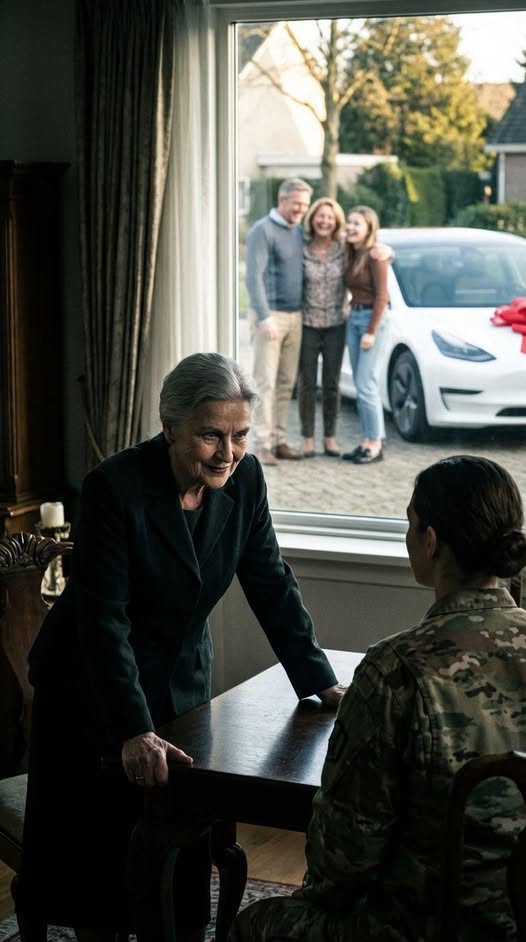
I didn’t find out my parents had liquidated my grandfather’s soul in a quiet, reasonable conversation. There was no apologetic phone call, no tentative sit-down over coffee. I found out standing in the foyer of my childhood home, staring at an empty display case while my younger sister’s brand-new Tesla Model 3 gleamed in the driveway like a trophy no one had earned.
When my grandmother finally learned what they had done—how they had bartered the one legacy my grandfather, General Silas Thorne, had specifically deeded to me—she didn’t scream. She didn’t weep. She simply offered a smile that didn’t reach her eyes and whispered, “That keepsake…”
The color vanished from my parents’ faces before she could even complete the thought.
I had known something was fundamentally broken the second I crossed the threshold. You can feel it when a house has been hollowed out without your consent. The air sits differently in the lungs; the acoustics change. Sounds echo off walls that used to absorb warmth. Even the scent had shifted—less like the comforting musk of old oak and cedarwood, more like a crime scene scrubbed with industrial bleach, as if someone were desperate to erase the fingerprints of a betrayal.
I had just returned on leave. It wasn’t the cinematic kind with “Welcome Home” banners and a roast in the oven. It was the practical, grit-under-your-fingernails kind—a few days of reprieve between duty rotations. I just wanted a bed that didn’t move and a night of sleep that wasn’t dictated by a whistle. My duffel bag was still biting into my shoulder when I saw it: the display case. It stood against the far wall of the living room, a silent sentry that had occupied that exact coordinate since the day the General retired and moved in with us.
Now, it was a glass coffin.
The interior was surgically clean. No dust outlines where the honors had rested for thirty years. No faint indentations in the velvet where the heavy metal of the Distinguished Service Cross had pressed down. Just a chilling, expansive nothingness. My chest constricted with the sharp, cold clarity of a pre-impact tremor—the same sensation I’d felt overseas seconds before an IED changed the rhythm of my life forever.
Gone were the medals, each one a testament to a sacrifice I was now replicating. Gone was the Ceremonial Dagger he’d been awarded upon reaching his generalcy, its hilt worn smooth by his steady hand. Gone was the folded flag, the one he had meticulously tucked into a triangle himself. And gone, most unforgivably, was the handwritten letter tucked behind the frame—the one addressed solely to me.
I dropped my bag. The thud was heavy, final. “Mom?” I called out.
No answer came from the house. Instead, a peal of bright, crystalline laughter drifted in from the driveway. My sister’s laugh. I turned to the window. The black Tesla sat there, sunlight sliding across its obsidian curves like oil. The temporary tags were still fluttering in the breeze. Inside, my sister, Chloe, was preening for a selfie, angling her phone to catch the reflection of her own success. She flipped her hair, smiling as if she hadn’t just parked her happiness on the wreckage of my history.
How many medals does a battery cost? I wondered. The disciplined stillness of my training settled over me. It was the only thing that kept me from shattering the window.
I stepped out onto the porch. Chloe noticed me, and for a fleeting second, her practiced influencer smile faltered. “Oh,” she said, her voice airy and dismissive. “You’re back early.”
“Where is Grandpa Silas’s display?” I asked, my voice a flat line.
She blinked, already losing interest. “The glass box? Ask Mom. She’s in the kitchen.”
Inside, the domestic scene was nauseatingly normal. My mother, Elena, was stirring cream into her coffee with rhythmic, hypnotic circles. My father, Arthur, sat at the head of the table, his eyes glued to a tablet. They looked like people who believed they were untouchable because they had never been truly tested.
“Where is it?” I asked. I didn’t sit. I didn’t offer a greeting.
My mother sighed, the sound of a woman inconvenienced by someone else’s grief. “Can you at least say hello before you start a scene?”
I looked at my father. “Where are my grandfather’s keepsakes, Dad?”
He didn’t look up from his screen. “We took care of it.”
The phrase took care of it felt like a physical blow. It was the language of disposal. “Took care of it how?”
My mother finally set her spoon down. The “clink” against the porcelain sounded like a gunshot. “You’re being dramatic. It was just sitting there, gathering dust. We had an opportunity, and we took it.”
“You sold it,” I stated. It wasn’t a question.
Silence stretched between us, thick and suffocating. My father finally looked at me, his expression hardened into a mask of false authority. “Yes. We sold the collection. The medals, the blade, the whole lot.”
“He left those to me,” I said, my voice dropping an octave. “Specifically. In writing.”
Chloe wandered in then, her keys jingling like a victory bell. “It’s not like you were using it,” she said with a shrug. “You’re never here. You’re always off playing soldier.”
I turned to her, the heat in my blood beginning to simmer. “I am serving, Chloe. There is a difference.”
She rolled her eyes. “You get a paycheck for that, don’t you? It’s a job.”
My father cleared his throat, trying to reclaim the moral high ground. “We are a family. What he left behind is a family asset. Your sister needed a reliable vehicle. Something safe. Something that reflects her potential. That car is a necessity; those medals were just metal.”
“They weren’t yours to sell,” I said.
My mother’s face twisted. “We didn’t want to burden you with the logistics. You have enough on your plate. Besides, your grandmother doesn’t need to know. She’s fragile. The stress would be too much for her.”
I looked at them—really looked at them. They hadn’t just sold objects. They had sold the only proof I had that someone in this bloodline understood the weight of my choices. They had liquidated my grandfather’s respect for me to buy a luxury car for a girl who couldn’t even define the word ‘sacrifice.’
“She deserves the truth,” I said, my hand already on the door handle.
For the first time since I’d walked in, I saw a flicker of genuine terror in my father’s eyes. He knew, deep down, that while he might be able to handle me, he was nowhere near prepared for the woman who had stood beside the General for fifty years.
The next morning, I drove to the Oakridge Senior Suites. The early light was harsh, stripping the world of its shadows. I preferred it. Shadows are where people like my parents hide their justifications.
My grandmother, Martha Thorne, was sitting by her window when I entered. She was a woman built of iron and grace, her silver hair perfectly coiffed, a book resting on her lap. She didn’t need to look at me to know the temperature of my soul.
“You look like your grandfather did when he knew a subordinate had lied to his face,” she said, her voice steady.
I sat across from her. The room smelled of lavender and old paper. “They sold it, Grandma. Everything. The medals, the dagger, the letter. They got ninety thousand dollars for it.”
Martha didn’t gasp. She didn’t tremble. She simply took a long, measured breath, the kind a marksman takes before pulling the trigger. “And the proceeds?”
“A Tesla for Chloe,” I replied.
Martha smiled then. It was a terrifying expression—a small, knowing curve of the lips that signaled the end of a peace treaty. “Well,” she whispered, “that explains why Elena was in such a hurry to ‘manage’ Silas’s estate.”
I felt a weight lift, replaced by a cold curiosity. “You aren’t surprised?”
“Anger is for the unprepared, child,” she said, reaching for my hand. Her grip was surprisingly strong. “Your parents have always confused kindness for weakness. They thought because I stayed quiet during the funeral, I had stopped watching. They forgot who taught Silas how to read a map.”
I told her everything—the “family asset” argument, the “you’re never here” dismissal, and the explicit command to keep her in the dark.
“Your grandfather spent forty years teaching officers that avoiding discomfort only compounds the casualty list,” she said. She stood up, moving with a purpose that belied her age, and walked to a small, locked mahogany cabinet. She produced a key from a chain around her neck and pulled out a thin, navy-blue folder.
“Silas didn’t trust assumptions,” she said, laying the folder on the table. “He trusted documentation. He knew Arthur was a man who looked for shortcuts. He knew Elena was a woman who saw heritage as a liquid currency.”
She opened the folder. Inside were high-resolution photographs of every item in the case, complete with serial numbers and appraisals. But at the very bottom was a document that made my heart stop.
“This,” she said, pointing to a highlighted section, “is a Specific Bequest within a Discretionary Trust. I am the executor. You are the sole beneficiary. The house they live in? That is part of the trust too. They don’t own it. The trust does.”
“They told me it belonged to the family,” I whispered.
“They lied,” Martha said. “They moved fast because they knew that once the probate period was fully settled, they wouldn’t be able to touch it. They committed grand larceny against their own daughter.”
I looked at the legal jargon. “What do we do?”
Martha picked up her phone. “Now, we let them believe they’ve won. We let them enjoy the leather seats and the quiet engine.” She looked at me, her eyes as sharp as the dagger they’d sold. “Go back to your base. Don’t argue. Don’t explain. Don’t warn them.”
“Grandma?”
“And when they invite you to their little celebration this weekend,” she added, “you make sure you wear your dress blues. Some lessons require a witness.”
The following weeks were a masterclass in psychological discipline. In the military, you learn that silence is a weapon. If the enemy doesn’t know where you are, they assume you’ve retreated.
Chloe’s social media was a relentless parade of the Tesla. Photos of her hands on the yoke, captions like “Manifesting my own destiny” and “Hard work finally paid off.” My parents commented with heart emojis. I stayed offline. I focused on my drills. I cleaned my rifle until the metal gleamed. I waited.
On Thursday, the invitation came. A text from my mother: “We’re having a little garden party to celebrate Chloe’s new chapter. It would be nice if you could show some family solidarity. 4 PM Saturday.”
I replied with three words: “I’ll be there.”
The drive to the house on Saturday felt like a deployment. I pulled up to the curb and saw the street lined with the cars of family friends and neighbors. The Model 3 was parked prominently in the driveway, draped with a ridiculous red bow. Laughter and the smell of grilled meat drifted from the backyard.
I stepped out of my car, adjusting my cover. My uniform was crisp, the medals on my chest a mirrored reflection of the ones currently sitting in some collector’s vault.
As I walked into the backyard, the atmosphere shifted. It’s a strange thing to watch a party die in real-time. The music—some upbeat pop track—seemed to lose its rhythm. The neighbors I’d grown up with looked at my uniform, then at the car, then back at me. They weren’t stupid. They knew Silas. They knew what those medals meant.
“You really wore the suit?” Chloe asked, sashaying over with a mimosa in hand.
“It’s a uniform, Chloe,” I said. “Not a suit.”
My father approached, a forced grin plastered on his face. “Glad you could make it, son. This is a big day for the family. Upward mobility, right?”
“Is that what we’re calling it?” I asked.
Before he could respond, the side gate creaked open. My grandmother walked in. She wasn’t alone. Beside her was a man in a charcoal suit, carrying a leather attaché case—Marcus Sterling, the most feared estate attorney in the county. Behind them were two men in dark windbreakers.
My mother rushed forward, her face a pale shade of grey. “Mom! You didn’t tell us you were coming. We would have picked you up!”
Martha didn’t stop walking until she was in the center of the patio. She looked at the guests, her presence commanding a silence so absolute you could hear the ice melting in the drinks.
“I wasn’t aware I needed an invitation to my own property,” Martha said quietly.
My father’s drink wobbled. “Your property? Martha, the house—”
“The house is held in the Thorne Legacy Trust,” Marcus Sterling interrupted, his voice like a gavel. “Of which Mrs. Thorne is the primary trustee. And we are here because a significant portion of the trust’s physical assets has been illegally liquidated.”
The party didn’t just stop. It evaporated.
“This is a private matter,” my mother hissed, looking around at the wide-eyed neighbors.
“You made it public the moment you used stolen funds to buy a car and put it in the driveway,” Martha replied. She turned to the two men in windbreakers. “Gentlemen, if you would.”
They walked toward the driveway. Chloe screamed. “Hey! What are you doing? That’s my car!”
“Actually,” Sterling said, pulling a document from his case, “it’s evidence of asset commingling. The buyer of General Thorne’s collection has already been served with a rescission notice. He has cooperated fully to avoid a receiving-stolen-goods charge. The ninety thousand dollars he paid has been frozen. Which means the dealership that sold you that car has not, in fact, been paid with legal funds.”
“We had a deal!” my father shouted, his face turning a purplish hue.
“You had a theft,” I said, stepping forward. “You took the letter, Dad. The one Grandpa wrote to me. Where is it?”
My father looked at me, and for the first time, I saw the cowardice that had been hidden under his tailored shirts. “It’s just a piece of paper…”
“It was my inheritance,” I said. “And you traded it for a battery on wheels.”
Martha looked at Elena. “The Trust is revoking your residency of this home effective immediately. You have forty-eight hours to vacate. The locks will be changed on Monday morning.”
“You’re throwing us out?” my mother gasped. “Over some old medals?”
“No,” Martha said, her voice cracking for the first and only time. “I am throwing you out because you raised a daughter who thinks a car is worth more than her brother’s service. I am throwing you out because you betrayed the man who gave you everything.”
The next hour was a blur of humiliation for them. The guests shuffled out, avoiding eye contact, leaving half-eaten burgers and lukewarm beer behind. The men in windbreakers—private recovery agents—began the process of impounding the Tesla.
Chloe sat on the curb, weeping not for her family, but for the loss of her leather seats. My parents stood in the middle of their manicured lawn, looking like refugees in their own lives.
“Where are the items?” I asked Sterling.
“They are in a secure vault at the firm,” he replied. “The buyer was quite distressed to learn the provenance was disputed. He wanted no part of a family feud involving a General.”
Two days later, I met Martha at the lawyer’s office. On the mahogany conference table sat the reinforced case.
My hands were shaking as I opened it. I didn’t care about the gold or the silver. I went straight for the envelope. It was slightly wrinkled, as if someone had stuffed it into a pocket in a hurry. I unfolded the aged parchment.
“To my grandson,” it began. “If you are reading this, it means the world has finally asked you to stand your ground. People will tell you that honor is a concept of the past, that loyalty is a transaction. They will try to convince you that the things I’ve left you are just objects. They are wrong. These are not prizes; they are anchors. Use them to hold steady when the storm comes from your own blood. You didn’t flinch in the field; don’t flinch at home. With love, Silas.”
I sat back, the air finally returning to my lungs.
The fallout was total. My parents had to liquidate their own savings to settle the legal fees and the botched car return. Without the house, they were forced into a cramped two-bedroom apartment on the other side of town. Chloe had to get a job—a real one—to pay off the depreciation on a car she no longer owned.
My mother called me once, a week later. She didn’t apologize. She asked me to talk to Martha. “We’re your family,” she pleaded.
“Family doesn’t steal your legacy while you’re serving your country,” I said. “Grandpa Silas knew that. That’s why he made the plan.”
I hung up.
I returned to base three days later. But I didn’t go back empty-handed. The display case was gone, replaced by a custom-made, fireproof vault I’d installed in my own small home near the base.
I don’t keep it in the living room for guests to see. I keep it in my study, where I can see it every morning before I put on the uniform. It serves as a reminder that some things cannot be bought, and some bonds cannot be broken by greed.
A month later, a small package arrived from Martha. Inside was a photograph I’d never seen—Silas and Martha, young and vibrant, standing in front of a mess hall in 1970. On the back, in her sharp, elegant script, she had written:
“The truth is a slow burn, but it leaves the cleanest ashes. You did him proud.”
I looked at the medals, the dagger, and the letter. I finally understood what the General had been training me for all those years. It wasn’t just for the wars abroad. It was for the quiet battle of integrity at home.
I closed the vault, the click of the lock sounding like the final word in a long, painful conversation. I was no longer just a soldier. I was a guardian. And for the first time in my life, the silence of my home felt like peace.
Epilogue: The New Vanguard
The Thorne family name didn’t end with the betrayal. It began a new chapter. I eventually transitioned into a role training new recruits in ethics and leadership. Every time I speak to a young private about the meaning of a badge or a ribbon, I think of that empty glass case in my parents’ house.
I tell them that your legacy isn’t what you leave behind in a will—it’s what you’re willing to fight for while you’re still standing.
My parents and I don’t speak. Chloe occasionally sends vitriolic texts that I delete without reading. But every Christmas, I sit with Martha. We don’t talk about the car or the house. We talk about Silas. We talk about the future. And we look at the photos of the medals, knowing they are exactly where they were always meant to be.
The world is full of people who see a price tag on everything. But as long as there are those who remember the value of a promise, the thieves will never truly win.