When my in-laws offered my thirteen-year-old son eighty thousand dollars for his college fund, I thought I’d misheard them.
Steven and Doris weren’t the generous type. They were the kind of people who gave birthday cards with a crisp twenty inside, if you were lucky. Christmas presents were practical and impersonal—socks, dish towels, a bargain-bin gadget you didn’t ask for. When my husband Shawn and I bought our first house, they mailed a potted plant and a note that said “Congratulations!” like they were ticking a box.
So when Doris set down her wineglass one random Wednesday and said, “We’ve been thinking… we’d like to contribute to Johnny’s college fund,” I smiled politely and braced for a small, respectable amount. A few thousand, maybe. They owned boutique hotels in three states. They had money. They just didn’t believe in sharing it.
Then Steven said, calm as if he were ordering dessert, “Eighty thousand.”
I laughed because it sounded ridiculous coming out of his mouth. “I’m sorry—what?”
“Eighty thousand,” he repeated. “We want him to have options. Good schools. No debt.”
Shawn squeezed my hand under the table like we’d just been handed a miracle. I tried to look grateful. I tried to feel grateful. Eighty thousand dollars could change Johnny’s life.
But my son didn’t smile. He didn’t look excited. He stared at his plate as if the food had suddenly turned to stone.
“That’s… incredibly generous,” I managed. “Are you sure?”
Doris’s smile was tight, practiced. “He’s our only grandson. We want to invest in his future.”
We raised glasses. Everyone drank. Johnny didn’t touch his juice.
I told myself he was overwhelmed. I told myself I was being paranoid. But something about it felt wrong. These were the same people who made us split the bill at Johnny’s birthday dinner two months earlier. The same people who preached that helping too much made you dependent. And now they were offering a small fortune like it was nothing.
Over the next week, my son changed.
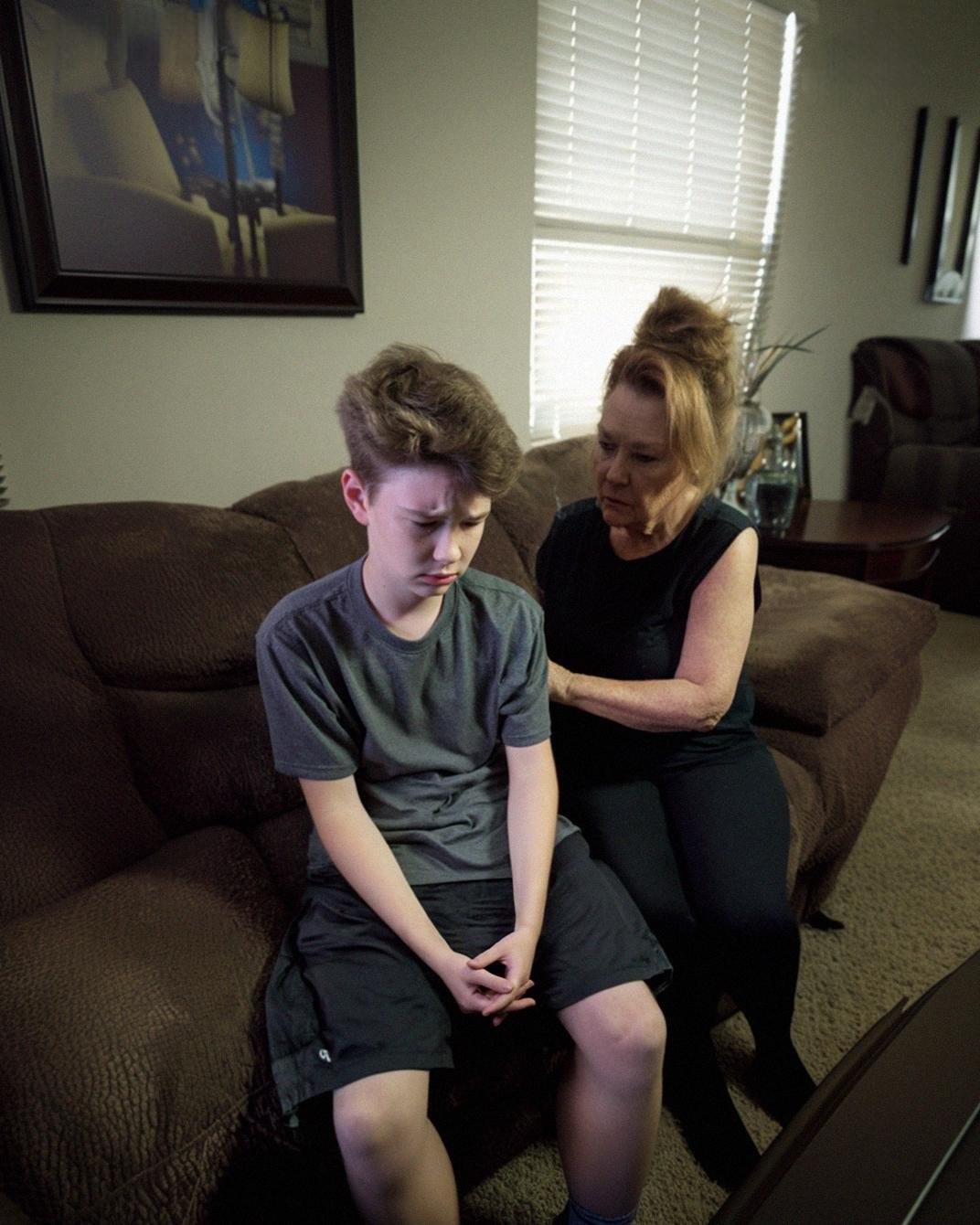
He stopped talking at dinner. He stopped laughing at his dad’s jokes. He came home from school and disappeared into his room. If anyone mentioned college or the fund, he went pale. It wasn’t a normal teenage mood. It was fear. The kind that sits under the skin and makes a kid look older than he should.
One night I found him sitting on his bed in the dark, knees pulled up to his chest.
“Johnny?” I sat beside him. “Talk to me. What’s going on?”
He shook his head without looking at me. “Nothing, Mom.”
“Sweetheart, you’ve barely spoken in days. Did something happen?”
His hands started trembling. “I can’t talk about it.”
My stomach dropped. “What do you mean you can’t?”
“I’m not allowed,” he whispered.
The air went cold. “Not allowed by who?”
He finally looked at me and there were tears in his eyes. “Please don’t ask me. I can’t. I just can’t.”
Then he started crying, quietly at first, like he was trying not to make noise. When I reached for him, he pulled away like he didn’t deserve comfort.
“I’m sorry,” he said. “I’m really sorry.”
That was the moment I understood this wasn’t about school stress or puberty. My son was carrying something heavy, and someone had made him believe it was his fault.
Three days later, my meeting ended early. I got home before anyone expected me. Shawn hadn’t answered my texts—he said he had back-to-back calls.
The second I stepped inside, I heard voices in the living room.
Steven. Doris. Johnny.
I moved quietly down the hallway and stopped where I could see without being seen. My son sat on the couch between them, shoulders tight, hands clenched in his lap. Tears slid down his face, but he wasn’t making a sound.
Doris spoke first, calm and controlled. “You understand what this money is really for, right?”
Johnny nodded.
Steven leaned forward. “And you understand the condition. You do not tell your mother what you saw. If you do, you lose everything. College. Trust. Your father’s respect. Everything.”
My blood ran cold.
“Do you understand?” Steven pressed.
“Yes,” Johnny whispered.
I stepped into the room so hard my voice startled all of them. “What not to tell me?”
They jumped. Doris recovered first, smoothing her expression into a smile that didn’t reach her eyes. “Emily! We didn’t hear you come in.”
“Clearly,” I said, staring at Johnny. “What is going on?”
“Nothing,” Steven snapped. “We’re discussing a surprise for your birthday.”
“A surprise that makes my son cry?”
“He wasn’t crying,” Doris said. “He’s emotional. Teenagers.”
Steven’s hand slid onto Johnny’s shoulder, squeezing slightly, a silent warning disguised as comfort.
“Right, Johnny?” he urged.
Johnny nodded without looking at me. “Yeah. Just… birthday stuff.”
Shawn appeared in the doorway then, briefcase in hand, confused. “What’s happening?”
“Apparently nothing,” I said, still locked on my son’s face.
Steven stood and adjusted his jacket. “We should go. Give you some space.”
They left quickly. Johnny vanished upstairs before I could stop him. I didn’t argue in front of Shawn. I didn’t push too hard that night. I pretended to accept the excuse.
But inside, something hardened.
Over the next two weeks, Steven and Doris started showing up more often—usually when Shawn was “working late.” They’d go upstairs, close Johnny’s door, and come down twenty minutes later with my son looking smaller and dimmer, like he’d been drained.
I couldn’t take it anymore.
While they were out one afternoon, I hid a small voice recorder inside a picture frame on Johnny’s desk. The next time they visited, I let them go up, waited, and listened for the click of his door.
That night, I retrieved the recording.
Doris’s voice was calm, almost gentle. “If your mother finds out and leaves your father, it’ll be your fault. One word about what you saw and you destroy this family.”
Steven’s voice followed, low and firm. “Your dad messed up. Adults do. But you don’t get to ruin his life over one mistake.”
Johnny’s voice sounded broken. “I won’t say anything. I promise.”
I sat in the dark replaying it until my hands shook.
So that was it. They weren’t giving money. They were buying silence. They were terrorizing a child to protect his father.
I needed the truth, not hints. I put a GPS tracker in Shawn’s car.
That Friday, Shawn kissed my forehead and said he’d be late at the office. I watched the tracker on my phone.
He didn’t go to work.
He drove across town and parked outside an apartment complex I’d never seen before.
I drove there with my chest tight enough to hurt. I parked where I could see his car and waited.
An hour passed. Then another.
Finally, the building’s front door opened and Shawn walked out with a woman.
She laughed at something he said, her hand resting on his arm like it belonged there. Younger than me. Casual. Comfortable.
I recognized her immediately.
Mrs. Keller—Johnny’s school counselor.
They stopped by Shawn’s car. He leaned in, smiling, and kissed her. Not quick. Not casual. Familiar. Real.
I recorded everything. Photos. Video. Proof.
Then I drove home and understood exactly what my son had seen: his father with the counselor. Probably at school. Probably close enough that a kid could stumble on it by accident and have his world crack in half.
And Steven and Doris didn’t care what it did to Johnny. They just cared that I never found out.
My birthday was the following week. Doris insisted on hosting dinner at our house. She brought catering, champagne, a perfect cake with my name written in elegant script. Shawn was suddenly attentive, sweet, affectionate, acting like we were a picture-perfect couple.
I played along.
Saturday night, the living room filled with friends and family. Everyone toasted. Shawn stood and raised his glass. “To my beautiful wife.”
Then I stood too.
“Thank you all for coming,” I said calmly. “I have a surprise.”
I connected my laptop to the projector.
The room filled with Doris’s voice: “You understand what this money is really for, right? You do not tell your mother what you saw.”
Faces shifted from confusion to discomfort. Then the photos appeared—Shawn and Mrs. Keller outside the apartment, kissing.
Silence hit like a wall.
Doris stood up, face pale. “Emily, this is—”
“A misunderstanding?” I finished, staring straight at her. “Go ahead. Explain why you bribed my child to cover my husband’s affair.”
Steven stepped forward. “You’re taking this out of context.”
“Then give me the context,” I said. “Tell everyone why you threatened a thirteen-year-old boy with losing his future if he didn’t protect his father.”
Shawn looked like he’d been turned to stone. “Emily, please. Let’s talk privately.”
“No,” I said. “You lost privacy when you cheated, and you lost any claim to decency when you let your parents terrorize our son.”
Johnny stood in the doorway then, crying openly now. “I’m sorry, Mom. I didn’t know what to do.”
I crossed the room, pulled him into my arms, and kissed his hair. “This was never your fault. Never.”
Then I looked at Steven and Doris. “The house deed is in my name. Get out.”
Doris tried to speak. Steven opened his mouth. I didn’t let them.
“Get. Out.”
They left. Shawn tried to follow me, begging, but I didn’t turn around. I didn’t owe him another conversation. I owed my son safety.
A week later, Shawn’s things were gone. The divorce papers were filed. The money never touched my son’s account, and I didn’t want it anyway.
They thought they could buy a child’s silence. Instead, they bought the end of their access, their control, and their illusion.
And for the first time in weeks, Johnny slept with his door open again.