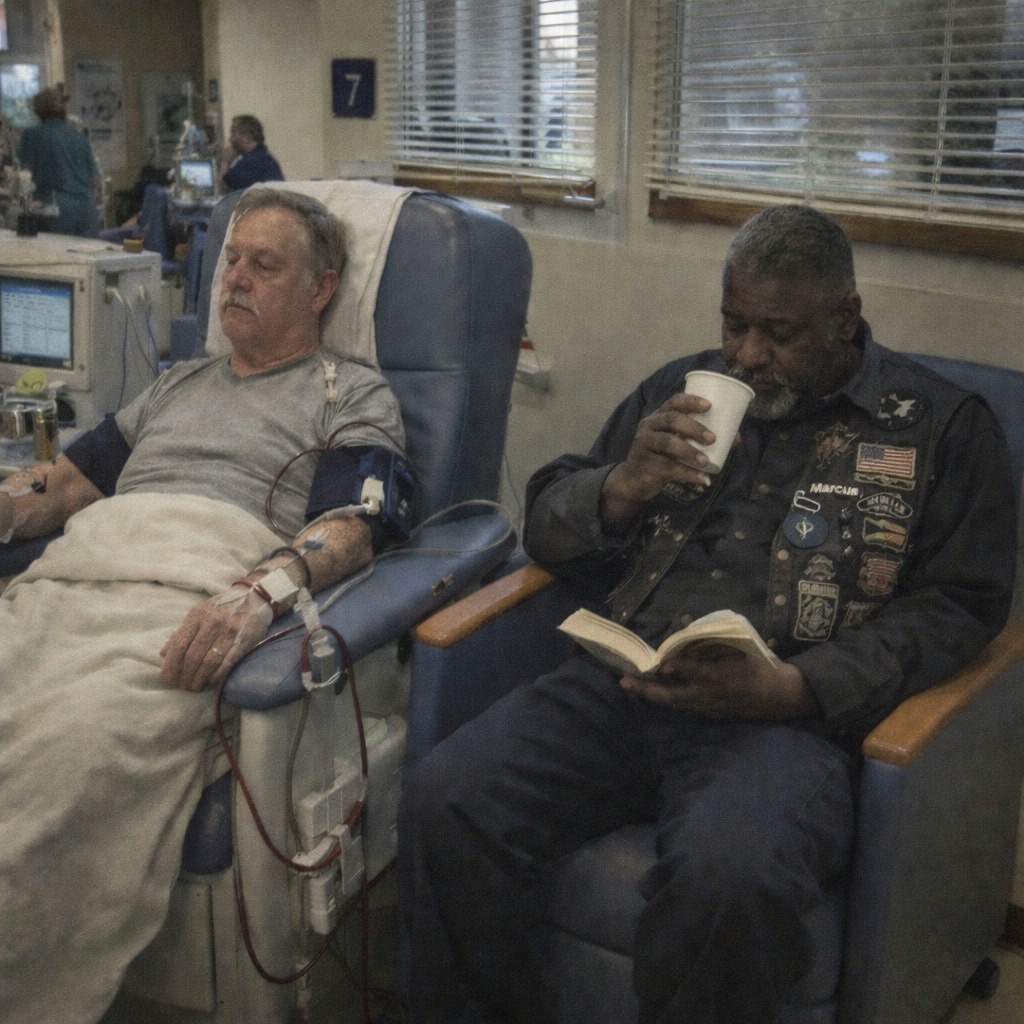
I have no family and no car, yet for four years, a man named Marcus has driven me to dialysis three times a week. He is fifty-eight, a veteran, and a widower who works the night shift as a hospital custodian just so he can be available during my morning sessions. He has never missed a day—not for holidays, not for blizzards, not for the exhaustion that must surely cling to him after a ten-hour shift on his feet. He drinks his coffee black, reads historical fiction, and occupies the visitor’s chair beside my dialysis machine with a constancy that borders on the sacred.
My own family stopped coming after the second month. My daughter visited twice before her children’s activities became too demanding and the drive became too long; eventually, she stopped calling altogether. My son came once, spent twenty minutes scrolling through his phone, and vanished before the machine had even finished cycling my blood. My ex-wife sent flowers on my birthday, but they were withered husks by the time I returned from the clinic. For a long time, I lived in a state of profound abandonment, wondering if my existence had become nothing more than a series of medical appointments and quiet despairs.
Then there was Marcus. At first, I was suspicious. I assumed he was confused or waiting for someone else. When I asked him why he was there, he simply said, “To keep you company.” When I told him I didn’t know him, he replied, “Not yet.” Over the next four years, that “not yet” transformed into a brotherhood. I learned his coffee order, his favorite authors, and the names of his two grown children. I learned that he volunteered at three different charities because staying busy was the only way he knew how to keep the grief of losing his wife at bay.
He researched my kidney-restricted diet and brought me muffins and bagels I could actually eat. He read aloud to me when I was too drained to hold a book. We played over five hundred games of gin rummy, and he kept a meticulous tally of his lead. When my blood pressure crashed during a particularly brutal treatment last year, Marcus was the one who held my hand while the nurses scrambled. My emergency contact was my daughter, but she didn’t answer her phone. Marcus was already there.
Last week marked my four-year anniversary on dialysis—four years of needles, machines, and the slow, grinding realization that I might never make it to the top of a transplant list. Marcus brought a card that said, “Four years of fighting. I’m honored to witness it.” When I told him he didn’t have to keep coming, that I would be okay on my own, he finally told me the truth. He explained that his wife had died waiting for a kidney that never came, and that on the day he first saw me, I was reading the exact same historical fiction novel she had been reading when she passed, with the bookmark in the same place. He took it as a sign that he was supposed to be there for me.
But yesterday, I learned that the sign went much deeper than a book. It started like any other Tuesday. I was hooked up to the machine in Chair 7 when a woman named Dr. Sarah Kellerman from the University Hospital transplant center approached me. She told me that a donor kidney had become available—not from the general list, but through a directed donation. Someone had specifically requested that their kidney go to me.
I was stunned. I knew no one who would make such a sacrifice. My family wouldn’t even visit me, let alone give me an organ. When I asked Marcus if he knew anything about it, he was uncharacteristically quiet. It wasn’t until later that evening, when he visited me in my hospital room before surgery, that the final pieces of the puzzle fell into place.
Marcus sat by my bed and confessed something he had been carrying for eight years. He told me about a night when he was driving home from work, exhausted and distracted. He had drifted into the oncoming lane and clipped a car, sending it spinning off the road. The driver survived the initial crash but suffered catastrophic internal injuries that led to chronic kidney failure. That driver was my wife, Jennifer.
“I’m the reason she needed a transplant,” Marcus whispered, his voice thick with a decade of remorse. “I’m the reason her health fell apart, and I’m the reason she spent two years on dialysis before she died.”
He had attended her funeral in secret. He had watched me from a distance, consumed by a guilt he couldn’t articulate. When he learned that I had developed kidney disease myself and that I was facing the same lonely end Jennifer had, he decided he couldn’t let it happen twice. He didn’t just show up for four years to ease his conscience; he had spent those years undergoing rigorous testing to see if he could be my donor.
“I took your wife’s kidneys,” Marcus said, “and now I’m giving you mine. It won’t bring her back, but it might give you a life beyond this chair.”
I wanted to be angry. I wanted to scream at him for the accident that had stolen my wife and my future. But then I looked at the man who had sat with me for twelve hours every week for four years. I thought of the coffee, the books, the gin rummy, and the hand-held in the dark. I realized that Marcus had been atoning for his mistake long before he signed the surgical consent forms. He had become my family when my real family had walked away.
I told him that Jennifer believed in redemption and that she would have forgiven him long ago. I told him to go through with the surgery, not just for me, but so he could finally begin to forgive himself.
The surgery was a success. Six months have passed since Marcus gave me his kidney, and for the first time in years, I am living a real life. I am no longer tethered to a machine. My daughter has recently re-entered my life, weeping with apologies for her absence. I haven’t told her the full story of Marcus and the accident yet; perhaps someday I will, but for now, it is enough that she is here.
Marcus and I still meet for coffee and cards. We visited Jennifer’s grave together last week, and Marcus stood at the headstone and whispered to her, “I’m taking care of him, like I promised.” I know he still carries the weight of the past, but I also know that he is no longer defined by it. We are two broken men who found a way to heal one another. He wasn’t just there to pay a debt; he was there because he became my friend. My family missed four years of my life, but Marcus never missed a single moment. He taught me that showing up is the greatest act of love there is, and that sometimes, the person who caused your greatest pain is the only one who can truly help you heal.