“Don’t you dare embarrass me,” Victoria hissed, her fingers digging into the meat of my forearm with a strength born of pure, unadulterated desperation. “Mark’s father is a federal judge. These people breathe a different kind of air, Elena. Just… stay in the background. Nod. Try to look like you belong in a room that costs more than your annual salary.”
I said nothing. I’ve spent fifteen years saying nothing, a decade and a half of cultivating a silence so profound it had become my primary residence. We were standing in the foyer of The Ivy, an establishment in Georgetown where the lighting is dim enough to hide secrets but bright enough to showcase diamonds.
Victoria was forty-five, three years my senior, and she had spent every one of those years convinced she was the protagonist of our family’s story. She was the golden child—the debate team captain, the Georgetown legacy, the woman who viewed life as a series of summits to be conquered. I was the “disappointment,” the quiet sister who spent too much time in the stacks of the Arlington Public Library and not enough time networking at the country club.
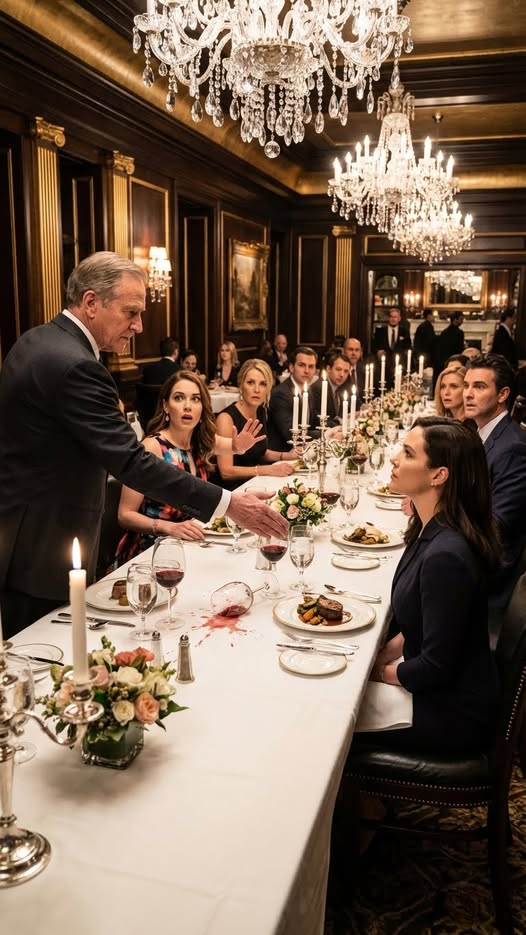
At dinner, seated around a circular table draped in heavy white linen, Victoria didn’t waste a second. She introduced me to the Reynolds family not by my name, but by my perceived status. “And this is my little sister, Elena,” she said, her voice dripping with a patronizing sweetness that felt like syrup over a blade. “She’s our resident underachiever. She works in government law—you know, the bureaucratic trenches. It’s a modest life, but she’s content with her little apartment and her hobbies.”
Judge Thomas Reynolds, a man with silver hair and eyes the color of a winter Atlantic, extended his hand toward me. He didn’t look at Victoria. He looked directly at me, his gaze sharpening with a sudden, electric recognition.
“Your Honor,” I said, my voice steady as a heartbeat. “It is good to see you again.”
The sound of Victoria’s wine glass shattering against the edge of the table was the only response.
The look on her face was fifteen years in the making.
To understand the wreckage of that dinner, you have to understand the foundation of the lie. Our parents owned a high-tier accounting firm in Northern Virginia. We grew up in the “right” zip codes, attended the “right” schools, and learned early on that human worth was a metric measured in country club tiers and luxury SUVs.
Victoria married Bradley, a corporate attorney, because he was the “right” move on the chessboard. She had the McMansion, the carefully curated Instagram feed, and the lifestyle that required a constant, exhausting performance.
When I went to law school, I didn’t go to Georgetown. Victoria told our parents I couldn’t “hack it” at a real institution. I went to a state school on a partial scholarship, took out loans to cover the rest, and worked three nights a week as a paralegal just to afford groceries. Victoria told everyone I was struggling because I lacked her innate brilliance.
After graduation, I didn’t join a “White Shoe” firm. I clerked for a district court judge.
“A clerk?” Victoria had laughed at our Christmas dinner that year, swirling a glass of expensive Napa cabernet. “Elena, that’s basically a glorified secretary. I thought you actually wanted to be a lawyer, not a typist for the elderly.”
I didn’t correct her. I had learned early on that Victoria’s happiness was predicated on my perceived failure. If she felt superior, the family dynamic remained stable.
What she didn’t know—what no one in the Martinez family bothered to investigate—was that my district court judge was Frank Davidson. And Judge Frank Davidson would, five years later, be appointed the Attorney General of the United States.
Under Davidson’s mentorship, I didn’t just practice law; I mastered it. I became a federal prosecutor, specializing in the kind of cases that don’t make for polite dinner conversation: public corruption, organized crime, and high-level racketeering. I was winning cases that made the front page of the Washington Post, while Victoria was busy divorcing Bradley because his “lack of ambition” was beginning to smudge her brand.
At twenty-nine, I was recommended for a federal judgeship. The vetting process was a gauntlet—FBI background checks that lasted eighteen months, Senate confirmation hearings that felt like a public autopsy, and a level of scrutiny that would have made Victoria’s head spin.
I told my family I was “still a prosecutor.” I let them think I was a mid-level government drone making seventy-five thousand a year. Victoria, meanwhile, was busy planning her second wedding to Richard, a pharmaceutical executive. At their engagement party, she had raised a glass and announced, “At least one Martinez sister married successfully.”
Three months later, I was confirmed to the federal bench. I was the youngest candidate in the circuit. I didn’t invite my family to the ceremony. I didn’t want their noise in my sanctuary.
I sat on that bench for thirteen years before Victoria met Mark Reynolds.
For over a decade, I presided over the United States District Court for the Eastern District of Virginia. I wrote opinions that were cited by appellate courts and mentored young attorneys who would go on to shape the legal landscape.
In my private life, I was a ghost. Victoria thought I lived in a “sad little apartment” because I refused to post photos of my home on social media. In reality, I owned a meticulously renovated townhouse in Old Town Alexandria worth nearly two million dollars. I had paid for it in cash, the result of a decade of careful investments and a judicial salary that Victoria never bothered to Google.
I drove a five-year-old Camry to family functions because it was reliable and, more importantly, because it confirmed Victoria’s bias. She didn’t know about the vintage Mercedes-Benz in my garage that I took out on weekend drives to the Shenandoah. She didn’t know about Michael, a fellow judge I had been seeing for four years, a man who valued my mind more than my pedigree.
Then came Mark Reynolds.
Mark was thirty-eight, a senior associate with ambitions that burned like a fever. But his real draw, the thing that made Victoria’s eyes glaze over with lust, was his father. Judge Thomas Reynolds sat on the Fourth Circuit Court of Appeals.
Victoria found out about the elder Reynolds on her second date with Mark. She called me, her voice trembling with a terrifying kind of glee.
“Elena, Mark’s father is a federal judge. Not some district court nothing—a circuit judge. Do you even understand what that means?”
“Yes,” I said softly, looking at the stack of briefs on my desk. “I have a general idea.”
“Of course you don’t. It means he’s basically one step below the Supreme Court. It means Mark comes from a family that actually matters. Influence, Elena. Real power.”
Then came the warnings. “I can’t have you embarrassing me. Mark’s family moves in circles you can’t even imagine. Senators, CEOs, the elite. If anyone asks what you do, just say you’re ‘in law.’ Technically true, and it prevents them from asking too many questions about your… situation.”
I watched from the sidelines as Victoria spent six months trying to transform herself into a woman worthy of the Reynolds name. She joined charity boards, hired a stylist to purge her closet of anything that didn’t scream “quiet luxury,” and curated an Instagram feed that was an exercise in high-society cosplay.
“Mark’s father knows Senator Williams,” she told me once, her voice hushed with awe. “They went to Yale together. Can you imagine? My future father-in-law has senators on speed dial.”
I didn’t tell her that Senator Williams had testified before me in a closed-door hearing regarding a campaign finance scandal three years prior. I didn’t tell her that I had attended a Harvard symposium with Judge Reynolds in March.
I simply waited for the inevitable collision.
The engagement dinner was an intimate affair. Just the immediate families.
Victoria had texted me a dress code: “Cocktail attire. Nice cocktail attire, Elena. Not your usual clearance rack blazers.”
I wore a navy silk dress that had been custom-tailored. It was understated, the kind of elegance that doesn’t shout but certainly commands the room. I wore pearl earrings—a gift from Michael—and drove the Camry to the restaurant, knowing Victoria would be scanning the valet line for any sign of my “mediocrity.”
She met me at the door, her eyes sweeping over me with a critical, squinting intensity. “The dress is… fine. Just remember: don’t volunteer information. Let me do the talking. I’ve told them you’re a government attorney in the local courts. It’s better that way.”
“Understood,” I said.
Our parents were already there, Dad in his blazer, Mom in her pearls, both of them radiating a nervous energy. They treated Victoria like a visiting dignitary and me like a tragic after-thought.
Then the Reynolds family arrived.
Judge Thomas Reynolds looked exactly as he did in the courtroom—commanding, silver-haired, and possessed of a gravity that pulled everyone toward him. His wife, Caroline, was a vision in classic Chanel. His daughter, Katherine, a venture capitalist who managed a four-hundred-million-dollar fund, had the sharp, restless eyes of someone who could smell a lie from a mile away.
Mark introduced everyone. “Mom, Dad, Katherine—this is Victoria’s family. Her parents, David and Marie, and her sister, Elena.”
Victoria stepped in immediately, her voice rising an octave. “My younger sister works in law. Government law. It’s very… bureaucratic, but she’s quite comfortable there.”
Judge Reynolds extended his hand toward my father, a polite smile on his face. Then, he turned to me.
The recognition was instantaneous. I saw the gears turn in his mind. I saw him process the fact that the “underachiever” sitting across from him was the same Judge Elena Martinez who had served with him on three different judicial committees.
I gave a nearly imperceptible shake of my head. Not here. Not yet.
He paused, a flicker of amusement crossing his eyes. “Elena,” he said smoothly. “A pleasure to meet you.”
“Your Honor,” I replied, my voice cool. “The pleasure is entirely mine.”
Victoria’s elbow found my ribs. “Just Mr. Reynolds, Elena. Don’t be weird.”
The dinner was a slow-motion car crash. Victoria dominated the conversation, her laughter too loud, her stories too polished. She talked about her “charity work,” her “cultural engagements,” and her deep admiration for people in positions of “real power.”
She glanced at me, her lip curling slightly. “Of course, not everyone has that drive. Some people are content to just… exist. My sister has always been one of those people. She prefers the safety of a government desk to the risk of real achievement.”
Judge Reynolds set his fork down. The sound of silver hitting porcelain was like a gunshot. “Success is a relative term, Victoria,” he said, his voice dropping into that low, resonant tone he used when delivering a verdict.
“Oh, absolutely,” Victoria chirped, oblivious to the frost forming in the room. “But there’s something to be said for making something of yourself. Elena, tell them about your… little court. Does it even have a name?”
Catherine Reynolds was staring at me now. She had been quiet for most of the meal, but now she was leaning forward, her eyes narrowed. “Wait. Federal criminal law? In the Eastern District?”
“Yes,” I said.
“Elena works for the government,” my father interjected, trying to save the moment. “We’re very proud of Victoria’s accomplishments, of course. Her marriage to Mark, joining a family as distinguished as yours… it’s a real achievement for the Martinez family.”
Judge Reynolds looked at my father, then at my mother, and finally at Victoria. The amusement had vanished. In its place was a cold, surgical curiosity.
“Victoria,” Judge Reynolds said. “Why do you think your sister isn’t successful?”
Victoria laughed, that nervous, dismissive sound. “Well, I mean, look at her. She drives a Camry. She lives in a tiny apartment. She’s a government employee. No offense to Elena, but she’s just… ordinary.”
“Ordinary,” Judge Reynolds repeated softly. “Elena, what is your official title?”
The table went silent. Victoria’s knuckles were white as she gripped her wine glass. My parents looked confused.
I looked Judge Reynolds in the eye. I didn’t look at my sister. “I am a federal judge for the United States District Court for the Eastern District of Virginia.”
The silence that followed was so absolute you could hear the distant clatter of the kitchen.
“What?” Victoria’s voice was high-pitched, disbelieving. “Elena, don’t. That’s not funny. Tell them you’re joking.”
“I’m not joking, Victoria.”
“You’re a judge?” My mother’s voice was a whisper. “Since when?”
“Thirteen years.”
My father shook his head, his face a mask of graying shock. “That’s impossible. You work in the courts. You’ve told us that for years.”
“I told you I worked in federal criminal law. I do. I preside over federal criminal cases. You assumed I was a clerk or a secretary. I simply stopped correcting you.”
Victoria’s face was now a violent shade of red. “You’re lying! You can’t be a federal judge. Federal judges are… they’re important! They’re appointed by the President!”
“Elena was confirmed in March 2011,” Judge Reynolds said, his voice cutting through Victoria’s hysteria. “I remember the Senate vote. It was nearly unanimous. Elena is one of the most respected jurists in the circuit.”
Catherine Reynolds was already on her phone. She typed rapidly, then turned the screen around for the table to see. It was a photograph from a legal journal—me in my judicial robes, standing beside Attorney General Davidson.
“Judge Elena Martinez: A Reputation for Fairness and Scholarship.”
My mother grabbed the phone, her hands trembling. “That’s… that’s you. In the robes.”
“Yes, Mom.”
Victoria slammed her hand on the table. “Why? Why would you hide this? Do you have any idea what this makes me look like? I’ve been telling the Reynolds family that you were a failure! That I was the only one who made something of myself!”
“Yes,” I said, my voice dropping to a whisper that carried more weight than her shouting. “You have. And you’ve been doing it for fifteen years. Every family dinner, every holiday, you used me as the floor so you could feel like you were standing on a mountain.”
“You made me look like an idiot!” she screamed.
“No, Victoria,” Judge Reynolds interrupted, his eyes flashing with a sudden, sharp anger. “You made yourself look like an idiot. You spent months introducing us to a version of your sister that didn’t exist, all to satisfy your own need for superiority.”
Mark Reynolds was looking at Victoria like she was a stranger. “You told me she was struggling. You told me you were helping her with her rent.”
“I… I thought she was!” Victoria stammered. “She lives in that dump in Alexandria!”
“That ‘dump’ is a historic townhouse worth one point eight million dollars,” Catherine said, looking up from her phone. “Her financial disclosures are public record. She’s significantly more successful than anyone at this table, Victoria. Including you.”
Victoria stood up, her chair screeching against the floor. She looked at our parents, but they couldn’t even meet her eyes. They were too busy staring at me, realizing that for thirteen years, they had been pitying a woman who was more powerful than they could ever imagine.
“This dinner is over,” Victoria hissed, grabbing her purse.
“I agree,” Judge Reynolds said. He turned to me. “Elena, I apologize for this. I had no idea the situation was so… fraught.”
“It’s not your fault, Tom,” I said. “I should have done this a long time ago.”
Victoria fled the restaurant, but the fallout was only beginning.
The text messages started at 11:00 PM.
Victoria: I can’t believe you did this. You ruined everything. You humiliated me in front of Mark’s parents.
Victoria: Mark is reconsidering the engagement. He says he doesn’t know who I am anymore. I hope you’re happy. You finally won.
I didn’t respond. I sat in my garden courtyard, Michael sitting silently beside me, a glass of bourbon in my hand.
“How do you feel?” he asked.
“Lighter,” I admitted. “Like I’ve been carrying a mountain and I finally just… put it down.”
The next morning, the calls from my parents began. My father’s voice was tight with a mixture of anger and embarrassment. “Elena, that was inappropriate. You made us all look like fools. You should have told us.”
“I told you I was a prosecutor, Dad. You never asked what came next. You were too busy listening to Victoria talk about her interior decorator.”
“We could have been proud of you!” my mother wailed into the phone. “Why didn’t you let us be proud of you?”
“Because your pride is conditional,” I told her. “You’re proud of me now because Catherine Reynolds thinks I’m extraordinary. You weren’t proud of me when you thought I was a ‘government drone.’ Success shouldn’t be the price of admission for a parent’s love.”
The engagement was off within the week. Mark Reynolds called Victoria and told her that he couldn’t marry someone who had spent thirteen years systematically belittling her own sister to feel better about herself. He said he saw a cruelty in her that he couldn’t unsee.
Victoria came to my chambers two weeks later. She didn’t have an appointment, and my clerk tried to stop her, but I waved her in.
She looked terrible. The designer clothes were gone, replaced by a Georgetown sweatshirt and jeans. Her eyes were rimmed with red.
“You got what you wanted,” she said, sitting in the leather chair across from my mahogany desk. “Mark is gone. The Reynolds family hates me. My life is a wreck.”
“I didn’t want any of that, Victoria. I just wanted to stop being your cautionary tale.”
“You lied to us,” she whispered.
“No. I lived my life. You created a narrative that made you feel good, and I simply stopped fighting it. It was easier to be ‘unsuccessful’ Elena than to deal with your jealousy.”
“I wasn’t jealous,” she snapped.
“Weren’t you? Look at this room, Victoria. Look at the degrees on the wall. Look at the robes. If you had known this thirteen years ago, what would you have done? You would have found a way to minimize it. You would have told everyone I got the appointment because of Frank Davidson’s connections. You would have made my achievement about you.”
She was quiet for a long time. The ticking of the clock on my mantle seemed incredibly loud.
“Mark said I’m cruel,” she said eventually. “Am I?”
“I think you’re insecure,” I said. “I think you’ve spent your whole life chasing a version of success that requires other people to be beneath you. And when you realized I wasn’t beneath you, your entire world collapsed because you didn’t have a foundation of your own.”
“I don’t know who I am if I’m not the ‘successful’ one,” she admitted, her voice breaking.
“Then maybe it’s time you found out.”
The Martinez family is still fractured. My parents are trying to navigate a world where their “underachiever” daughter is a federal judge and their “golden child” is a three-time divorcee living in a rental apartment. They call me now, asking for my opinion on legal matters, trying to bridge the gap they spent a decade widening. I take their calls, but I keep the townhouse doors locked. Some wounds heal; others just become part of the landscape.
I attended Catherine Reynolds’ wedding in Nantucket six months later. It was a small, elegant ceremony by the sea. Mark was there, looking older, more subdued.
“Judge Martinez,” he said, stepping toward me during the reception. “I wanted to apologize. For the way my family… for the way I believed the things Victoria said.”
“You saw what you were invited to see, Mark. Don’t carry that.”
“I just wonder,” he said, looking out at the waves. “If she could have been different if she’d known the truth.”
“The truth doesn’t change people,” I said. “It just reveals them.”
Judge Thomas Reynolds joined us, clinking his glass against mine. “Elena, I’ve been meaning to ask—that sentencing reform task force. I need your input.”
“Always working, Tom,” I laughed.
I drove back to Alexandria that night, the vintage Mercedes humming perfectly under my hands. I thought about the fifteen years I spent in the shadows. I thought about the wine glass shattering and the silence of the bench.
I’m no longer hiding. I don’t drive the Camry anymore. I don’t wear clearance rack blazers to appease a sister’s ego.
I am Judge Elena Martinez. I am a daughter, a jurist, and a woman who finally realized that being seen is worth the price of the noise.
Victoria texted me as I pulled into my driveway.
Victoria: I’m starting therapy. The doctor asked me who I am when I’m not being ‘better’ than someone. I didn’t have an answer. But I’m going to try to find one.
I didn’t respond. But for the first time in fifteen years, I didn’t delete the message.
I just parked the car and walked into the light.