Chapter 1: The Architecture of Silence
For the better part of three decades, I operated under the delusion that silence was the currency of peace. I believed that if I absorbed the shock, remained immobile, and buried my reactions beneath layers of disciplined calm, the people I loved would eventually recognize the steel in my spine. I was wrong. They didn’t see strength; they saw submission. They mistook my quiet for fragility and my loyalty for blind obedience. And every time I attempted to stand tall, they found a mechanism to dismantle me, brick by brick.
The epiphany didn’t arrive during a firefight or a debriefing. It arrived on a Tuesday, in the sterile, airless expanse of a military tribunal, the moment my father looked me in the eye and dismantled my existence. He didn’t speak in anger; that would have implied passion. He spoke with the terrifying certainty of a man who believes he is the sole arbiter of truth. Something inside me, a mechanism that had been straining for years, finally snapped. But it didn’t break—it hardened.
The air inside the San Diego Tribunal Chamber was dense, tasting of stale coffee and recycled anxiety. The walls were a pale, unforgiving gray, reflecting the clinical hum of fluorescent lights that bleached the color from everything they touched. Every acoustic detail was amplified in the vacuum of tension: the scrape of a chair leg against vinyl, the nervous shuffle of polished boots, the stifled cough of a junior officer terrified of breathing too loudly.
I stood at the epicenter of this theater, my palms fused to the seams of my dress uniform, my heartbeat a sharp, rhythmic hammer against my ribs. The insignia on my chest caught the harsh overhead glare. For a fleeting second, I considered the bitter irony: the symbol of service gleaming over a heart they were systematically preparing to stop.
Across the aisle sat the architect of my demise: Major General Raymond Parker.
He was immaculate, a statue carved from ego and regulation. He was the kind of man who wore his rank like a second skin, carrying order in his posture and judgment in his silence. The rows of ribbons across his chest caught every flicker of light, a colorful testament to a history written by the victors. He didn’t look at me. He hadn’t truly looked at me in years.
When the presiding officer called for his testimony, the sound of his chair sliding back was the only warning. He advanced to the witness stand with the precise, predatory grace he had drilled into thousands of recruits. Shoulders squared, chin elevated, voice projecting authority as naturally as breathing.
“My daughter,” he began, the possessive pronoun sounding more like an apology than a claim, “is not merely a disgrace to this country. She is a disgrace to the word soldier.”
The silence that followed was absolute. It was a physical weight, pressing down on the lungs of everyone in the room. I felt the collective gaze of the panel shift toward me, hungry for a reaction—a flinch, a tear, a tremor. They wanted the breakdown. But I offered them nothing. My body remembered its training even while my soul charred.
My father turned, returned to his seat, and sat with the supreme confidence of a man who had just delivered a divine truth. Inside me, the turbulence stilled. It wasn’t rage. It wasn’t heartbreak. It was a cold, crystalline clarity. For years, I had accepted the micro-aggressions, the dismissive nods, the unfavorable comparisons to my brother Ethan. But this was not a reprimand. This was an erasure.
And if my time in the shadows had taught me anything, it was that an eraser is a powerful tool—until you decide to grab the pen and rewrite the record.
From the periphery of my vision, I detected a subtle shift on the tribunal bench. Admiral Leland Hayes sat three seats to the right of the presiding officer. His face was a topographic map of hard decisions, currently unreadable beneath the shadows of the overhead lights. His gaze swept over me once, clinical and detached, before arresting.
For the briefest fraction of a second, his eyes dropped to the side of my uniform, just below the ribcage. The fabric there was stretched taut, barely concealing the uneven topography of scar tissue that lay beneath.
The change in Hayes was microscopic to an untrained eye, but screamingly obvious to me. His jaw muscles bunched. The rhythmic tapping of his index finger against the mahogany desk ceased. In that frozen stillness, I saw it: Recognition.
The rest of the room saw a disgraced Captain waiting for the guillotine. Hayes saw something else. He saw a shadow from a file that had been incinerated. A ghost stamped with marks that were never meant to see the light of day.
The presiding officer cleared his throat, the sound shattering the spell. “The tribunal will recess for fifteen minutes.”
As the room dissolved into the low murmur of controlled chaos, my father leaned back, crossing one leg over the other. He looked satisfied. He believed he had buried me under the crushing weight of his reputation. He had no idea that the grave he had just dug was empty.
Chapter 2: The Shrine of False Gods
To understand the tribunal, you have to understand the house in Fayetteville, North Carolina.
It was a town where the thrum of Chinook helicopters was as common as Sunday church bells. Our house stood on a cul-de-sac of manicured lawns, indistinguishable from the neighbors’ on the outside. But inside, it was a museum dedicated to one man.
The entry hallway was dominated by ‘The Wall.’ It wasn’t family photos or artwork that greeted guests; it was a shrine of commendations, plaques, and framed medals belonging to Raymond Parker. Dinner was not a time for nourishment or connection; it was a tactical review. My father would sit at the head of the table, cutting his roast beef with surgical precision, recounting the glories of Desert Storm.
My mother would smile, a fragile, fading thing, nodding on cue. Ethan, my brother, would listen with eyes wide and hungry, a boy bred to inherit a crown. And me? I was the furniture. I learned to make myself small, to absorb the atmosphere without disturbing it.
When I enlisted, the surprise in my father’s eyes was brief. It looked like pride, initially. But the moment I informed him I had selected Intelligence over Infantry, the pride curdled into a pity so deep it felt like scorn.
“Courage isn’t pressing keys, Kinsley,” he had said, his voice flat. “It’s pulling triggers.”
He didn’t shout. He never had to. His disappointment was a quiet, suffocating fog.
Years bled into one another. While Ethan sent home glossy photos of his fighter squadron and polished jets, my world contracted into windowless rooms, encrypted channels, and code words.
Then came 2019.
My assignment took me to the barren, majestic ridges of Yemen. The operation was off-book, a ghost protocol named Operation Glass Falcon. Our objective: intercept a convoy transporting a binary biological agent capable of liquidating a military base in under four minutes.
Intelligence—the very thing my father mocked—claimed the exchange would happen at dawn. We arrived three hours early. But intelligence is only as flawless as the humans who survive to report it. We walked into a slaughterhouse.
The ambush was precise and mechanical. Half my team was eradicated before I could unsling my rifle. We fell back to a concrete bunker where the samples were stored, trapped between a cliff face and a wall of enemy fire. There was no air support. No extraction. The comms were screaming—or maybe that was me.
I remember the heat. It wasn’t just temperature; it was a physical weight, tasting of copper and cordite. I made the only calculation that balanced the equation.
“Detonate the site,” I ordered.
“Captain, we’re inside the blast radius,” my sergeant yelled over the roar of gunfire.
“I know. Detonate it.”
When I pressed the trigger, the world didn’t go black. It went white.
I woke up ten days later in a black-site medical facility. My identity tags were gone. My ribs were held together by titanium and hope. The nurse who changed my dressings wouldn’t look me in the eye. When I asked about my team, she whispered, “KIA. All of them.” Then she paused, rearranging the IV tubes. “You too, apparently.”
That night, a man in a dark suit walked into my room. He wore no rank, but he carried the atmosphere of a man who moved armies. It was Admiral Leland Hayes.
He stood at the foot of my bed, studying me like a rare artifact that had survived a fire.
“You did what you were ordered to do,” he said, his voice devoid of pity. “And because of that, none of this ever happened.”
He placed a single envelope on the bedside table. Inside was a sheet of government stock paper with one line of typed text.
From this point forward, Captain, you do not exist.
“Your code name is Raven,” Hayes said. “You serve in the shadows now.”
I stared at him, drugged and broken, trying to decipher if I had been promoted or damned. He didn’t wait for an answer. By the time the door clicked shut, Kinsley Parker was dead.
Chapter 3: The Ghost in the Machine
For two years, I lived in the gray.
There were no letters home. No phone calls. My father, I later learned, had toasted Ethan’s promotion to Major while I was bleeding out in a safe house in Tirana. To him, I was a disappointment who had vanished. To the world, I was a clerical error.
My war was silent. It was fought in the margins of classified reports. I stopped assassinations before the targets knew they were marked. I sabotaged supply lines that officially didn’t exist. And in the rare, terrifying moments of stillness, I would touch the scar tissue beneath my ribs. The surgeons had done their best, but the shrapnel had left a map on my skin—three jagged, intersecting lines that looked unmistakably like a bird in flight. A raven.
When the program was decommissioned, they gave me a new file. A retroactive discharge. A clean slate. I was sent home with a generic service record that listed me as an administrative officer who had served “with adequacy.”
Returning to Charleston felt like walking into a stranger’s memory. My father opened the door, his expression unreadable. He didn’t hug me. He simply stepped aside to let me in, as if I were a guest who had arrived late to a party that was already over.
“At least Ethan never embarrassed the family name,” he said over dinner that first night. He said it casually, while salting his potatoes.
I stopped eating. The fork felt heavy in my hand. I looked at him—really looked at him—and saw not a giant, but a man desperate to curate his own legacy.
Later that night, unable to sleep, I wandered into his study. The room smelled of mahogany and old paper. On his desk, marked with a red “CONFIDENTIAL” stamp, was a file bearing my name.
I opened it.
It wasn’t a record of my service. It was a redaction. He hadn’t just accepted my “administrative” cover story; he had actively buried any inquiries into my disappearance. A memo, written in his handwriting, was clipped to the front: Seal all records indefinitely. Citations of negligence recommended to preclude further investigation.
I couldn’t breathe. He hadn’t been protecting me. He had been protecting the Parker brand. In his eyes, my chaotic, unexplained absence was a stain. He preferred a daughter who was a documented failure over a daughter who was a question mark.
When the summons for the tribunal arrived a month later, initiated by an “anonymous” review of my service record, I knew exactly whose hand held the pen. He wanted to finalize the narrative. He wanted to strip me of my rank officially, to sever the limb before it could infect the host.
I packed my uniform. I looked at myself in the mirror. I didn’t see the failure he saw. I saw the storm he wasn’t expecting.
Chapter 4: The Ultimatum
Two weeks before the trial, the air in the defense attorney’s office was stifling. Lieutenant Reed was young, earnest, and completely out of his depth. He looked at the stack of evidence against me with the despair of a man trying to stop a tidal wave with a bucket.
“Captain Parker,” Reed said, his voice trembling slightly. “If we plead guilty to procedural negligence, we can save your pension. You’ll lose your clearance, but—”
“I didn’t break the law, Lieutenant,” I cut in, my voice low. “I obeyed a higher one.”
He blinked, confused. “The prosecution has statements from General Parker. He claims you abandoned your post. There is no record of your whereabouts for twenty-four months.”
“That’s because the record is in a vault that requires a retina scan to access.” I leaned forward. “Under the Uniform Code of Military Justice, Section 41-C, I intend to invoke Directive Echo-7.”
Reed dropped his pen. It clattered loudly against the desk. “Echo-7? That’s a ghost protocol. It’s for operatives declared KIA who are… not. It hasn’t been used in a decade. If you cite a defunct black-ops directive and can’t prove it, they will court-martial you for perjury. You’ll be in Leavenworth for twenty years.”
“I know.”
“You’re gambling your life on a myth, Captain.”
“No,” I said, signing the invocation form. “I’m gambling on memory.”
Reed stared at me, a mixture of horror and awe on his face. He didn’t understand. He thought I was fighting for my career. He didn’t realize that ghosts don’t need careers. They need resurrection.
That night, I opened an old wooden box I kept hidden in the back of my closet. Inside lay a photograph of six people standing in the Yemen desert, faces obscured by dust and goggles. And beneath it, a folded document: Operation Glass Falcon – Authorization Directive.
Signed by Admiral Leland Hayes.
I ran my thumb over the signature. The man who had erased me was now sitting on the panel that would judge me. It was a collision of past and present that felt almost ordained. If he didn’t recognize me, I would go to prison. If he did, he would have to admit he had authorized a mission that violated international treaties.
I closed the box. The latch clicked like a trigger being set.
Chapter 5: Echo Seven
The courtroom had settled into a heavy, suffocating rhythm. My father’s testimony had done its damage. The panel looked weary, ready to deliver a verdict and go to lunch.
“Captain Parker,” the presiding officer said, looking over his spectacles. “You may present your defense.”
I stood up. The scraping of my chair was a violence in the quiet room. Lieutenant Reed was practically hyperventilating beside me.
“Permission to speak, sir,” I said.
Admiral Hayes, from the bench, spoke. “Granted.”
I took a breath, tasting the stale air. “I am not submitting a defense against the charges of negligence,” I announced. “I am submitting a correction of the record.”
A murmur rippled through the gallery. My father frowned, annoyance flickering in his eyes.
“Under Directive Echo-7,” I continued, my voice gaining strength, “I request immediate declassification of my service record regarding Operation Glass Falcon.”
The room froze. It wasn’t just quiet; it was the silence of a bomb squad watching a timer count down.
A Lieutenant Commander on the panel scoffed. “That directive is for deceased operatives, Captain.”
I locked eyes with him. “Exactly.”
I turned my gaze to Hayes. He was staring at me, his face pale, his hand frozen halfway to his water glass.
“Authorization code: Raven-Four,” I said clearly.
The glass slipped from Hayes’s fingers. It didn’t break, but the thud against the table echoed like a gunshot. My father stood up, his face flushing red.
“This is absurd!” he barked, his voice losing its polished veneer. “She is hallucinating. There is no such operation. I demand this testimony be stricken!”
“Sit down, General!” Hayes’s voice cracked through the air like a whip.
My father stunned, sank back into his chair. He had never been spoken to like that in his life.
Hayes looked at me. The mask was gone. In his eyes, I saw the bunker. The fire. The decision.
“Captain,” Hayes said, his voice trembling with a suppressed intensity. “Do you have physical verification?”
“Yes, Admiral.”
“Show us.”
“Objection!” the prosecutor yelled.
“Overruled,” Hayes snapped. “Show us, Captain.”
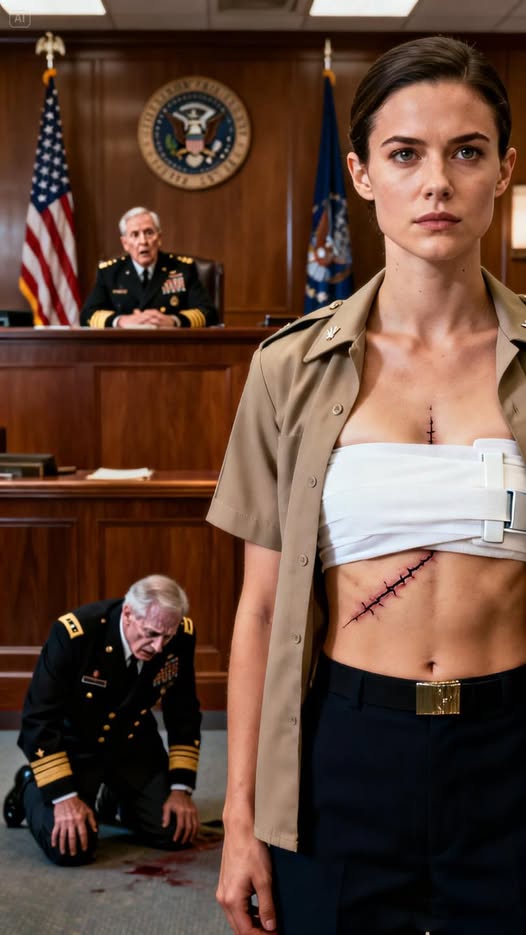
I didn’t look at my father. I looked straight ahead at the seal of the United States hanging on the wall. I reached up and unbuttoned my jacket. One button. Two. The sound of the fabric parting was deafening. I pulled the collar aside and lifted the hem of the undershirt.
There, pale and jagged against my skin, were the scars. Three lines. A triangle. The wings. The mark of the survivor.
The gasp from the room was collective.
Hayes stood up slowly. He looked like he was seeing a ghost—which, in a way, he was.
“Dear God,” he whispered. “The Raven mark.”
He turned to the rest of the panel, his voice regaining its command, though it was thick with emotion. “General Parker,” he addressed my father, who was staring at my ribs with a look of absolute horror. “Your daughter commanded the unit that intercepted the Glass Falcon bioweapon. She was presumed dead because I ordered her erased to protect the agency. Her ‘negligence’ saved the lives of three thousand Marines in that sector.”
My father’s face went gray. The color drained out of him until he looked like a black-and-white photograph of himself. His mouth opened, but no words came out. The narrative he had constructed—the hero father, the failure daughter—dissolved in seconds.
“She isn’t a disgrace,” Hayes said, looking at me with profound respect. “She is the only reason the rest of us are sleeping at night.”
He slammed the gavel down. “All charges dismissed. This tribunal is sealed under Top Secret clearance level immediately. Clear the room.”
Chapter 6: Ashes and Iron
The room emptied rapidly, the officers filing out as if escaping a contagion. They couldn’t look at me. They couldn’t look at my father.
He remained in his chair, a collapsed star. The medals on his chest, once so blinding, now looked like cheap costume jewelry. He stared at his hands, trembling on the table.
I walked over to him. I didn’t feel triumph. I didn’t feel joy. I felt a hollow, peaceful release. The burden was gone.
“You always wanted me to bleed for this country,” I said softly.
He flinched. He looked up, his eyes rimmed with red, wet with tears that wouldn’t fall. “Kinsley… I didn’t know.”
“You didn’t ask,” I replied. “You were too busy polishing your own reflection.”
“I thought…” His voice broke. “I thought I was protecting the name.”
“The name is fine, General,” I said. “But the family is gone.”
I stepped back, snapped a crisp, perfect salute—not to his rank, but to the uniform we both wore—and turned my back on him. I walked out of the double doors, the sound of my boots distinct and steady.
I didn’t look back.
Epilogue: The View from the Shadows
Six months later, winter had settled over Washington D.C.
From my office on the fourth floor of the Pentagon, the city looked like a grid of gray stone and white marble. My desk was clear, save for a secure laptop and a single ID card. No rank. Just the name Raven.
I had been reinstated, not as a Captain, but as a specialist. My work was dark, quiet, and essential.
A notification chimed on my screen. An email from a civilian address.
Sender: R. Parker
Subject: Kinsley
I hovered the cursor over it. The preview showed the first line: I was wrong about everything. I am so…
I stared at the words. He had lost his Medal of Honor; the review board had revoked it following the “discrepancies” revealed at my tribunal. He was a man alone in a house full of dust.
I didn’t feel anger. I didn’t feel the need for his apology. I had already received the only validation that mattered—the survival of the people I protected.
I moved the cursor to the trash icon. Click.
I closed the laptop and stood up, walking to the floor-to-ceiling window. Outside, a black bird landed on the railing, shaking the snow from its glossy wings. It tilted its head, watching me with intelligent, bead-like eyes.
I smiled, touching the scar beneath my jacket. It didn’t ache anymore. It was just skin.
“Mission complete,” I whispered to the glass.
I turned away from the window and walked back into the shadows, where the real work was waiting.