I believed that hiring a young caregiver for my 82-year-old mother would finally give me room to breathe.
Instead, it pulled me into a revelation I never saw coming—one that had been unfolding quietly during their Sunday walks.
I’m 58 years old. I’ve been married for 33 years, raised three children to adulthood, and spent decades thinking I understood my life’s rhythm.
People say things calm down once the kids move out. They’re wrong.
The noise doesn’t disappear—it just changes shape.
I teach high school English. My days are fueled by coffee, teenage emotions, and essays that swear blue curtains symbolize “the human condition.”
My husband, Harlan, is an electrical engineer—steady, dependable, the kind of man who fixes appliances late at night without complaint.
We were finally approaching that quieter chapter.
Then my mother fell.
Mom has always been sharp-tongued and strong-willed. At 82, her mind is still quick, but her body has started to betray her.
In January, she slipped in her kitchen and fractured her hip. Overnight, the woman who once handled everything herself needed help just to stand.
My father died suddenly years ago. He left Mom financially secure, though she never flaunted it.
After the fall, the hospital suggested a caregiver—someone to help without taking away her independence.
It made sense.
That’s how Piper entered our lives.
She was 26, soft-spoken, organized, and calm. She showed up in light blue scrubs with a binder already prepared from my mother’s discharge papers.
She listened. She respected boundaries. She treated my mother like an adult, not a problem to manage.
Mom approved instantly.
So did I.
For weeks, everything was perfect.
Meals were cooked. Medications were handled properly. Physical therapy became routine instead of torture.
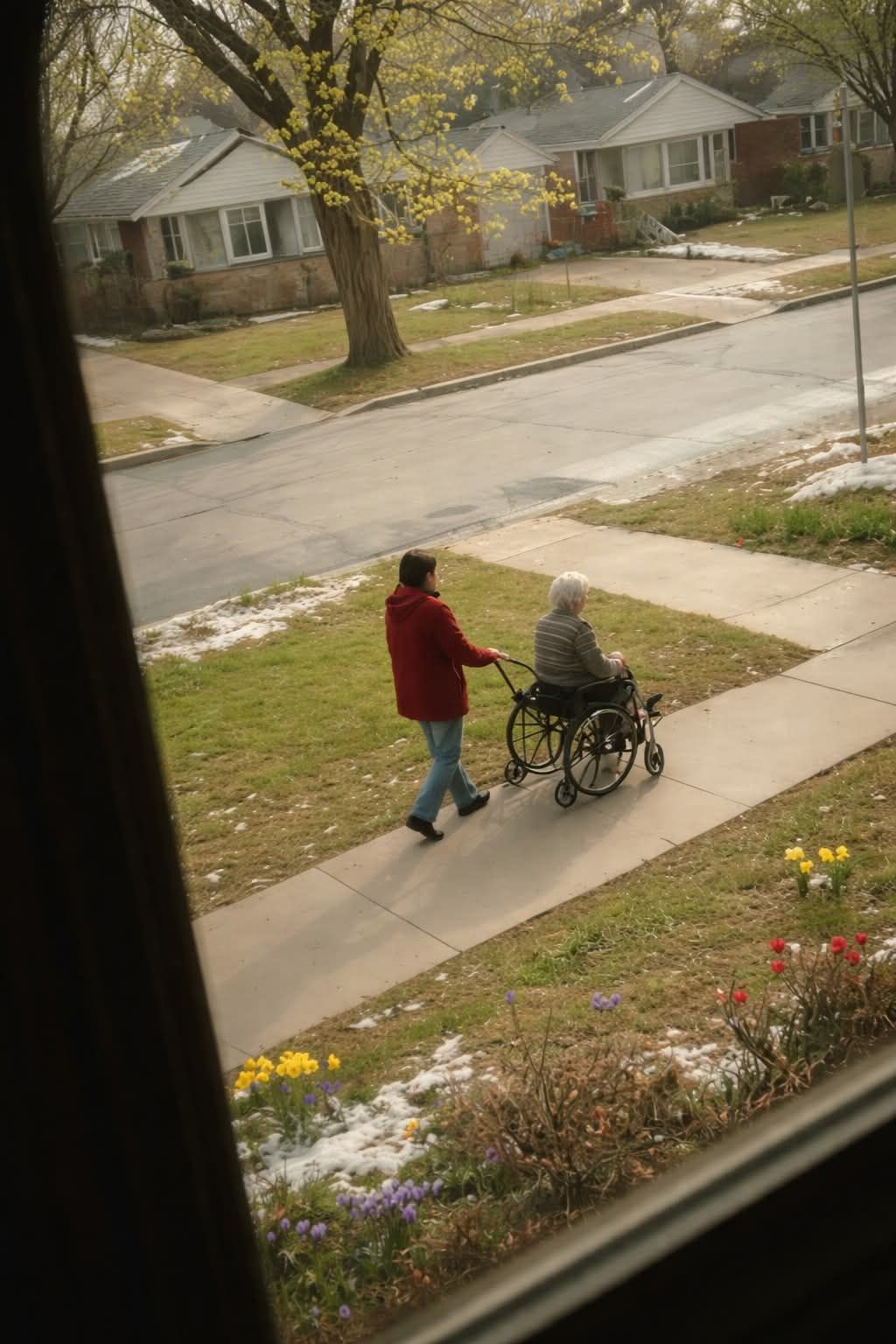
Every Sunday afternoon, Piper took Mom on a short walk around the neighborhood.
That’s when something shifted.
Mom began coming back from those walks… different.
Not angry. Not sad.
Just tense—like she was holding something in.
“How was your walk?” I’d ask.
“Fine, dear,” she’d say. Same words. Same tone. Every time.
By the fifth Sunday, my instincts were screaming.
Then one afternoon, they returned and I saw it clearly—Mom’s eyes were red, her hands shaking slightly on her walker.
Later that night, unable to sleep, I checked the doorbell camera we’d installed for safety.
I expected nothing.
I got everything.
“I can’t keep this from my daughter,” Mom whispered in the recording.
“She deserves to know.”
Piper’s voice followed—quiet, controlled.
“She’s not ready. This could change everything.”
The clip ended.
My heart didn’t restart for several seconds.
The following Sunday, I sent Piper home early and sat with my mother alone.
I told her what I’d heard.
I asked if she was being pressured. Manipulated. Taken advantage of.
She shook her head and said six words that rewrote my past:
“It’s about your father.”
She told me he’d had an affair—long before I was born.
That a child came from it.
A daughter.
Then she said the name.
Piper.
Shock does strange things. I laughed. Then I felt sick.
Mom explained that Piper had searched for answers after her own mother died.
She’d found my father’s name. Found us.
She became a caregiver to be close—not for money, but for truth.
She’d crossed a line, yes. She took a strand of my hair to confirm what she feared and hoped was true.
Wrong—but driven by desperation.
We did another DNA test. Properly. With consent.
The results confirmed it.
We are half-sisters.
Telling my husband was hard. Telling my children was surreal.
But slowly, the anger softened into something more complex—grief, understanding, and cautious curiosity.
Piper still cares for my mother.
But now she also stays for dinner. Laughs at old stories. Helps finish crossword puzzles.
Sometimes I hear her say, half-joking, “Okay, Mom Cora… what’s another word for ‘unexpected family’?”
I’m still angry at my father.
Still unsettled by how it all began.
But I’m grateful the truth came out while my mother is still here—while we can face it together.
My life cracked open in a way I never imagined.
But not every crack is a collapse.
Some are just openings—wide enough to let someone new step inside.