“Officer, please. I’m just trying to get home to my family.”
The words barely cut through the noise of Atlanta’s Terminal T South. Rolling suitcases rattled over tile. Announcements echoed overhead. People moved in every direction, impatient, tired, focused on their own lives. No one noticed the exhaustion in the voice of the man standing near the baggage carousel, a soldier just back from a fourteen-month deployment, finally home.
Officer Derek Lawson noticed him.
Lawson took the military ID from the man’s hand, glanced at it, and laughed. Then he let it drop to the floor like trash.
“Fake,” he said. “A uniform doesn’t make you a soldier. Especially not you.”
The soldier blinked, confused but calm. “Sir, I just landed. You can scan the card. It’s valid.”
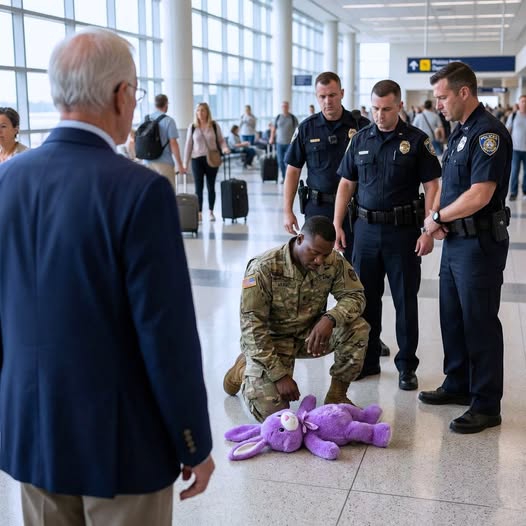
Lawson didn’t bother. Walsh and Tanner moved in, practiced and silent. One grabbed the duffel bag and dumped it upside down. Clothes spilled out. Toiletries skidded across the tile. A small purple stuffed rabbit rolled free.
“That belongs to my daughter,” the soldier said quietly.
Tanner crushed it under his boot.
Lawson shoved the man forward, hard, driving him to the floor. “Hands behind your head. Face down.”
And just like that, Staff Sergeant Aaron Griffin—combat medic, Bronze Star recipient, man who had pulled wounded soldiers from burning wreckage—was pinned to the floor of an American airport. Phones rose in the crowd. People filmed. No one intervened.
Five feet behind the officers, a man in a navy blazer stood perfectly still.
General Raymond T. Caldwell had been there for two full minutes.
Aaron had boarded the plane hours earlier with one thought in his mind: home. His wife Emma. His six-year-old daughter Lily. Fourteen months of sand, smoke, and blood were finally over. He had missed birthdays, school milestones, bedtime stories delivered through frozen video calls. In his bag, carefully wrapped, was a purple rabbit he had carried through bases and mortar attacks, because Lily loved purple.
Four months earlier, that same man had dragged a young lieutenant from a burning convoy in Syria. The lieutenant’s femoral artery was severed. Aaron had clamped it shut with his bare hands and held pressure for eleven minutes while the man screamed and bled and helicopters circled overhead. He didn’t let go. The lieutenant lived.
That lieutenant was General Caldwell’s son.
Caldwell had pinned the medal on Aaron’s chest weeks later, eyes wet, voice breaking, unable to explain why he owed the medic more than words could cover.
Now Caldwell watched as three airport officers laughed while humiliating that same soldier.
Walsh yanked Aaron’s wrists back. Lawson circled him slowly, enjoying the attention. “You people think you belong anywhere. You don’t.”
Aaron stayed still. He knew the math. Any movement would be called resistance. Any word would become a threat. He stared at the crushed rabbit inches from his face and thought of Lily waiting with a glitter-covered sign that would never be lifted in arrivals.
Caldwell raised his phone and recorded everything.
Then he stepped forward.
“Excuse me, gentlemen.”
Walsh spun around, startled. Tanner followed. Lawson turned last, irritation on his face.
“This is police business,” Lawson snapped. “Step back.”
Caldwell didn’t move.
“I’ve been standing behind you for two minutes and forty-three seconds,” he said calmly. “I heard every word. I saw everything.”
He looked down at Aaron. “Stand him up.”
Something in Caldwell’s voice cut through training and ego. Walsh and Tanner obeyed instantly, helping Aaron to his feet.
Caldwell turned to Lawson. “Brigadier General Raymond T. Caldwell. Commanding General, 3rd Brigade Combat Team, 101st Airborne.”
The terminal went silent.
“That man you forced to kneel is my soldier. A combat medic. Fourteen months in Syria. Seven confirmed lifesaving actions under fire. Including saving my son.”
Lawson’s face drained of color.
Caldwell held up his phone. “This footage is already secured and shared. Every insult. Every violation. Every second.”
He didn’t raise his voice. He didn’t need to.
“Staff Sergeant,” he said to Aaron, “collect your belongings. We’re leaving.”
They walked out together. Behind them, three officers stood frozen, careers collapsing in real time.
What followed took weeks.
FOIA requests were blocked. Body camera footage mysteriously vanished. Officials claimed no misconduct. Media narratives shifted, questioning Aaron’s mental health instead of the officers’ actions. Emma was quietly pushed onto leave at work. Lily came home asking why kids said her dad was dangerous.
Aaron nearly quit. Nearly signed a statement withdrawing his complaint just to make it stop.
That night, Caldwell knocked on his door.
“You saved my son’s life,” the general said, sitting at Aaron’s table. “I won’t let them destroy yours.”
They didn’t fight quietly after that.
Investigative journalists received documents. Emails surfaced. Body cam footage was recovered, including Lawson saying, “Watch this. I’m gonna have some fun.” A pattern emerged: fourteen prior complaints against Lawson, all buried. A network protecting him. Money trails. Political interference.
Then the final truth landed.
Lawson had once been military police. Discharged years earlier for excessive force. The officer who signed the papers?
Colonel Raymond T. Caldwell.
The airport incident wasn’t random. It was revenge.
Public hearings followed. Testimony piled up. Caldwell’s son took the stand and described the medic who saved him in the desert. The room listened in silence.
Votes were unanimous.
Lawson was fired. Pension forfeited. Federal charges filed. The police chief resigned. A city councilman vanished from public life. Internal Affairs collapsed under scrutiny.
Aaron went home.
Lily’s rabbit was cleaned and stitched. The Bronze Star citation was framed. Life didn’t return to what it was—but it moved forward.
Some uniforms grant authority. None grant immunity.
Three officers thought they could humiliate a soldier because no one important was watching.
They never checked who was standing right behind them.