The Marines Whispered About the Woman With the Scars — “She Won’t Last a Week,” They Smirked, Until a Visiting General Stopped the Inspection, Looked at Her Face, and Remembered the Child Who Walked Back Into the Fire
The laughter started before Ava Miller even reached her assigned spot in formation, the kind of laughter that didn’t need volume to wound because it carried certainty, the kind that came from people who believed they already understood the world well enough to decide who belonged and who didn’t.
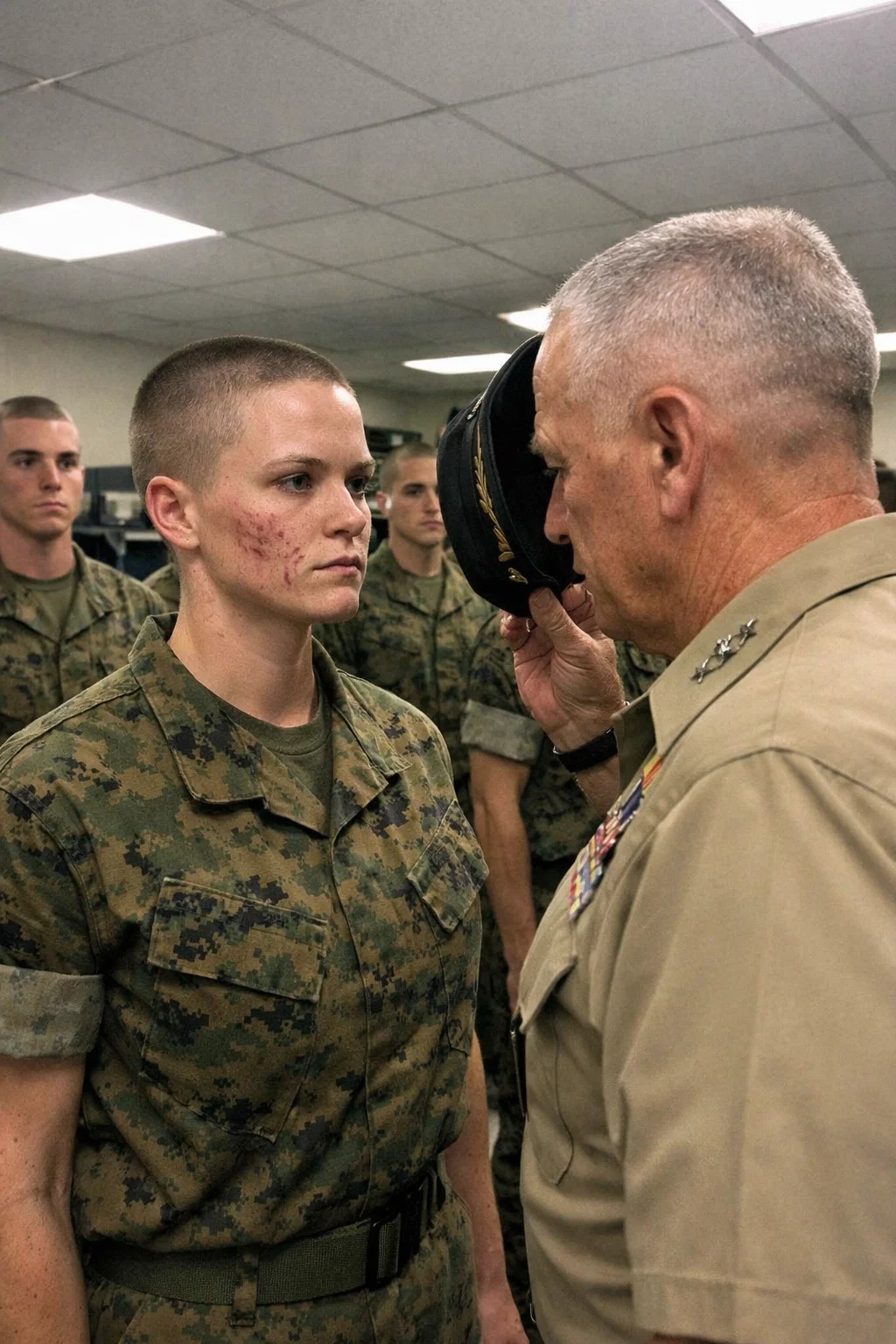
It followed her like a shadow as she passed through the gates of the Marine Corps barracks, boots striking the concrete in a rhythm she had practiced in her head for weeks, her posture rigid, her gaze fixed straight ahead, refusing to acknowledge the whispers that clustered around her face rather than her uniform. The scars did that. They always did. Thin, uneven lines stretched from her left cheekbone down toward her jaw, pale but unmistakable, not the kind that came from training accidents or careless moments, but the kind that told a story no one ever waited to hear.
“Looks like she lost a fight with a wild animal,” someone murmured just loud enough for others to catch.
Another voice followed, sharper, amused. “Guess the mirror won.”
Ava didn’t turn. She didn’t react. She had learned long ago that flinching only fed people like that. Silence, for her, wasn’t weakness. It was survival.
That night, while the other recruits sat on their bunks laughing about home, trading stories, easing themselves into the strange new rhythm of military life, Ava sat quietly against the wall, carefully cleaning her boots even though they were already spotless. The scars pulled when she bent her neck too far, the old grafted skin tightening in a way that reminded her body never fully forgot what it had been through. She welcomed the pain. Pain was honest. Pain didn’t pretend.
When the lights went out, the memories came, as they always did.
Heat that felt alive, breathing, hunting. Smoke so thick it erased walls, erased doors, erased every safe exit she’d ever known. Her younger brother’s voice cutting through it all, high and terrified, screaming her name from somewhere inside the burning house. She remembered the moment she decided, without hesitation, that she was going back in, because there had never been a version of her life where she didn’t. Fear had existed, yes—but it had never been stronger than responsibility.
The scars were the price of that choice.
Morning arrived brutally, the way it always did in training, ripping recruits from shallow sleep and throwing them straight into motion. Physical drills exposed everything. Ava wasn’t weak, but she was slower, her stride limited by skin that didn’t stretch the way it should, lungs that had learned long ago what smoke could do to them. She finished every run, every drill, but always just behind enough for people to notice.
“She won’t last.”
“Those scars are gonna be her excuse.”

“She’s already broken.”
She heard every word. She stored them all.
She didn’t push herself to prove them wrong. She pushed herself because quitting had never been an option, not when she had already survived something that should have ended her once.
Still, doubt crept in during the quiet moments. Would she always be the scarred one? Would her face speak louder than her discipline, her resolve, the reason she stood in that uniform every morning?
Seven days into training, the answer arrived without warning.
The barracks snapped into rigid silence at the announcement of a general inspection. Major General Michael Anderson’s name alone was enough to drain the room of air. He was the kind of officer whose reputation preceded him, a man forged in wars people spoke about in lowered voices, known for seeing things others missed.
Boots aligned. Backs straightened. No one dared shift.
The general moved slowly down the line, his gaze sharp, methodical, unreadable. He passed one recruit, then another, inspecting without comment, until he reached Ava.
And stopped.
The silence became unbearable.
Everyone expected it—the criticism, the dismissal, the sharp observation about her pace or the way her collar sat unevenly against scarred skin. Instead, the general leaned in slightly, his eyes tracing the jagged line along her face with something that wasn’t judgment.
Recognition.
“Miller,” he said quietly, not as a command, but as a realization.
“Sir, yes, sir,” Ava answered, her voice steady even as her heart hammered.
To the shock of every Marine present, Major General Anderson removed his cover and lowered his head.
“Eight years ago,” he said, his voice carrying effortlessly through the barracks, “there was a four-alarm fire in a Chicago tenement. The third floor was declared a total loss. Fire crews were ordered not to re-enter.”
A ripple of unease moved through the ranks.
“But a twelve-year-old girl didn’t accept that,” he continued. “She went in anyway. She brought her younger brother out. Then she heard a baby crying next door and went back in again. On her third trip, the roof collapsed. She shielded that infant with her own body.”
The general turned, his gaze locking onto the recruits who had laughed the loudest days earlier, his eyes now terrifyingly calm.
“That infant,” he said, “was my grandson.”
The room froze.
Ava felt her breath catch, not in triumph, but in something dangerously close to grief, memories pressing in on her chest as the truth spilled into the open without her consent.
The general looked back at her, really looked at her, seeing the way she stood despite pain, the way she carried a body that had already paid its price once.
“You’re not here to become a Marine, Miller,” he said softly. “You’ve been a warrior since you were twelve. We’re just giving you the uniform that matches it.”
He issued new orders before leaving—specialized physical therapy, zero tolerance for disrespect—and when he marched out, the barracks felt altered, as though the walls themselves had shifted.
No one laughed after that.
A year later, at graduation, Ava stood at the front of her class, scars visible against her dress blues, no longer something to hide. Major General Anderson shook her hand and leaned close.
“My grandson wants to meet you,” he said. “He wants to know the woman who saved his life.”
Ava smiled, the scarred skin at her cheek creasing gently, not with shame, but with pride.
She wasn’t the girl they mocked.
She was proof that fire doesn’t always destroy.
Sometimes, it forges.