At my father’s funeral, I expected to say goodbye. Instead, a mysterious woman in a wedding dress stepped forward and revealed a love story frozen in time.
By the time we got to the church, I couldn’t cry anymore. I’d spent a week doing just that—crying in the shower until the water ran cold, crying over bitter black coffee that I hadn’t the heart to finish, and crying into my mother’s shoulder until my eyes felt like raw wounds.
But at the funeral, standing in the hush of polished wood and white lilies, I just… floated.
My name is Kate. Daniel was my father, and on the day we laid him to rest, something extraordinary happened.
At first, everything was the way it was supposed to be. The organ played a gentle, mournful hymn that vibrated in the floorboards. The priest murmured something kind about “a life well-lived” and “eternal rest.” My mother, Catherine, sat beside me, composed but pale, her hands folded tightly in her lap, knuckles white against the black fabric of her dress.
We were mid-service, deep in a silent prayer that felt heavy with the scent of incense, when the heavy oak doors at the back of the church creaked open.
And in she came.
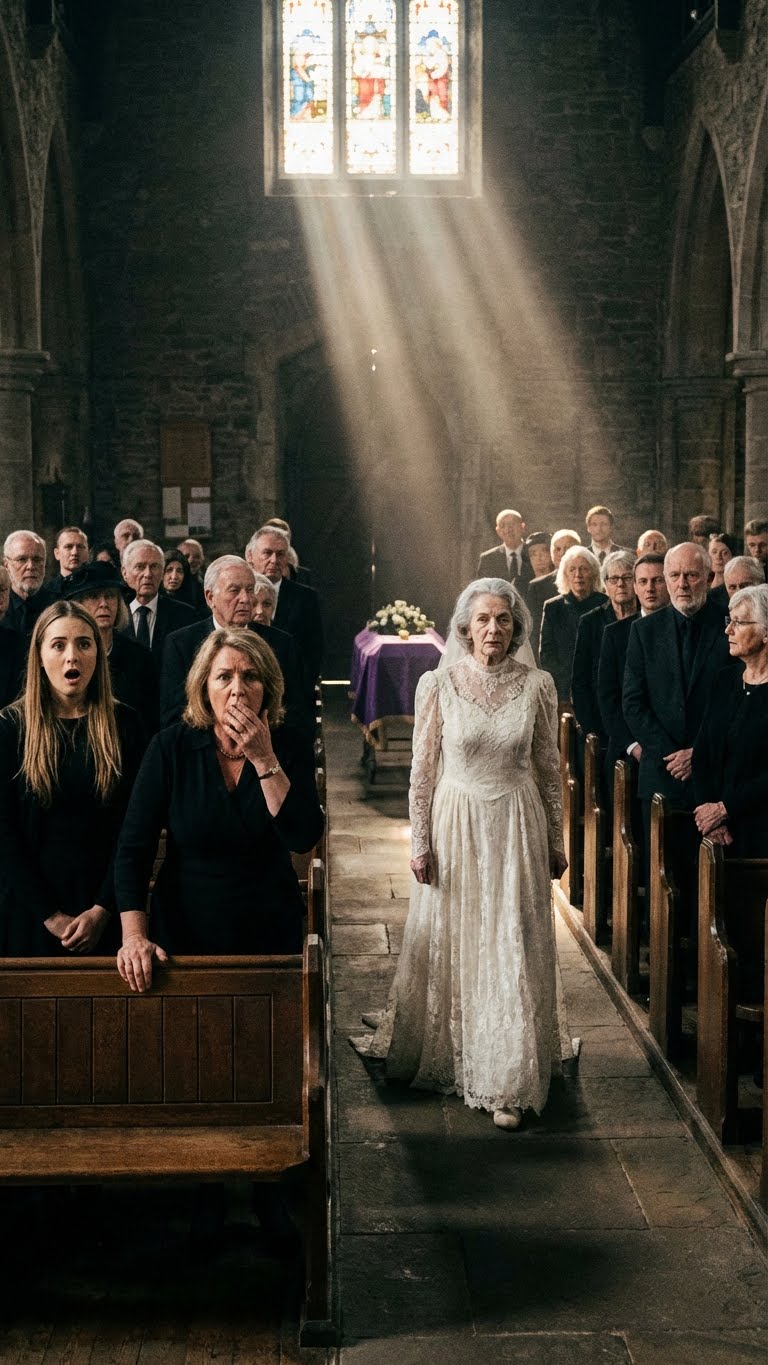
A woman, older, maybe seventy, maybe more, walked slowly down the aisle. She wore a white wedding dress.
Not a costume. Not a veil-and-tulle fairytale confection. It was sleek. Modest. Laced sleeves that hugged her arms, a high Victorian collar, and delicate satin gloves. Her hair was pinned neatly in a silver bun, and her face, though etched with the map of a long life, glowed with something between sorrow and a terrifying certainty.
At first, I thought she must be lost. A confused bride from another ceremony, perhaps suffering from dementia, wandering into the wrong sanctuary.
Then I looked at my mother. Her face had drained of all color, leaving her looking like a porcelain doll about to shatter.
The woman walked straight to my father’s casket. She moved with a deliberate grace, ignoring the sea of black-clad mourners who stared at her white silhouette like it was an apparition.
She placed her hand, gloved and trembling, on the dark mahogany wood. And then she whispered something, her voice carrying through the sudden, suffocating silence.
“You finally got to see me in white, Daniel.”
I gasped, the sound sharp in my throat, almost choking on the air. Gasps echoed around the room like ripples in a pond. Whispers ignited—Who is she? Is she crazy? Should someone call security?
Then she turned.
Her voice shook as she spoke, but her words were clear, slicing through the tension.
“No, I’m not crazy. And yes, I know exactly how I look. But if it’s alright… I’d like to tell you a story.”
No one moved an inch. The priest stood frozen near the altar, his mouth slightly open.
She stood by the casket, holding a small bouquet of lilies that matched the ones on the altar, and took a deep breath, steeling herself.
“Fifty years ago,” she said softly, her eyes scanning the crowd but seeing only the past. “I fell in love with a boy named Daniel at our high school prom. I was seventeen. He was eighteen. He wore a blue tie that clashed horribly with his suit, and he danced like he didn’t care what anyone thought. Like the music was only for us.”
A soft, melancholic laugh slipped through her sadness.
“That night, under the cheap gymnasium streamers, he told me, ‘One day, I’ll see you in a wedding dress, Ellen. Maybe not tomorrow, but someday…’ And I believed him. With every fiber of my being, I believed him.”
She paused, her gaze drifting back to the casket.
“We were young. Full of dreams about road trips and small houses with yellow porches. But two weeks later, he was drafted. Vietnam. He kissed me goodbye under a streetlamp, the yellow light catching the tears on his cheeks. He said he’d write every week. And he did. So did I. I poured my heart into those letters. We planned a life on paper, ink becoming our mortar.”
Silence wrapped the room, heavy and thick.
“But one day, his letters stopped. And two weeks after that, the telegram came.”
She gripped the edge of the casket, her knuckles straining against the white gloves.
“Killed in action,” she whispered. “That’s what it said. A telegram in a plain envelope. Black ink on thin, yellowed paper. I stared at it so long I stopped seeing the words… just the shape of them, like meaningless symbols on a page.”
Her voice cracked slightly, a fissure in the stone of her resolve, but she didn’t stop.
“And just like that, the world dropped out beneath my feet. I couldn’t breathe. I couldn’t speak. I remember my father saying something about how proud he’d be of Daniel… and I just stared at the wall. For hours. Days. The silence was deafening.”
The church was so still, I could hear the old ceiling fan tick softly above us, marking the seconds of a story we had never known existed.
“I wore black for months. I didn’t cut my hair. I didn’t go to dances. I turned down every boy who tried to walk me home. I kept his letters in a shoebox under my bed and read them like scripture. Over and over, until the paper was worn soft as fabric. And when I turned twenty, I told my mother I’d never marry. She cried harder than when we buried the telegram.”
A silence stretched long and reverent, a collective holding of breath.
“But then… ten years later,” her eyes softened, shimmering with unshed tears. “I was in a little grocery store in another town. Just passing through on my way to visit an aunt. I was reaching for a loaf of rye bread, and there he was. Daniel.”
She exhaled the name like a prayer, a holy invocation.
“Alive. Laughing. His hair was shorter, touched with gray at the edges, lines of worry etched around his eyes. And he was holding a little girl’s hand.”
A soft, collective intake of breath rippled through the room. I felt my own chest tighten. A little girl. Was that… me? Or a sister I never knew?
“I thought I was seeing a ghost,” Ellen continued. “My knees gave out. I grabbed the shelf to keep from collapsing into the canned vegetables. And I did what I’d trained myself never to do.”
She smiled faintly, bitterly.
“I ran.”
Her hands shook slightly as she continued, clutching the lilies as if they were the only anchor in a storm.
“I left the store. I didn’t say a word. I got into my car and drove five miles before I had to pull over because I couldn’t see the road through the tears. My body couldn’t process it. My heart was screaming that he’s alive. But my head kept reminding me that I had buried him. I had mourned him for a decade.”
She steadied herself against the casket, looking at the wood as if she could see through it to the man inside.
“But something wouldn’t let me forget. I called the military. I dug through archives. I filed every inquiry I could, fueled by a desperation I couldn’t name. I spoke to someone in a musty office with walls lined in medals and silence. And after weeks of red tape and cold shoulders… I found the truth.”
She turned to the room, her voice clearer now, stronger with the weight of revelation.
“There had been a mix-up. The Daniel listed as dead wasn’t my Daniel. But it was someone with the same name. Same age. Same unit. A clerical error, they called it. Just a mistake on a piece of paper that shattered a life.”
Her mouth trembled, and a tear finally escaped, tracking a slow path down her powdered cheek.
“My Daniel had come home. But not to me. He had been injured, physically and spiritually. He spent years in hospitals, thinking I had moved on, thinking he was too broken for the girl he left behind. By the time I’d found him again in that grocery store, he had a wife. A family. A little girl with the same dimples he used to tease me about.”
She touched her chest, her gloved hand over her heart.
“And so, I let him go. I walked away. I didn’t storm into his life. I didn’t demand he leave his family. I loved him enough to let him be happy, even if it wasn’t with me. But I never forgot. And I never broke my promise.”
I sighed, a jagged sound. My heart was pounding so hard I could feel it in my fingertips. I didn’t know what to think. I was grieving my father, and so was my mother… but this woman? She was grieving a ghost who had come back to life only to be lost again.
“I never married,” Ellen whispered, her voice quivering with something deeper than sadness—a profound, quiet dignity. “Not because I didn’t have the chance, but because I made him a promise. That one day, he’d see me in white. And I wanted to keep it. Even if it was only now. Even if he couldn’t open his eyes to see it.”
The room didn’t breathe. Not a stir. Not a cough. Just the weight of those words hovering in the air like sacred dust.
I glanced at my mother. Her eyes were full, shimmering pools of grief and understanding. Her mouth, trembling, was caught somewhere between breaking and healing.
And then, without a word, she stood.
Catherine, my mother. Daniel’s wife. My father’s widow.
She stepped forward slowly, her heels quiet against the polished stone floor. Her hand was steady, even though I could feel the storm raging inside her.
I reached out instinctively, my fingers brushing the air, wanting to protect her, to stop her from confronting this ghost from the past. But I didn’t stop her. I didn’t have to.
She walked straight to Ellen.
The woman in white looked up, startled, her breath catching in her throat. Her gloved hands fluttered like frightened birds, unsure whether to stay, flee, or fold in on herself.
And then my mother held out her hand.
“I knew about you,” she said gently, her voice soft enough to soothe the entire room.
Ellen’s eyes widened. “You… you did?”
“He told me once over dinner,” Mom said, a sad smile touching her lips. “Years ago. We were making dumplings, flour everywhere. And he spoke about how there was a girl before me. A girl he had lost to the war, not because she died, but because the war took the boy who loved her. He returned… broken. He felt he wasn’t the same man he was before, and he didn’t want to burden her with his ghosts.”
Ellen gasped, one hand flying to her mouth as tears spilled freely down her cheeks.
My mother smiled through her own tears, a smile lined with sadness but lit with something deeper—grace.
“He loved deeply,” she said. “I could feel it in the way he loved me, in the way he loved our daughter. And now… now I know who taught his heart how to love first.”
She reached forward and took Ellen’s hand. And they embraced.
It wasn’t awkward. It wasn’t tense. It was healing. A quiet acknowledgment of two lives touched by the same man, in different chapters, under different skies. Two women who had loved the same soul, separated by time and circumstance, now united in his final moment.
And in that moment, I understood something I hadn’t before.
That real love—true love—doesn’t compete. It doesn’t hoard. It just… exists. It expands.
After a few breaths, they stepped apart, still holding each other’s hands, still tethered by the memory of the man lying in the casket between them.
I walked toward them, slowly. My legs felt heavy, but my spirit felt strangely light. My voice was barely a whisper when I spoke.
“Thank you,” I said to Ellen.
She looked at me, her eyes glassy and kind. “For what, child?”
“For loving him when he was younger,” I said, tears finally spilling over. “For keeping your promise. For showing me… showing us, a part of him that we never knew existed.”
She nodded, a soft smile breaking through her grief. “He was worth it, sweetheart. Every minute of the wait.”
The funeral ended, but the story didn’t.
We invited Ellen back to the house for the reception. It felt right. She belonged there, among the photos and the memories.
Later, sitting in our living room with a cup of tea, she told us more. We learned that she had kept my father’s letters in a cedar box tied with a yellow ribbon, the paper worn and fragile from years of rereading. She’d kept her wedding dress boxed too, preserved in acid-free tissue paper. It was the one she had bought years ago, the one she imagined he’d see her in. Every stitch was a vow she never got to say aloud.
And that day, she finally let it see the light. Not for a ceremony, but for closure… and for love.
That evening, after the guests had left and the house fell into a heavy quiet, I sat alone on the porch. The last of the day’s sun hung low and amber in the sky, painting the world in gold. I clutched a photo album that still smelled faintly of dust and time.
Inside were pages I’d flipped through a hundred times as a kid. My dad in a varsity jacket, grinning with a cocky confidence I barely recognized. Dad holding me on his shoulders at a parade, looking exhausted but proud. Dad kissing Mom in front of our Christmas tree, his eyes crinkled with joy.
His smile was there in every photo. The same smile Ellen must’ve seen fifty years ago under a string of prom lights.
I stared at his face and realized something I hadn’t been ready for until today.
We don’t own the people we love. We share them. Sometimes with the world, sometimes with the past, and sometimes with the ghosts of who they used to be.
And sometimes, we share them with someone who walked away with half their heart but never stopped carrying it, protecting it like a flame in the wind.
That day, I didn’t just say goodbye to my father. I met him again.
Not the man who packed my school lunches or taught me how to ride a bicycle with patient hands. But the boy who whispered dreams into a girl’s ear under a streetlamp. The boy who promised her he’d one day see her in white.
I met the part of him that had danced under a disco ball, carefree and wild. The part that had written letters from the front lines of a war, terrified and hopeful. The part that had been mourned too soon and rediscovered too late.
And I met Ellen, the woman who kept her promise. Who waited, not for a wedding… but for closure. For the chance to let love be seen, even if just once.
I closed the album and pressed it to my chest, letting the last golden threads of sunset tangle in my hair. The air was cooling, but I felt warm.
A few minutes later, I heard the screen door creak behind me. Mom appeared, wrapped in a knitted shawl, holding two mugs of tea and a small paper bag from the coffee shop down the street.
“Chamomile and lemon,” she said softly, handing me one. “And they had those little raspberry tarts you like. I thought we could use a little sweetness.”
I smiled and took the cup, the ceramic warm against my palms.
“Thanks, Mom,” I said. “But I should have done this for you. I should be taking care of you right now.”
“Kate,” she sighed, sitting in the wicker chair beside me. It creaked under her weight, a familiar, comforting sound. “I’m okay, my love. Truly. I’ve had years with your father. Decades of laughter and struggle and joy. And as heartbroken as I am, he’s at peace. These past few years have been really difficult on him, with his cardiac issues. He was tired, Kate. I’m fine, I promise. Let me take care of you, sweetheart.”
She sipped her tea, her gaze drifting to the horizon where the sun was dipping below the treeline. For a moment, we didn’t speak. We just sat there, mother and daughter, letting the warmth settle in our hands and the silence settle in our hearts.
“He told me about her once,” she said after a few minutes, her voice thoughtful. “Just once. Said he’d loved someone before me, thought she was gone. But he was a different man now, and he couldn’t look back. He was proud of who he became, but he was very aware of how Vietnam had changed him. He didn’t think he deserved the innocence of that first love anymore.”
I nodded, looking at the steam rising from my cup. “He didn’t dwell on Ellen. I think he wanted to protect her… and you.”
“He did love you,” I added, turning to look at her. “That was obvious in everything he did.”
“And he loved her,” she said, without a trace of bitterness or jealousy. “In a different life. In a different world.”
We shared a quiet smile, a secret understanding passing between us.
“I’m glad she came,” I whispered. “And I’m glad that it didn’t make you feel anything other than… I mean, Ellen gave us something we didn’t know we needed.”
“She gave him something, too,” Mom said, reaching out to squeeze my hand. “The ending he never got. The fulfillment of a promise made by a boy who didn’t know if he’d live to see tomorrow.”
We toasted with our mugs, the clink soft in the twilight. We let the silence hum between us, not empty but full of history and grace.
And just like that, I knew:
Love doesn’t vanish when the heart stops beating. It doesn’t disappear when telegrams lie or wars intervene. It waits.
It waits in a dress packed away in a box. It waits in a promise whispered in the dark. It waits in the space between goodbye and forever.
And sometimes, if you are lucky, it steps out of the shadows in white, just to say, “I remember.”