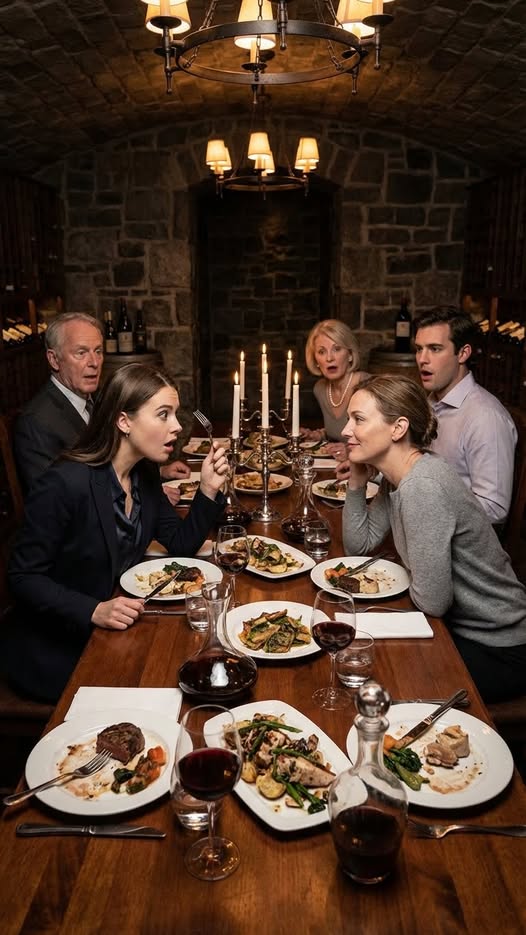
The acoustics of L’Jardin were designed for the wealthy to hear themselves think, yet all I could hear was the steady, rhythmic grinding of my father’s teeth as he smiled. It was a practiced, lethal expression—the kind he used when closing a deal or dismissing a subordinate. He leaned across the crisp, blindingly white linen of the tablecloth, gesturing toward me with his Pinot Noir as if I were a smudge on a masterpiece he was trying to sell.
“Don’t mind Khloe,” he said, his voice dripping with that sickening, honeyed charm he reserved for high-net-worth clients and waitstaff he intended to under-tip. “She’s our permanent work in progress. Still trying to find her footing in the real world.”
Beside him, my brother’s new fiancée, Sienna Sterling, didn’t offer the expected polite chuckle. She didn’t smile at all. Instead, she stared at me, her brow furrowing slightly, her eyes narrowed as if she were trying to solve a complex differential equation and I was the missing variable.
My name is Khloe Vance, and I am twenty-nine years old. For as long as I can remember, I have been the silence in a family that only valued noise. My parents, Alistair and Eleanor Vance, had built a boutique investment firm in the heart of Chicago’s Financial District—a temple of mahogany and arrogance dedicated to the worship of the almighty portfolio. My older brother, Julian, was the golden child, the crown prince of perception. He followed their footsteps with a terrifying, robotic precision.
Their world was loud, polished, and obsessed with the optics of success. They measured human worth in stock options, country club tiers, and the carat count of the diamond on a woman’s finger. In their eyes, if a thing didn’t produce a loud, immediate roar of profit, it didn’t exist.
And then there was me.
I didn’t want to manage legacy wealth; I wanted to disrupt the very systems that moved it. While Julian was learning how to schmooze at the Union League Club, I was in the corner of my drafty studio apartment in West Loop, my life defined by the quiet, electric hum of a server rack. My days were fueled by stale coffee and the blue light of three monitors; my nights were sacrificed to the altar of lines of code.
To my family, this wasn’t ambition. It was a failure to launch. They saw my thrift-store sweaters and my refusal to attend their endless, soul-sucking galas not as the lean-startup sacrifices they were, but as proof that I couldn’t cut it in the “high-stakes” world they inhabited. They loved me, perhaps, in the way one loves a pet that refuses to be housebroken—with a mixture of pity and profound, bone-deep shame.
What they didn’t know was that my quiet little life was about to scream.
As the first course was served, my father’s laughter boomed through the private wine cellar, bouncing off the racks of 1982 Bordeaux. He was in his element, holding court, blissfully unaware that the foundation of his superiority was made of sand.
I looked at Sienna, and for a fleeting second, I saw a spark of recognition in her eyes that made my blood run cold.
The dinner at L’Jardin wasn’t an isolated incident; it was the climax of a lifetime of strategic dismissals. To the Vances, I was a liability to the brand.
I remembered the Summer Solstice Gala at their Lake Geneva estate just a month prior. It was the event of the season—the kind of party where governors rubbed elbows with hedge fund titans. I only found out it was happening when I saw the photos on my cousin’s Instagram: my entire family clinking Baccarat flutes on the dock, the sunset painting them in gold. Everyone was there. Except me.
When I called my mother the next morning, her voice was light, airy, and utterly devoid of guilt.
“Oh, sweetheart,” Eleanor had chirped, “we didn’t want to overwhelm you. It was a very high-level crowd. Lots of technical talk about market volatility and institutional shifts. We just didn’t want you to feel… inadequate.”
Inadequate.
It wasn’t an oversight. It was a quarantine. They were protecting their social standing from the perceived stain of my “hobby.”
The public humiliations were sharper, more jagged. Last Fourth of July, at a neighbor’s barbecue, my father had held court by the grill, a pair of silver tongs in one hand and a glass of expensive bourbon in the other.
“Julian is taking over the Asia-Pacific accounts next quarter,” he’d bellowed to a circle of nodding men. “He’s the future of the firm.” Then, he’d spotted me standing by the drinks cooler. “And Khloe? Well, she’s still finding herself.”
He’d made air-quotes with the tongs, and the group had chuckled—a dry, patronizing sound that felt like sandpaper against my skin. He used my life as a punchline to make himself look like the benevolent, patient patriarch. I drove home that night with his laughter ringing in my ears. It was the sound of my own father telling the world I was a joke.
But the breaking point—the moment I decided to stop being the “work in progress”—came three days before the engagement dinner.
Julian had called me. His voice was dripping with that faux-concern that always preceded an insult.
“Hey, Chlo,” he’d said. “I was thinking… with the dinner coming up, I know things are tight for you. I’m going to wire you five hundred bucks. Do me a favor? Go buy a dress that doesn’t look like it came from a donation bin. I want you to look presentable for Sienna. First impressions are everything in her world.”
“Presentable,” I’d repeated, the word tasting like copper in my mouth.
“Yeah. I just don’t want any distractions. This dinner is important for the family image. I’m sure you understand.”
He didn’t want to help me. He wanted to curate me. He wanted to ensure his “struggling” sister didn’t smudge the glossy, high-gloss image he was selling to his new, powerful fiancée.
“Thanks, Julian,” I’d said, my voice dangerously, deceptively calm. “But I have something to wear. I’ll be fine.”
“Are you sure? I just want everything to be perfect.”
“I’m sure,” I’d replied, and hung up.
What they didn’t see—what they never bothered to ask about—was my reality. What my family saw as failure was actually “stealth mode.” While they were playing tennis at the club, I was on 4:00 AM encrypted calls with my lead developers in Zurich. While they were bragging about five-figure commissions, I was closing a Series B funding round with a consortium of international investors who saw the global potential of my platform: Ether Systems.
They heard “app” and thought I was building a game for teenagers. They didn’t know I had built an AI-driven, decentralized supply chain network that was currently being bid on by three of the largest shipping conglomerates in the world. I was under a strict NDA until the funding officially closed at midnight.
I remember sitting at my desk that night, the night Julian offered me charity money. I had just signed the final digital contracts. The valuation of my company was now higher than my father’s entire firm, including their real estate holdings.
The irony was so thick I could almost taste it, like the metallic tang of a coming storm.
As I sat at the table in L’Jardin, I felt the digital transfer of the final funds hit my escrow account. The storm had arrived.
The air in the private wine cellar smelled of aged oak and unearned confidence. The dinner felt less like a celebration of love and more like a hostile merger acquisition meeting. My father was mid-monologue, inflating the numbers of Julian’s recent deals, while my mother wouldn’t stop complimenting Sienna’s “investment eye”—a topic my mother understood with the depth of a decorative saucer.
I sat there, pushing a lone, buttery scallop around my plate, feeling the familiar, heavy cloak of invisibility.
Finally, the spotlight turned to me, and the temperature in the room seemed to drop ten degrees.
“Khloe is still tinkering with her… computer thing,” my mother explained to Sienna, patting my hand with a pitying condescension that burned worse than a physical blow. “We keep telling her it’s time to get serious. To join the real world.”
Julian chimed in with a smug grin, adjusting his silk tie. “Yeah, we’ve even offered to get her an internship at the firm. You know, answering phones, filing paperwork… just to get her used to a professional environment. But she likes her freedom.”
Sienna, who had been quiet for most of the meal, turned her sharp, intelligent eyes toward me. Unlike my family, she didn’t look at me with pity. She looked at me with curiosity.
“What kind of project is it, Khloe?” she asked. Her voice was steady, the voice of a woman who ran a major VC firm in Silicon Valley and didn’t have time for small talk.
Before I could even part my lips, my father cut in, waving his hand as if swatting away a persistent fly. “Honey, it’s boring. She’s building some app. One of a million out there. It’s a hobby, really.” He sighed—a heavy, theatrical sound that suggested my very existence was a cross he heroically carried for the family.
For the next ten minutes, they discussed me as if I were a ghost. They painted a portrait of a lost, confused girl who refused to grow up, a burden they managed with saint-like patience. I felt the heat rising in my cheeks, a slow-burning fuse, but I said nothing. I just focused on a single drop of condensation sliding down the side of my water glass.
The final insult arrived with the bill. It was presented in a velvet folder, a ritual of wealth. My father made a grand, sweeping show of pulling out his Amex Black Card. He looked directly at me, a sad, patronizing smile on his face.
“Don’t worry about the cost, Khloe,” he said. “I’ve got this. You just save your pennies for rent. I know how hard it must be, living on… whatever it is you make.”
The message was crystal clear: You are the charity case. You are the outlier. You are not one of us.
I just nodded, the silence in my throat feeling like setting concrete. This wasn’t new. This was just the climax of twenty-nine years of being told I was less-than.
“Actually,” Sienna said, her voice cutting through the smug atmosphere like a diamond through glass. She wasn’t looking at the bill. She was looking at me. “I’ve been meaning to ask. What did you say the name of your company was again, Khloe?”
My heart hammered against my ribs, a wild bird in a cage. This was the moment. The NDA had expired ten minutes ago.
I met her gaze. I didn’t blink. “It’s called Ether Systems.”
The name hung in the air, vibrating.
Sienna’s glass stopped halfway to her lips. She froze. The polite, bored mask of the fiancée vanished, replaced instantly by the cold, predatory intensity of the Silicon Valley shark.
“Ether?” she repeated. The word was a heavy stone dropped into a still pond. “Wait. Are you… are you C.V. Vance?”
My father laughed—a nervous, jagged sound. “Yes, Vance is our last name, Sienna. What’s your point? We’re all Vances here, except for Khloe’s lack of a business plan.”
Sienna ignored him entirely. She leaned forward, her eyes locked on mine with a mixture of awe and dawning terror. “You’re the founder? The ‘Ghost of Chicago’?”
I took a slow, deliberate sip of my water, savoring the silence that was suddenly, beautifully absolute.
“I prefer the term ‘Chief Architect,’” I said quietly.
The room didn’t just go quiet; it became a vacuum.
Sienna whipped her head toward Julian, her expression one of utter disbelief. “You told me your sister was… ‘tinkering.’ You told me she was a ‘work in progress.’”
Julian stammered, his face turning a mottled, ugly shade of red. “She is! I mean… she lives in a studio! She wears sweaters from the seventies! Sienna, babe, don’t get confused. You work with actual founders. Unicorns. Khloe is just playing around with some logistics code.”
Sienna didn’t look at him. She looked like she wanted to crawl under the table. She pulled out her phone, her fingers flying across the screen with practiced urgency. She slammed the device onto the center of the white tablecloth, screen-facing my family.
It was a Bloomberg Technology alert that had gone live minutes ago.
The headline was bold, stark, and undeniable: “THE INVISIBLE UNICORN: How Ether Systems Became a $400 Million Disruptor in Silicon Silence.”
There was no photo of me—I had been careful about that—just the minimalist, silver logo of my company. But the name C.V. Vance was bolded in the very first paragraph, identified as the sole founder and majority shareholder.
“This is her?” Sienna’s voice rose, cracking with a frantic energy. “Julian, my firm has been trying to get a meeting with C.V. Vance for eight months. We had a standing offer to lead her Series B at a massive premium, but we couldn’t even get past her legal firewall. Her ‘assistants’ are some of the most expensive lawyers in Manhattan.”
My father stared at the phone. I watched the color drain from his face, starting at his forehead and moving down to his jaw until he looked like a wax figure melting under high heat. My mother’s mouth opened, but no sound came out; she looked like a fish gasping for air in a tank that had just been drained.
“Four hundred million?” my father whispered. The “Black Card” still sat in the velvet folder, suddenly looking like a toy, a relic of a much smaller world.
“That was the valuation before the shipping conglomerate bidding war,” I said, my voice steady and cool. “The final number is… significantly higher.”
Julian looked from the screen to me, his expression fracturing into a grotesque mosaic of shock, jealousy, and absolute, unadulterated horror. Every insult he had hurled—charity case, failure, unpresentable, distraction—was now hanging in the air, radioactive and ridiculous.
“I… I didn’t know,” my father stammered, his voice stripped of its booming authority. He sounded small. He sounded old.
“No,” Sienna said, her voice turning icy as she looked at her future in-laws. “You didn’t know. Because you didn’t ask. You were too busy listening to yourselves talk to realize the most powerful person in this city was sitting at your own table.”
She looked at me, and for the first time, she looked genuinely intimidated. “Khloe… I am so sorry. I had no idea who I was sitting across from.”
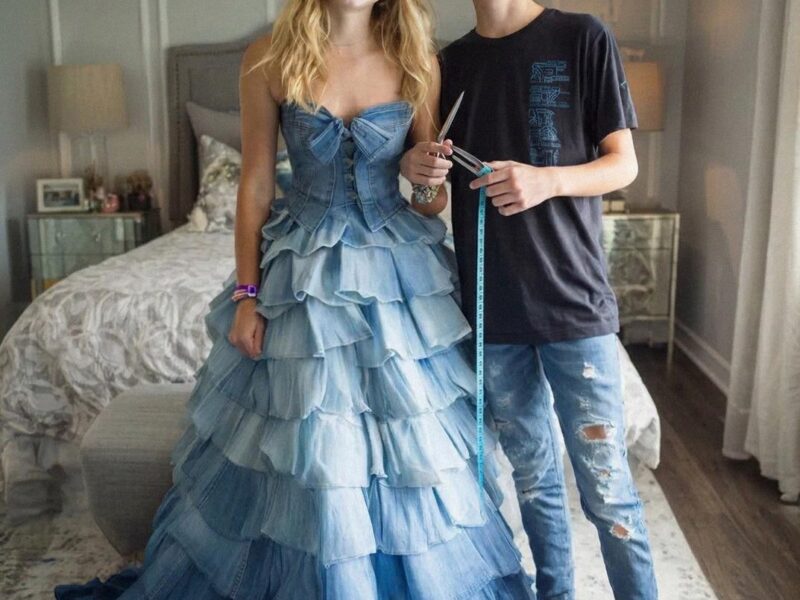
I stood up. The movement was fluid, effortless. I smoothed the front of my dress—the one Julian thought was a “donation bin” find. In reality, it was a custom piece from a minimalist designer in Antwerp, worth more than Julian’s car. I hadn’t told them that, either.
“It’s quite alright, Sienna,” I said, offering her a small, professional smile. “You were the only one tonight who actually treated me like a human being instead of a problem to be solved. Have your people call my office on Monday. We can discuss the Series B… though the terms have changed significantly since this morning.”
Then, I turned to my family.
They looked shrunken, as if the very walls of L’Jardin were closing in on them. The mahogany and the wine and the status they worshipped had failed them. They had spent twenty-nine years trying to build an empire of noise, only to be silenced by the very girl they tried to bury.
“I have a board meeting in London via teleconference at 7:00 AM,” I said, picking up my clutch. “I really should get some sleep.”
I looked at my father, who was still staring at the Bloomberg headline as if it were a death warrant.
“Enjoy the wine, Dad. And don’t worry about my rent.” I paused, my hand on the back of my chair. “Oh, and you’ve got the bill, right? Since you made such a grand show of it.”
I walked out of the private room. I didn’t look back.
The walk through the main dining room of L’Jardin felt different. The air didn’t feel heavy with arrogance anymore; it felt light, charged with the electricity of my own liberation.
I stepped out into the cool, crisp night air of Chicago. The city skyline loomed above me, a forest of steel and glass, and for the first time, I felt like I truly owned my piece of it.
The silence behind me wasn’t the silence of me being ignored. It was the silence of a hierarchy crumbling into dust. My family hadn’t lost a daughter that night; they had lost her years ago, with every eye-roll, every snide comment, and every “quarantine” from their precious social circles. Tonight, they had simply realized the magnitude of their loss. They had lost the privilege of knowing the woman I had become.
I hailed a black car—not because I couldn’t afford a limousine, but because I still valued the utility of things over their flash. As the car pulled away from the curb, I saw my father and Julian emerge from the restaurant. They looked frantic, scanning the sidewalk for me, their faces illuminated by the neon glow of the city. They looked like men who had just realized they’d been holding a winning lottery ticket for decades and had accidentally thrown it in the trash.
I leaned back against the leather seat and closed my eyes.
My phone buzzed in my lap. A text from an unknown number.
“Khloe, it’s Sienna. I’m calling off the engagement. I can’t be part of a family that treats brilliance like a burden. I’d still love to talk business on Monday. You’re an inspiration.”
I didn’t reply. Not yet.
The “work in progress” was finished. The “Ghost of Chicago” was finally visible. And the silence? The silence was finally mine to control.
————
Six months later, Ether Systems moved into its new headquarters—the top three floors of a glass tower overlooking the lake.
My parents still call. They leave long, rambling voicemails filled with apologies and invitations to brunch, to galas, to family reunions. They talk about how “proud” they are, as if they had any hand in the architecture of my success. I haven’t answered a single one.
Julian’s firm took a massive hit after the “Invisible Unicorn” story broke. Investors realized that if the Vances couldn’t even recognize the billion-dollar potential in their own home, they certainly couldn’t be trusted with anyone else’s capital. He’s currently “finding himself” in Europe, though I suspect he’s mostly finding out how hard it is to live without the Vance name carrying any weight.
Sometimes, when the city is quiet and I’m the last one in the office, I look out at the lights of the Loop. I think about that dinner at L’Jardin. I think about the smell of the wine and the sting of the insults.
The world will always try to tell you who you are. It will try to categorize you, minimize you, and keep you in a box that fits its own comfort. But there is a singular, terrifying power in silence. When you stop trying to convince people of your worth, you give yourself the room to actually build it.
My name is Khloe Vance. I am no longer a work in progress. I am the architect of my own empire. And for the first time in my life, when I speak, the whole world is listening.