The air in my parents’ living room was always three degrees too cold, a thermostat setting designed to preserve the pristine upholstery rather than comfort the guests. It was Christmas Day, the kind that looks perfect on Instagram—a twelve-foot spruce groaning under vintage ornaments, a fire crackling with engineered precision, and a silence that felt heavy enough to bruise.
I am Sarah, the daughter who left. The daughter who, three years ago, packed a sedan with garbage bags full of clothes and a five-year-old child, choosing the uncertainty of rent payments over the suffocating cost of my mother’s “generosity.”
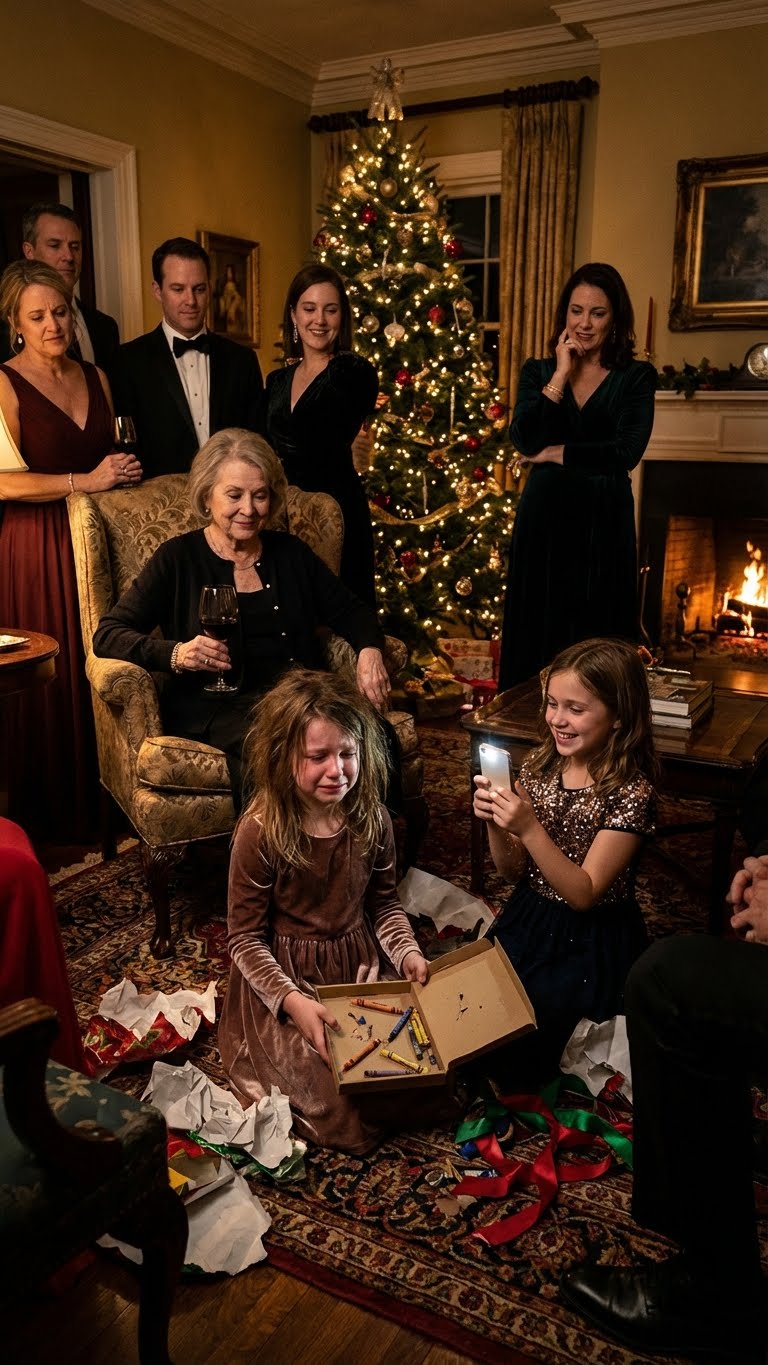
Today was supposed to be a truce. My daughter, Ellie, now eight years old and possessing a heart too big for this jagged world, sat cross-legged on the Persian rug. She looked small against the backdrop of excess. My sister, Chloe, was perched on the loveseat, her three children—Michael, Hannah, and Ryan—surrounded by a fortress of shredded wrapping paper.
“Go on, El,” my father, Robert, grunted from his armchair, not looking up from his scotch. “Open it.”
Ellie reached for the box with both hands. It was small, dented, and wrapped in paper that was visibly wrinkled, the tape yellowed and peeling. It looked like an afterthought dragged out of a recycling bin. But Ellie, still believing in the magic of the season, smiled up at me.
“It’s heavy,” she whispered, her eyes bright.
I didn’t smile back. A cold dread was already coiling in my gut, a snake waking up from hibernation.
She tore the paper. Underneath was a generic cardboard box, the corners crushed. She opened the lid. The room went silent, save for the hum of the expensive refrigerator in the next room.
Inside was a box of crayons. Not a new box. A used box. The yellow wax was snapped in half. The “Blueberry” wrapper was peeled off. The box itself was stained with grease, as if it had sat at the bottom of a diner bag for a month.
I swear I heard someone snort.
My mother, Linda, took a slow sip of her Chardonnay. She didn’t look at Ellie. She looked at me, a smirk playing on her lips—a look I knew better than my own reflection.
“That’s what happens when your mom walks away from the family,” she said. Her voice was light, conversational, as if she were commenting on the weather. “Santa knows who’s been loyal.”
The cruelty of it wasn’t the gift. It was the public execution of an eight-year-old’s spirit.
To my left, Chloe’s kids were tearing into the spoils of being the “good” grandchildren. Hannah was unboxing a brand-new iPad Pro for her digital art. Michael was screaming over a Nintendo Switch OLED model. Ryan was already pairing noise-canceling Bose headphones to a new iPhone.
I looked at Ellie. Her fingers were clutching the greasy crayon box so tight her knuckles were white. She was freezing her face in a smile, terrified that if she let it drop, she would be the one ruining Christmas. She was trying to convince herself it was still a gift.
Something inside me, a dam I had spent three years reinforcing with therapy and distance, finally broke.
I stood up. The movement was sudden enough that the ice in my father’s glass clinked.
“Mom?” Ellie whispered.
“Put it down, baby,” I said softly.
I walked to the tree. Hidden behind the bulk of the trunk was a stack of gifts I had brought. I had spent months picking them out. Double shifts at the hospital, skipped lunches, selling my old jewelry—I had paid for every brick of my life, and I had paid for these. Limited edition sneakers for Michael. A VR headset for Ryan. A professional drawing tablet for Hannah.
They were wrapped in thick, silver paper, tied with velvet ribbons. They looked like apologies. They looked like a plea for acceptance.
I picked up the entire stack. It was heavy, awkward in my arms.
“Sarah, sit down,” Chloe snapped, looking up from her phone. “You’re blocking the light.”
I turned to face them. I walked to the center of the room, right over the expensive rug, and I opened my hands.
The boxes tumbled. They hit the floor with a chaotic thud, sliding across the wood. The VR headset box made a sickening crunch.
“These were for you,” I said, my voice steady, lacking the tremble I expected. “They aren’t anymore.”
My mother laughed, a sharp, barking sound. “Oh, stop being dramatic, Sarah. It’s a joke. God, you always have to ruin everything with your sensitivity.”
“A joke?” I asked. I looked at my father. He looked confused, like a man waking up in a room he didn’t recognize. “Humiliating a child is a joke to you?”
“She needs to learn humility,” my mother spat, the veneer cracking. “She needs to know that choices have consequences. You chose to leave. You chose to live in that… shack. You don’t get the premium package when you cancel the subscription, Sarah.”
I didn’t answer. I walked to the door and opened it. The biting wind of a Chicago winter slammed into us, freezing the heat in the hallway.
“Ellie. Coat. Now.”
Ellie scrambled up, leaving the crayons on the floor. She ran to me, burying her face in my side.
“You walk out that door,” my father warned, his voice rising, “and don’t you dare ask for help when your car breaks down or your roof leaks. We are done.”
I looked back at them—a tableau of miserable, wealthy people surrounded by things that couldn’t love them back.
“Those gifts,” I said, pointing to the pile on the floor. “I’m returning every single one. Merry Christmas.”
I slammed the door. The sound echoed like a gunshot. But as we walked down the driveway to my beat-up sedan, I knew the war hadn’t ended. It had just begun.
The drive home was silent. Ellie held her hands in her lap, staring out the window at the gray slush passing by. She didn’t cry. That almost made it worse. If she had cried, I could have comforted her. But this silence? This was the silence of a child learning that adults can be monsters.
I stayed up late that night, sitting in my modest living room with the stack of silver-wrapped gifts still in the backseat of my car. I thought about what would have happened if I hadn’t gone. If I had just mailed the presents. They would have taken them, posted performative “thank yous” on Facebook to keep up appearances, and still handed Ellie that crushed box like a warning shot.
The next morning, the stores were chaos. Return lines snake around aisles, filled with couples bickering over mixers and tired parents. Mariah Carey was singing All I Want For Christmas Is You on a loop that felt like psychological warfare.
I stood in line for three hours.
One by one, I placed the items on the counter. The tablet Hannah wanted. Gone. The VR headset. Gone. The limited-edition shoes Michael begged for. Gone.
“Was there anything wrong with these items?” the cashier asked, popping gum.
“No,” I said, watching the refund total climb on the screen. “They just went to the wrong people.”
I walked out with $1,200 credited back to my card. It felt like blood money, but it was mine.
I went home, made a pot of coffee, and sat at my laptop. It was time to cut the strings.
For years, even after moving out, I had subsidized their digital lives. It was a habit, a way to feel useful, a way to buy a seat at the table. I managed the family Spotify. I paid for the Netflix Premium. I covered the Amazon Prime. I paid for the obscure grocery delivery app, Fesco, that my mother used because she refused to step foot in a supermarket. I was even the primary account holder on the family cell phone plan because my credit score was better than my father’s after his “business restructuring.”
I started cutting.
Netflix: Sign out of all devices. Change password.
Spotify: Remove users “Mom,” “Dad,” “Chloe.” Change password.
Amazon: Remove household members. Change password. disable one-click purchasing.
Fesco: Account disabled. Card removed.
AT&T: I initiated a transfer of billing responsibility. If they didn’t accept it in 24 hours, the lines would be suspended.
I wasn’t paying another cent for their Wi-Fi and entertainment so they could sit around trashing me behind my back.
The first message came around 3:00 PM.
Dad: Netflix is down. Fix it.
I didn’t reply.
By 4:00 PM, my mom texted. Mom: The grocery delivery never showed up. Did you forget to place the order? We have nothing for dinner.
By 5:00 PM, she called. I let it go to voicemail.
“Sarah, maybe we misunderstood the gift. Maybe it was a gag gift and we forgot the real one. Don’t be so dramatic. Ellie shouldn’t be taught to hold grudges. Call me back. The internet is acting up too.”
I blocked her number. Then I blocked his.
Two days passed in a blissful, terrifying silence. We ate leftovers. We watched movies on my Netflix account. I explained to Ellie that Grandma and Grandpa were in “time out” because they forgot how to be nice.
Then, late on the second night, my phone rang. It was a number I didn’t recognize.
I let it ring. Then it rang again. And again.
I answered. “Hello?”
“They kicked me out.”
It was Chloe. Her voice was low, tight, vibrating with a panic I had never heard from my golden-child sister.
“What?”
“Mom and Dad,” she choked out. “They said I was the reason everything is falling apart. They said I embarrassed the family by letting you come to Christmas. They said… they said I’m a leech.”
“Where are you?”
“A motel off the interstate. The Starlight. It’s… Sarah, the sign is flickering and the vending machine only takes quarters and the outlet sparked when I tried to charge my phone. The kids are asleep in one bed. I’m on the bathroom floor.”
My sister—the one who mocked me, the one who took the iPhones while my daughter got trash.
“Do you have anywhere else to go?” I asked.
“No. He blocked my cards. Dad… he cancelled the supplementary credit cards.”
I closed my eyes. I could have told her this is what happens. I could have told her welcome to the real world.
“Come here,” I said.
Silence stretched on the line. “Are you serious? You aren’t just saying that?”
“No,” I said. “I mean it. Pack the kids. Come here.”
She arrived an hour later. She looked like a refugee from a failed state. No makeup, no loud opinions, no phone in her hand. Just quiet. Her kids dragged trash bags of clothes, looking shell-shocked.
Ellie opened the door. She didn’t ask about the crayons. She just handed Hannah a blanket.
Chloe sat at my kitchen table while I made tea. Eventually, she looked at me, her eyes hollow.
“I really didn’t know they’d do that to her,” she whispered. “To Ellie. I thought… I thought it was a mistake.”
“I know,” I lied. She knew. She just hadn’t cared until the target moved to her back.
“I didn’t think they’d do it to me, either,” she added.
And that’s when it hit us both. They had never been a family. Not really. They were just people who used blood as a leash.
But the leash had snapped.
“You can stay,” I said. “But be warned. The war isn’t over.”
She looked at her phone, which was buzzing on the table. A notification from Dad.
“No,” she said, turning the phone over. “I think it’s just getting started.”
The next few days felt unreal, like we were walking through a house made of glass. My sister and her kids settled into the guest room—which was really just my office with an air mattress. To my surprise, there were no complaints. No entitlement. Chloe folded blankets with military precision, a habit from our childhood I had forgotten. Trauma leaves the same fingerprints, even on different victims.
Ellie gave up her room to her cousins without a word and camped on the couch, treating it like a grand adventure.
We didn’t bring up Christmas directly, but it was there in the pauses. In the way Chloe flinched when a car door slammed outside. In the way Hannah hid her new iPad under a pillow, ashamed to use it in front of Ellie.
Peace lasted exactly three days.
Then the utilities started acting up.
We woke up on a Tuesday to dry faucets. Not a drop. I called the city water department, ready to report an outage.
“No outage, Ma’am,” the operator said. “We received a request to cancel service at this address effective immediately. The caller identified as the homeowner.”
I stood in my kitchen, clutching the phone. “I am the homeowner. I didn’t call.”
“Well, they had the account number and the social security verification.”
My parents. I had let them help me set up the utilities when I first bought the place, back when I thought their “help” was genuine and not a way to plant surveillance bugs in my life.
“It was a fraudulent call,” I said, my voice shaking. “Reactivate it. Now.”
I had to go down to the city clerk in person with a deed and ID. By the time I got home, the power company called. A pending disconnect request for Friday.
I didn’t tell Ellie. I just boiled bottled water for a bath and made pancakes.
I spent the afternoon changing everything. Passwords, security questions, two-factor authentication. I locked down my identity like Fort Knox.
When I told Chloe, she stared at the wall. “They always said, ‘If you make your bed, you lie in it.’“
“I guess they’re hoping we lie in it cold and in the dark,” I said.
I laughed. It was an absurd, jagged sound. “They’re trying to smoke us out.”
That night, while I was washing dishes, Chloe got the call that broke her. She stepped onto the porch to take it. Ten minutes later, she came back in, sat at the table, and didn’t speak for a full minute.
“They cut me off,” she said.
“From what?”
“Everything. Bank accounts frozen. The car lease—Dad called the dealership and said he’s stopping payments. My health insurance dropped. Dad just texted: ‘You’re on your own now. Figure it out.’“
She didn’t cry. She just stared at the table, realizing that her entire life had been a subscription service, and the subscription had just been cancelled.
The next day, Hannah came home from school with a white envelope. She found it stuffed in her backpack.
“A lady gave it to me at the gate,” she said.
I opened it. It was a printed letter, signed by my parents.
Hannah,
Until your mother repents for her betrayal, she is not to contact us. We are re-evaluating our relationship with all grandchildren. We are setting boundaries against toxicity.
She is eleven.
Chloe read it and ran to the bathroom. I heard her retching.
That was the moment I stopped playing defense.
I added Chloe to my health plan at work as a dependent. I transferred money to her new, private account for groceries. I bought her kids winter coats to replace the ones “Grandma” had bought, which Chloe was now terrified to have them wear.
I gave her back the dignity our parents had spent years renting out to her.
And when my parents found out—because they monitored everything—they snapped. They blocked me on everything. But not before sending one last email.
From: Dad
Subject: Final Notice
You chose her. Don’t come crying when she ruins you too. You are dead to us.
I stared at the screen. Then I hit delete.
They thought they were cutting me off. They didn’t realize they were setting me free.
But the story wasn’t over. New Year’s Eve was two days away, and my parents were about to make one final, fatal miscalculation.
I was in the frozen food aisle of the grocery store, debating between mango and strawberry popsicles, when my phone buzzed. It was my Aunt Karen—my mother’s sister, the family gossip, and generally a neutral party in our cold wars.
Aunt Karen: Are you really not going to the party?
I stared at it. Me: What party?
She sent a screenshot. It was a digital invitation for a “New Year’s Eve Gala” at my parents’ house. Full catering. Live DJ. Champagne tower at midnight. The guest list included everyone: aunts, uncles, cousins, old neighbors, church friends. Everyone but me. Everyone but Chloe.
I didn’t care about the party. I cared about the text that followed.
Aunt Karen: They told everyone you weren’t welcome. They said you cut the family out and they’re ‘respecting your need for distance.’ They said you refused to let Chloe’s kids stay with you and that you returned the gifts out of spite because they weren’t expensive enough.
I stood there, the cold air from the freezer case numbing my face. They were rewriting the narrative. They were painting me as the unstable, greedy daughter who abandoned her family.
“Mom?” Ellie tugged on my sleeve. “Mango or Strawberry?”
“Both,” I said. “We’re celebrating.”
I didn’t reply to Karen. I didn’t post a rant on Facebook. I didn’t have to.
Because someone else already had.
By the time I got home, my phone was blowing up. A video was circulating on TikTok and Facebook. I hadn’t posted it. Chloe hadn’t posted it. But one of the teenage cousins, Ryan, had been recording during the gift exchange.
The video was captioned: This is how some families treat the ones who choose peace.
It showed the cut: Chloe’s kids opening iPhones, cheering. Then it panned to Ellie. The audio was crisp. You could hear the crinkle of the reused paper. You could see the grease stains on the box. You could see Ellie’s hopeful smile falter as she pulled out the broken crayons. And you could hear my mother’s voice, clear as a bell: “That’s what happens when your mom walks away from the family.”
It had 1.2 million views.
My inbox was full. Old friends, distant relatives, people I hadn’t spoken to since high school.
“I saw the video. I’m so sorry.”
“That was cruel.”
“Your mom is a monster.”
And then, a text from Carla, my mom’s oldest friend. The woman who never missed a party, who brought the fancy cheese board every year.
Carla: Your parents have been saying a lot of things. But the video speaks for itself. No one is listening to them anymore.
New Year’s Eve arrived.
At my house, we strung dollar-store lights around the living room. Ellie and Hannah made paper hats out of construction paper. We made a mountain of nachos and root beer floats. Chloe baked a lopsided cake with “NEW START” written in icing that had melted slightly.
At 11:55 PM, Carla sent me a photo.
It was my parents’ living room. The catering trays were full, the shrimp cocktail untouched. The DJ was sitting on a stool, scrolling through his phone. The room was set for thirty people.
There were four people there. My parents, sitting at opposite ends of the room, holding champagne glasses that looked heavy in their hands.
Carla: They left before 10:00. Even the Pastor made an excuse to go early.
My parents had tried to weaponize the community against us. But they forgot that the community had eyes. They had exposed their own cruelty, and the world had quietly stepped back.
In my living room, we counted down with a YouTube livestream.
“Three… Two… One… Happy New Year!”
We shouted it until our throats hurt. We hugged—me, Chloe, the four kids. A knot of people who had been broken by the same hammer, now forging something new in the fire.
For the first time, I didn’t feel like the black sheep. I didn’t feel like the disappointment. I felt chosen.
January 1st was quiet. The kind of peace I hadn’t known existed. No eggshells. No passive-aggressive comments about my weight or my job. Just pancakes and board games.
By the second week of January, the silence from my parents was absolute. No birthday text for Ryan. No apology. But it wasn’t a noble silence; it was a performative one. They were waiting for us to crawl back. They were waiting for the money to run out, for the hardship to break us.
They didn’t know I had been broken for years, and I had learned how to put myself back together with steel instead of glue.
One afternoon, Ellie came home with a question. “Mom, are we ever going back to Grandma’s?”
I looked at her. “No, sweetie. We aren’t.”
“Okay,” she said, shrugging. “Can we make cinnamon rolls instead?”
She didn’t miss them. She missed the idea of them. And we were replacing that idea with something real.
Then, the final blow came. Not from them to us, but from the universe to them.
My sister got a job. It was remote, data entry, nothing glamorous. But it was enough. She looked at me one evening on the porch, the winter sky turning a bruised purple over the neighborhood.
“I think I can find a place next month,” she said.
“Don’t rush,” I said. “This is our house now.”
A week later, a letter arrived in the mail. No return address. It was from my mother. I stood by the trash can, debating whether to open it.
I did.
It wasn’t an apology. It was a list. A list of everything they had ever bought for me, itemized with estimated values. Ballet lessons: $4,000. Prom dress: $200. College tuition assistance: $15,000.
At the bottom, it read: You will never be able to repay what you owe us.
I laughed. A genuine, belly-deep laugh.
They were still trying to transact. They still thought love was a ledger.
I took a lighter from the kitchen drawer. I walked out to the porch where the snow was falling softly. I lit the corner of the paper.
I watched the numbers curl into ash. I watched the guilt burn away.
“What are you doing?” Chloe asked, stepping out with two mugs of tea.
“Closing the account,” I said.
I dropped the burning paper into the snow and watched it sizzle out.
The holidays had started as a war. But standing there, breathing the crisp, clean air, I realized we had won the only prize that mattered.
We were free. And for the first time in their lives, my parents were exactly what they deserved to be.
Alone.