The Small Round Scar Millions of People Share: The Forgotten Story Behind the Smallpox Vaccine Mark
For most of my childhood, I barely noticed it.
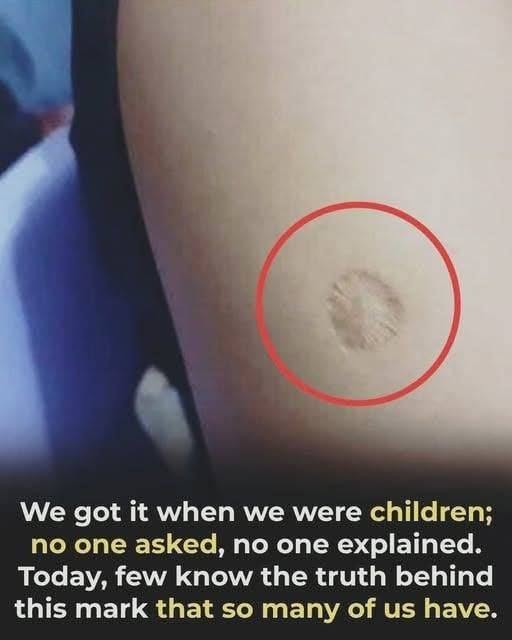
A small, round indentation on my mother’s upper arm.
It wasn’t large. It wasn’t dramatic. It was simply there—a permanent part of her skin, as familiar as a freckle or a birthmark.
I saw it almost every day growing up, yet I never thought to ask about it.
Then, years later, a chance encounter with a stranger revealed a remarkable secret hidden in plain sight.
What I discovered connected my mother to millions of people around the world—and to one of humanity’s greatest medical victories.
The Moment I Finally Noticed
The realization happened unexpectedly.
I was standing on a crowded train platform when I noticed the exact same circular mark on the arm of a stranger.
It stopped me in my tracks.
The scar looked identical to my mother’s.
Same size.
Same shape.
Same location.
For a moment, I wondered if it was a coincidence.
But after seeing the mark repeatedly on older adults over the following months, my curiosity grew impossible to ignore.
When I finally asked my mother about it, her answer was simple.
“It’s from the smallpox vaccine.”
At the time, I had no idea how much history was contained in those five words.
A Scar That Defined a Generation
For people born before the early 1970s, this distinctive scar was incredibly common.
In many countries, it was nearly universal.
Today, younger generations often have no idea what it is.
But for decades, that small circular mark served as visible proof that someone had been vaccinated against one of the deadliest diseases humanity has ever faced.
The scar became a silent badge shared by millions.
A reminder of a world very different from our own.
What Was Smallpox?
Before its eradication, smallpox was among the most feared infectious diseases on Earth.
Caused by the variola virus, it spread rapidly through communities and often left devastation in its wake.
Symptoms typically began with:
- High fever
- Severe fatigue
- Headaches
- Body aches
- Chills
Soon afterward, a painful rash would appear.
The rash developed into fluid-filled lesions that covered large areas of the body.
Many survivors were left permanently scarred.
Others lost their eyesight.
Millions never survived the disease at all.
For centuries, smallpox shaped human history, causing widespread fear and altering countless lives.
Families lived with the constant threat of outbreaks.
Entire communities could be transformed almost overnight.
Why Did the Vaccine Leave a Scar?
One of the most fascinating aspects of the smallpox vaccine was how it was administered.
Unlike most modern vaccinations, which are delivered through a quick injection, the smallpox vaccine used a specialized two-pronged needle.
Healthcare workers would make multiple punctures in a small area of skin.
This process intentionally triggered a localized immune response.
Over the following days, a characteristic reaction developed:
- A small bump formed.
- The bump became a blister.
- The blister developed into a scab.
- The scab eventually healed.
When the healing process was complete, many people were left with the familiar circular scar.
Far from being considered a flaw, the mark was viewed as evidence that the vaccination had worked.
It represented protection against a disease that once terrified the world.
A Tiny Scar with a Massive Meaning
What makes this scar so remarkable isn’t its appearance.
It’s what it represents.
Every smallpox vaccination scar tells a story of prevention, science, and collective action.
Each mark symbolizes a period when communities around the globe united around a common goal: stopping a deadly disease.
The scar served as a visible reminder that someone had received protection not only for themselves but also for the people around them.
In many ways, it became a symbol of public health success.
The Greatest Victory in Medical History
The story of smallpox has an ending unlike almost any other disease.
After decades of international vaccination campaigns, health organizations and governments worked together to track outbreaks and vaccinate vulnerable populations.
The effort required extraordinary coordination.
Doctors.
Nurses.
Scientists.
Volunteers.
Public health workers.
Entire nations participated.
The result was historic.
In 1980, the World Health Organization officially declared that smallpox had been eradicated worldwide.
For the first time in human history, a disease responsible for countless deaths had been completely eliminated through coordinated global effort.
It remains one of the greatest achievements in modern medicine.
Why Younger Generations Rarely Have This Scar
Because smallpox was successfully eradicated, routine vaccination programs eventually ended in many countries.
As a result, people born after vaccination programs were discontinued generally do not carry the distinctive scar.
For many younger adults, the mark has become something of a mystery.
They notice it on parents, grandparents, teachers, or older relatives and wonder where it came from.
What they are seeing is more than a scar.
They are seeing living history.
More Than a Mark on the Skin
When you look at a smallpox vaccination scar today, you’re looking at something far bigger than a medical procedure.
You’re looking at proof of a moment when humanity faced a shared threat and overcame it.
You’re seeing evidence of scientific innovation.
Community cooperation.
Perseverance.
Hope.
The scar reminds us that some of history’s most important stories are not only written in books.
Sometimes they are written directly onto our bodies.
A Lasting Connection Across Generations
Every generation leaves behind traces of its experiences.
Some leave photographs.
Some leave letters.
Some leave monuments.
The generation that lived through the fight against smallpox left something different.
A small circular scar.
A tiny mark that speaks to one of the greatest public health victories ever achieved.
It serves as a reminder of what people can accomplish when they work together toward a common goal.
And for millions of people around the world, that scar remains a quiet but powerful symbol of survival.
Final Thoughts
The next time you notice that small round scar on the arm of a parent, grandparent, friend, or stranger, take a closer look.
What may seem like an ordinary mark is actually a piece of living history.
It’s a reminder of a disease that once terrified the world.
A tribute to the scientists and healthcare workers who fought it.
And a symbol of one of humanity’s greatest triumphs.
That tiny scar tells a remarkable story.
A story of resilience.
A story of science.
A story of survival.
And a story worth remembering.