I spent twenty-two years believing the story my mother had carved out for me: that my father was a heartless man who walked away the moment he discovered she was pregnant. I grew up admiring her strength, watching her balance degrees, careers, and the heavy weight of single parenthood without a single complaint. I thought I knew exactly who I was and where I belonged. But in the middle of my college graduation, under a bright spring sun, a stranger tapped me on the shoulder and uttered a single sentence that turned my entire reality into a mountain of ash.
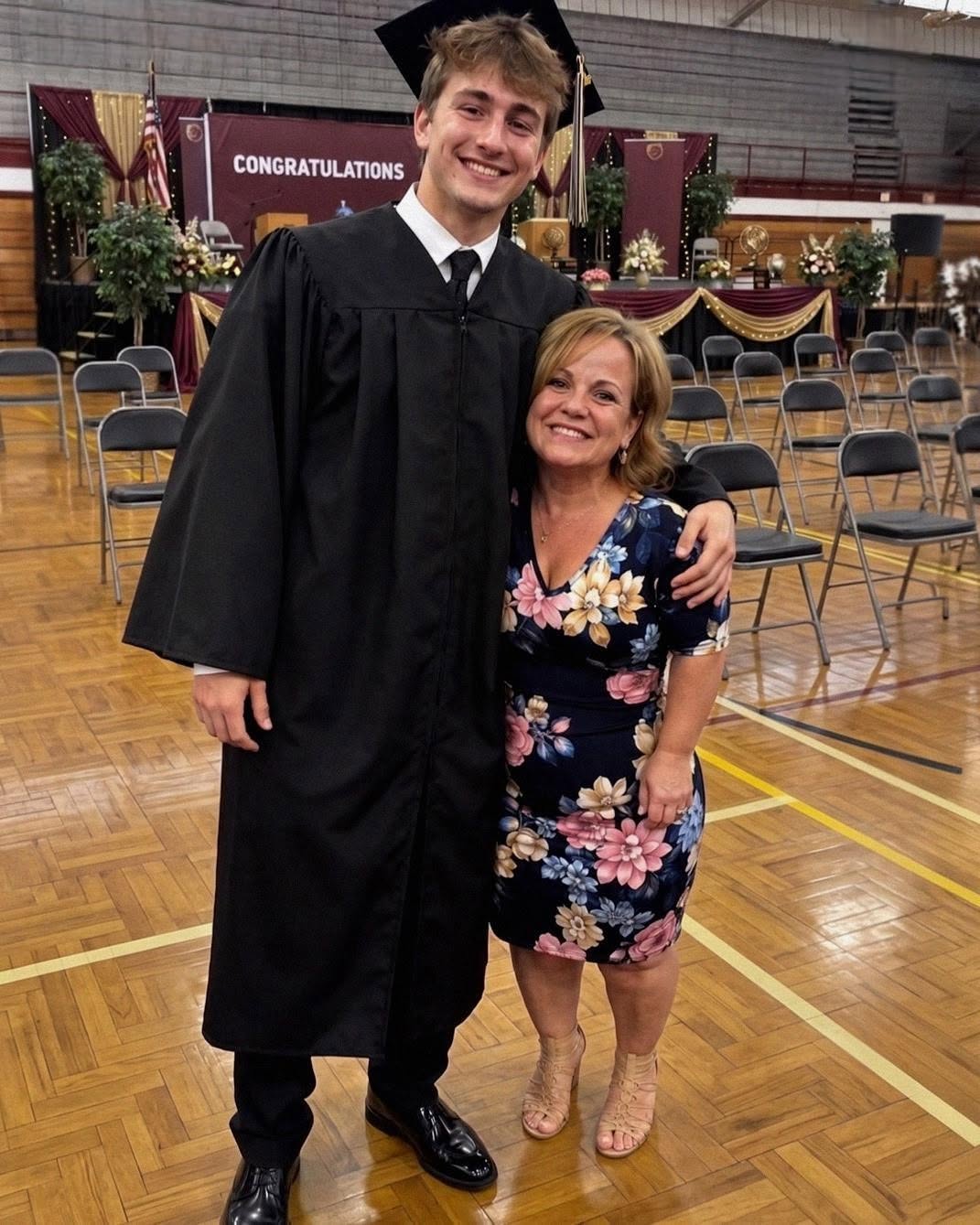
The day was supposed to be the pinnacle of my life—a celebration of hard work, late-night study sessions, and the unbreakable bond I shared with my mother, Laura. She was radiant in her light-blue dress, her eyes brimming with the kind of pride that only comes from witnessing a child overcome the odds. As I stood in the courtyard surrounded by the joyous noise of champagne corks and cheering families, a man I didn’t recognize lingered near a bench, his eyes tracking my every movement. He was well-dressed, in his mid-forties, and wore an expression of intense, painful study. I initially ignored him, assuming he was just another proud parent lost in the crowd.
Then, he approached me. When he spoke my name, my mother’s hand on my shoulder stiffened, her body going cold and rigid. “I’m sorry to interrupt,” he said, his voice thick with emotion, “but I’ve been looking for you for a long time. I’m your biological father.” I laughed—a brittle, confused sound—because the idea seemed ludicrous. My mother had never shed a tear over him; she had never spoken his name with anything other than calm indifference. But as he looked at me, I saw the familiarity in his features, a mirror image of the man staring back from my own reflection.
My mother immediately tried to usher me away, her voice sharp with panic, but the stranger persisted. He told me the story I had been fed—that he had abandoned us—was a calculated, desperate lie. He claimed that he had been told I didn’t exist, that my mother had told him she’d had a miscarriage decades ago. The courtyard felt like it was shrinking. As we moved to a quieter patch of grass, he revealed the truth behind the deception. It wasn’t just my mother’s choice; it was a campaign of fear orchestrated by his own parents. They had pressured my mother, offering money and threats of custody battles, convinced that an unplanned pregnancy would destroy his life.
My mother, young and utterly alone, had believed that if she told him I was alive, his powerful, wealthy family would snatch me away the moment I was born. She had chosen to vanish, to create a life where I was safe from their reach, even if it meant living with the false narrative that I was unwanted. Listening to them speak, I realized that my father’s “abandonment” was actually a tragedy of missing information. He had lived for years thinking he had lost his child, while my mother had lived for years terrified that her child would be taken from her. The man, Mark, had only learned the truth months prior when a mutual friend could no longer bear the secret.
When we returned home that night, the apartment felt like a tomb. My cap and gown, symbols of my academic victory, lay discarded on a chair like shed skin. We sat in the kitchen, the tea in our mugs going cold, until my mother finally broke down. She didn’t offer a hollow excuse; she offered the brutal, terrifying truth of her youth. She told me about the lawyers, the donors, and the people who looked at a twenty-year-old student and saw only a problem to be erased. I looked at her—not as a superhero, but as a traumatized, exhausted woman who had sacrificed everything to keep me safe from a world that wanted to own me.
I realized then that she hadn’t abandoned our family unit; she had protected it in the only way she knew how. She hadn’t lied because she wanted to be cruel; she had lied because she was trying to survive a reality where she was entirely outgunned. The anger I felt toward her evaporated, replaced by a profound, sobering empathy. I reached across the table and took her hand. For the first time, our roles shifted. I was no longer just the kid being cared for; I was a partner who could hold her up through the fallout of her own brave, terrified choices.
I didn’t rush to embrace Mark, nor did I discard my mother’s story. I kept Mark’s card in my wallet, a tangible tether to a piece of my identity that had been missing since the day I was born. We began a slow, deliberate process of getting to know one another—coffee meetings, long phone calls, and the difficult work of reconciling the man he was then with the man he is now. He never once blamed my mother, nor did he try to force his way into the life I had built. He simply stood by, waiting, as I navigated the wreckage of my old life to find the new one.
In the end, I didn’t lose my past; I gained the truth, and with it, a complicated, multifaceted understanding of what it means to love someone. My mother’s secret wasn’t a betrayal; it was a fortress she had built for me out of necessity. I learned that sometimes, the people who raise us are forced to make decisions that haunt them for decades, and that true growth happens when we are brave enough to ask for the truth—even when it threatens to dismantle everything we thought we knew. I may have graduated from college that day, but I truly graduated from the comfort of my own illusions, stepping into a world that was far more messy, far more painful, and infinitely more human.