The art of the double date—or in this case, the triple date—is a delicate social dance that often feels like an unscripted audition for the role of the “perfect partner.” On a crisp evening in April 2026, a group of three close friends and their significant others gathered around a small, candlelit table in a bustling bistro. The air was thick with the scent of roasted garlic and the competitive hum of young romance. For most at the table, the night was a masterclass in performative charm. Two of the friends were effortlessly navigating the conversation, weaving honeyed nicknames and sugar-sweet lines into their dialogue with a practiced ease that made the whole endeavor look like a romantic comedy. They were the “smooth” ones—men who knew exactly when to lean in, when to lower their voices, and exactly which poetic adjectives to use when describing their affection.
But then there was him. While his friends were charming their girlfriends with the fluid grace of seasoned diplomats, he sat in his chair feeling like an imposter in a tuxedo. His heart wasn’t just beating; it was thundering against his ribs, a frantic rhythm that drowned out the ambient jazz playing in the background. He was desperately scanning the landscape of the dinner table for something—anything—clever to say. He felt the weight of expectation pressing down on him. He wanted to be the man who could deliver a line so profound it would make the candlelight dim in comparison. He wanted to match the polished energy of the table, to prove that he, too, belonged in this world of effortless romantic gestures.
The conversation eventually pivoted toward him, as these things inevitably do. The collective gaze of the group shifted, and a silence descended—a pause that dragged on for what felt like an eternity. It was that unbearable, suffocating space where pride and panic collide in the human brain. He could see his friends’ girlfriends watching him, eyes wide with anticipation, waiting for him to contribute to the symphony of sweetness. He looked at his own girlfriend, whose expression was a mixture of patient encouragement and quiet curiosity. He opened his mouth, but the sophisticated metaphor he had been trying to construct vanished into the ether. His brain short-circuited under the pressure of the spotlight.
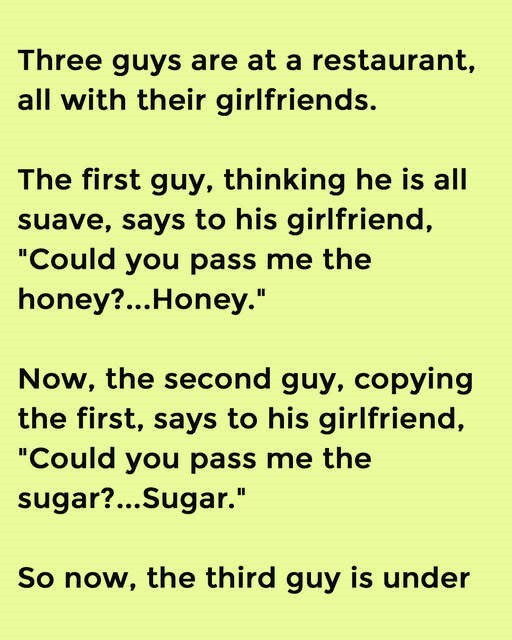
Instead of a sonnet, he blurted out the first thing his eyes landed on: “Could you pass me the… napkin, napkin?”
The words hung in the air, pathetic and repetitive. For a split second, the table froze in a state of pure, unadulterated social shock. The smooth flow of the evening had been interrupted by a request for a piece of disposable paper. The silence was so sharp it could have cut the sourdough. He felt the heat of a flush rising from his collar to his hairline, certain that he had just committed the ultimate romantic blunder. He expected the disappointed sigh, the awkward clearing of throats, or perhaps the sympathetic pat on the arm that signifies a failed attempt at being “one of the guys.”
Then, the unthinkable happened. The whole group exploded. It wasn’t a polite, stifled titter; it was a volcanic eruption of laughter—louder, freer, and more genuine than any sound that had been made all night. The performative tension that had been hovering over the table like a cloud evaporated in an instant. His “napkin” comment had acted as a pressure-release valve for the entire evening. The “smooth” friends stopped trying to be poets and started being humans again. The girls leaned back in their chairs, their laughter echoing off the bistro’s brick walls, finally relaxing into the reality of the moment.
His girlfriend’s reaction was the most telling of all. Her eyes weren’t filled with the disappointment of a woman who had expected a diamond and received a pebble. Instead, they shone with a deep, radiant affection. She didn’t want a scripted monologue or a rehearsed compliment; she wanted him. She reached for the stack of napkins and handed one to him, her fingers lingering against his as she did so. She wasn’t just handing him a tool to wipe his face; she was acknowledging the beauty of his awkward honesty. In her eyes, his failure to be “smooth” was the most romantic thing he had done all evening because it was the only thing that was entirely, undeniably real.
As the night progressed, the dynamic of the triple date shifted entirely. The forced nicknaming ceased, and the conversation turned to real stories, shared jokes, and the kind of comfortable banter that only exists when people stop trying to impress one another. The “napkin incident” became the touchstone of the evening, a shorthand for the fact that they were all allowed to be imperfect. By being the one to “crash through the moment” rather than missing it, he had inadvertently saved the night from the boredom of perfection.
Later, as the group dispersed and the cool night air hit their faces, he walked side-by-side with his girlfriend under the soft, amber glow of the streetlights. The bistro was behind them, but the memory of his blunder still felt fresh. He let out a self-deprecating huff and joked that he’d be ready with a much better, significantly more impressive line next time they went out. He started to apologize for not being as “on his game” as the other guys.
She didn’t let him finish. She stopped walking, turned to face him, and squeezed his hand with a firmness that demanded his full attention. She told him, in no uncertain terms, that she liked him exactly as he was—stammers, napkins, and all. She explained that while the honeyed lines were nice to hear, they often felt like they were meant for someone else, or for an audience. But his request for a napkin? That was just for her. It was a moment of vulnerability that showed he was more concerned with her than with his own ego.
In that quiet, imperfect moment on the sidewalk, the truth finally clicked into place for him. He understood that sincerity beats smoothness every single time. Smoothness is a shield; it’s a way to navigate the world without ever having to show your true face. Sincerity, however, is an invitation. It is the willingness to be seen in all your clumsy, unpolished glory. He realized that the greatest romantic gesture isn’t the one you’ve rehearsed in the mirror; it’s the one that happens when you’re brave enough to fail in front of the person you love. As they continued their walk home, he didn’t feel the need to scan the horizon for clever metaphors anymore. He realized that as long as he was honest, he was already saying everything she needed to hear. The night that started with a panic over a napkin ended with the realization that the most beautiful smiles are the ones shared over the truth.