The bonds of marriage are often described as a sacred commitment to sacrifice, a promise to shield one’s partner from the storms of life. For Rachel, this was not merely a romantic sentiment but a literal, physical reality. When her husband, Nick, was diagnosed with end-stage renal failure, she didn’t hesitate. She didn’t weigh the risks or calculate the cost of living the rest of her life with a single kidney. She saw the man she loved dying, and she offered a piece of herself to save him. She believed that by placing her life on the line, she was cementing a bond that would last forever. She never imagined that the very organ she gave him would be the engine that powered his betrayal.
The surgery was a success, but the recovery was a nightmare. Two days after the transplant, Rachel lay in her hospital bed, her body throbbing with a deep, visceral ache. She was groggy from the anesthesia and the heavy cocktail of painkillers, her side stitched and fragile. Across from her, Nick sat in his own bed, breathing easily with the help of his new kidney. Rachel looked at him with a tired smile, expecting a moment of shared gratitude. Instead, he looked at her with a coldness that froze the blood in her veins.
“You finally fulfilled your purpose,” he said, his voice weak but clear. “Let’s get divorced. The truth is, I can’t stand you. And I never loved you.”
Rachel’s first instinct was to laugh, assuming it was a morphine-induced hallucination or a cruel, misplaced joke. But as Nick continued, his words became a clinical dissection of their fifteen-year marriage. He explained that he had stayed only because it was convenient, and then because he was sick and needed a donor. Now that he was healthy, he was done with the charade. He wasn’t just leaving; he wanted everything—the house, the savings, and most importantly, full custody of their eleven-year-old daughter, Chloe. His argument was as chilling as it was calculated: Rachel would be a recovering invalid, unstable and incapable of providing a home, while he was a “reborn” man with a fresh lease on life.
Returning home was like entering a battlefield where she had already been disarmed. Every step up the stairs felt like a climb toward an execution. While Chloe hovered by her side, a guardian angel in pigtails, Nick remained an emotional ghost, already mentally moved out. The true scale of the treachery revealed itself when Rachel checked their joint accounts. Over $23,000 had been drained in a series of clandestine withdrawals. When confronted, Nick didn’t deny it. He called it “restructuring assets for his future.” He had already retained Daniel, the most formidable divorce attorney in the state, while Rachel was left with no funds and a body that was still struggling to heal.
The legal assault was swift. Rachel was served with papers that painted her as an emotionally volatile woman who had been unhinged by her surgery. The narrative Nick and Daniel crafted was one of a primary provider protecting his child from an unstable mother. Rachel was forced to move in with her sister, broke and broken, clutching Chloe as if the girl were her only anchor in a hurricane. The night before the final custody hearing, Chloe sobbed into her mother’s side, terrified of being handed over to a father she no longer recognized. Rachel promised her daughter that everything would be okay, though, in her heart, she felt the crushing weight of a system that seemed designed to reward Nick’s ruthlessness.
The courtroom the next morning was a sterile arena of polished wood and hushed whispers. Nick sat next to Daniel, radiating the confidence of a man who had already won. As Daniel stood to deliver his opening remarks, he dismantled Rachel’s character with surgical precision. He spoke of “erratic behavior” and “vindictiveness,” successfully objecting to every attempt Rachel made to defend herself. Without an attorney to navigate the labyrinth of legal procedure, Rachel felt herself drowning. The judge seemed to be leaning toward Daniel’s arguments, his nods becoming more frequent as the hearing progressed.
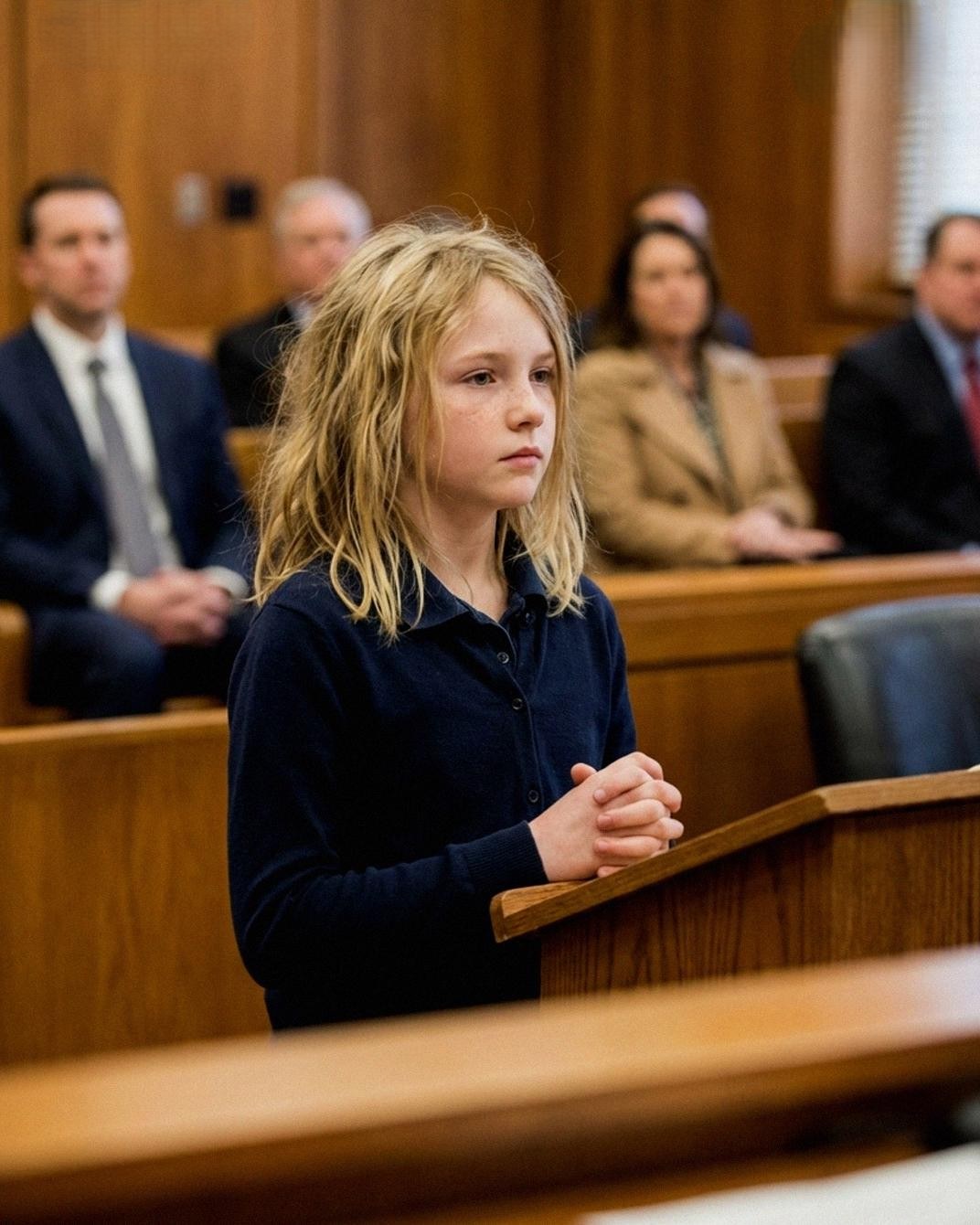
Then, the silence of the room was broken by a small, clear voice. “Your Honor? May I say something?”
Chloe stood from the gallery, her hands trembling as she clutched a tablet with a cracked screen. Despite the objections from Daniel, the judge, moved by the child’s earnestness, allowed her to approach. Chloe explained that she had been practicing recording videos for a school project weeks before the surgery and had accidentally captured something she wasn’t supposed to. As the bailiff connected the tablet to the courtroom monitors, the atmosphere shifted from tension to absolute stillness.
A video flickered to life. The date stamp confirmed it was recorded two weeks before the transplant. The footage showed the back of Nick’s head as he sat in their living room, speaking to a woman over a video call. His voice, stripped of the “heroic patient” facade, was jagged with malice.
“Once the transplant’s done, I’ll finally be free,” Nick’s recorded voice echoed through the chamber. “I’ve already moved the assets. The custody strategy is in place. She won’t see it coming. I’ll leave her with nothing.”
The courtroom gasped as the recording continued, revealing that Nick had essentially treated his wife as a biological warehouse, a resource to be harvested before being discarded. The most damning moment came when a young Chloe was heard in the background. Nick realized she was there, ended the call, and told her it was “adult stuff.” He then explicitly bribed his daughter, promising her a brand-new tablet if she kept his secret.
The video ended, and the silence that followed was deafening. Nick leaped to his feet, shouting about “edited files” and “context,” but the damage was irreversible. The judge’s face had hardened into a mask of judicial fury. He didn’t need forensic verification to see the truth written in Nick’s panicked eyes. In a matter of minutes, the tide turned. The judge granted Rachel immediate temporary full custody and ordered a forensic audit of every cent Nick had moved. The “unstable” mother was suddenly the victim of a calculated conspiracy.
Outside the courtroom, the confrontation reached its final, poetic conclusion. Nick, still arrogant despite his crumbling world, attempted to intimidate Rachel one last time, admitting aloud in the hallway that he had used her because she was “trusting and desperate for a family.” He didn’t notice that his own lawyer, Daniel, was standing right behind him.
“I can’t represent you anymore,” Daniel said, his voice dripping with professional disgust. He realized that Nick hadn’t just lied to his wife; he had lied to his counsel and attempted to weaponize the court through fraud. In a final act of redemption, Daniel handed Rachel a business card for a colleague who handled pro bono cases for victims of domestic and financial abuse. “Call them,” he said. “They’ll finish what was started today.”
Rachel stood in the hallway, the physical ache in her side finally beginning to fade, replaced by a surge of genuine strength. She looked at her daughter, the girl who had carried a burden far too heavy for her years to save her mother. Rachel had given a kidney to save a life, but it was her daughter’s courage that had saved their future. As they walked toward the exit together, Rachel realized that while she was missing an organ, she had found a reservoir of resilience she never knew existed. She wasn’t leaving with “nothing”; she was leaving with the only things that ever truly mattered: her daughter, her truth, and her freedom.