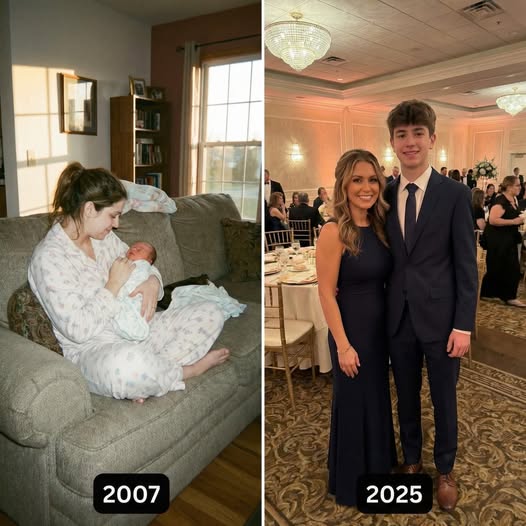
The trajectory of a human life is often determined not by the grand ambitions we hold in our youth, but by the quiet, sudden redirections that demand we set those ambitions aside. My mother was barely eighteen when my arrival rewrote the script of her existence. While her peers were obsessing over senior portraits, university applications, and the exhilarating uncertainty of the open road, she was stepping into the heavy, rhythmic cadence of maternal responsibility. My biological father had vanished into the ether long before my first breath, leaving her to navigate the transition into adulthood in a state of profound isolation.
She was a woman of few words regarding the things she had surrendered. She didn’t dwell on the dances she missed or the college semesters that were traded for double shifts. Instead, she labored in silence. I have vivid childhood memories of the kitchen table—not as a place for family dinners, but as a workstation where she pored over GED study guides late into the night, the soft glow of a desk lamp illuminating a face that was far too young for the exhaustion it carried. Piece by piece, she constructed a stable world for me out of the raw materials of sacrifice and grit. As I grew older, I began to realize that the comfort of my life was built upon a foundation of silent concessions she never once announced.
By the time my own senior year of high school arrived, the weight of her history sat with me more clearly than ever. I was experiencing all the milestones that define the transition into adulthood—milestones she had bypassed out of necessity. One evening, as we sat in the familiar quiet of our kitchen, a thought occurred to me with startling clarity. Prom was approaching, an event many of my classmates viewed as a trivial rite of passage, yet for my mother, it represented a specific door that had been slammed shut by the reality of my birth. Without overthinking the social implications, I looked at her and asked if she would be my date.
At first, she laughed, a quick, nervous sound that suggested she thought I was playing a joke. But as the silence stretched and she saw the sincerity in my eyes, the laughter died away, replaced by a look of quiet disbelief. She hesitated, her hands smoothing the tablecloth as she wrestled with the invitation. It wasn’t that she didn’t want to go; it was that she had spent nearly two decades conditioning herself to believe that certain experiences simply belonged to a different version of her life—a version that no longer existed.
The social friction began almost immediately within our own home. My stepsister, Brianna, viewed the proposal through the narrow, judgmental lens of high school hierarchy. To her, the idea was “weird” and “cringe-worthy.” She worried aloud that people would mock us, that the story would become a punchline, and that her own social standing might be collateral damage. Her stinging words created a momentary shadow, but they ultimately served to strengthen my resolve. The purpose of the invitation was far more significant than the opinions of teenagers who had never known the weight of a sacrifice. This wasn’t about social optics; it was about restitution.
When the night of the prom finally arrived, the house felt charged with an unusual energy. When my mother finally stepped out of her bedroom, the transformation was breathtaking. She was wearing a dress of soft, shimmering blue silk—a color that seemed to pull the light toward her. For a moment, the years of hard labor, the late-night studying, and the weary lines of responsibility seemed to dissolve. She looked less like the woman who had carried the world on her shoulders and more like the seventeen-year-old girl who had been interrupted so many years ago.
However, the world is rarely kind to those who step outside of conventional boundaries. As we arrived at the school courtyard, the atmosphere grew tense. Brianna was there with a circle of friends, and as we approached, the sound of sharp, performative laughter cut through the evening air. She made a pointed joke, clearly intended to diminish my mother and turn our presence into a spectacle for her peers. I felt my mother’s hand tighten on my arm, the old habit of retreating into the background beginning to take hold.
Before the moment could sour into a lasting memory of shame, my stepfather, Mike, stepped forward. Mike was a man of steady temperament, but there was a newfound iron in his voice as he addressed the group. He didn’t shout or resort to insults; he simply re-centered the truth. He reminded everyone standing there that the woman they were attempting to ridicule had spent her youth doing what most of them couldn’t imagine—raising a child alone, working multiple jobs, and refusing to let a difficult life harden her heart into something brittle. He spoke of the dignity in her labor and the beauty in her resilience. His words didn’t just silence the laughter; they drained the power from it. The crowd dispersed, and the balance of the evening was restored.
Inside the ballroom, the night unfolded with a gentleness I hadn’t expected. We didn’t hide in the corners. We danced to songs that spanned generations, took photographs that captured a joy long postponed, and shared a space that had once felt inaccessible to her. What had begun as an unusual social experiment slowly evolved into something the rest of the room seemed to instinctively respect. It was a visible, living act of gratitude. My classmates, initially confused, began to see not a “mom at prom,” but a woman being honored for a debt that could never truly be repaid.
The drive home was quiet, the city lights blurring past the windows as the adrenaline of the evening began to fade. The music had ended, but the air in the car felt lighter than it had in years. My mother reached across the center console and squeezed my hand, her voice barely a whisper in the dark. She confessed that she had buried the dream of a night like this so deep she had forgotten where she put it. She had convinced herself that she didn’t need it, that it didn’t matter, but having it realized had mended something she hadn’t known was broken.
That moment taught me a vital lesson about the nature of time and the milestones we miss. Some doors stay locked for a lifetime, but others are simply waiting for someone with enough love to turn the key. We often think of the past as a fixed, unchangeable terrain, but acts of intentional kindness can reach back and offer a sense of peace to the younger, struggling versions of the people we love.
My mother’s blue silk dress now hangs in the back of her closet, a quiet trophy of a rite of passage reclaimed. The past hasn’t disappeared—her years of struggle are still a part of her story—but that struggle no longer defines her entire narrative. It has found a gentler place to rest, tucked away behind the memory of a dance floor, a soft blue dress, and a son who decided that it’s never too late to give back a piece of the youth that was given up for him.