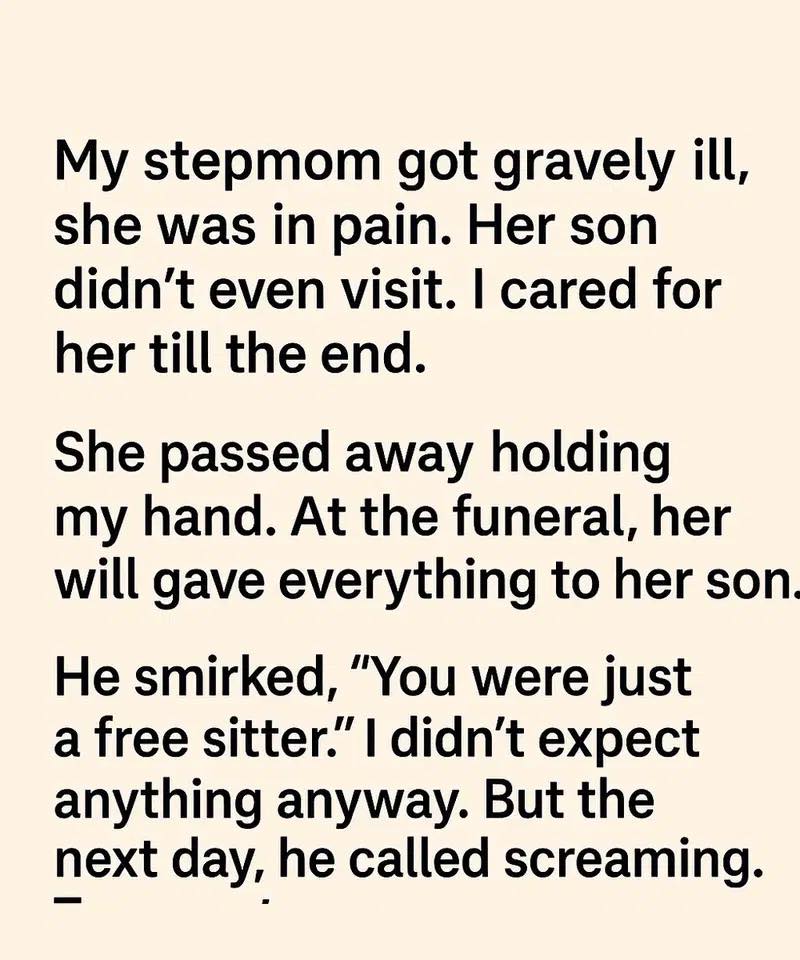
The morning following a funeral possesses a unique, heavy silence—a stillness so profound that it seems to soften the very texture of the world. Voices lose their edge, footsteps become muffled, and the relentless rhythm of time seems to falter, as if the universe itself is holding its breath in the wake of a departure. I had expected the days ahead to be defined by a slow, predictable descent back into routine, the kind of hollow normalcy that serves as a protective shell for the grieving. I anticipated the quiet work of sorting through memories and the gradual fading of the sharpest pains. I did not expect the phone to ring with the sound of a legacy being dismantled in real time.
When her son called, the silence was shattered. His voice was a jagged mixture of confusion and burgeoning anger, vibrating with the kind of energy that only comes from a sudden, unwelcome revelation. He had been performing the grim, necessary task of clearing out his mother’s estate—sorting through the artifacts of a life lived—when he stumbled upon a box that didn’t fit the narrative he had constructed for her. Inside, hidden away like a secret too heavy to carry, was a letter. It wasn’t addressed to him, his siblings, or any member of the bloodline. It was addressed to me.
His questions came in a frantic, tangled torrent. He wanted to know why his mother, a woman he thought he knew completely, would spend her final, precious energy writing to someone outside the family circle. He wanted to know what it meant, what was hidden in the ink, and if this single piece of paper had the power to rewrite the history of their relationship. I listened, my own heart hammering against my ribs, as he described the contents of the envelope. As he spoke, the picture of her final months—months I had shared with her in the quiet periphery of her family’s life—began to emerge in vivid, heartbreaking detail.
The letter was a testament to the “small things” that often go unrecorded in official histories. She had written with a gentle, steady gratitude, thanking me for the acts of care that her family, caught in their own lives and their own frictions, had been unable to provide. She spoke of the long afternoons when the house felt cavernously quiet, and I had simply sat with her, offering a presence that didn’t demand she “get better” or “be strong.” She thanked me for listening when the physical pain made her restless and for the calm, level tone of my voice when the encroaching fear of the end threatened to pull her under.
Perhaps most poignantly, she admitted in the letter that she had felt paralyzed by the dynamics of her own family. She confessed that she could not bring herself to alter her will or change her legal legacy without triggering a firestorm of conflict among her children. She chose instead to leave me her words, wanting me to know that my patience and kindness had meant more to her than any material asset she could have possibly bequeathed. It was a private validation, a quiet “thank you” from a woman who felt she had run out of time to be brave in public.
However, it wasn’t just the letter that had unsettled her son. It was what lay beneath it in that dusty box—a collection of remnants that spoke of a life lived in the shadow of “almost.” There were old receipts for items never purchased, scattered notes on legal pads, and a series of photographs from a decade they had spent largely apart. Most significantly, there were draft documents for a small trust she had once intended to set up for him—a gesture of financial repair for the years of emotional distance. These were the blueprints of a bridge she had never finished building, the evidence of intentions that had remained unspoken and unfulfilled.
He hadn’t known she had even tried to close the gap between them. To him, the distance had been a fixed point, a permanent feature of their landscape. Seeing those unfinished plans was like seeing a ghost of a different life—one where they had reconciled, where the words “I’m sorry” and “I love you” hadn’t been choked back by pride or fear. The papers spoke of a regret she had carried silently, a desire for repair that she had been too intimidated to execute.
I spoke to him gently, trying to navigate the minefield of his grief. I explained that the letter was never intended as a betrayal or a slight against his position as her son. It was simply her safe haven. For her, writing to me was a way of expressing the vulnerability she felt she couldn’t show to her own children without reopening old wounds or sparking new arguments. The letter wasn’t a replacement for her love for him; it was a symptom of the complexity of that love—a love so burdened by history that it had become difficult to express directly.
As the hours passed and we talked through the echoes of her life, the sharpness in his voice began to fade. The anger was replaced by a somber, reflective kind of wonder. He began to see that what she had left behind was far more significant than wealth, property, or a clearly defined inheritance. She had left a profound reminder of the velocity of life. She had left a warning that time moves with a deceptive speed, and that the “perfect moment” to say what needs to be said often never arrives.
We realized that legacies are not always written in leather-bound wills or recorded in courthouse basements. Some of the most enduring legacies are written in the margins of daily life—in the moments of patience, the quiet acts of listening, and even in the regrets of the things we failed to do. Her letter was her final, desperate attempt to build that bridge she had struggled to cross while she was alive. It was a gift of truth, offered posthumously to help her son understand that she had never stopped trying to find her way back to him, even if she had to use a stranger’s letter as her map.
In the end, the day after the funeral taught us both a difficult lesson. Kindness leaves a deeper mark on the soul than money ever could, and love that remains unspoken does not disappear; it simply becomes a quiet burden that the living must learn to carry. As I hung up the phone, the silence of the morning returned, but it felt different—less like a vacuum and more like a space where words finally had the room they needed to settle. She had left us with the hope that, even when the clock has run out, the truth can still find a way to be told.