The silence of my home had always been a comfort, but after Calvin’s funeral, it felt like a predator. At eighty-one, I had learned the rhythm of loss. First, it was the screech of tires that took my husband Walter and my daughter Eileen on the same gray afternoon. Then, it was the sudden, silent collapse of a seventeen-year-old boy on a basketball court. Calvin was my last anchor to a world that felt increasingly unfamiliar. He was the boy who would burst through my screen door every Sunday at noon, his presence a whirlwind of motion, laughter, and an appetite that never seemed satisfied.
I returned from the funeral in a daze, the smell of church lilies still clinging to my coat. I expected to find my small house exactly as I’d left it—cold and stagnant. Instead, as I dragged my suitcase up the walkway, I saw the splintered wood of the doorframe. My heart hammered against my ribs like a trapped bird. Someone had tried to force their way in while I was burying the only reason I had left to wake up in the morning.
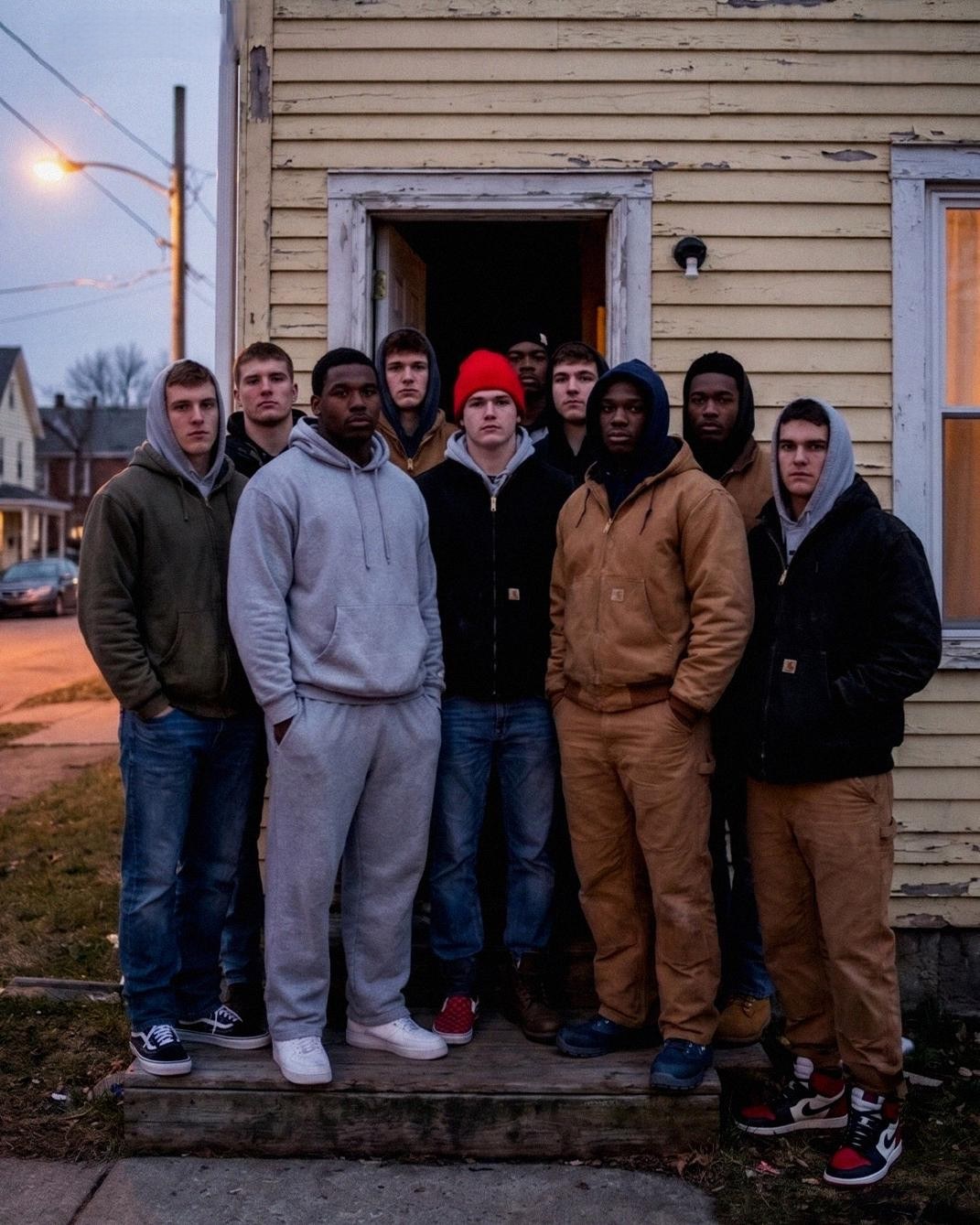
I pushed the door open, ready to scream or flee, but the air inside didn’t smell like fear. It smelled of sautéed garlic, slow-roasted beef, and floor wax. I stepped into the living room and froze. There were ten of them. Boys I didn’t know, with skin tones and styles that the neighborhood watch usually whispered about with suspicion. They were scattered across my home like a chaotic renovation crew. One was perched on a ladder painting over a water stain; another was on his knees with a scrub brush. Two more were hauling heavy grocery bags into my kitchen.
My voice came out as a sharp rasp. What are you doing in my house?
A tall, broad-shouldered boy named Andre turned around, a paintbrush frozen in mid-air. He looked at me with eyes that had seen far too much for someone his age. He explained that the door had been tampered with before they arrived. They hadn’t broken in to steal; they had broken in to protect.
Calvin gave me your address months ago, Andre said, his voice dropping an octave. He told me that if anything ever happened to him, I had to come here. He made me write it down. I thought he was just being dramatic, but he was dead serious about you, Ma’am.
The realization hit me harder than the grief had. Calvin had known. Not that he was going to die, but that he lived a life where safety was a luxury and I was his most precious, vulnerable asset. As the boys continued their work, the story of my grandson’s secret life began to unfold. I knew him as the boy who fixed my hinges and ate my peach pie. These boys knew him as the one who brought groceries when their mothers were sick, the one who tutored them in algebra on the hood of a car, and the one who stood between them and the gangs that prowled the local courts.
The house wasn’t being fixed by professionals. The paint lines were wobbly, and the fabric they had tacked onto Walter’s old armchair was slightly crooked. But as I looked at their sweat-streaked faces, I realized that this was the most beautiful my home had ever looked. It looked loved. It looked like a living testament to a boy who refused to let anyone sit alone.
That afternoon turned into a Sunday tradition that saved my life. I started cooking again—not the small, lonely portions of a widow, but massive pots of chili, mountains of mashed potatoes, and dozens of biscuits. I learned their names and their burdens. Mateo, who had a genius for plumbing but no father to show him how to use a wrench. Rico, whose temper was a shield for a heart that had been broken by the foster system. Dev, the youngest, who ate my cooking with a desperation that suggested he hadn’t had a hot meal in days.
The neighborhood saw them as a threat. They saw the hoodies and the loud laughter on my porch and assumed the worst. But inside those four walls, they were just boys. They followed my rules: no swearing, shoes off at the door, and no one leaves until they’ve had seconds. They became the grandsons Calvin left behind for me to finish raising.
The true test of our makeshift family came on a rainy Tuesday night in November. A frantic pounding on the door woke me at eleven. I opened it to find Andre and Jamal supporting a bleeding Dev between them. He had been jumped by a group he was trying to distance himself from. The air in my living room instantly turned toxic with the scent of blood and the heat of pure, unadulterated rage.
Rico was already heading for the door, his jaw set in a way that signaled a point of no return. Andre was reaching for his car keys, his eyes flat and dangerous. They weren’t looking for justice; they were looking for revenge.
I didn’t think. I simply planted my eighty-one-year-old body in front of the door and didn’t move. I told them that if they walked out that door to shed more blood, they were spitting on Calvin’s memory. I told them that I had already buried everyone I ever loved and that I refused to stand on another curb and watch a black car carry one of them away.
Andre tried to tell me to move, calling me Nana for the first time. I told him no. I told him that calling an ambulance was an act of courage, and staying alive was an act of rebellion. I looked them in the eyes and called them what they were: children. My children.
The tension snapped like a dry twig. Andre dropped his keys. Mateo called for help. We chose the hard path of peace instead of the easy path of violence.
Now, my Sundays are loud again. The house is filled with the sound of arguments over basketball and the scraping of forks against plates. Sometimes, when the screen door creaks, I still expect to see Calvin’s lanky frame standing there. The grief hasn’t gone away, but it has changed shape. It’s no longer a hollow pit; it’s the foundation for a table that keeps getting longer.
Last Sunday, Dev looked up from a plate of chicken and asked if I made the food for everyone or just the people I loved. I looked around at the ten boys who had become my guardians, my handymen, and my heart. I told him it was the same thing. I thought I had lost everything, but it turns out my grandson was just expanding the family. In the end, we weren’t just fixing a broken house; we were fixing each other.