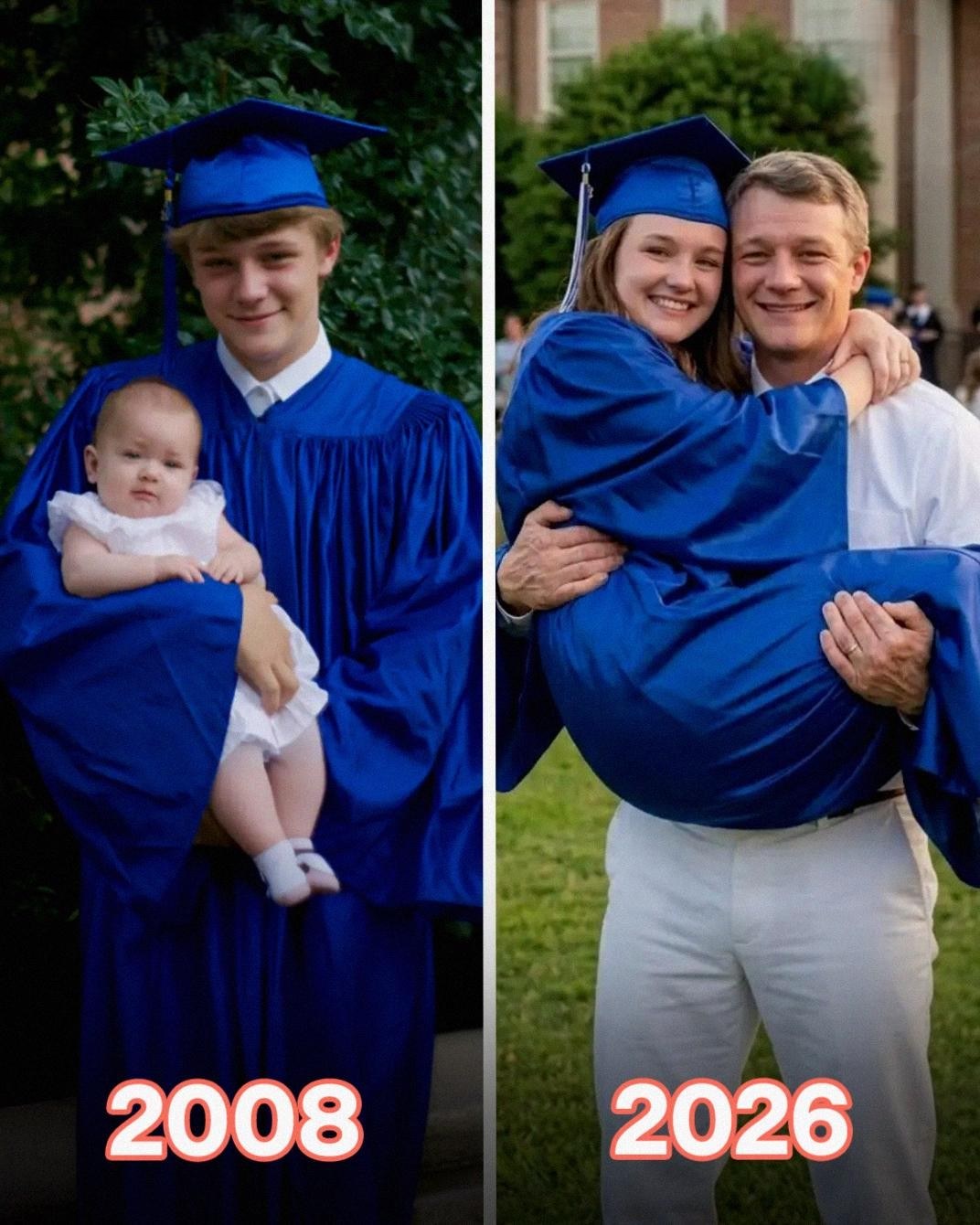
The center of our home is anchored by a single photograph hanging directly above the living room couch. The glass is marred by a thin, spiderweb crack in the corner—the result of a stray foam soccer ball and an eight-year-old’s overenthusiastic kick. When it happened, my dad didn’t get angry. He simply stared at the frame for a long moment and whispered, “Well, I survived that day. I can survive this.” In the image, a lanky teenage boy stands on a high school football field, his graduation cap sitting crookedly atop his head. He looks utterly terrified, his eyes wide with a mixture of shock and fierce determination. Clutched in his arms is a tiny bundle wrapped in a fleece blanket. That bundle was me.
For years, I teased him about his expression in that photo. I told him he looked like he was holding a live explosive, afraid that a single wrong breath might cause me to shatter. He would always give a characteristic shrug to dodge the emotional weight of the memory and reply, “I wasn’t going to drop you. I was just convinced I was going to break you. But apparently, I did okay.”
“Okay” was an understatement. He did everything. My dad was only seventeen the night I entered his life. He had returned home from an exhausting shift delivering pizzas to find his old bicycle leaning against the fence. In the front basket, tucked inside a series of blankets, was a three-month-old baby girl. He initially thought someone had left a bag of laundry or trash, but then the bundle moved. Under the folds was a note that would reorder his entire universe: She’s yours. I can’t do this. His mother had passed away, his father was long gone, and his uncle was a man of few words and less affection. He was just a kid with a rusty bike and a part-time job. Most teenagers in that position would have called the police or social services, surrendering the burden to the state. Instead, he wrapped me tighter, adjusted his graduation gown, and walked onto that football field the next morning to receive his diploma with his daughter in his arms. That was the day the picture was taken, and that was the day he chose to never put me down.
He traded a college education for construction sites and pizza routes. He learned to braid hair from poorly produced YouTube tutorials because he couldn’t stand the thought of me being teased for a messy ponytail. He burned countless grilled cheese sandwiches, but he never let me feel the coldness of being a child whose mother had vanished. So, when my own graduation day arrived eighteen years later, it felt like the ultimate victory lap for both of us. We walked onto that same football field together, his jaw tight as he fought back “emotional pollen” and pretended he wasn’t on the verge of tears.
The ceremony was just beginning when the equilibrium of my life was shattered. A woman stood up from the crowd, but she didn’t wave or take a photo. She walked toward us with a predatory focus, her eyes searching my face as if looking for a reflection of herself. When she spoke, her voice trembled with a strange, high-pitched intensity that silenced the surrounding rows. “Before you celebrate today,” she announced, “there’s something you need to know about the man you call ‘father.’”
I felt the air leave the stadium. My dad’s face went pale—a look of sheer, bone-deep terror I had never seen before. The woman pointed a trembling finger at him and declared, “That man is not your father. He stole you from me.”
The accusation rippled through the stands like a physical wave. My mind struggled to process the words; it felt like being told the earth was hollow. I grabbed my dad’s wrist, looking for a denial, but he remained silent, his head bowed. The woman, who identified herself as Liza, claimed he had lied to me my entire life. She reached for my hand, asserting that I “belonged” to her. Instinctively, I recoiled, and my dad stepped forward, his arm forming a solid barrier between us.
“You’re not taking her anywhere,” he said, his voice regaining its strength. Finally, he looked at me, his eyes filled with a devastating honesty. “I never stole you, but she is right about one thing. I’m not your biological father.”
The truth came out in a jagged rush. Liza had lived next door to him eighteen years ago. She had been struggling, and her boyfriend wanted nothing to do with a child. She had asked my dad to watch me for one night so she could talk things over with the father. She never returned. My dad, a seventeen-year-old boy with no legal standing and a heart full of compassion, simply kept me. He assumed she had run off. He didn’t tell me the truth as I grew older because he wanted me to feel like I was a child who was chosen and wanted, not a secret to be managed.
Liza cried out, claiming she had tried to return, but an older teacher from the school stepped down from the stands to provide the missing piece of history. She remembered them both; she remembered Liza disappearing that summer with her boyfriend, and she remembered the boy who stayed behind to raise a baby that wasn’t his.
The shape of the story shifted instantly. I looked at the man who had braided my hair, attended every parent-teacher conference, and worked double shifts to buy my first car. “In my heart, you were mine the moment I carried you through that graduation,” he whispered.
Liza’s desperation soon took on a darker, more transactional tone. She wasn’t there out of a sudden burst of maternal guilt. She revealed that she was suffering from leukemia and needed a bone marrow transplant. I was her last hope for a match. The crowd, which had been murmuring in confusion, fell into a stony silence. The realization that she had returned not to be a mother, but to ask for a life-saving sacrifice, felt like a final betrayal.
My dad didn’t tell me what to do. He placed a steady hand on my shoulder and told me I owed her nothing, but that he would support whatever choice I made. In that moment, I realized that every value I possessed—my sense of duty, my compassion, and my integrity—had been gifted to me by him. I turned to Liza and told her I would get tested. Not because she was my mother, but because the man who raised me had taught me to do the right thing, even when the person asking didn’t deserve it.
The principal, who had watched the entire drama unfold, stepped onto the field. He declared that there was only one person who deserved to walk me across the stage to receive my diploma. The stadium erupted in applause as I slipped my arm through my dad’s. We walked toward the stage, retracing the steps he had taken eighteen years prior.
Biology provides the blueprints of a life, but it doesn’t build the home. A parent is the person who stays when the cost of staying is everything you have. As we walked together, the crack in the glass of that old photo didn’t seem to matter anymore. The image was whole, and so was I.
I can help you draft a letter of gratitude for a mentor or parental figure, or provide tips on how to organize a family archives project to preserve your own.