There’s a quiet fear many carry but rarely voice:
What if I reach old age and realize I never truly lived?
Not “lived” in the sense of wealth or fame—but with integrity, meaning, and inner peace.
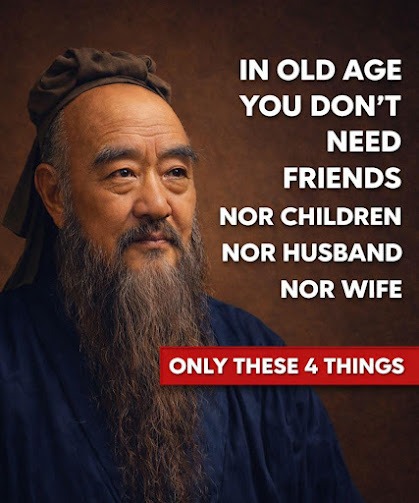
Over 2,500 years ago, Confucius addressed this very anxiety—not with promises of eternal youth, but with a profound truth:
Old age is not a decline. It is a mirror.
It reflects the choices we’ve made, the values we’ve honored, and the relationships we’ve nurtured.
From his teachings emerge four timeless principles to build a life that ages not with regret, but with grace.
1. Personal Dignity: The Unshakable Core
“The noble person is firm in self-respect, yet gentle in conduct.”
Confucius taught that true dignity isn’t about status—it’s about never betraying your conscience.
Saying “no” when your soul says “no”
Choosing honesty over convenience
Standing by your word, even when it costs you
Those who live this way grow old without the weight of hidden shame. Their silence isn’t emptiness—it’s the calm of a clear conscience.
Ask yourself: Can I look back on my choices and still respect the person I was?
2. Lifelong Learning: The Mind That Never Retires
“Learning without thought is labor lost; thought without learning is perilous.”
For Confucius, wisdom wasn’t static—it was cultivated daily.
Reading, reflecting, asking questions
Staying curious about people, ideas, and the world
Embracing humility: “When I walk along with two others, they may serve me as my teachers.”
An aging mind that keeps learning stays light, engaged, and resilient—not burdened by irrelevance.
Practice: Dedicate 15 minutes a day to learning something new—even at 80.
3. Right Relationships: The Web of Belonging
“Do not impose on others what you yourself do not desire.” (The Golden Rule)
Confucius believed we become whole through harmonious relationships—with family, friends, and community.
Listening more than speaking
Repairing ruptures with humility
Offering kindness without expecting return
In old age, these bonds become your shelter. Not because they fix loneliness, but because they remind you: You mattered to someone
Nurture: One relationship this week with patience and presence.
4. Purposeful Action: Living by Your Values
“The superior person acts before he speaks, and afterwards speaks according to his action.”
A life well-lived isn’t measured in achievements, but in alignment.
Doing work that feels meaningful—even if small
Acting with compassion, not just intention
Leaving things better than you found them
When your actions reflect your values, old age becomes a harvest, not a reckoning.
Reflect: Does my daily life reflect what I say I believe?
Confucius didn’t promise an easy life—or a painless old age.
He offered something deeper: a path to inner stability that time cannot erode.
Because when you live with dignity, curiosity, connection, and purpose,
you don’t just grow older.
You grow whole.
“The wise find joy in water; the virtuous find joy in mountains. The wise are active; the virtuous are tranquil. The wise are joyful; the virtuous are long-lived.”
— Confucius, Analects
Which of these principles resonates most with you? How are you building a life you’ll be proud to look back on? Share your reflection below—we’re all walking this path together.