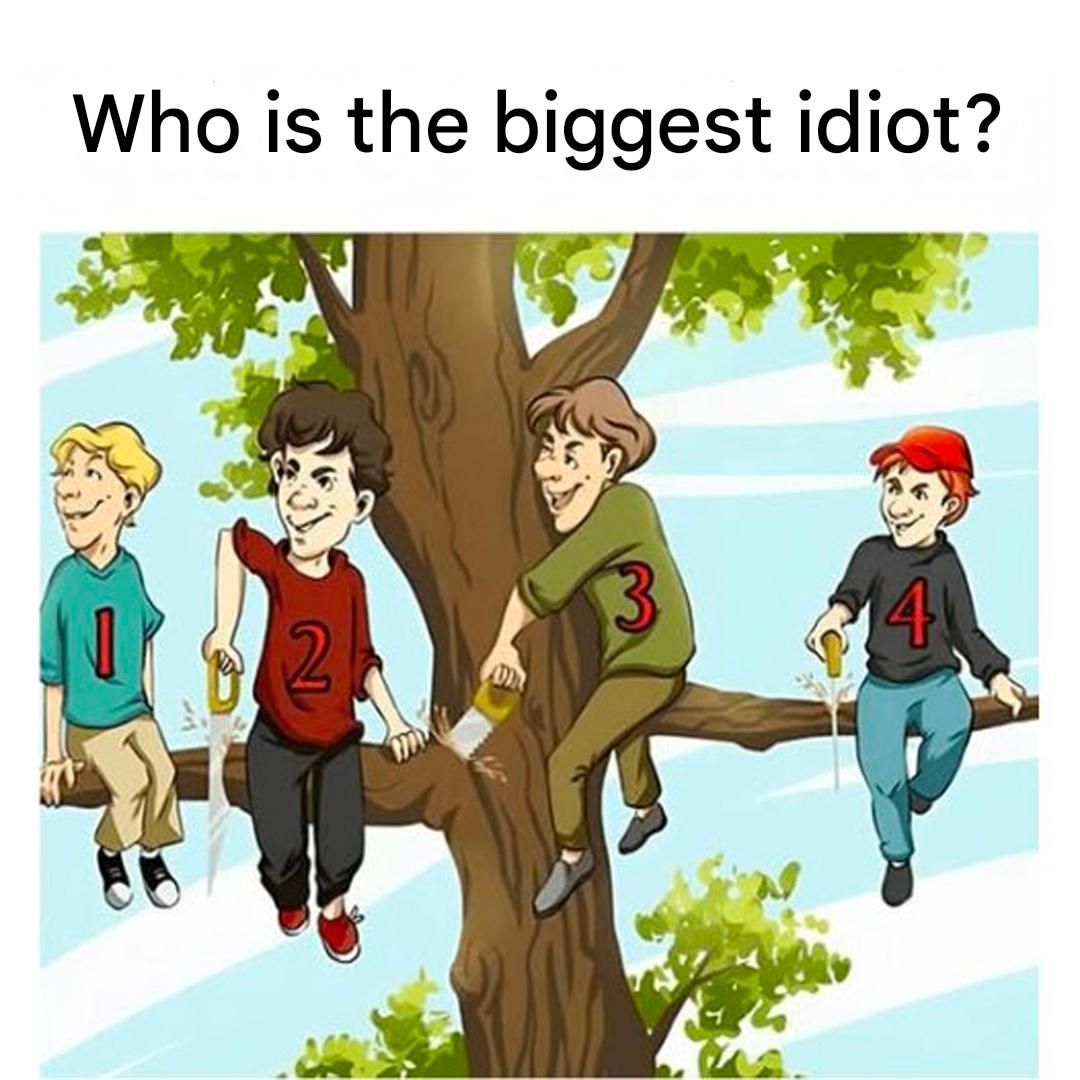
A simple, almost childlike image, and yet… it’s making thousands of internet users think. It shows four people sitting on the same tree branch, each holding a saw. They all seem ready to cut wood under someone else. So, in your opinion: who is making the biggest mistake? The instinctive answer often reveals more about you than you might think. Before analyzing, visualize the scene. Four individuals lined up on a branch, each focused on their own action. The situation seems almost absurd… and yet, this image acts as a mirror to our relational dynamics.
Number 1: Is blind trust a mistake?
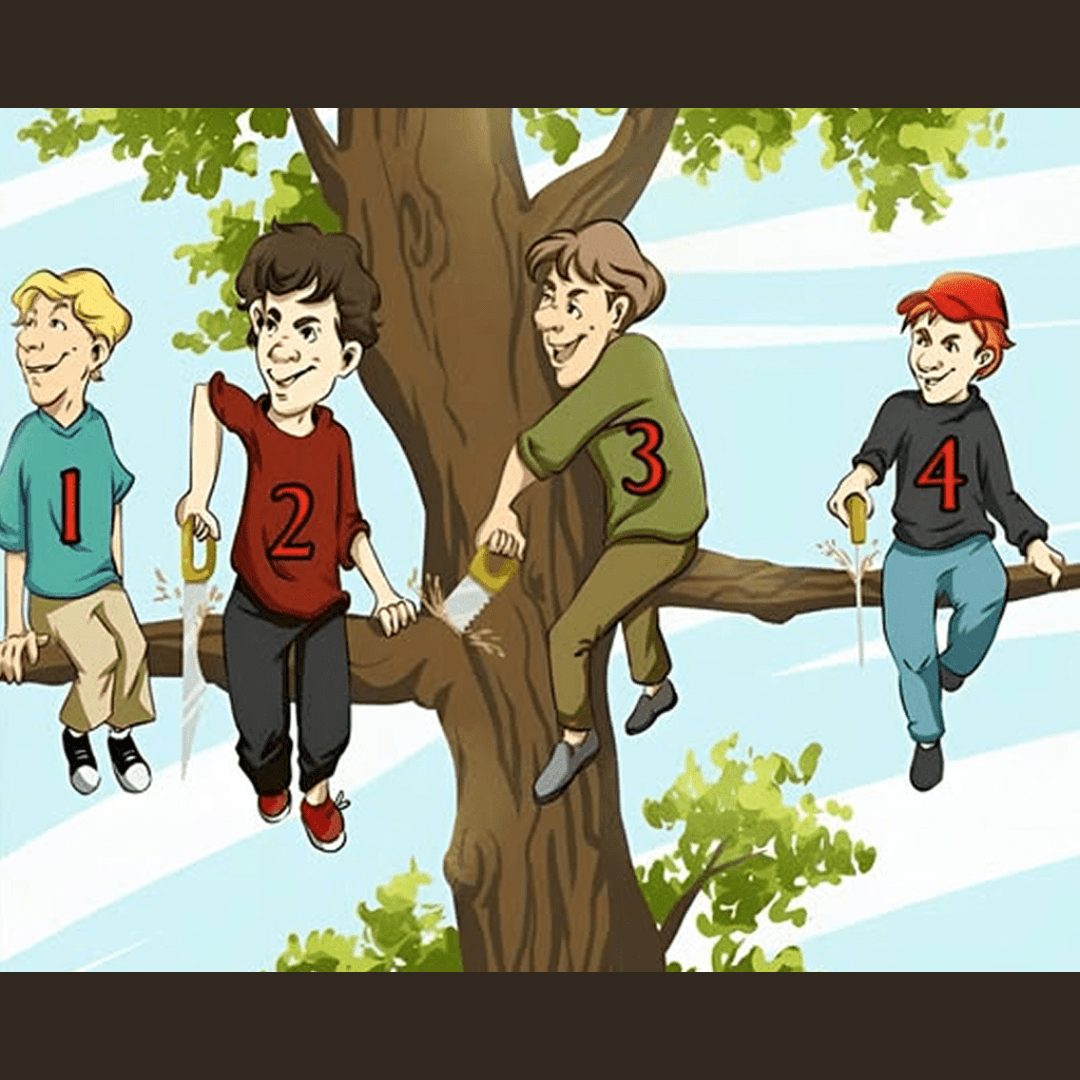
At the very end of the branch, character 1 stares straight ahead. He seems calm and serene. Behind him, however, someone is sawing the wood that supports him. Many immediately declare: “He’s the one making the biggest mistake!”
Why? Because he trusts. He doesn’t suspect the danger and moves forward without looking back.
But is it really a mistake? Trust is the foundation of any healthy relationship. Certainly, excessive naivety can lead to disappointment, but living in constant mistrust would be far more exhausting. Character 1 represents that part of us that still believes in the good in others.
The real lesson is not to become suspicious, but to learn to observe without losing the ability to trust.
Numbers 2 and 3: The trap of rivalry
Right behind him, number 2 is sawing off number 1’s branch. He thinks he’s gaining the upper hand and controlling the situation. Yet, unknowingly—or pretending to ignore it—number 3 is already doing the same thing to him.
This is the vicious cycle of rivalry. We expend considerable energy trying to outmaneuver, surpass, or push others aside, forgetting to secure our own position. This dynamic is common in professional life as well as in some friendships.
The question to ask is simple: am I building… or am I comparing myself?
By trying to weaken someone, you often end up weakening the entire structure. A branch only holds if it remains intact: when one falls, the overall balance is threatened.
Number 4: The Illusion of Control
Near the trunk, character 4 seems best positioned. He saws the branch at its base, thinking he can bring down the whole group while remaining safe. Strategically, he appears smarter. But is he really safe?
This position symbolizes the illusion of absolute control. Believing that one can manipulate situations or dominate others without consequence is a risky gamble. If the branch breaks at the base, everyone falls… including the one who thought they were the most protected.
Success achieved at the expense of others remains fragile. Without cooperation and mutual support, even the strongest position can falter.
What if the biggest mistake was elsewhere?
Perhaps the biggest mistake doesn’t belong to any one person in particular. It may lie in a scarcity mentality: the idea that there’s only room for one person at the top.
In everyday life, we don’t have to saw off someone’s branch to move forward. We can choose to strengthen the tree, create new opportunities, and collaborate rather than compete.
There is also an invisible “fifth character”: the observer. She watches the scene, analyzes the dynamics, and decides not to play this destructive game. She learns from the mistakes of others and chooses a different path.
This image reminds us of one essential thing: our actions have a collective impact.
So, the next time you are tempted to “saw off” a branch — out of jealousy, fear, or competitiveness — ask yourself a simple question: am I helping the tree grow… or weakening it?