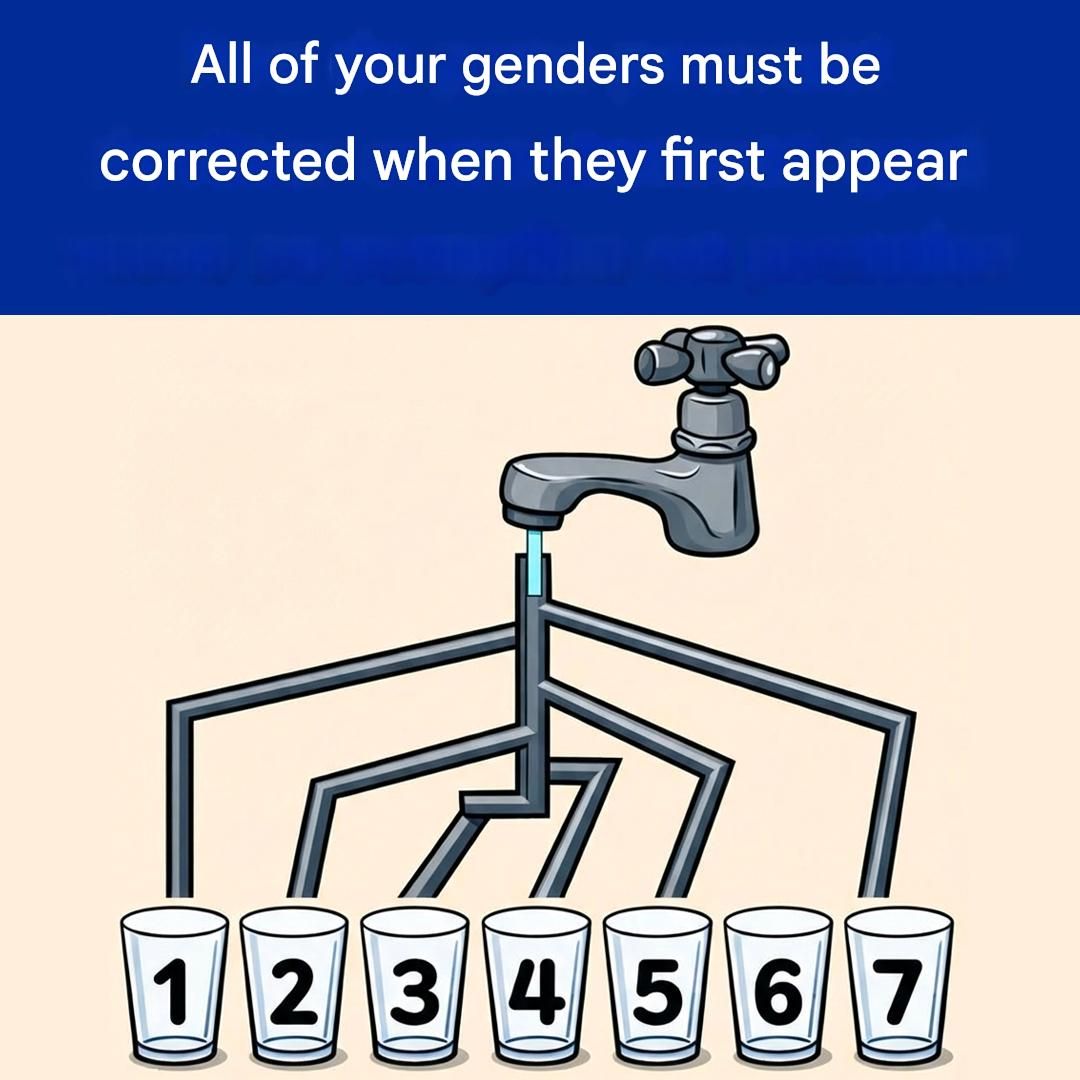
At first glance, the image seems obvious: a series of glasses connected by pipes, water ready to flow… and a simple question: which glass will fill up first? Easy, right? Yet, this visual trick trips up thousands of internet users. What if the real difficulty lies not in the logic… but in your impatience?
A puzzle that exploits our desire to go fast
Faced with this type of puzzle, our brain immediately switches to “quick solution” mode. We follow the pipes with our eyes, imagine the water flowing, and look for the most direct path. In a few seconds, a solution emerges.
Glasses with 3, 4, or 7 openings are often mentioned. They seem ideally positioned for quick filling.
But here’s the catch: this puzzle doesn’t test your speed. It tests your powers of observation.
And that changes everything.
Why almost everyone is wrong

The pressure of the timer (less than 20 seconds) encourages us to answer without checking. Our minds assume that a glass must fill up. It’s logical: if water goes in, it must go somewhere.
However, this reasoning is based on a false assumption.
We look for movement. We anticipate a result. We forget to examine every detail.
However, in this particular puzzle, each channel conceals an obstacle.
The detail that few people notice
Upon closer observation, it becomes clear that all passages are blocked.
The outlets of glasses 1 and 5 are blocked from the start.
Glass 2 is blocked at the end of its channel.
Glasses 3, 4, and 7 have blockages in the middle of their pipes.
Glass 6 is not connected to any water supply circuit.
Result ?
The water cannot flow into any container.
The surprising (but amusing) answer
No glass will be filled.
Yes, none.
It is often at this point that the famous
“But of course! How could I have missed that?” arises.
This mixture of obviousness and frustration is what makes the enigma so powerful. It doesn’t rely on complex calculations, but on our tendency to assume that an action necessarily leads to a consequence.
Why do these puzzles work so well?
These puzzles exploit two very human reflexes:
- We believe that there must be an “active” solution.
- We underestimate the importance of small blockages.
Our brains prefer dynamic scenarios: a starting point, a final result. Here, the real answer is the complete absence of an outcome.
And this paradox makes the challenge particularly memorable.
An excellent exercise to train your attention
Beyond the game, this puzzle reminds us of a valuable rule: observe before concluding.
In everyday life, too, we tend to jump to conclusions and follow the most obvious path. Yet, it is often the details invisible at first glance that change everything.
The next time you come across a viral puzzle , ask yourself a different question: not “where will this go?”, but “what could be blocking the way?”.
Because sometimes, the real solution is not in movement… but in the illusion of obviousness .