The Hidden Meaning of the Little Finger — A Small Detail That Inspires Big Reflection
Personality is usually explained through psychology, life experiences, and the environments we grow up in. Yet across the world, many cultures have also looked at everyday physical traits as symbols of identity and character. From facial expressions to posture, and even the shape of the hands, people have long searched for meaning in the visible details of the human body.
One especially intriguing example is the little finger — often called the pinky. It is the smallest finger on the hand, easy to overlook, and rarely given much attention in daily life. And yet, throughout history, different traditions have attached symbolic meanings to it as a way of reflecting on personality and human behavior.
These interpretations are not scientific measurements or reliable personality indicators. Instead, they are cultural metaphors — imaginative ways people have used physical features to explore identity, strengths, and individuality. What makes them fascinating is not whether they are “true,” but how they encourage reflection on the many ways people express themselves.
Surprisingly, this tiny finger holds more meaning — both physically and symbolically — than most of us realize.
The Little Finger’s Quiet but Powerful Role in Everyday Life
Before looking at symbolism, it helps to understand the little finger’s actual physical importance.
Despite its small size, the pinky plays a major role in how our hands function. It contributes significantly to grip strength, balance, and coordination. Without it, everyday actions — holding a cup, writing, typing, lifting objects, or even shaking hands — would feel less stable and more difficult.
The little finger works together with the ring finger to provide support along the outer edge of the hand. This support helps distribute force when gripping objects. In fact, studies of hand mechanics have shown that the pinky contributes a surprisingly large portion of total grip strength.
In simple terms, it may be small — but it is essential.
Because of this steady and supportive role, many cultural interpretations have associated the little finger with qualities that are subtle yet powerful — communication, expression, emotional balance, and personal connection.
Its physical function becomes a metaphor for personality.
Symbolism and Cultural Interpretations of the Pinky
Across different traditions, the little finger has been seen as a reflection of how people communicate, connect with others, and express themselves socially. These interpretations vary widely, but they share one common theme: the pinky represents how individuals interact with the world around them.
Importantly, these ideas are symbolic storytelling — not scientific conclusions. They are ways cultures have described personality traits through visual metaphors.
And those metaphors can be surprisingly meaningful.
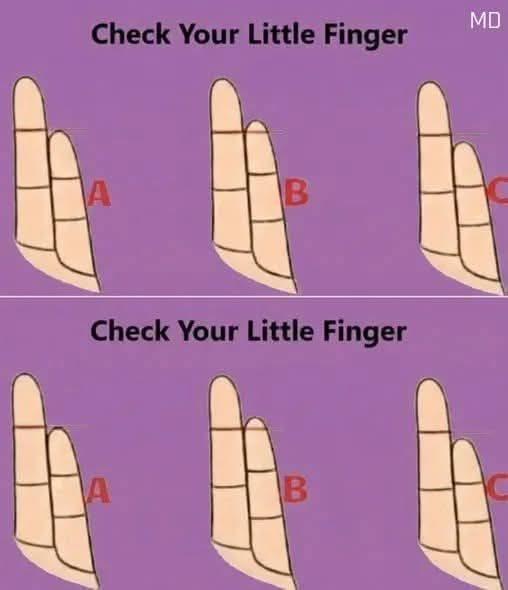
When the Little Finger Is Seen as Long: A Symbol of Expression
In some cultural interpretations, a longer little finger is symbolically associated with communication and social confidence.
People linked to this symbolism are often described as expressive, open, and comfortable engaging with others. They may enjoy conversation, share ideas easily, and feel energized by social interaction. In storytelling traditions, such individuals are portrayed as natural communicators — people who connect, persuade, and express themselves with ease.
But the symbolism goes deeper than just talkativeness.
A longer pinky is sometimes said to represent emotional openness — the ability to share thoughts honestly, form relationships easily, and engage with the world in a direct and confident way. It becomes a metaphor for outward energy — the kind that flows toward others.
Again, this is not a physical rule or prediction. It is simply a cultural image — one that celebrates expressiveness and connection.
When the Little Finger Is Seen as Short: A Symbol of Quiet Strength
Other traditions associate a shorter little finger with different — but equally valuable — qualities.
Instead of focusing on outward expression, this symbolism highlights inward strength. Individuals connected to this interpretation are often described as thoughtful listeners, patient observers, and steady supporters. They may speak less but understand more. They may prefer depth over noise, reflection over attention.
In cultural storytelling, these individuals are often portrayed as emotionally grounded — people who offer loyalty, empathy, and reliability without seeking recognition.
Their strength is quiet but dependable, much like the little finger itself — always supporting, rarely demanding attention.
This symbolism reminds us that personality does not need to be loud to be meaningful. Sometimes, the most powerful presence is calm, steady, and quietly attentive.
Why These Symbolic Meanings Still Fascinate Us
Modern psychology does not connect finger length to personality traits. Yet symbolic interpretations remain popular across cultures and generations. Why?
Because humans naturally seek meaning in what we can see.
Physical features are constant, visible, and personal. They provide a simple way to start conversations about identity, strengths, and individuality. Symbolism transforms everyday details into stories — and stories help us understand ourselves and others more deeply.
Even when we know something is symbolic, it can still feel insightful. It invites questions like:
- How do I communicate with others?
- Do I express myself openly or quietly?
- Where does my strength show — outwardly or inwardly?
- What unique qualities do I bring to relationships?
In this way, symbolism becomes less about prediction and more about reflection.
The Bigger Lesson: Personality Is Always More Than Appearance
While cultural interpretations of physical traits are fascinating, they also carry an important reminder.
Human personality cannot be measured by appearance alone.
Character is shaped by life experiences, relationships, values, and choices made over time. It evolves constantly. No physical feature — large or small — can define the depth of a person’s identity.
Yet symbolism still serves a purpose.
It encourages curiosity about individuality. It highlights that different qualities — expressive or quiet, energetic or steady — all have value. It reminds us that strength appears in many forms, not just the most visible ones.
And sometimes, the smallest physical details can spark the biggest reflections.
A Gentle Reminder Hidden in Plain Sight
The little finger rarely draws attention. It does not dominate movement or command focus. Yet it plays a crucial role in balance, support, and strength.
In many ways, it mirrors the unseen qualities that shape human character — patience, loyalty, emotional steadiness, quiet confidence.
These traits often go unnoticed, yet they hold everything together.
Perhaps that is why so many traditions chose this small finger as a symbol. It represents the idea that what seems minor may actually be essential. That subtle contributions can carry great importance. That quiet strength can be just as powerful as bold expression.
Celebrating Individuality — One Small Detail at a Time
Whether you relate more to the symbolism of expressiveness or quiet observation, the message is ultimately the same: every personality has value.
Some people shine through words and energy.
Others through calm presence and steady support.
Some lead conversations.
Others listen deeply and understand.
All are meaningful. All are needed.
The little finger — modest yet essential — becomes a simple reminder that individuality comes in many forms. No single trait defines a person. Instead, identity is a rich combination of experiences, qualities, and connections that shape who we are over time.
Final Thought: Small Things Often Carry the Greatest Meaning
The next time you notice your little finger resting quietly beside the others, consider what it represents.
Not a scientific label.
Not a personality test.
But a symbol — one that invites reflection on the many ways strength, expression, and connection appear in human life.
Sometimes, the smallest details hold the most powerful lessons.
And sometimes, something as simple as a tiny finger can remind us that every part of who we are — seen or unseen — contributes to the whole.