My father spent twenty-eight years building a fortress of suspicion, stone by jagged stone, and I spent six weeks dismantling it until there was nothing left but the dust of his own ego.
For as long as I have possessed a memory, Gerald Townsend viewed me not as a child, but as a biological insult. He called me an “aesthetic anomaly,” too refined, too blonde, and too blue-eyed to have sprouted from his dark-featured lineage. To him, my very existence was a subpoena, a living piece of evidence testifying to a betrayal my mother, Diane, had supposedly committed in the shadows of their early marriage. He didn’t see a daughter; he saw a cold case that he was determined to solve.
The ultimatum came on a sweltering Sunday evening at my parents’ estate in Fairfield, Connecticut. The house was a sprawling, six-bedroom Tudor—a monument to Gerald’s success as a civil engineer, a place he frequently reminded us he’d “erected with his own two calloused hands.” Inside, the air was thick with the scent of expensive lemon wax and the suffocating pressure of forced perfection.
We sat at the massive oak table, the Restoration Hardware furniture gleaming under a chandelier that cast sharp, judgmental shadows. My mother clutched her linen napkin as if it were a life raft. My brother, Marcus, the dark-haired “Golden Child” who inherited Gerald’s features and his favor, kept his eyes fixed on his plate. My grandmother, Eleanor Whitmore, sat at the head, her silver hair pinned back with military precision, her eyes tracking Gerald with the silent intensity of a predator.
Gerald cleared his throat, the sound rasping like sandpaper.
“I won’t be attending the ceremony, Tori,” he stated. The words didn’t just fall; they detonated.
My mother’s fork clattered against her Wedgwood china. “Gerald, please,” she implored, her voice a fragile thread. “Not tonight. Not when she’s so close to her day.”
He ignored her, reaching into his charcoal blazer to extract a folded document. He slid it across the table toward me. It was a consent form for a DNA paternity test. His signature was already there, a bold, aggressive scrawl.
“I won’t walk another man’s daughter down the aisle,” Gerald said, his voice rehearsed and hollow. “I’ve endured the whispers for three decades. You have six weeks. Take the test. Make the results a public record for the entire family. If the science says you’re mine, I’ll be at the altar. I might even offer an apology.” He smiled, but it was the cold, reptilian curve of a man who believed he’d already won. “But we both know what the ink will say.”
I stared at his Rolex Submariner glinting under the lights. Twenty-eight years of being the “Cuckoo in the Nest.” I didn’t cry. I didn’t scream. I simply looked him in the eye and said, “I’ll remember this, Gerald. Every single second of it.”
As I reached for the paper, my grandmother Eleanor’s hand shot out and gripped my wrist, her eyes burning with a secret she hadn’t shared in thirty years.
——————
To understand why I didn’t crumble that night, you have to understand the curriculum of my childhood. Gerald’s cruelty wasn’t an explosion; it was a slow, steady erosion.
When I was seven, I stood outside their bedroom door and heard him spit the word “bastard” at my mother, followed by a demand to know where my “Aryan hair” came from. When I was twelve, he refused to sign my volleyball permits because he “wasn’t into subsidizing a stranger’s athletic career.”
The disparity was a physical weight. When Marcus was whisked away to Boston University on Gerald’s dime, I was told my “real father” could handle my nursing school tuition. I took out the loans. I worked double shifts at a greasy spoon diner in Hartford, my feet aching as I studied anatomy between orders. I graduated with sixty thousand dollars in debt and a degree Gerald didn’t have the right to claim a single percentage of.
But the true victim wasn’t me—it was Diane. He used me as a blunt force instrument against her. Every vacation, every bill, every triumph Marcus had was turned into a weapon to remind her of her alleged infidelity. Five years ago, the pressure nearly shattered her. Eleanor found her in the bathroom with an empty bottle of diazepam. She survived, but she lived in a state of perpetual apology, a ghost haunting her own home.
The night after the “Grenade Dinner,” I sat in my modest one-bedroom apartment. My fiancé, Nathan, was sketching architectural plans at the table. He saw the DNA form and his jaw tightened so hard I thought his teeth might crack.
“Just do it, Tori,” he urged. “Prove the bastard wrong. Shut him up so we can have our wedding in peace.”
“It’s not about the wedding anymore, Nathan,” I whispered, looking at the journal where I’d kept every unkind word Gerald ever said. “It’s about the coup. He wants the truth? I’m going to give him enough truth to bury him.”
I contacted GeneTrust, an independent laboratory far removed from Gerald’s sphere of influence. I didn’t just want a paternity test. I wanted a full forensic breakdown.
Two weeks later, Gerald turned sixty. He threw a lavish gala at the Fairfield Country Club, inviting sixty relatives to witness his triumph. He stood up to give a speech, clutching a glass of Chateau Margaux.
“I see my ‘daughter’ is here,” he said, the air quotes around the word daughter dripping with venom. The room went silent. “I hope she’s ready to stop the charade. You know what they call a bird that lays eggs in another’s nest? A cuckoo. It’s a parasite, isn’t it?”
I stood up, my black dress a stark contrast to the festive décor. “Thank you for the biological lesson, Gerald,” I said, my voice echoing off the floor-to-ceiling windows. “I’ll see you at the engagement party. I’ll bring the results.”
As I walked out, my grandmother cornered me in the parking lot, her face pale as the moon. “Tori, wait. There’s an eleven-minute discrepancy in your birth record that St. Mary’s tried to bury.”
—————–
The urgency in Eleanor’s voice changed the trajectory of my investigation. She handed me a yellowed copy of my birth record. I was born at St. Mary’s Hospital on March 15th, 1997. My mother’s memories were vivid—she remembered the clock on the wall striking 11:58 p.m. as I was placed in her arms. But the hospital’s official log said 11:47 p.m.
Eleven minutes. A lifetime of lies could be told in eleven minutes.
I submitted three samples to GeneTrust: a cheek swab from myself, a voluntary sample from my mother—who gave it with trembling hands and a whispered, “Whatever it says, you are mine”—and a few strands of hair I’d scavenged from Gerald’s brush during a final, forced Thanksgiving visit.
The results arrived on a Tuesday at 9:47 p.m. I was alone. Nathan was in Boston for a consultation. I opened the PDF, my heart drumming against my ribs.
Subject A: Tori Townsend vs. Subject B: Gerald Townsend. Genetic Match: 0%.
My breath hitched. I’d expected this. Gerald was right. I wasn’t his. The affair was real, or so the science seemed to suggest. I felt a wave of nausea, thinking of my mother’s broken life.
But then, I scrolled down.
Subject A: Tori Townsend vs. Subject C: Diane Townsend. Genetic Match: 0%.
I stopped breathing. The screen seemed to vibrate. 0% match to Gerald. 0% match to Diane.
I wasn’t the product of an affair. I wasn’t their biological child at all. My mother hadn’t cheated; she had been robbed. I called the lab’s emergency line, screaming for an explanation. The technician, a woman named Dr. Reyes, was clinical. “There is no error, Ms. Townsend. You are not related to either person who raised you. The samples were pristine.”
I sat on my kitchen floor, the cold linoleum pressing against my skin. For twenty-eight years, my father had called my mother a liar. For twenty-eight years, he had been wrong about the cheating, but right about the biology. I was a “cuckoo’s egg,” but the bird hadn’t laid me there on purpose.
I went to my mother the next morning. Gerald was at golf. I showed her the report. I watched her face drain of color, her lips moving as she read the 0% over and over.
“I felt you,” she sobbed, her hands clutching mine. “I felt you come out of me, Tori. You were mine. You were red and screaming and mine.”
“I believe you, Mom,” I said, the fire of a new kind of rage igniting in my gut. “Which means someone switched us. And if I’m not yours, that means your biological daughter is out there somewhere, living my life.”
The phone rang. It was Margaret Sullivan, the retired head nurse from St. Mary’s. “I’ve been waiting for this call for twenty-eight years,” she rasped. “Come to the Riverside Diner. Alone.”
——————
Riverside Diner in Bridgeport was a relic of the eighties, smelling of burnt grease and regret. Margaret Sullivan was seventy-two, her hands shaking as she toyed with a patch of duct tape on the vinyl booth.
“I was twenty-four that night,” she whispered, sliding a worn leather journal toward me. “A trainee nurse, Carla, mixed up the infants after their first bath. By the time we realized the error at 2:15 a.m., both mothers had already bonded. Both had fed the babies. The administrator… he was a monster. He told us a switch would be ‘too traumatic.’ He made us sign NDAs. He threatened our licenses.”
I read the handwriting in the log.
11:47 p.m. – Baby Girl born to Diane Townsend. 7lb 2oz.
11:58 p.m. – Baby Girl born to Linda Morrison. 6lb 4oz.
“Who is she?” I asked, my voice a jagged edge.
Margaret pulled out a printed social media profile. Her name was Rachel Morrison. She lived in Springfield, Massachusetts. I looked at her picture and felt a jolt of electricity. She had chestnut hair, brown eyes, and a jawline that was a carbon copy of Marcus’s. She was an elementary school teacher. She was Diane’s daughter.
I spent the next three days in a fever dream. I messaged Rachel. I told her the “insane” truth. I expected a block, a report, a laugh. Instead, she called me within twenty minutes, her voice a mirror of my own shock.
“My parents… my legal parents… they always joked I didn’t look like them,” Rachel sobbed. “My dad, David, passed away three years ago never knowing. Tori, I have a brother? I have a mother who’s still alive?”
We met at a Starbucks halfway between our worlds. We didn’t talk at first. we just stared. I saw Gerald’s dimple on her cheek. She saw her own biological mother, Linda Morrison, in the shape of my nose and the color of my eyes. We were strangers who had been robbed of a sisterhood.
“Gerald is going to pay for this,” I told her, clutching her hand. “He wants a public reckoning? We’re going to give him a catastrophe.”
Rachel’s DNA results comparing her to Gerald and Diane hit my inbox two days before the engagement party. 99.99% match. The trap was set.
————–
The engagement party was held at Whitmore Estate, Eleanor’s ancestral home. It was a Georgian manor with rose gardens that felt like a sanctuary. We had invited sixty guests—the same sixty who had received Gerald’s “Cuckoo” email.
Gerald arrived late, draped in a Tom Ford suit, his Rolex catching the light. He looked like a man about to deliver a fatal blow. He didn’t know that the “victim” was the one holding the sword.
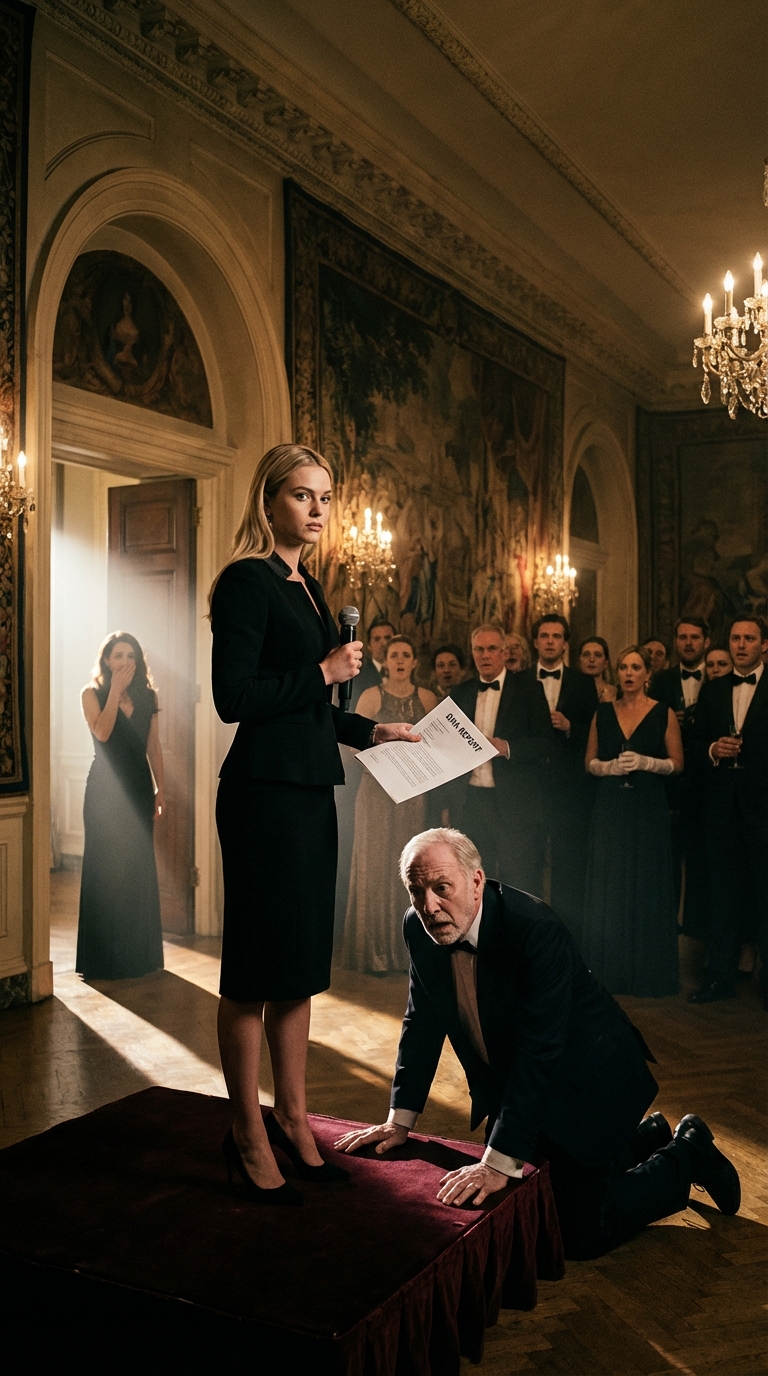
Halfway through the cocktail hour, Gerald demanded the microphone. He stepped onto the toast platform, his smirk wide.
“I think we all know why we’re here,” he began, his voice booming. “Family is built on truth. I asked Tori for the science, and Marcus was kind enough to find the GeneTrust confirmation in his mother’s inbox. 0% genetic match. My daughter isn’t my daughter.” He turned to Diane, his face twisting with thirty years of hate. “You lied, Diane. You brought a stranger into my house and called it a Townsend.”
The room was deathly silent. My mother stood beside Eleanor, her posture straighter than I’d ever seen.
I walked onto the stage and took the microphone from his hand. He was so stunned by my calmness that he let go.
“You’re right about the science, Gerald,” I said, my voice cold and lethal. “I am not your biological daughter. And I am not Diane’s biological daughter, either.”
The smirk faltered. The relatives began to murmur.
“Let me introduce you to someone,” I said, gesturing to the side door.
Rachel Morrison stepped into the light. The room gasped. Marcus nearly dropped his glass. The resemblance was undeniable—she was a Townsend through and through.
“This is Rachel,” I continued, as the wall-mounted display I’d rigged earlier flickered to life. The GeneTrust reports filled the screen. “She was born eleven minutes before me. A trainee nurse at St. Mary’s made a mistake, and the hospital covered it up. Rachel is your biological daughter, Gerald. She’s the one you’ve been punishing my mother for over three decades.”
I pointed to the back of the room. “And this is Margaret Sullivan, the head nurse that night. She has signed a notarized statement. The hospital threats end tonight.”
Gerald’s face went from triumph to a sickly, ashen grey. He looked at Rachel—really looked at her—and I watched twenty-eight years of arrogance shatter. His knees buckled. He collapsed onto the platform like a puppet with cut strings.
“I didn’t know,” he whispered to the floor.
“You didn’t want to know,” I spat, standing over him. “You chose suspicion because it gave you power. You chose cruelty because it made you feel righteous. You didn’t just lose a daughter today, Gerald. You lost your entire legacy.”
My mother stepped forward, her heels clicking on the hardwood like a judge’s gavel. She looked down at the man on his knees and said, “Pack your things, Gerald. The Tudor is mine. Eleanor made sure of it.”
————-
The fallout was a tidal wave. Diane didn’t just leave him; she dismantled him. Eleanor had long ago ensured that the Fairfield Tudor was in a Whitmore family trust. Gerald was evicted within forty-eight hours.
Rachel and I filed a joint lawsuit against St. Mary’s Hospital. The discovery phase was a bloodbath for the administration. We found emails from the late nineties discussing the “liability risk” of the switch. They had budgeted for a cover-up every year since 1997. The settlement was eight figures, but the public apology printed in the New York Times was what we truly craved.
The most profound moment, however, wasn’t in a courtroom. It was in a quiet kitchen in Springfield.
I met Linda Morrison, my biological mother. She was fifty-six, with my blonde hair and my blue eyes. When she saw me, she didn’t say a word; she just pulled me into a hug that smelled of lavender and a home I’d never known.
“Your biological father, David, died three years ago,” Linda told me, showing me photos of a man with my button nose. “He used to joke that Rachel had an ‘old soul eyes.’ He didn’t know they were your mother’s eyes, Tori.”
We didn’t try to replace the lives we’d lived. Diane and Linda became “The Other Mothers,” meeting for lunch once a month to trade stories about the daughters they’d raised but hadn’t birthed. Marcus and Rachel discovered they were both left-handed, both hated cilantro, and both possessed the same rhythmic foot-tapping habit when they were nervous.
I married Nathan two months later in the Whitmore Rose Garden. Gerald wasn’t there. He was in a small apartment in downtown Hartford, attending court-mandated therapy and trying to figure out how to be a person without a Rolex to hide behind.
My mother walked me down the aisle. She wore champagne silk and held her head high. She was no longer a piece of evidence; she was the architect of her own life.
———–
I’m sitting in my new home now, looking at a ultrasound photo pinned to the fridge. Nathan is in the kitchen, humming as he makes dinner.
I spent twenty-eight years trying to fit into a mold that was never meant for me. I straightened my hair, I studied nursing instead of art, I tried to be “practical” to prove I wasn’t the “Cuckoo” Gerald feared. I lived my life as an apology for a crime that didn’t exist.
But here is the truth I’ve learned: DNA is a map, but it isn’t the destination. The woman who held my hand during my nightmares, the woman who stayed in a broken marriage to protect me—she is my mother. The woman who looked into my eyes and saw her own lost history—she is my mother too.
Gerald Townsend spent twenty-eight years being certain. He was certain Diane was a cheater. He was certain I was a stranger. He was certain his cruelty was a form of justice.
He was wrong about everything.
Trust is a choice. Doubt is a poison. And thirty years of doubt can destroy a family, but one day of truth can build a new one.
Family isn’t defined by the blood in your veins, but by the people who refuse to let you bleed alone. If someone demands a test to prove your worth, they’ve already failed the only test that matters.
As I cleared the table, I found an old, unopened letter from Grandma Eleanor tucked into the back of my birth certificate folder. It was addressed to my ‘biological mother.’ The date on the envelope was three days before I was born.