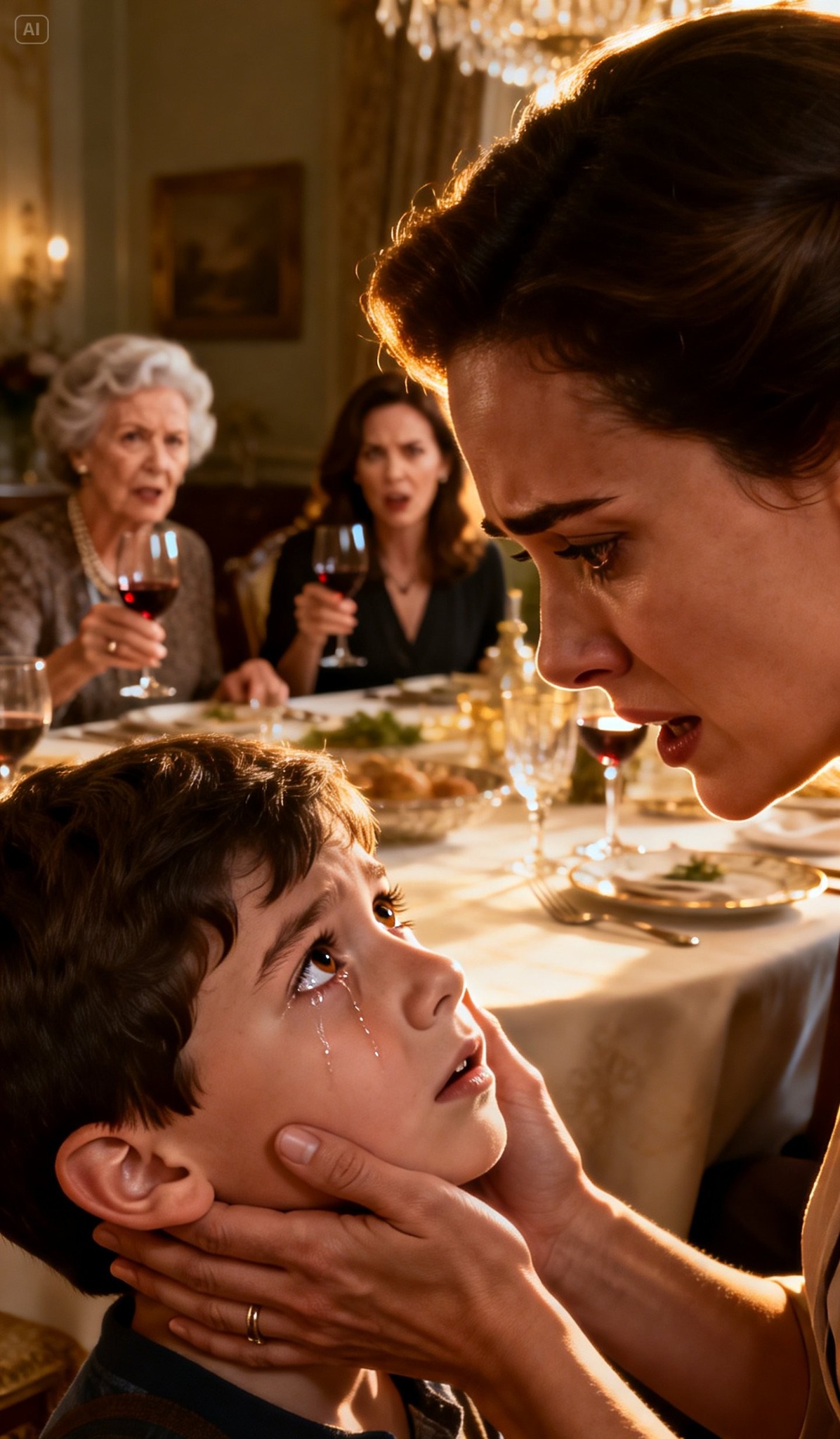
My five-year-old son approached me, and my heart stopped before my brain could register why. It wasn’t a physical injury—there was no blood, no scraped knee—but the devastation in his eyes was absolute. His bottom lip was trembling, a tiny, violent vibration that he was trying so hard to control.
“They… they were l-l-laughing at… at m-me.”
I didn’t say a word. I didn’t ask for clarification. I didn’t need to. The sound of their laughter was still drifting from the living room, sharp and jagged, piercing the muffled quiet of the hallway. I simply took Lucas’s small, cold hand in mine, turned on my heel, and marched back into the lion’s den.
The atmosphere in my parents’ living room was heavy with the scent of pot roast and expensive wine—a wine I had paid for. My mother was mid-sip, her eyes crinkling with amusement. My younger sister, Kayla, was leaning back on the plush sofa, smirking at something she had just whispered to our cousin, Ben.
I stopped in the center of the room. The air shifted. The laughter died, strangled by the sudden, suffocating tension I brought with me.
“This,” I said, my voice dangerously steady, “was the last time you will ever see my son.”
My mother froze, her glass hovering halfway to her lips. It was as if she had hit an invisible wall. Kayla’s smirk faltered, her skin draining of color until she looked like a porcelain doll left out in the rain. Ben mumbled something incoherent and looked at his shoes, unable to meet my gaze.
I didn’t shout. I didn’t scream. I didn’t throw the crystal vase sitting on the mantelpiece, even though every fiber of my being wanted to shatter it against the wall. This moment wasn’t about rage. Rage is hot; rage burns out. This was cold. This was the absolute zero of emotional detachment.
It hadn’t been strangers. It wasn’t cruel kids on a playground. It was them. My blood. My family.
We were at my parents’ house for Sunday dinner, an obligation I had been guilt-tripped into attending. My mother had called three times that week, her voice dripping with that familiar, cloying sweetness. “Lucas barely knows his own family, Lana. You’re being unfair. The boy needs to toughen up; the world isn’t going to coddle him just because he stammers.”
I had said yes. I always said yes. I viewed it as the tax I had to pay to keep the peace. But tonight, the tax had become too high.
I hadn’t been in the room when it happened, but I knew the script. I had seen Kayla mimic Lucas’s speech before, mouthing his stutter under her breath, eyes rolling, whispering to Ben, “He’s cute, but God, he’s going to get eaten alive in kindergarten.”
And Ben? He was the sidekick, the laugh track to her cruelty.
Holding Lucas’s hand, I felt him squeeze my fingers. He was terrified. But I wasn’t.
“Mom?” Kayla’s voice was small, testing the waters.
I turned to my mother. “Starting next month, you’ll need to figure out how to cover the mortgage yourselves.”
The silence that followed was louder than any scream. My mother’s mouth opened, but no sound came out.
I pivoted to Kayla. “And you might want to look into community college, or perhaps a full-time job. I’m done funding your education while you mock my child behind my back.”
“Lana, wait—” my mother started, standing up, her chair scraping violently against the hardwood.
I didn’t wait. I turned, grabbed our coats from the rack by the door, and walked out into the cool evening air. I ushered Lucas into the car, buckled him in, and got into the driver’s seat. My hands were shaking now, not from fear, but from the adrenaline of a bridge finally, irrevocably burning.
They didn’t chase us. They didn’t run out to the driveway. I think part of them believed I was bluffing. They thought I was just having a moment, a flare-up of “hormonal emotion,” and that I would come crawling back once I cooled off. After all, I was the fixer. I was the bank. I was the doormat.
They had no idea that I wasn’t just leaving a dinner party. I was leaving a lifetime of manipulation.
As I pulled out of the driveway, I looked in the rearview mirror. The house stood there, glowing warm and golden in the twilight—a perfect suburban picture funded by my bank account, housing people who despised the very thing I loved most.
The drive home was quiet. Lucas sat in the back, clutching his toy fox, staring out at the passing streetlights.
“Do you want music, baby?” I asked softly.
He shook his head.
When we got home, the apartment felt different. It was smaller than my parents’ house, less grand, but it felt safe. I heated some milk for him, the routine grounding me. I tucked him into bed, smoothing the hair back from his forehead.
“I am so proud of you,” I whispered. “Not just for telling me, but for being exactly who you are.”
He looked up at me, his eyes large and searching. “I… I didn’t want to go b-back there.”
“You won’t,” I promised him. The weight of those two words settled between us, solid as stone. “I promise.”
I kissed his forehead and turned off the lamp. I went into the living room, opened my laptop, and sat in the dark, the screen’s blue light illuminating the resolve on my face.
It was time to execute the plan I should have started years ago.
My fingers hovered over the keyboard. The banking portal was open.
For two years, I had been the silent pillar holding up my parents’ lifestyle. After my dad blew his retirement savings on a “guaranteed” investment scheme that evaporated overnight, the panic had set in. They were going to lose the house. The shame would have killed them—or so they said. So, I stepped in. I covered the mortgage. I paid the utilities.
Then came Kayla. “She’s so bright, Lana, she just needs a chance,” my mother had pleaded. So I paid for her tuition gaps. I bought her textbooks. I paid her car insurance because “she couldn’t focus on her studies if she was working.”
They called me generous then. They called me the responsible one. They praised me, but the praise always felt like a transaction—a receipt for services rendered.
Funny how quickly “generous” turns to “soft” when you stop signing checks. You baby him too much. You’re raising a snowflake.
I navigated to the recurring transfers page.
Mortgage Support: CANCEL.
Kayla Tuition/Expenses: CANCEL.
Car Insurance Policy: REMOVE PAYER.
I sent Kayla one final transfer—$500. Just enough to cover her food and gas for the rest of the month. I wasn’t a monster; I was just done being a martyr.
Then, I did the hardest part. I picked up my phone.
Block Contact: Mom.
Block Contact: Dad.
Block Contact: Kayla.
Block Contact: Ben.
I set the phone down on the coffee table. The silence in the apartment was absolute, but my mind was racing. I expected the fallout to come in the morning. I was wrong. It came in twenty minutes.
My phone lit up like a Christmas tree. Since I had blocked their calls and texts, the voicemails started piling up in the “Blocked Messages” folder, and the emails began pinging on my laptop.
Ping.
From: Mom
Subject: What the hell, Lana?
“What did you do? The transfer was cancelled. You are being irrational. You are ruining this family over a harmless joke. Call me immediately. You will regret this.”
Ping.
From: Kayla
Subject: YOU’RE JOKING RIGHT?
“So I lose school because your kid can’t take a joke? You are a psycho. Fix this. NOW.”
I didn’t reply. I didn’t engage. I simply took screenshots of every message, every threat, every insult, and dragged them into a folder on my desktop titled “The Proof.”
But then came the one that actually hurt. A voicemail from my father.
My dad rarely got involved in the drama. He preferred to sit in his armchair, read his paper, and let my mother handle the dirty work. I hadn’t heard his voice directly addressed to me in months.
I pressed play.
“Lana. It’s Dad.” His voice was gruff, devoid of warmth. “Check your accounts. There’s been a mistake. And call your mother. She’s hysterical.” A pause. Then, four words that seared themselves into my memory. “You owe us everything.”
Click.
I sat there, the phone cold in my hand. I owe you everything?
I thought about the nights I worked overtime to make sure their property tax was paid. I thought about the speech therapy sessions I paid for out of pocket because my insurance wouldn’t cover the full amount, all while making sure Kayla had gas money.
That sentence was the final nail in the coffin. It wasn’t an apology. It wasn’t concern for Lucas. It was pure, unadulterated entitlement. They viewed me not as a daughter, but as a resource. An ATM with a heartbeat.
I thought maybe, just maybe, after a few days of silence, they would cool down. They would reflect. They would realize they had crossed a line.
I was naive.
Two days later, the war moved to a new front.
Kayla posted a “vague” status update on Facebook: “Funny how bitter single moms ruin everything because they’re too sensitive to function in the real world. Some people just want to watch the world burn because they’re miserable.”
Comments from my cousins poured in. omg what happened? Sending prayers hun! Family is so hard sometimes.
I didn’t respond.
Then, my mother unleashed the nuclear option. A group email. Subject line: “Family Crisis – Prayers Needed.”
She CC’d everyone. My aunts, my uncles, my godmother, even a cousin in Ohio I hadn’t spoken to in a decade. It was a masterpiece of fiction. A long, dramatic novella about how I was “dismantling the family structure,” how I had “turned Lucas against them,” and how I had been “emotionally unstable ever since the divorce.”
She painted herself as the weeping matriarch and me as the vindictive daughter punishing them for no reason.
I sat at my kitchen table, sipping coffee, reading the email. Lucas was at school. The sun was shining through the window. And for the first time in my life, reading their poison, I felt… nothing.
I wasn’t scared of them anymore. They could spin whatever story they wanted. They could paint me as the villain in their twisted fairytale. It didn’t matter.
Because villains hold all the power.
But my calm was shattered by a notification from my bank app. It wasn’t a transfer. It was an alert.
LATE PAYMENT NOTICE: MORTGAGE LOAN #8842.
My blood ran cold. I had stopped the payments, yes. But I had forgotten one crucial detail. When my father’s credit tanked two years ago, I hadn’t just paid the mortgage.
I had co-signed for the refinancing.
Legally, I was still tied to that house. If they went down, they could drag my credit score down with them.
I stared at the screen, my heart hammering against my ribs. I had blocked them out of my life, but on paper, we were still shackled together. I needed a way out, and I needed it fast.
I knew I had to act before the bank came for me.
I spent the next three weeks in a bureaucratic hell. I called the bank every day. I sent in endless paperwork—proof of payments, account history, affidavits stating I was no longer contributing to the household. I initiated the process of “Partition to Sell,” a legal maneuver that essentially forced the other owners to refinance in their own names or sell the property.
It was aggressive. It was nuclear. And it was necessary.
During this time, the silence from my family shifted. The anger on social media quieted down, replaced by a frantic, nervous energy. I could feel it. The silence wasn’t pride anymore; it was panic.
I started getting texts from numbers I didn’t recognize. Flying monkeys.
Aunt Denise: “Lana, your mother is really stressed. Kayla didn’t mean it. Don’t punish the whole family.”
Cousin Ben’s Mom: “We miss Lucas. Let’s put this behind us.”
Not a single person asked, “How is Lucas?” Not one. They only cared about the boat being rocked.
When the bank finally processed my request to remove myself from the deed—pending a refinance they would never qualify for—I sent my mother the confirmation document. No subject line. Just the PDF.
The message was clear: You are on your own.
Three days later, I was at work. I managed a logistics team for a shipping company—a job that required precision, thick skin, and the ability to solve problems quickly. I was at my desk when the receptionist buzzed me.
“Lana? There’s a young woman here to see you. She says she’s your sister.”
My stomach dropped. I looked at the clock. 2:00 PM.
“Tell her I’m busy,” I said.
“She says it’s an emergency. She’s… she’s crying, Lana.”
I closed my eyes and exhaled slowly. “I’m coming out.”
I walked to the lobby. Kayla was standing by the ficus plant, wearing a hoodie and sweatpants, looking nothing like the polished, arrogant girl at the dinner party. Her eyes were red.
When she saw me, she didn’t hug me. She stepped forward, hands clenched.
“You blocked me,” she spat. The tears were there, but the tone was pure venom.
“Yes,” I said calmly. “I did.”
“I can’t register for classes, Lana. The bursar put a hold on my account. I need three thousand dollars by Friday or I get dropped.”
“That sounds stressful,” I said, my voice flat.
“Stressful? You cut me off! You ruined my life!” Her voice rose, echoing off the glass walls of the lobby. People were looking. My security guard, Mike, took a step toward us.
“I didn’t ruin your life, Kayla. I stopped subsidizing it.”
“Over a stutter?” she screamed. “You’re doing this over a stupid stutter?”
And there it was. Even now, facing the collapse of her future, she couldn’t help herself. She still minimized it. She still viewed my son’s pain as a punchline.
“Mike,” I said, not taking my eyes off her. “Please escort her out.”
Kayla’s jaw dropped. “You’re kidding. I’m your sister!”
“No,” I said softly. “You’re a stranger who bullies a five-year-old.”
Mike, a large man with a gentle face, stepped between us. “Miss, you need to leave.”
As he guided her toward the revolving doors, she twisted back, her face contorted with ugly, desperate rage.
“You think you’re better than us now?” she shrieked. “You think he’s not going to grow up hating you for taking his family away?”
I stood there, watching her disappear onto the street. Her words hung in the air, toxic and heavy. Will he hate me?
I left work early that day. I needed to see him.
When I got home, the babysitter was reading on the couch. Lucas was in his room. I walked in softly. He was sitting on the floor, surrounded by books. Not the baby books he used to cling to, but new ones. Books about space. Books about dinosaurs.
He looked up and smiled. A real smile. It reached his eyes.
“Mommy!”
“Hey, buddy.” I sat down next to him. “What are you reading?”
He held up a book about planets. “J-Jupiter is… is really big.”
I waited. I didn’t finish the sentence for him. I didn’t rush him.
He took a breath, his little chest expanding. “It has… storms. Big storms.”
“It does,” I agreed.
He crawled into my lap, resting his head against my chest. We sat there for a long time, just breathing.
“Mommy?”
“Yes, baby?”
He looked up at me, his face clear, his eyes bright. “I l-love you.”
It was clear. It was confident. There was no shame in his struggle, only the effort of communication.
I kissed his hair, blinking back tears. “I love you more.”
Kayla was wrong. He wouldn’t grow up hating me. He was growing up loved. He was growing up safe. And that was worth every bridge I had to burn.
But while our world was healing, theirs was catching fire.
It started with the house.
Three months after I pulled the payments, the foreclosure notice went up. It was taped to the front door of my parents’ perfect suburban home—the one they bragged about at every Christmas party like it was a trophy of their superior morality.
FORECLOSURE NOTICE. DO NOT REMOVE.
The neighbors, of course, saw it immediately. In the suburbs, gossip travels faster than light. The whispers started. My mother stopped going to her garden club. My father stopped going to the golf course.
I didn’t visit. I didn’t drive by. I heard about it from Aunt Denise, who called me in a panic, begging me to “fix it.”
“I can’t fix it, Denise,” I told her. “I’m not on the deed anymore.”
“But they’re your parents!”
“They are adults,” I corrected. “And they made their choices.”
Next came Kayla. Without my funding, the reality of her lifestyle hit her like a freight train. She dropped out of college. She couldn’t afford the tuition, the rent on her off-campus apartment, or the car insurance.
Her social media presence shifted drastically. Gone were the latte selfies and party photos. They were replaced by vague, dark quotes about betrayal and “fake people.”
One night, I was working late when an email popped up.
From: Kayla
Subject: Please read.
I hovered over the delete button. Curiosity won.
It was a wall of text. Excuses. Half-apologies. I was under pressure. I didn’t mean it like that. You know how Ben is, he egged me on.
Then, paragraph four, the pivot.
I’m going to lose my apartment, Lana. I have nowhere to go. Mom and Dad are losing the house, I can’t go there. Please. I just need a loan. I’ll pay you back. Lucas won’t even remember this when he’s older, but I’ll remember that my sister turned her back on me when I needed her most.
She was still doing it. Using Lucas as a pawn. Minimizing the trauma.
I didn’t respond. I forwarded the email to my “Proof” folder and closed the laptop.
They still thought I would break. They thought I was the old Lana—the keeper of the peace, the sponge that absorbed all the family dysfunction so they didn’t have to. But that Lana was gone. She had died the moment her son looked at her with tears in his eyes.
Winter came. The holidays approached.
I booked a trip for Lucas and me. We were going to a cabin in the mountains. Just snow, hot cocoa, and peace. No obligatory dinners. No passive-aggressive comments about my parenting.
Two nights before we left, there was a knock at my door.
It was 11:00 PM. Lucas was asleep. I checked the peephole.
My mother stood there. She looked older. Her hair, usually perfectly coiffed, was windblown and graying at the roots. She was wearing a thick scarf, clutching a plastic grocery bag.
She knocked again, softly.
“Lana?” Her voice was muffled by the heavy wood. “It’s freezing out here. I just want to talk.”
I stood on the other side of the door, my hand resting on the deadbolt. I could open it. I could let her in. I could give her tea, listen to her cry, write a check, and fix it. It would be so easy to fix it.
But then I looked at the dinosaur stickers Lucas had put on the hallway wall. I thought about his humming this morning while he ate his cereal—a happy sound he never made at their house.
I took my hand off the lock. I turned off the porch light and walked away.
She waited fifteen minutes. Then, I heard her slow, heavy footsteps receding down the walkway.
The next morning, the bag was still there. Inside was a stack of old photos—me as a kid, her holding Lucas as a baby—and a note scribbled on yellow lined paper.
Family is family. No matter what happened, please come home.
I stood in the doorway, the cold wind biting at my cheeks, holding the note.
“Home,” I whispered to the empty air.
That house wasn’t home. It was a theater where I had performed for their approval for thirty years. This apartment—with the toy fox on the floor and the smell of oatmeal on the stove—this was home.
Spring arrived early that year.
Lucas was on the patio, sitting on a little blue stool, drawing on the bricks with sidewalk chalk. I watched him from the kitchen window, stirring pasta sauce.
He was humming again.
His speech therapist had emailed me earlier that week. He’s moved into the mild category, Lana. He’s relaxed. He’s confident. Whatever you’re doing at home, keep doing it.
I smiled, tasting the sauce. It needed more basil.
My phone pinged. A single email.
From: Dad
Subject: (No Subject)
I opened it. One sentence.
We lost the house.
That was it. No request. No apology. No attempt to reconnect. Just the blunt, brutal fact, delivered by a man too proud to beg but too broken to stay silent.
I stared at the words. The same man who told me I owed them everything was now announcing that they had nothing.
I waited for the guilt. I waited for the urge to rush in and save them. But it didn’t come. Instead, I felt a strange, quiet sense of finality. Like closing a book you didn’t particularly enjoy reading.
Kayla ended up moving out of state—some rumors said she was staying with a friend in Arizona, waiting tables. My parents moved into a small apartment with my mother’s sister, a woman they used to mock relentlessly for being “lower class.”
The silence stretched. And then, it stuck.
September came. Kindergarten started.
On the first day of school, Lucas stood in front of the full-length mirror in the hallway. He was wearing his new backpack, which was almost as big as he was.
I knelt down to fix his collar. “Are you nervous?” I asked, brushing a stray hair from his forehead.
He looked at himself in the mirror, then at me. He grinned.
“I’m going to… to make so many f-friends.”
My heart swelled. “You are.”
Then his expression turned serious, but not sad. “I d-don’t care if they laugh, Mom.”
He said it simply, as a matter of fact.
“Why not?” I choked out.
“Because,” he shrugged, grabbing his lunchbox. “I know… I know who I am.”
I watched him walk out the door to the waiting bus, his steps light, his head held high.
That night, after he fell asleep, I sat on the couch in the quiet dark. I let it all hit me. The years I spent twisting myself into knots to please people who wouldn’t lift a finger for me. The money I poured into a bottomless pit of entitlement. The way they chipped away at my soul until I thought I was lucky just to be tolerated.
It had taken a five-year-old boy to show me the truth.
They had laughed at him. They had mocked his voice. But in the end, his voice was the only one that mattered.
They had lost their house. They had lost their status. They had lost us.
And we? We had everything we needed. We had peace. We had each other.
We were free.