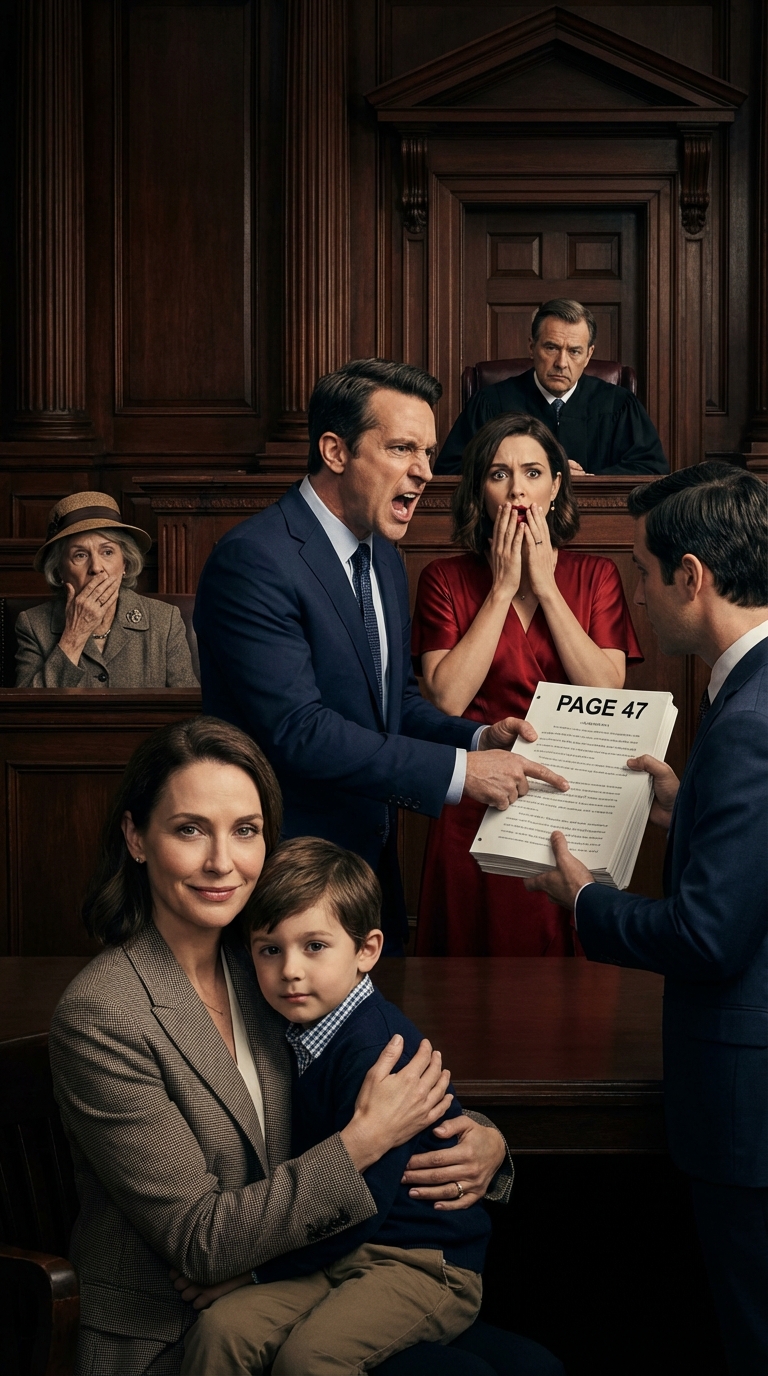
They say the loudest sound in a courtroom isn’t the judge’s gavel, but the silence that follows a life-altering revelation. I sat at the petitioner’s table, my spine pressed against the hard oak chair, watching the man I had loved for a decade prepare to devour my future. Vincent Saunders looked every bit the conqueror. He adjusted his silk tie, the gold clip catching the sterile fluorescent light, and offered me a smile that was less about affection and more about a predator savoring its kill.
Three weeks ago, I signed a document that technically rendered me homeless and penniless. I handed over the keys to our five-bedroom colonial in Willow Creek, the titles to both luxury vehicles, and my entire stake in Saunders Properties LLC. My attorney, Margaret Collins, had maintained a mask of professional stoicism, but her eyes had pleaded with me to reconsider. Across the aisle, my mother-in-law, Evelyn Saunders, sat in the gallery like a queen observing a peasant’s exile. Beside her, Brittney Lawson, Vincent’s twenty-seven-year-old “business consultant” and current mistress, leaned into the frame of her smartphone to take a celebratory selfie.
Vincent’s lawyer, Gerald Hoffman, cleared his throat to read the final execution clause. Vincent’s smirk was wide, arrogant, and triumphant. It was the smile of a man who believed he had successfully traded an “unremarkable” wife for a younger model and a debt-free empire.
That smile vanished exactly forty-seven seconds later.
As the legal jargon began to settle into the air, the color drained from Vincent’s face, leaving him a sickly shade of gray. He looked at me, his eyes wide with a dawning horror, but I didn’t flinch. I simply touched the thin gold band on my finger—the only asset he hadn’t tried to steal—and felt the first breath of true freedom I’d had in eight years.
To understand how we arrived at this moment of absolute ruin, you have to go back three years, to the night I accidentally discovered that my husband’s empire was nothing more than a cathedral built atop a sinkhole.
For eight years, I played the role of the dutiful shadow. Vincent was the sun; I was merely the moon reflecting his borrowed light. We lived in a sprawling, meticulously manicured house in the suburbs of Houston—a house with five bedrooms we didn’t need and a mortgage we couldn’t actually afford. Vincent drove a Porsche Cayenne; I drove a twelve-year-old Honda Accord that smelled faintly of crayons and stale coffee.
“I’ll manage the ledgers, Diana. You manage the home,” he’d told me on our honeymoon in Maui. At twenty-four, I was intoxicated by his confidence. I wanted to avoid the volatile financial shouting matches that had defined my parents’ divorce, so I traded my autonomy for a peace that I would later realize was just a slow-acting poison.
Before our son, Tyler, was born, I was a senior accountant at a mid-sized firm downtown. I loved the binary nature of numbers—they didn’t lie, they didn’t have hidden agendas. But when I reached the third trimester, Vincent shifted into a tone of “reasonable authority.”
“A Saunders child deserves a full-time mother, not a daycare cubicle,” he’d said, sipping an expensive Scotch. “I make more than enough for the three of us.”
So, I resigned. I traded my spreadsheets for sippy cups. When Tyler started kindergarten and I took on part-time remote bookkeeping to keep my mind sharp, Vincent dismissed it as a “hobby.” To him, I was part of the upholstery—functional, quiet, and utterly overlooked. He spent his evenings at “investor galas,” wearing a Rolex Submariner he’d bought to celebrate a commercial deal that, I would soon learn, had never actually closed.
The cracks appeared on a rainy Tuesday evening three years ago. Tyler needed his passport for a school trip, and Vincent had left his home office unlocked—a rare lapse in his usual paranoia. I found the passport in the top drawer, but as I pulled it out, a heavy manila folder spilled onto the floor.
The first thing I saw was a “Final Notice” from First National Bank, stamped in a red ink that looked like a fresh wound.
My accountant’s brain overrode my wifely instincts. I began to leaf through the documents. Ninety days past due on a $340,000 commercial loan. A delinquent account notice from Wells Fargo. A searing letter from a collection agency regarding an unpaid levy on a strip mall in Pearland.
I sat in his oversized leather chair, the air in the room suddenly too thin to breathe. Vincent wasn’t a mogul; he was a magician performing a disappearing act with our life savings. His company was hemorrhaging cash, drowning in over $2 million of debt, and he was still buying silk ties and Scotch.
I didn’t scream. I didn’t confront him when he walked through the door smelling of rain and expensive gin. Instead, I took my phone and photographed every single page, my hands steady even as my heart felt like it was being squeezed by a cold hand. I put everything back, turned off the light, and went to bed.
I didn’t sleep. I calculated. And that night, I realized that if I was going to save Tyler’s future, I had to become the very thing Vincent thought I was too “simple” to be: his most dangerous auditor.
I lay there in the dark, listening to Vincent’s rhythmic snoring, and realized the man beside me was a stranger holding a match to our house. The question wasn’t if it would burn, but how much I could salvage from the ashes before he realized I had the fire extinguisher.
The following morning, I placed a call to Rachel Morrison, my college roommate and a branch manager at a regional bank. She was the only person who had ever looked at Vincent and whispered, “He’s a bit too polished, Di. Be careful.”
I met her in a nondescript cafe, sliding a thumb drive across the table. “I need a full forensic look at my credit, Rachel. And I need to know exactly what liabilities are attached to my name as a spouse in a community property state.”
Rachel called me two days later, her voice tight with concern. “It’s worse than the office papers showed, Diana. He’s been using your electronic signature. There are two personal loans—one for $150,000 and another for $80,000—that look like they were authorized by you. This is criminal fraud.”
“Not yet,” I whispered, staring at Tyler playing with his Lego sets on the rug. “If I report him now, the bank seizes everything, and Tyler and I end up in a shelter. I need time.”
For the next two years, I lived a double life. I was the “unremarkable” wife by day, and a financial architect by night. I opened a secret savings account at an out-of-state credit union, funneling every cent of my part-time bookkeeping income into it. I documented every dinner where he bragged about non-existent profits. I saved every email where he told me to “stay out of the big boy business.”
As the debt grew, so did Vincent’s arrogance. It’s a strange phenomenon—the more a man loses his grip on reality, the tighter he grips his ego. He began coming home later, the scent of a floral perfume that wasn’t mine clinging to his Tom Ford suits.
“You’ve let yourself go, Diana,” he remarked one evening, eyeing my leggings and oversized sweater. “Look at Brittney, my new associate. She understands the power of presentation. Ambition is attractive. You should try it sometime.”
I just nodded and offered him more wine. I wasn’t jealous of Brittney. In fact, I felt a twisted sort of pity for her. She was buying into the myth of the Saunders Empire, unaware she was hitching her wagon to a falling star.
The tipping point came during a monthly dinner at Evelyn’s estate in River Oaks. Evelyn had always treated me like a temporary guest in her son’s life. That night, she invited Brittney to sit at the head of the table.
“Vincent finally found a woman who matches his caliber,” Evelyn said, her voice like shards of ice. “Diana, dear, be useful and help the maid with the appetizers. This is a business conversation.”
I stood in the kitchen, listening to the laughter from the dining room, while Tyler sat at the small breakfast nook, looking confused. “Mommy, why is that lady sitting in your chair?”
“Because she likes the view, sweetheart,” I said, kissing his forehead. “But views change.”
That was the night Vincent told me he wanted a divorce. He didn’t offer a reason—he didn’t feel he owed me one. He just sat me down and handed me a list of demands.
“I want the house. I want the Porsche. I want the company. I’m keeping the lifestyle I built,” he said, leaning back with a look of supreme entitlement.
“And Tyler?” I asked, my voice a whisper.
He shrugged. “You keep the kid. I’m starting a new chapter. A child would just slow down the expansion of the firm.”
He called our son “the kid.” An afterthought. A line item he was willing to write off.
I looked at Vincent, seeing him clearly for the last time. He wasn’t a lion; he was a scavenger. And he had just made the biggest mistake of his life: he assumed I was as empty as he was.
“I’ll sign,” I said, lowering my head to hide the flash of steel in my eyes. “But I want my lawyer to draft the final language to ensure there are no future claims.” Vincent smirked, thinking I was just trying to protect my meager child support. He had no idea I was about to hand him exactly what he asked for—and everything he deserved.
Margaret Collins’s office was a sanctuary of dark wood and the smell of old paper. When I laid out my three-year dossier of Vincent’s fraud, debts, and the forged loan documents, she didn’t speak for five minutes.
“He thinks he’s stealing the gold,” Margaret finally said, a predatory glint in her eyes. “He doesn’t realize he’s actually demanding the lead.”
“Texas is a community property state,” I said, my accountant’s mind clicking into gear. “If I fight for half, I’m fighting for half of a $4.7 million hole. I don’t want half. I want none of it.”
Margaret pulled a thick volume of the Texas Family Code from her shelf. “Under the Liability Assumption Clause, we can structure the agreement so that the party receiving the asset also assumes all associated encumbrances, liens, and third-party debts. If he insists on sole ownership of the company and the properties, we can make him solely responsible for the mountain of debt attached to them.”
“He won’t read the fine print,” I said. “He’s too busy looking at Brittney and his reflection.”
“We need to be careful,” Margaret warned. “We’ll include a Waiver of Independent Financial Review. He’ll have to sign a document stating that he had the opportunity to audit the books and chose to waive it because of his ‘intimate knowledge’ of his own business.”
The weeks leading up to the hearing were a masterclass in psychological warfare. Vincent and Evelyn turned the entire social circle against me. I was the “lazy housewife” trying to “leech” off a self-made man. Brittney called me to gloat, telling me how they were going to redecorate “her” house.
“Just sign the papers, Diana,” Vincent emailed me, CC-ing his lawyer. “Stop being difficult. You’re lucky I’m letting you take the furniture from Tyler’s room.”
Every insult was a gift. Every threat was evidence of his “undue pressure” that Margaret documented. We buried the Liability Assumption Clause on Page 47 of a fifty-two-page settlement agreement. We surrounded it with tedious paragraphs about the division of holiday decorations and the custody of a lawnmower he hadn’t used in years.
The night before the hearing, I sat in my small, two-bedroom rental apartment. Tyler was asleep, dreaming of superheroes. I looked at the final draft of the agreement. It was a masterpiece. It gave Vincent everything he’d ever boasted about. It made him the King of Willow Creek.
It also made him personally liable for every forged loan, every delinquent mortgage, and every penny of the $4.7 million debt that was currently suffocating Saunders Properties LLC. By signing this, he was legally releasing me from every debt he had incurred in our names.
I packed my simple gray suit and my grandmother’s sapphire ring. I felt a strange sense of mourning, not for the marriage, but for the girl I had been—the one who thought silence was the same thing as peace.
I woke up on the morning of January 3rd to a bright, cold Houston sun. I drove my old Honda to the courthouse, passing Vincent’s Porsche in the parking lot. He had a ‘VIP’ parking sticker on the bumper. I parked in the back, near the exit. I knew that by noon today, the man who had treated me like furniture would be begging for a seat at my table.
The courtroom was smaller than I expected, the air smelling of floor wax and desperation. Judge Harriet Dawson presided with a face like carved granite.
“We are here for the matter of Saunders versus Saunders,” she announced. “I understand a final settlement has been reached?”
“Yes, Your Honor,” Gerald Hoffman said, preening. “My client has been exceedingly generous. Mrs. Saunders is relinquishing all claims to the marital estate and the business in exchange for full custody and a modest lump sum.”
Judge Dawson turned to me. “Mrs. Saunders, is this your wish?”
“It is, Your Honor. I just want a clean break.”
Vincent let out a soft, mocking huff of laughter. He leaned over to Brittney and whispered something that made her giggle.
“Mr. Saunders,” the judge continued, “you have signed a waiver of independent financial review. You are asserting that you are fully aware of the financial standing of all assets you are receiving?”
“I am the CEO, Your Honor,” Vincent said, his voice ringing with practiced authority. “I know where every nickel is. I don’t need a court-appointed accountant to tell me what I built from the ground up.”
“Very well. Sign the execution page.”
I watched the Montblanc pen in his hand. It moved with such confidence. Swish. Swish. With those few strokes of ink, he officially took ownership of the Willow Creek house (and its $800,000 underwater mortgage). He took the Porsche (and its astronomical lease arrears). He took the company (and the $2.5 million in fraudulent loans he had forged my name on).
The moment the clerk took the papers, Margaret Collins stood up.
“Your Honor, for the record, we would like to highlight Article 4, Section 12, found on page 47. The Liability Assumption Clause is now in full effect.”
Gerald Hoffman’s brow furrowed. He began to flip through his copy of the document. He found page 47. I watched his eyes scan the text. Then, I watched them stop. He read it again. Then a third time.
The silence I mentioned earlier? It started right then.
“Vincent,” Gerald hissed, his voice trembling. “Did you… did you read this section?”
“The holiday decoration section?” Vincent asked, still smiling at the gallery. “Who cares? Let her have the Christmas lights.”
“No,” Gerald whispered, his face now the color of a bleached bone. “The liability clause. You just assumed personal responsibility for the entire debt load of the LLC, the secondary mortgages, and the personal bridge loans. You just released Diana from over four million dollars in liabilities.”
Vincent’s smile didn’t just fade; it curdled. He snatched the papers from his lawyer. His eyes raced over the legal prose—the words Margaret and I had polished until they were as sharp as a scalpel.
“The party receiving the assets shall assume all encumbrances… the Petitioner is hereby held harmless and indemnified against all prior marital debts…”
“This is a mistake!” Vincent roared, standing up so fast his chair screeched. “She tricked me! This isn’t what we agreed to!”
“Mr. Saunders, sit down!” Judge Dawson barked. “You signed a waiver. You stood before this court and claimed you knew every nickel. You explicitly stated you did not want an audit.”
“But the company is worth millions!” Vincent cried, his voice cracking.
“The company,” I said, speaking for the first time, my voice echoing in the sudden stillness, “hasn’t turned a profit in thirty-six months, Vincent. The ‘investors’ you’ve been meeting are actually debt consolidation agents. And as of five minutes ago, they are entirely your problem.”
From the front row, Brittney Lawson’s jaw dropped. She looked at the smartphone she’d used to take the selfie, then at Vincent, as if she were seeing a ghost. She stood up, not to support him, but to grab her designer bag.
“Wait, four million in debt?” she asked, her “business consultant” persona vanishing. “Vincent, you told me the house was paid off!”
Evelyn Saunders looked like she’d been struck by lightning. She looked at me, her eyes filled with a sudden, sharp realization that the “useful maid” had just dismantled her son’s life with a pen.
I walked out of that courtroom while Vincent was still shouting at his lawyer. I didn’t look back. I didn’t need to. I could hear the sound of his empire collapsing behind me, and for the first time in my life, I wasn’t the one who had to pick up the pieces.
The aftermath was as swift as it was brutal. Within ninety days, the Willow Creek house was in foreclosure. The Porsche was repossessed in the middle of the night, an event the neighborhood chat group discussed for weeks.
Vincent’s “Empire of Sand” finally succumbed to the tide. He filed for Chapter 7 bankruptcy, but because of the way we had structured the settlement and his signed waiver, the court held him to the personal liability for the fraudulent loans. He didn’t just lose his money; he lost his reputation.
Brittney Lawson disappeared within a week, reportedly moving back in with a former boyfriend who actually had a steady paycheck. Evelyn Saunders had to sell her River Oaks estate to cover the legal fees her son had racked up trying—and failing—to void our agreement.
I, on the other hand, went back to school. I finished my CPA certification and took a job at a top-tier forensic accounting firm. I specialize in “marital fraud”—finding the money men like Vincent try to hide.
Tyler and I live in a modest but beautiful condo near the park. He’s thriving. He has a mother who is present, who isn’t hiding in the margins of someone else’s life.
Vincent reached out to me a year later. He was living in a studio apartment and working commission-only at a used car lot.
“I want to see Tyler,” he said over the phone, his voice stripped of all its former vibrance. “I’m in therapy, Diana. I’m trying to take accountability.”
“Accountability is a long road, Vincent,” I replied. “We have conditions. Supervised visits, monthly reports from your counselor, and you never—ever—mention money in front of him.”
He agreed. He didn’t have the strength to argue anymore.
I’m sharing this story because I know there are other “Dianas” out there. Women—and men—who have been told they aren’t smart enough to understand the numbers, who have been treated like furniture in their own homes.
My silence wasn’t weakness; it was a strategy. My patience wasn’t passivity; it was the slow sharpening of a blade.
The people who underestimate you are giving you a gift. They are giving you the cover of darkness to build your own light. Don’t be afraid of the silence. Use it. Because one day, you’ll reach the 47th page of your own story, and you’ll realize that you weren’t the one being trapped—you were the one designing the exit.
Last week, Tyler and I were sitting at the kitchen table. He was doing his math homework, his brow furrowed in concentration.
“Mom,” he asked, “why do numbers matter so much?”
I sat down beside him and smiled. “Because, sweetheart, numbers are the only things that tell the truth when people are too afraid to.”
He nodded, satisfied, and went back to his addition.
I looked at my own life—the small, honest, hard-won life I’ve built. It isn’t a colonial mansion or a Porsche. It’s better. It’s mine.
If this story hit a nerve, tell me: Have you ever been underestimated? Have you ever felt like you were just “furniture” in someone else’s empire? What would you have done in my place?
Leave a comment below. Let’s remind each other that we are stronger than the ledgers they try to write us into. And if you’re in the middle of your own “three-year plan,” keep going. The 47th page is coming.
And it is glorious.