The first time my parents explicitly stated my daughter was an “inconvenience,” I rationalized it, attributing their bluntness to stress or simply being overwhelmed. It was a stifling July evening, and I had brought Ava, my four-year-old, to their suburban home directly after work. My usual sitter had canceled at the eleventh hour, leaving me scrambling. My mother, with her perpetually coiffed silver hair, opened the door, her gaze sweeping down Ava’s sticky, sweat-streaked face before turning its full, cool intensity upon me. “Why do you always expect us to drop everything for your child?” she demanded, the words sharp as glass.
I offered an awkward laugh, attempting to deflect the sudden chill, and extended a cold soda in a futile effort to lighten the mood. “It’s just for a couple of hours, Mom,” I pleaded, my voice thin. “I had to pick up an extra shift. Rent’s due, you know.” My father, sunk deep into his worn leather recliner, didn’t even bother to glance up from the evening news. “We raised our kids,” he grunted, his voice gruff, “not our grandkids.” Ava, clinging to my leg, her worn purple stuffed rabbit clutched like a tiny shield, offered a hesitant wave. “Hi, Grandpa.” He merely responded with another grunt. That was it. No smile, no warmth, just the cold, familiar dismissal.
Still, in that moment, I told myself they were merely tired. They had always been colder to me than they were to my sister, Courtney. But lately, their habitual indifference had sharpened into something overtly cruel, as though I were an irritating mosquito buzzing around the periphery of their real family. Courtney’s husband, Courtney’s perfectly behaved children, Courtney’s meticulously curated, seemingly effortless life—all of it funded, either directly or indirectly, by my parents.
Courtney had never worked a day in her life. She married a man my parents adored: a successful dentist who regularly gifted them cruise tickets and generously paid for their elaborate kitchen remodel. When she delivered her twins, my mother had lovingly knitted intricate blankets for each. When I had Ava, I received a perfunctory text message: “Congrats.” This was immediately followed by a stinging, “Hope you can afford her.” I had swallowed that hurt for years, biting down on it like shattered glass in my mouth, refusing to let the bitterness poison my outlook, especially not for Ava. I worked two jobs, often skipped meals, and sacrificed birthdays, but I ensured my daughter was safe, warm, and, above all, loved. Her genuine smile before bed each night was my unwavering proof that I was, despite everything, doing something fundamentally right.
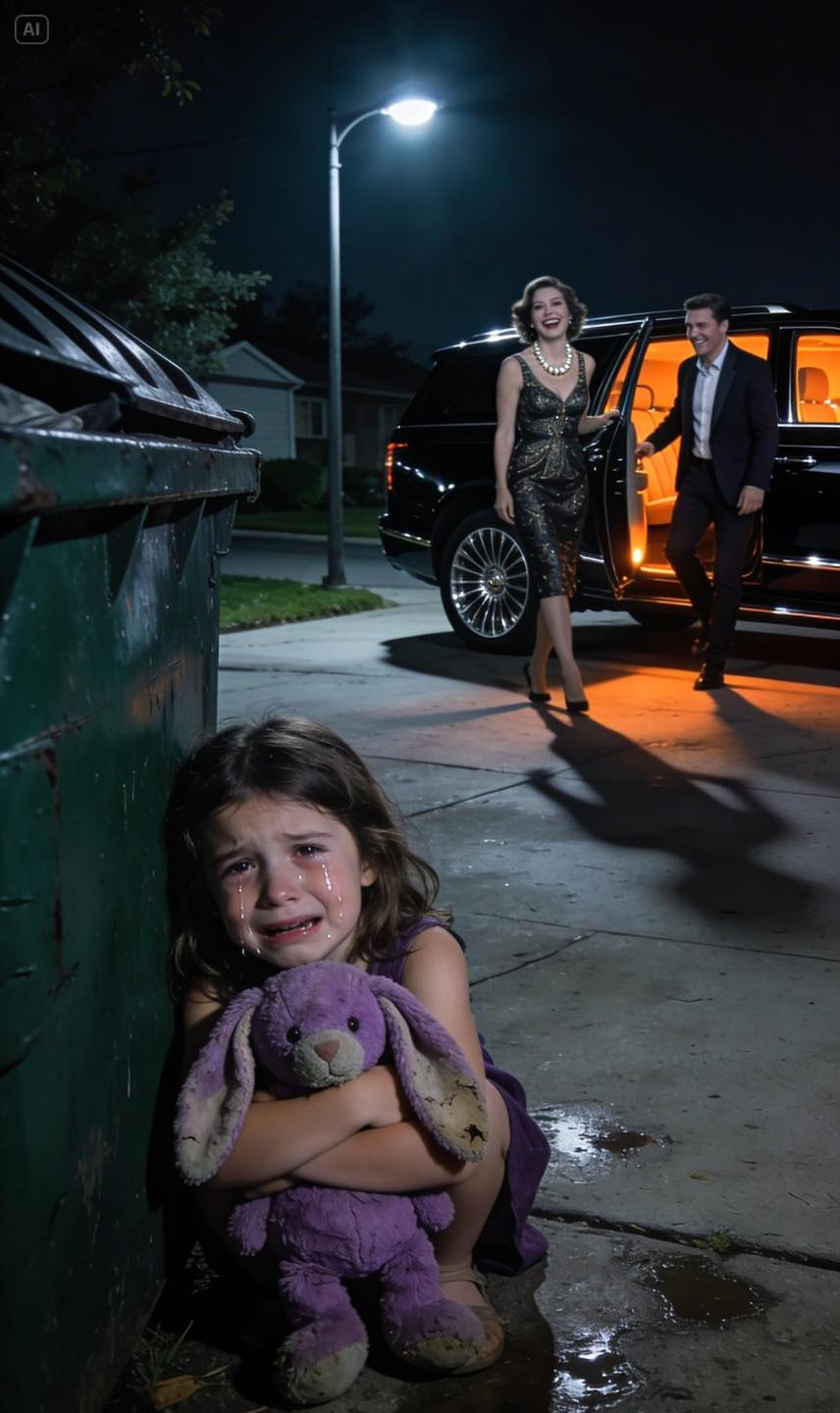
Until the night they left her screaming next to a dumpster.
That dreadful day began like any other disaster in my perpetually teetering life. I received a last-minute call from work, an unexpected shift that promised double pay—a lifeline for our meager budget. But Ava was suffering from a stomach bug and couldn’t attend daycare. I called Courtney directly; it went straight to voicemail. I texted her, my plea hanging unanswered in the digital ether. I knew, deep down, it was futile to ask, but desperation gnawed at me, so I called my parents. “Just a few hours,” I pleaded, my voice thin and raw. “Please.”
A long, pregnant pause stretched across the phone line. “We’re heading to dinner,” my mother finally stated, her voice flat, devoid of any warmth. “Reservations at 6:00.” I glanced at the clock; it was 5:22. “I can be there in ten minutes,” I rushed, a frantic edge to my tone. “Please, Mom. Ava hasn’t eaten all day. She just needs rest, and I swear I’ll pick her up before you even get back.” Another agonizing silence. Then, my father’s gravelly voice cut in. “We’ll wait ten minutes,” he declared, each word a cold, hard stone. “Not one more.”
I thanked them, my voice shaking with a potent cocktail of relief and simmering resentment. I bundled Ava, clutching her bunny, into the car, driving as if a storm of unimaginable fury chased us. When I skidded into their driveway, they were already moving towards their vehicle. My mother, precariously balanced on heels too high for her age, my father patting his pockets for his wallet, their faces set with an air of practiced annoyance. “She’s sick,” I murmured, gently pulling Ava from her car seat. “Just let her lie on the couch. I packed her medicine and everything.” My mother merely opened the back door to their house, her gaze barely registering my daughter. Ava whimpered, “I don’t feel good.” “You’ll be fine,” my mother muttered, a dismissive wave of her hand. “Just don’t throw up on anything expensive.” My father leaned down, his eyes meeting Ava’s, cold and hard. “No noise, no fussing. Got it?” Ava blinked, her tiny face pale. I knelt, kissed her forehead, and whispered, “You’re safe. Mama loves you.” Then, with a heavy heart, I left, promising myself I’d bring her a giant ice cream sundae when my shift finally ended.
That promise, a fragile beacon of hope, died abruptly in the middle of my double shift. At 7:43 p.m., my phone buzzed with a message. From Mom.
The words flickered across the screen, surreal and horrifying: She cried too much. We left her outside. Can’t be bothered. Enjoy your shift.
I thought I was hallucinating, misreading the cruel message. I called. No answer. I called again, frantic, but it went straight to voicemail. My hands, trembling uncontrollably, ripped off my apron. I bolted out the back door of the restaurant, not even bothering to tell my manager, the sound of my footsteps echoing my panic. I just ran.
It took eleven agonizing minutes to reach their house. When I pulled up, the porch was eerily empty. The lights were off, casting the house in an ominous shadow. But then, I heard it—a faint, choked sobbing, emanating from behind the trash bins at the side of the house. I sprinted, my heart a frantic drum against my ribs, and there she was: Ava, curled into a pathetic ball on the cold concrete next to the dumpster, her beloved bunny soaked in what looked like soda. Her face was blotchy, streaked with tears, her small hands shaking, her eyes wide with terror. “Mommy!” she sobbed, launching herself into my arms, her small body ice cold against mine. “I called for you! I called for you so much!”
I didn’t speak. I couldn’t. I just held her, pulling her against me until her shivering subsided. In that moment, a profound transformation occurred within me. I ceased to be the daughter who perpetually begged for crumbs of love, the one who tried endlessly to appease. I became, irrevocably, the mother who would never, ever forget this betrayal.
I didn’t knock on their door. I didn’t scream accusations into the silent night. I simply took Ava home, gently warmed her a bowl of soup, and held her close until she finally drifted into a fitful sleep on my chest. Then, as the silent house settled around us, I opened my laptop. And I started planning. Not just revenge, no—that felt too simple, too fleeting. This was about permanent removal. Not just from their house, but from their lives, irrevocably. I didn’t sleep that night. I lay there in the dark, Ava’s soft, even breaths a precious rhythm against my chest, and watched the ceiling fan spin like a relentless clock, counting down. Counting down to the shattering end of whatever tattered illusion of family I had desperately clung to.
The next morning, I took Ava to the pediatrician. Her voice was hoarse, her throat a raw red from crying in the cold night air, and her small body registered a dangerously low temperature. The doctor, her expression a mix of professional concern and guarded sympathy, looked at me directly. “How long was she out there?” she asked, her voice soft but probing. I lied, the words catching in my throat. “A minute or two.” She gave me a long, searching look that clearly indicated her disbelief, but she merely nodded, scribbled a prescription for medicine, and instructed me to ensure Ava stayed warm and safe. I walked out of that office, feeling as if the very walls of my world had already crumbled, leaving me with nothing but this one tiny hand clasped in mine. I wasn’t going to let it go. Not again. Not ever.
That week, I maintained a deliberate, resolute silence. I didn’t contact my parents. I didn’t respond to my mother’s text message, which arrived two days later, chilling in its casual cruelty: We hope Ava learned her lesson. Disrespect is loud. She was loud. I didn’t even get angry. I simply read it, closed the message, and added it to a new, private digital folder I had just created, aptly named “Truth They Never Expected.” Every text, every casual insult, every “she’s not our problem” they had ever sent me—I meticulously screenshotted it all, a growing archive of their indifference.
But my plan wasn’t about public exposure. That felt too easy, too fleeting, too reliant on fleeting social media outrage. I didn’t want pity. I certainly didn’t want “social media points.” I wanted consequence, a slow, corrosive silence—the kind that gnaws at people when they smugly believe they’ve won. So, I started with the thing they cared about most: Courtney’s manufactured status and, by extension, their own carefully cultivated public image.
I knew my parents were utterly obsessed with appearances, especially now that Courtney’s husband was embarking on a campaign for local office. My father strutted around, bragging to anyone who would listen that his son-in-law was “the future of the district.” My mother, with an almost comical zeal, printed fake campaign shirts with our last name prominently underlined, as if it were a declaration of royalty. They hosted lavish dinner fundraisers, threw meticulously planned garden parties, and made donations they could ill afford, solely to ensure their names appeared on plaques and donor lists. Meanwhile, I remained invisible.
Except I wasn’t. Because I still possessed something none of them paid any attention to, something they deemed beneath their notice: my job, my position. I worked in logistics and scheduling for one of the city’s major hotel chains. The very same chain that just so happened to be hosting Courtney’s husband’s formidable campaign event in three weeks.
I pulled every favor I had cultivated over years, meticulously shifted calendars, swapped names, and strategically scheduled my coworker, a trusted friend, to be in charge of event coordination that night. Then, I specifically requested her for “event detail backup” three days before the fundraiser, citing some last-minute “catering needs” I needed to confirm. When I revealed whose name was attached to the event, she blinked, a flicker of recognition in her eyes. “Wait,” she asked, “that’s your family?” I nodded slowly. “You want this event to go well?” she probed, her gaze shrewd. I offered a small, knowing smile. “I want it to go exactly the way they planned.” She understood. The silent promise of complicity passed between us.
Meanwhile, at home, I dedicated every evening to showing Ava what unconditional love truly meant. She received extra bedtime stories, snuggled into new, soft pajamas. I painstakingly saved up to buy her a $12 play doctor kit, a small treasure she cherished, because she had declared, with earnest conviction, that she wanted to “make sick kids better someday.” But concurrently, I began a deliberate, subtle withdrawal from my parents in the public sphere. When they called, I let it ring. When they asked about Ava, I offered terse, one-word answers, watching them visibly squirm in discomfort.
Then Courtney, with her perpetually perfect hair and ostentatious fake pearls, materialized at my doorway one evening. “Look,” she began, her voice dripping with an artificial sweetness, “I know things got a little out of hand, but Mom and Dad are really hurt you’re ignoring them.” I simply stared at her, my expression unyielding. “You mean they’re hurt I didn’t thank them for putting my daughter next to a garbage bin?” Courtney rolled her eyes, her facade of concern crumbling. “God, you’re always so dramatic. She’s fine, isn’t she?” I didn’t say another word, merely slowly closed the door on her indignant face. She hammered on it, her voice muffled but shrill. “You’re jealous! You always have been! Just because Mom and Dad chose me doesn’t mean you get to ruin everything now!”
Chose. That word resonated in my skull like a deafening bell. They chose her. Every single time. And now, I was finally choosing me.
Three nights before the highly anticipated campaign fundraiser, I received another message from my mother. Courtney says you’ve been cold. What happened to family first? That’s why we went to dinner. Family? We couldn’t deal with all your drama anymore. I didn’t respond. Instead, I printed the message and carefully added it to a sealed envelope. Ava, with innocent enthusiasm, helped me tape it shut.
The night of the event finally arrived. I dressed simply: a black blouse, dark jeans, flat shoes. Nothing fancy, nothing to draw attention. I wasn’t there to make a scene; I was there to orchestrate one. I arrived at the hotel just before the first guests began to filter in, slipping unnoticed into the back office where my friend, my accomplice, handed me a slim folder. Inside was everything I needed: seating charts, microphone schedules, a detailed list of VIP donors, and one tiny detail that only I would have recognized for its true significance. The “Family Spotlight Segment.” Five precious minutes had been reserved for “proud family remarks.” A moment when the campaign manager planned to bring up Courtney and her parents for a brief, glowing speech on character, values, and legacy. My friend looked at me, her expression uncertain. “You sure you want to go through with this?” she whispered. I nodded, my gaze firm. “I’m not saying a word.”
And I didn’t. But I made damn sure someone else did.
You see, in that envelope Ava had helped me seal, the one we had meticulously labeled “Truth They Never Expected,” it didn’t just contain screenshots of venomous texts. It held a printed timeline, precise dates and times, damning text messages, and a statement, written in block letters, in Ava’s own careful hand. I had helped her spell out each word, letter by painstaking letter: Grandma left me at the trash. I was scared. I cried a lot. I called for Mom. She didn’t come.
That envelope was slipped into a donation box at the event, discreetly placed there just as the “proud family segment” began. The campaign manager, completely oblivious, picked it up by mistake, assuming it was another donor form. He opened it on stage, his voice resonating through the ballroom, and began to read it live. By the time he hit the chilling line, I called for Mom. She didn’t come. The entire room had fallen into an astonished, horrified silence. Courtney’s practiced smile was frozen, a grotesque mask. My father blinked, his face slack with disbelief. My mother slowly, agonizingly, shook her head, as if trying to dislodge a nightmare. Then, whispers began to ripple through the room, quickly escalating into gasps, then the tell-tale gleam of countless phone screens as cameras emerged. The word “dumpster” hung in the air like a curse, heavy and toxic.
Courtney, her face contorted with fury, lunged for the microphone. “That’s fake! That’s planted! She—my sister’s trying to ruin us!” And that’s when I stood up from the back row, a quiet figure in a black blouse, and walked slowly, deliberately, down the center aisle. I didn’t say a word. I simply handed the stunned campaign manager my hotel ID and offered a calm, steady nod. He read it, then looked at Courtney, his expression hardening. “You didn’t mention your sister worked at the hotel,” he stated, his voice now devoid of its earlier warmth. They asked me to speak, to explain myself, to defend my actions. I refused. Because silence, I knew, was heavier than any speech. I simply turned and walked out. And I swear, I didn’t hear clapping. I heard silence. The kind that burns through pride and settles deep in the chest. The kind that destroys.
They didn’t call right away. For a week, all I saw were the relentless headlines: Candidate’s Campaign Rocked by Family Scandal. Why Was a Child Left Crying Near a Dumpster? The Sister Who Stayed Silent While the Truth Spoke Louder. Courtney’s husband dropped out of the race within days, his political aspirations reduced to ashes. Their major donors, once so eager to align themselves with a rising star, swiftly pulled out, leaving a gaping financial void. My father lost his coveted consulting side hustle, a lucrative position that existed solely because of who his son-in-law was. My mother, once a ubiquitous presence, stopped showing up to her various church committees, her social standing irrevocably shattered. They went quiet. A chilling, all-encompassing quiet.
Until they didn’t.
It began with a text from my father. This has gone too far. You’ve made your point. Then my mother called, leaving a voicemail, her voice thick with sniffling. “We’re ruined. Courtney’s marriage is on the rocks. People are saying things. Your daughter exaggerated. Please, we’re still your parents.” Still. That word again, as if biology itself was a debt I still owed them, a lifelong obligation regardless of their cruelty.
They sent a gift: a doll for Ava, beautifully dressed, but with no card, no note. Ava, holding the doll, looked up at me, her innocent eyes wide. “Is this from the people who called me loud?” she whispered. I nodded. She clutched the doll tighter, then softly said, “I don’t want it.” So, I donated it to the shelter down the block, a small gesture of redirected kindness.
They came in person next. One evening, I opened the door to find them standing on my porch, both visibly thinner than I remembered, their eyes hollow, like people who had been starving for attention and had suddenly realized no one was watching anymore. My dad attempted a weak smile. “Can we come in?” he asked, his voice hesitant. Ava stood directly behind me, her small hand clutching mine, her eyes peeking out. I looked down at her, then back at them. “No,” I said, my voice steady, devoid of emotion.
My mother’s mouth fell open, a gasp escaping. “We’re your family!” she cried, her voice cracking. I shook my head slowly. “No. Family doesn’t dump children beside trash. Family doesn’t toast to their pain.” My father, his composure finally snapping, blurted, “We raised you!” I met his gaze, a small, sad smile playing on my lips. “And now,” I replied, “I’m raising her without you.”
I closed the door slowly, deliberately, the soft click of the lock echoing the finality of my decision. I sat down beside Ava on the couch and turned on her favorite cartoon. We shared popcorn, the simple rhythm of our evening a stark contrast to the buzzing of my phone, unanswered, behind us. Because I wasn’t living for apologies anymore. I was living for peace. For warmth. For bedtime songs and safe arms. And for a future where Ava would never, ever doubt that she mattered, profoundly and unconditionally. My parents can beg, they can plead, they can demand, but silence? Silence is all they will ever get from me.